Everything's Fine - The Fantastic Four: First Steps Review
The non-diegetics of Marvel Studios have become more interesting than the diegetics
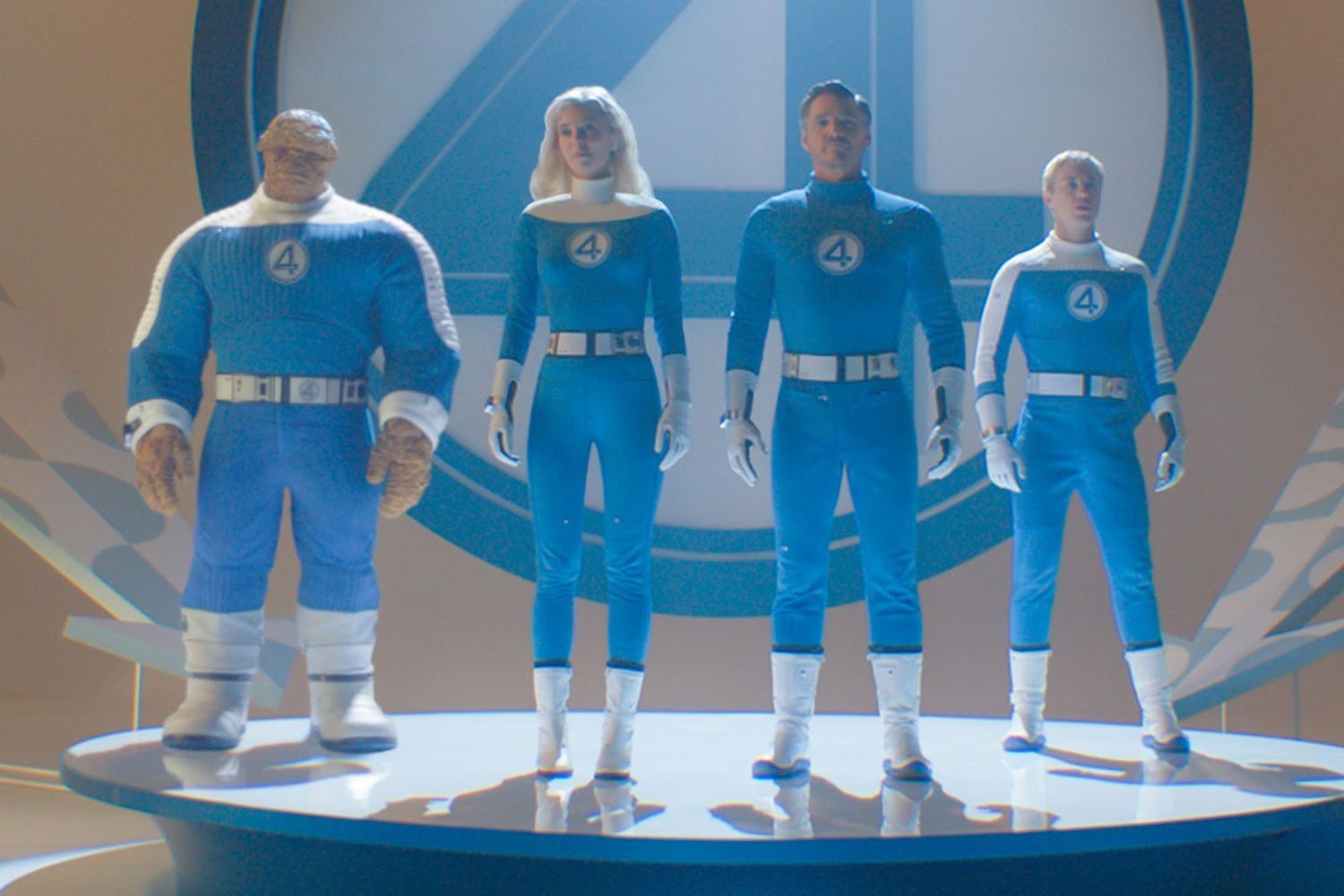
In the wake of seeing Fantastic Four: First Steps, I found myself outside the theater with two friends. Barring something that’s self-evident in the moment, it’s difficult to put together immediate thoughts about whatever it is I’ve seen. The perfunctory question came up: “How was it?” The perfunctory answer followed, again and again: “it was fine!”
Hardly the ringing endorsement anyone wants.
Even with exceedingly low expectations, Fantastic Four: First Steps has been more disappointing in the hours since stepping out of that theater. It’s not even a bad movie. It’s good. It’s even doing interesting things. There’s an exciting space sequence that had big Interstellar vibes (compliment). It focuses on the central four characters and emphasizes their family aspects without bullshit manufactured drama. Each hero has a moment to shine. There’s great tension between Reed and Sue that comes from who Reed is as a character. They also made the very welcome choice to have basically none of the movie matter to the MCU proper, where its only connection to the grander vision is at the end of its brief mid-credits scene. Marvel even set it on Earth-828 and didn’t even tie it to the post-credits scene in Thunderbolts*. Looking back to the biggest complaints about Captain America: The First Avenger, it’s like Marvel learned a lesson about perpetually setting up what’s next. There, they manufactured a third act to perfectly setup Cap’s paradigm going into The Avengers1. Here, larger tapestry is a low priority.
Marvel made a Fantastic Four movie that’s purely Fantastic Four and basically nothing else. They didn’t bother with doing a big origin story, getting that all out of the way via voice over/newsreel footage at the outset. It’s insane that this is restraint for Marvel, but it’s applaud-worthy that they’re learning.
Still, this isn’t good enough to allay any of the concerns, to stop the whispers, or kill the schadenfreude of Marvel eating humble pie. This has been going on since the Kang the Conquerer called-shot blew up in their face2. It’s merely a passable, lite, airy summer blockbuster that can’t support the weight of the MCU drama around it. The reason to go see a Marvel movie opening weekend is to be part of the conversation, but what conversation is happening around this movie that requires seeing it? Maybe this’ll stand the test of time, perhaps some grand masterpiece in the long run. But I disagreed with something my friends were saying in our post-theater discussion. Why see this movie again? What grand depths are there to plumb? What joyous experiences require multiple viewings? Are the spectacular action sequences so thrilling that audiences will watch them on repeat over and over again when it hits Disney+ in three months? With Fantastic Four: First Steps, what you see is what you get.
Unforutnately for Marvel Studios, the larger context surrounding their movies is what’s most interesting about them about the moment. As it feels like they’re in a crisis, this larger discussion of the studio itself is far more compelling. Whatever wheel-cranking they’re doing to get them back on course as cultural juggernaut is still an ongoing process.
We’re not there yet.
What would it take for Marvel to “be back”?
For all the “Marvel is back!” talk that’s now cliche for every Marvel release, there’s a whole lot of implications to prove that that simply isn’t the case. In retrospect, for all that Marvel has produced some excellent, even Oscar-worthy blockbusters, their power has always been in quantity over quality. There was an inertia to propel every film into the next installment. The quality was always at least a baseline “good enough”. They popularized the post-credits scene, in part because of its ability to serve as free marketing to get audiences excited for next time. Marvel has always excited its audience about “what’s next!” The only time that isn’t really true is Avengers: Endgame, where the only real promise at the end of the movie is Sam getting Cap’s shield. Everything else in that movie is an ending that ties to Marvel’s previous decade rather than enticing where it’s going.
That’s part of the reason that finale is so successful.
That baseline of quality engaged audiences and the narrative propulsion meant even the duds were just bumps in the longer road. Didn’t like Thor: The Dark World? Well the two movies before it were Iron Man 3 and The Avengers and the two after it were Captain America: The Winter Soldier and Guardians of the Galaxy. Thought Doctor Strange was a dip? On either side of that movie was Captain America: Civil War & Ant-Man or Guardians of the Galaxy Vol. 2 & Spider-man: Homecoming.
That changed because of the pandemic, which forced Marvel to take a year off. Momentum killed them. Their current rut stems from rarely clearing that bar of “acceptable” quality. These once exciting events have become obligatory chores. Sure, Fantastic Four: First Steps features a fabulous retro-60s future, and the central four in the cast are quite good… but that’s not enough. Not when Brave New World was bad or when Thunderbolts* felt so slipshod. When was the last time Marvel had a run of two solid hits in a row? Like two, no-reservations “that was a good one!” Hasn’t been in this decade.
At least two of Marvel’s three films in 2025 needed to be solid hits. That hasn’t happened. Brave New World is a narrative disaster and Thunderbolts* was their biggest financial flop outside of The Marvels. These disappointments mean Fantastic Four is having to pick up slack it shouldn’t have to. Add that to this being the last film we’re getting til Avengers: Doomsday3 and there’s a sense that Marvel is breaking glass in case of emergency, accelerating everything so they can put the experiments of the last five years in the rearview.
Meta-text
How insane is it that I’ve gone this long and haven’t even gone into the plot of this movie? Or talked about Sue & Reed and their big pregnancy storyline? Or showcasing the rad interstellar surfing of the Silver Surfer?
I said this in my Letterboxd review, but it says a lot about Marvel Studios that the conversation around their movies and machinations are far more interesting than any of the movies they’re making. This has been true for quite some time, but now that we’re on the other side of this year’s releases, it’s undeniable. Sure, I could make complaints about how I wish that they’d made Galactus an even more vibrant purple (a nitpick) or that I wish we’d gotten way more showcasing of all the Fantastic Four powers that weren’t Johnny Storm. I could talk about how they nail Reed’s weird aloofness and his big brain trying to solve problems by imagining the unthinkable. Or I could talk about how the Fantastic Four’s best superpower is their brand development by putting it everywhere from the seatbelts on their spaceship (which no one will see) to the bottoms of the team’s shoes.
Which makes sense. Outside of a couple of random examples, they really don’t do a lot of showcasing the team’s powers unless it’s Johnny Storm. There’s good bending and stretching for Mr. Fantastic in the finale, but that’s really only in the final act of the movie. Sue has a big moment with the black hole and then later when she pushes Galactus into the wormhole, but beyond that…?
Marvel has created this perfect problem for themselves. They have never, ever been content with the one movie in front of them. It’s been their greatest strength since Nick Fury wanted to talk to Tony Stark about “the Avengers Initiative”. That’s now become their greatest liability. It’s become difficult to turn off a discussion about these movies on their own terms. We compare them all. We think about what’s next. Marvel tells its audience what’s coming years down the line. It’s an endless grind with no conceivable destination.
So what happens when Marvel releases a movie like this? Outside of the mid-credits stinger this might as well be Marvel’s answer to James Gunn’s Superman. No outside heroes or villains. No mirror universe doubles or allegories. This doesn’t feel like some setup for a grander plan like promising Shang-Chi will return or that there’s going to be competing Avengers teams or even that mo-cap Patton Oswalt is going to team up with spacesuit Harry Styles4. It’s just a straight up Fantastic Four movie.
That would be fine… except for the part where Marvel really doesn’t make movies like this anymore. It’s not their strong suit.
The Marvel movies that play best are the ones where a visionary filmmaker (like Ryan Coogler) comes in with a clear vision and fills the space with characters and life to create a fully-realized ethos within the larger existence. If there’s a problem with this movie, it’s that the “fully-realized ethos” basically amounts to a loose family dynamic and a whole lot of retro-60s futurism. There’s a perfunctory plotline with Ben Grimm building a relationship with Rachel Rozman (Natasha Lyonne), but it feels like a narrative dead end. Something that just barely missed out on the cutting room floor. It doesn’t go anywhere. It merely exists.
The result is a perfectly enjoyable movie that’s still quite vapid. The most profound moment in the movie is when Sue gives her big speech to the protesting crowd. “I will not sacrifice my child for our planet, but I will also not sacrifice out planet for my child.” And also the space chase was a good few minutes of fun.
What will it take to get out of this?
The crazy thing is that I liked this movie more than Thunderbolts* even though that movie left me more eagerly anticipating what happens next.
But even if this feeling of the MCU taking a step in the right direction excited me, coming out a few weeks after Superman makes it feel behind the times. Fantastic Four’s opening weekend box office has it on par with DC’s big first swing, but Gunn’s critiques of Marvel all come across here and make it look worse by comparison. This isn’t a movie about anything specific, about as family-forward as a Fast & Furious movie. It has no distinct style, vision, voice, or tone. Strip away the retro-60s aesthetic and the only thing special about this movie is its lack of connection to the larger MCU.
It’s this homogeneity that’s slowly killing Marvel. These movies lack any sort of risk or big swing that makes the enterprise worth continuing. It feels like Marvel has fully bought into the notion that their audiences only want safe, stress-tested, four-quadrant stuff. Marvel thinks Marvel fans care about Marvel because it’s Marvel. They don’t need a finished script to start cameras rolling because the problems will work themselves out in production and post-production. Films get a greenlight because Feige needs them for an eventual Avengers movie, not because the scripts are read. This has worked for them for almost two decades. Why change? They cut corners where they can in order to meet release dates scheduled years and years in advance. They force digital artists into insane crunch by changing direction mid-stream, sometimes demanding complet start-overs within the same calendar year as the film’s release. And like… sure. The artists are not giving Marvel what they want, but they produced what Marvel asked for. Marvel just… changed their mind as they work to find the movie well into post-production. It feels unwise, consisting fixes in post are the most expensive and hardest to change.
If Marvel wants to keep making these movies while flying by the seat of their pants, it means that the farther they get away from solid ground (eg: the foundations of Phases 1 & 2) the harder the falls that end up happening. In theory they should have used the pandemic to slow down, re-adjust, and make improvements after 12 straight years of sprinting into the future. They didn’t. Instead of trusting the talent they have to make a quality product, they’ve tightened their grip on the overall vision of what they’re doing. Demanding way too much coverage and too many options so they can craft whatever they made after the fact rather than sticking to a definitive and strong vision of what a movie is. In the vacuum of “hmmmm, this isn’t working” they fall back to what’s previously worked.
Again, homogenous. Recycled.
Marvel’s M.O. has always been to bring on work-for-hire directors and use them as traffic cops while the movies make themselves. If a director can bring a vision that contributes to the film’s direction that’s great! But they’re always second fiddle to Marvel itself. Isn’t it strange that directorial followups within a given character are never as good as the original? Winter Soldier is better than Civil War. Ragnarok is better than Love & Thunder. Black Panther is better than Wakanda Forever. The first time out, it’s like Marvel gives these directors a bit more freedom to define the world and figure out what might work. After initial success, they do more traditional studio interference, failing to recognize that audiences were responding to authorial voice rather than the cacophony of their notes.
A solution to the homogeneity would be Marvel pivoting to directors they trust, and facilitating the making of something messy and esoteric and unique within the Marvel style rather than their hallmark sterile, by-committee, stress-tested, perfectly inoffensive fare. It means completely changing their narrative that Kevin Feige is biggest reason for their success. He’s a terrific producer, but a producer is only one aspect of a production made up of hundreds of individuals and artists.
Enter Doctor Doom
And now it’s a waiting game from now until Avengers: Doomsday. This movie teases Doctor Doom himself5. But the most current interesting thing about it isn’t RDJ.
A few months ago, Marvel kicked Doomsday’s release date back seven months, from the beginning of May to the end of December. They claim this is to give them extra time to work out what’s already been a rushed production. Understandable. It’s also a retreat from that first-week-of-May release that has defined their release calendar since Iron Man (and every previous Avengers film). The thinking comports with Disney’s strategy rather than Marvel’s. The late December blockbuster has worked really well for Star Wars and Avatar, giving those blockbusters long tails into January as people go to see them over and over again.
Two problems, though.
Most obviously, Marvel trying to release a movie with a long tail flies in the face of everything they’ve been doing for the last decade or so. They’ve really prioritized strong, robust opening weekends to mitigate the steep dropoff that happens once people have caught the latest adventure and moved onto other things. There’s been movies that with good runs at the box office (Black Panther and Avengers: Endgame stand this test), but Thunderbolts* is already out of theaters and about to start streaming on Disney+. That’s sadly normal for them.
Less obvious is a conflict waiting to happen: their December 2026 date is the same one Warner Bros. has camped on for Dune: Part Three.
People might want another Barbenheimer weekend (my partner has already trademarked Avengers: Dunesday), but there’s a big reason that won’t happen: Marvel wants to juice their box office numbers with IMAX screens (and other premium formats). Part of the reason there’s six minutes (so brave) of full IMAX ratio in Fantastic Four is to prove that they can properly utilize the aspect ratio rather than just put out a movie in IMAX for the sake of a big big screen and juicing their box office with premium ticket pricing.
Meanwhile, Villeneuve’s Dune movies are posterchildren for IMAX living past Christopher Nolan. They also kick ass. Maybe IMAX will find the promise of opening weekend Marvel money tempting, but it feels like Dune wins this no problem, especially considering Dune Part Two outgrossed four of the last six Marvel releases.
It says everything about the world that Marvel comes in like the 800 pound gorilla, passive-aggressively stares at Warners to take the L, and people want them to fold. Was a time they were untouchable. But now…? Now they feel so lost in the wilderness that they’re filming their all-in Avengers movie without a finished script, hoping that it’ll all come together by bringing back everything and anything they can that’s worked for them in the past. Even if it means making the most expensive movie of all time.
Avengers: Doomsday has to come out in 2026 because it’s one of Disney’s big tentpole releases that year. Without it, the only Marvel movie out that year is Spider-man: Brand New Day, which is a co-production with Sony. Dune Part Three has to come out in December 2026 because Warners is gonna make a big Oscar run like Lord of the Rings. It just might work. Which company will blink?
Cultural backseat
James Gunn’s Superman features big cartoony monsters. It gives Guy Gardner an atrocious bowl haircut and makes sure to emblazon Mr. Terrific’s jacket with “Fairplay”. It’s not afraid to be corny and silly and also about big ideas. It features a central relationship with some heart-swelling kissing and a strong romance between the two leads.
Meanwhile, Fantastic Four is a passable movie where their Galactus has the requisite handlebars on his head. He is purple, but not so vibrant that it’s embarrassing. Reed & Sue have a few scenes of intimacy, but I truly don’t even remember them being physically intimate outside of his hands on her invisible belly. I guess they kiss in the first scene where Sue reveals she’s pregnant? It’s shocking that it didn’t register. The car seat scene at the end is more memorable, and that feels like a weird appendage leftover from a previous draft that was too good to leave out. What else is there to say about Fantastic Four?
Marvel has made so many movies and gone on for so long that the conversation around their movies has subsumed the movies themselves. To celebrate Marvel movies is to celebrate Marvel itself, not the movies they make. If they made interesting movies that were worthy of proper discussion and 3,000-word Substack reviews, we’d be talking about the cotton candy they’re so regularly churning out.
No wonder the conversation has turned on them.
This never bothered me. Looking at Marvel as a big narrative tapestry building to The Avengers, it ruled, and the last line is one of my favorite last lines in a movie this century. ↩
Referring, of course, to Kevin Feige saying that Kang was not big enough to be a follow-up to Thanos and that they needed Doctor Doom. No way this is accurate. After doing a big casting of a major up-and-coming talent, locking him down for a slate of films, putting him in the first season finale of Loki, introducing him in Quantumania, centering him in Loki season two, and making a big grand announcement of Avengers: The Kang Dynasty, forgive the skepticism that this is true. Kang could totally be a big proper Avengers villain. It also felt like Marvel was trying to tee-up Kang as a more central player than Thanos, this time a threat who would just grow and grow. The arrogance of that move, though, means that when audiences responded poorly to his big roll-out, it kneecapped Kang’s ability to be effective. It also didn’t help that Jonathan Majors got convicted on assault and battery charges, though that did provide a convenient out by which Marvel could dump him so they could spend the budget of Alien: Romulus on getting Robert Downey Jr. back. ↩
Not counting Spider-man: Brand New Day because of Spidey’s big rights sharing deal with Sony. That’s a movie that has to come out so Sony can maintain the rights, rather because it adds to the overall tapestry of where we’re going. Maybe I’m wrong, but I don’t see Doctor Doom playing a big role— then again. Now I think of it. Sony has been extremely happy to pay for an outrageous payday like RDJ’s to help their movies feel more tied into the universe at large. So… maybe. Table it for now. ↩
Lol that one is never going to happen. ↩
A friend said it was a massive cock tease that the mid-credits scene never shows Doctor Doom’s face. This is true. However, not showing Robert Downey Jr.’s face means Marvel can use a stand-in and save themselves probably $20m. Hard to blame them. ↩