A Femme Fatale in a Male-centric Neo-Noir - Memento

Nolan's Iliad is an ongoing series exploring the works of Christopher Nolan on the eve of his next major motion picture The Odyssey. While lots of other places dissect Nolan as the grand puzzle master, he's far more interesting as a populist, emotionally grounded filmmaker. And that really starts here...
Memento is a movie that ripped my brain apart.
This is hardly a story unique to my person. But it's a movie I heard about long before I got a chance to see it. My dad is the one who recommended it to me first. There were two reasons...
The first is obvious/the primary selling point of the movie. Christopher Nolan's proper debut is a story about a man with anterograde amnesia... told backwards. Unable to form new memories, he perpetually lives with the last few moments as the only ones he remembers, and Nolan puts together a script that makes perfect sense even though the beginning is the last thing to happen and the end is the functional beginning that sets the main character (Leonard) on his path towards freedom. There's a ton of other subtle tricks here, not the least of which is his alternating between color and black and white to (as film critic David Sims put it) separate the objective from the subjective. And... the implications of the film's final moments were so seismic in their revelation that I don't remember the next two weeks of my life. I'm sure those memories are nebulously in there somewhere, but I remember the last few minutes ripping my mind open. The next memory I can chart on a timeline is about two weeks later, driving home from work, and recognizing that I was still trying to grapple with what Nolan did.
The second is more interesting.
Released in 2000, Christopher Nolan missed an iconic year of cinema by less than twelve months. 1999 is pound for pound the best year for film in my lifetime. American Beauty might have won Best Picture, but that was also the year of Fight Club, 10 Things I Hate About You, Eyes Wide Shut, The Virgin Suicides, Girl Interrupted, Star Wars Episode I: The Phantom Menace, Notting Hill, The Sixth Sense, The Green Mile, Toy Story 2, But I'm A Cheerleader, The Blair Witch Project, Magnolia, The Talented Mister Ripley, The Iron Giant, Being John Malkovich, The Mummy, Sleepy Hollow, and that's just the top 20 most popular 1999 films on Letterboxd.
But 1999 was also the year of The Matrix.
My dad knew I was a big Matrix fan (to be fair he was too), and knew that my love of the movie extended to two of Memento's leads. Joe Pantoliano (who played Cypher in The Matrix) plays Leonard's charismatic, enigmatic best friend Teddy while Carrie Anne Moss (Trinity) plays a woman named Natalie. That casting sparked my imagination for a long time.
More than two decades after that first viewing, Memento is still great. It's been a long time since the movie befuddled me like it did that first time, and I've definitely corralled it into a thing I can wrap my head around. What most interests me now, though, isn't the puzzle box nature of who Leonard is, nor is it why he does what he does or what in his life might or might not be true. Like the last shot of Inception, Leonard's amnesia is not the point of the movie. Nolan is instead introducing a recurring theme that runs through his first decade of work: that the worst thing in the world is losing the woman he loves.
This does introduce a new endemic problem to Nolan's work: his movies are about men. Lots of men. Like he makes movies for men about men dealing with the problems of their men brains. Every movie he makes has basically one woman (Eliot Page came out as transgender many years after Inception's release and Jessica Chastain's character Murph was originally Cooper's son (not daughter) in Interstellar) flitting around the plot while the men stay focused at the center. This has led to inaccurate criticisms that Nolan can't write women when it's probably something else.
In terms of weak Nolan females, it's between Natalie or Mal (Marion Cotillard in Inception) as exhibit A in this argument. The way people tell it, Carrie-Ann Moss plays a woman who only serves to progress the plot or torment Leonard in ways that are possibly misogynistic. At the very least, she's not nearly as interesting as Leonard or Teddy.
False.
What Nolan is doing with Natalie is far more complicated, nuanced, and powerful than the way people read her. She might seem evil and conniving, but that's a byproduct of the film's structure. How the audience feels about her to start is not how she is at the end of the movie. She's the only character who really has an arc, but watching it in reverse makes it difficult to parse. And because her story in the movie ends after we've seen her do a whole manner of unsavory things to Leonard (not the least of which is getting an entire bar to spit into his free mug of beer), it's easy to look at her as some harpy that represents Nolan's take on a gender he rarely casts in the spotlight.
That's not what he's doing.
Memento is a daytime neo-noir starring a makeshift detective trying to solve an impossible-to murder, a crooked cop who's using him for an unknowable amount of illicit activity, and a femme fatale who pulls herself out of a bad situation (though it's not as clean as that).
But to get there, we first need to pull apart the audience's dramatic irony of Leonard's experience.
What Leonard only kind of knows...
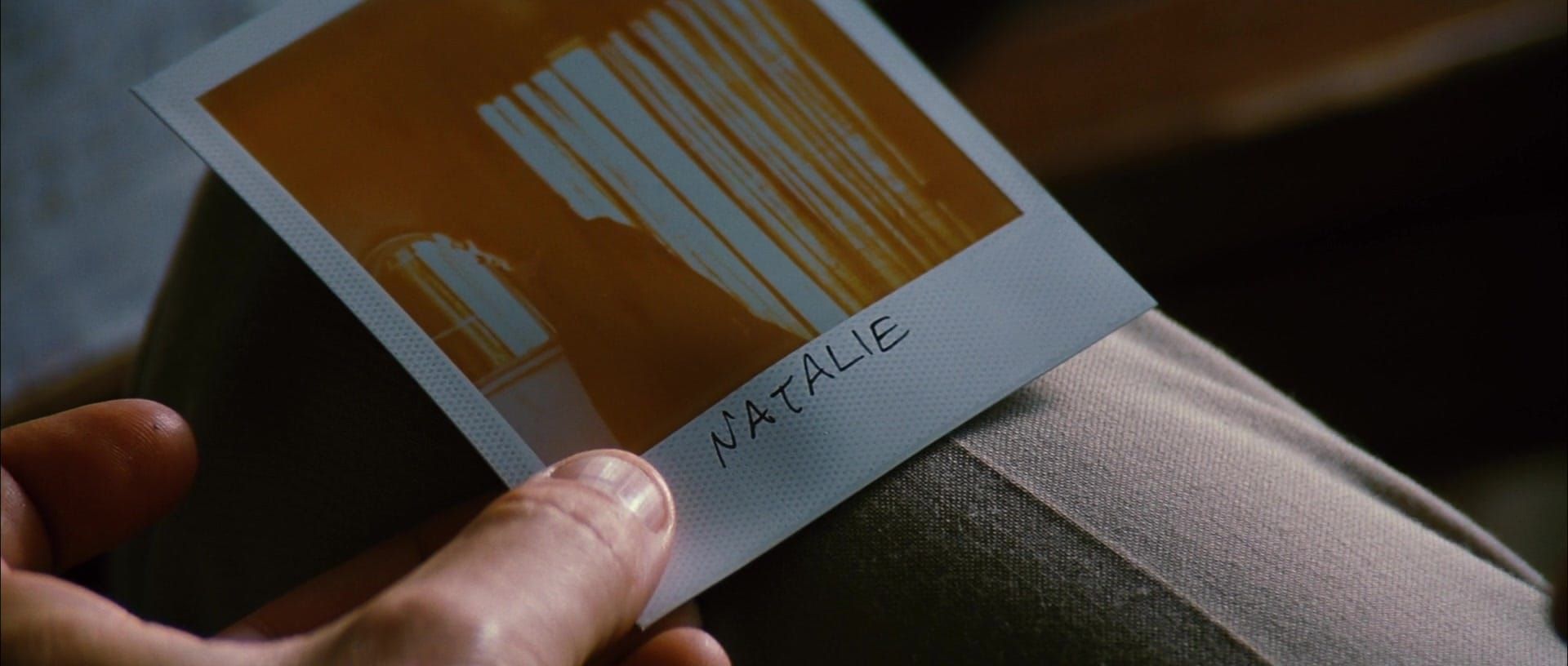
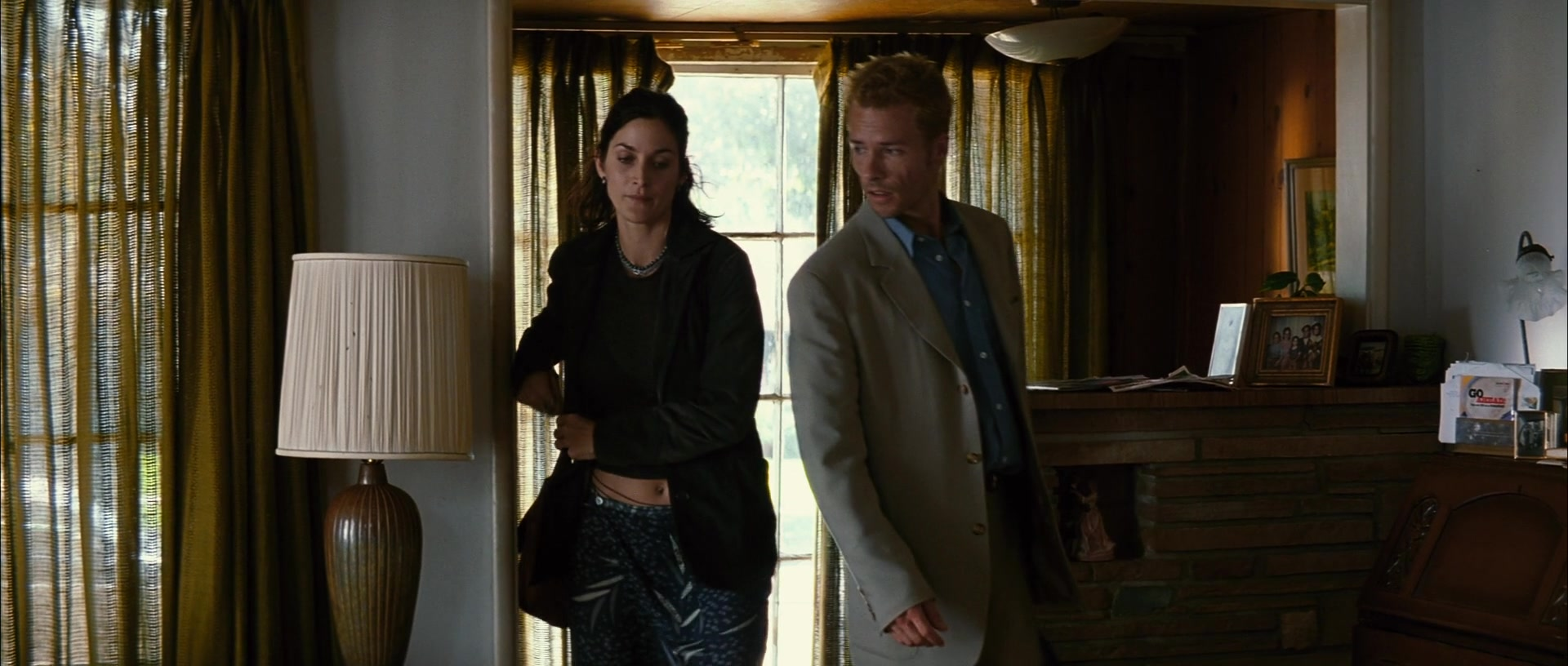
The first time Leonard meets Natalie, it's at the diner where she gives him the license information that will lead to him murdering Teddy (which, from the audience perspective Leonard has recently done). Just before she comes in, Leonard looks at a polaroid of her. It's of her profile from far away, her head bowed, almost demure and delicate. The light is soft, and frames her almost angelic figure.
The note on the back ("She has also lost someone; she will help you out of pity") buttresses the desire to trust her implicitly. It's also gross to say, but Nolan's introduction to her in sunglasses, with a cut lip, and a bruised cheek immediately codes her as someone to pity in return. Being a victim of abuse builds an immediate sense of empathy towards her. In the larger genre convention, it plays into her role as a femme fatale in Nolan's neo-noir. She's in a bad spot, but... she seems okay now.
The next time the narrative returns to her, it's with Leonard waking up in her bed. Again, that intimacy between them builds trust, ending with showing the moment she offers to help him.
But the thing that gets him into her bed? It's the audience's introduction to the Dodd subplot, where Nolan reveals that Leonard has "taken care of" some dude named Dodd at Natalie's request. She tries to calm him down, but Leonard's resulting emotional break builds that sense of pity she returns to him, the one inscribes onto the back of his polaroid of her. This is where she sees his humanity and learns about his tattoos. She touches him and hears his mutterings about how vulnerable he actually is and how much he knows it.
It's the most tender moment in a movie that includes scenes where Leonard reminisces about his dead wife.
That... should be strange, though, right? If they're so close, shouldn't she know about all of these things? But it's also strange that he's doing all of this without any real notes about her, and it's this event that makes him write down the note that will allow him to implicitly trust her in the diner. She's not been around long enough for a proper reminder. The only other note on the back of the polaroid is one he scratched out at some point in the past.
Natalie then disappears for half an hour while Leonard goes to deal with Dodd.
When she comes back, it's in the context of her following the beating that marred her face to this point. Her tearful entry and blaming it on Dodd is what sends Leonard chasing after him on the subplot that's taken up the most recent chunk of the movie.
Only... that's not actually what happens.
Because in the very next sequence, Natalie goads Leonard into the violence against her, and we find out he is the one who did that to her.
It's wantonly malicious on her end, especially considering the way she removes every single pen from the living room so Leonard can't make a note about what she's done. It puts everything to that point in jarring context.
More than that, it quickly becomes clear that this is one of his first encounters with Natalie. Soon after that, she invites him into her home, and it's the first time she's getting a real look at this strange man. It's around this point that it might feel like Natalie is some horrible manipulator, a woman who is not afraid of using extreme profanity to defame Leonard's wife and garner a violent response from him in the name of killing a random bad dude who's looking for her. She makes everyone in the bar spit in his beer to see if his amnesia is real, and otherwise treats him very poorly upon their first meeting.
Taken at face value, she seems like a poorly drawn character, a femme fatale baked in misogynistic tropes that reduce women to harmful stereotypes.
And given Nolan's laserlike focus on men after this movie and the fact that this movie literally has only one other women (a prostitute), it's easy to look at Natalie and think that she is only what she is.
That, however, falls into one of the central traps of this movie. Nolan's reverse chronology structure means telling the whole film through Leonard's eyes. If Natalie seems monstrous in one scene, it's because that's what Leonard sees and it's the only impression he has of her. If she seems warm and kind, that's because... same reason, really.
Look past the structure's conventions. By the end of the film, Nolan has built Leonard into one of the most unreliable narrators in the history of cinema. It's not fair to reduce Natalie to the male gaze of that individual, especially considering that he is 100% untrustworthy by the end.
So... let's not.
An Interlude: What Leonard did...
While Memento is a film built on unreliable characters with each of their own agendas, there are a a number of things that are true.
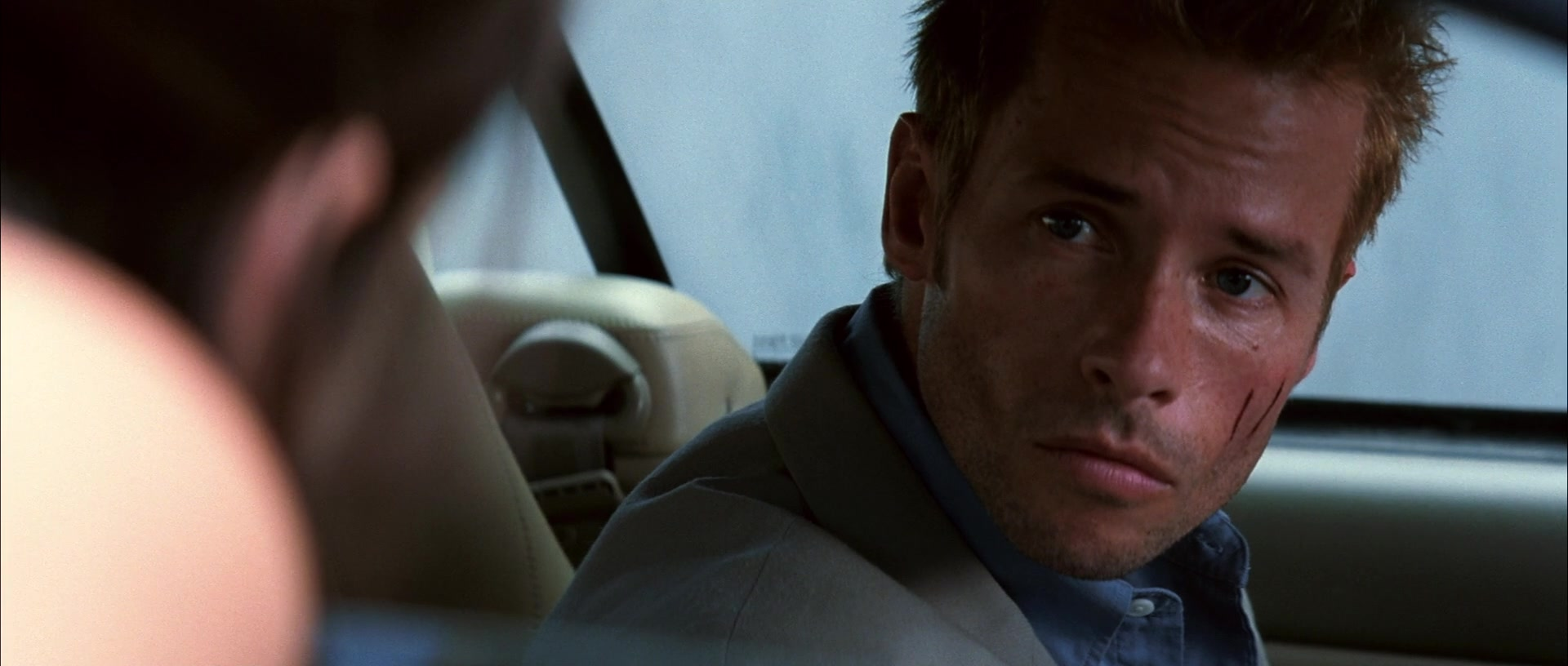
At the end of Memento (the chronological beginning of the story), Leonard kills a man named Jimmy Grants. Jimmy Grants is running drugs out of Ferdy's bar where his girlfriend Natalie works as a bartender. Teddy at some point meets with Jimmy Grants (at one point even going in the bar long enough for Natalie to notice him) and sets up a deal. He then has Leonard go to the deal under the impression that Jimmy Grants is the "John G." Leonard has been searching for.
Leonard then kills Jimmy Grants, steals his clothes and his car, and leaves himself a note that will put him on the path to turn Teddy into the new "John G." For the entirety of the time he's hunting Teddy, Leonard is more or less wearing the skin of the man he murdered, and fulfilling this journey is where the movie begins, with Teddy's murder at the hands of his ostensible best friend.
There are other notes here too. One of Leonard's critical tattoos about the identity of the man who murdered his wife is that he is a "drug dealer", though there's no way to know how Leonard knows this. Given how easy it was for him to jot down Teddy's license plate and tattoo it immediately on his body, it had to come from somewhere. As pure speculation: this is something Teddy probably brought to Leonard in the name of furthering his ends. Leonard is the perfect fall guy, completely incapable of remembering any crime he commits, and living in motels or whatever makes him something of a drifter without a permanent address (and thusly difficult to track down).
This is also why Teddy is so wary of Leonard's recklessness. With Jimmy dead, Leonard needs to lay low. Stealing Jimmy Grants's identity is the opposite of that. But because Leonard sabotaged his relationship with Teddy ("don't believe his lies") there's now a permanent rift between them that ends with one man murdering the other. Teddy has no idea there's even a problem.
In the end, this is the core of what makes the film so devastating. Leonard acknowledges that he is capable of manipulating information and lying to himself to guarantee future actions that benefit his current mental state. He might not get the catharsis or remember it, but it will absolutely happen. There's no reason to believe Teddy is the John G. who murdered Leonard's wife, and it's possible that following the Teddy murder, Leonard's time with Natalie will continue her abusing his fragile psychological state. Getting him to get rid of Dodd is no different from Teddy's opportunism. Everything in the movie is a sequence of events Leonard puts into play as soon as he stepped out of his motel room in that plaid lumberjack outfit.
(Which... who on earth did he kill so he could steal that?)
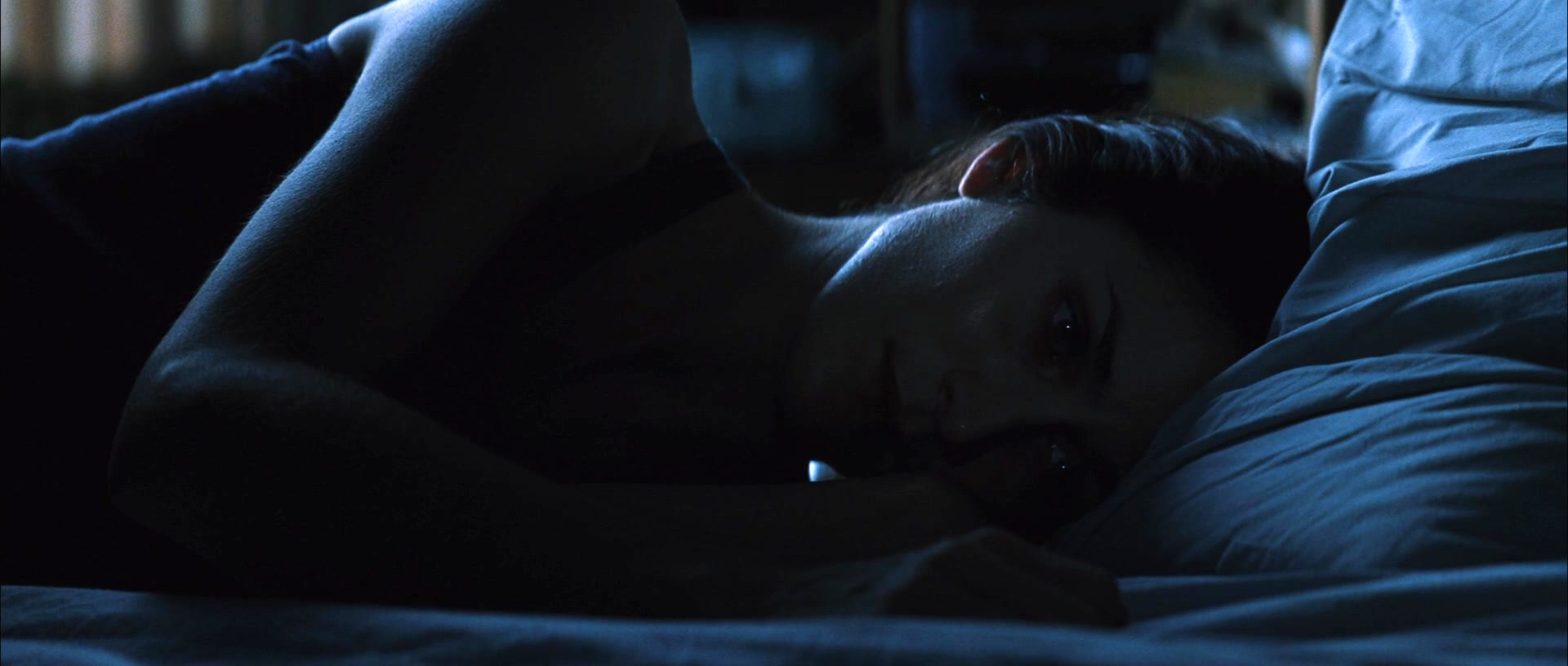
Natalie-mento
From Natalie's perspective, her boyfriend Jimmy went off to a drug deal. Shortly after that, his car returns only with this random ass dude with a bad bleach blonde dye job behind the wheel. And that dude is wearing Jimmy's clothes. And says he has no idea where Jimmy is or even who Jimmy is.
But... this is definitely Jimmy's car. And these are definitely Jimmy's clothes.
And he is definitely not Jimmy.
Faced with this, once Natalie recognizes that Leonard is not a threat, she uses him to ensure her own security amidst unknown circumstances. One thing she knows for sure: Leonard's condition both makes him safe and his naivete makes him a tool she can use. Yeah, she manipulates him by stealing the pens and getting him to get neutralize the Dodd threat, but... that's just opportunism.
The hardest bit, though, is a very quiet, very subtle moment Nolan includes early in the film. As Leonard reflects on what it's like to live with his condition, opining that he might have gotten his revenge years ago and never ever know it, she listens in silence, pretending to be asleep. When he gets up to make the note about her, Nolan inserts a single shot of Carrie-Anne Moss turning over in bed, laying her hand on his empty side of the bed, probably still warm, where Jimmy used to be.
It's also one of the only times the movie leaves Leonard's persepective.
Themes of loss run through this first half of Nolan's career. It's the Bruce's parents and Rachel in the Dark Knight films. It's the wives in The Prestige or the vast universe of time and space separating Cooper from Murph in Interstellar or Cobb holding onto the memory of Mal in Inception. What brings Natalie and Leonard together might be circumstance, but what draws them into this intimacy is that profound loneliness of losing the person they love.
While Leonard will never ever get an answer to what happened to his wife, Natalie will also probably not get something definitive either. Leonard left no record of his encounter with Jimmy (apart from like... stealing his clothes and his car; sure, Leonard left his clothes and truck behind, but what are the chances those are his) and has no idea that he's the man who killed him. Teddy's death at the end of the film means a whole lot of information about Leonard's path dies with him. It's unlikely he kept detailed notes about his time with Leonard (why would he), and that lack of clarity further separates Natalie from the truth.
Because what matters is not what she does to Leonard in the past, but rather where she leaves him in the future. She exudes such compassion and warmth in the wake of Leonard taking care of Dodd. More than that, in Natalie, Leonard finds a kindred spirit, someone who has also lost someone. And watching it again it's easy to see all the moments Natalie actively fucks with him by calling him Lenny, and sure that might be malicious, but it's also affectionate in trying to position herself as a ghost of Leonard's wife. She has seen the man behind the circumstance, seen how rich his psychological makeup is, and she has come to care for him at least somewhat. After their night together, there's that hope the memory of her sticks, that whisper "I think you will", the sort of blind optimism that comes from someone who wants to believe they can transcend another's limitations. That their kiss can mean more than just a kiss. That maybe, just maybe she can make him into more than he currently is.
Yes, the premise and the structure of Memento is what gets people to show up, but it's character moments like this that keep people coming back. It's Leonard trying to find something that will fill his life after his wife's murder. It's Teddy trying to save his friend from jeopardy when he's in an emotionally vulnerable state. And it's Natalie trying to move on amidst her weird grieving process for something to which she will never get an answer.
The black and white can move forward in time while the color moves backwards. The cause and effect reverse and the payoffs precede the plants. But at the heart of this twisty, turny puzzle box is the throbbing beating heart of people in pain trying to escape their torments. Perhaps they succeed, but Nolan gives enough for the audience to leave the movie in a place that (while absolutely haunting) can feel wildly optimistic. It might overwrite a fortnight's worth of memories, but it'll always be a movie to turn over in their heads because of these characters and the thematic implications of their existence.
Think Memento is just its gimmicky little structure? We all know that Christopher Nolan is so much better than that.
Just like he writes female characters so much better than people will ever give him credit for.