
Held At A Distance - Insomnia

Nolan's Iliad explores the films of Christopher Nolan through the prism of his talents as more than just a puzzle box guy.
Following Memento, it's unsurprising that Nolan took a work-for-hire studio job next.
What is surprising is that what his followup was not just a remake of a recent film from five years previous, but also a film for which he does not have a writing credit. In fact, it's the only film in his entire filmography for which that is true.
And... sure, he probably did SOME minor tweaking here and there, but so much of the reason the film feels the way it does is because this isn't Nolan's story. If originality defines Nolan's legacy (especially starting with Inception), the biggest reason this movie lacks a dedicated following is because this is far away from the major thematic ideas that interest him. Smaller thematic ideas (men grappling with their masculinity) recur, and the recurring motif of making movies centered on men makes this an undeniably Nolan project.
Mostly, though, Insomnia is what happens when Nolan makes a mostly intellectual exercise and without the deep personal richness endemic to all of his other films.
Nolanesque tactility
None of this is to say that Insomnia is a bad movie. It's quite a good one, and the hallmarks of Nolan's style feel more present here than they did in Memento. Three movies in (and only two at anything resembling a decent budget) and the he's already defined the visual look and pacing rhythms that define his movies even to today.
For starters, he has such a specific eye for how to construct an image. As the various trucks and jeeps travel across the vast Alaskan expanse, they all feel like Nolan's framing for establishing/travel shots moving forward. Whether it's tracking parallel to a vehicle car or watching another drive by... the compositions are undeniably Nolanesque.
It's so hard to explain how this is true. I remember reading some interview about The Americans where someone (maybe Noah Emmerich?) talked about what it was like to direct episodes and how the visual language of the show was far more esoteric than anyone would imagine. There was a certain distance from which to film the characters, certain lenses and specific color palettes to incorporate. There's a specificity to it that most viewers wouldn't notice, but it's the sort of thing that should mean an audience member changing the channel should be able to be like "oh shit is this The Americans?"
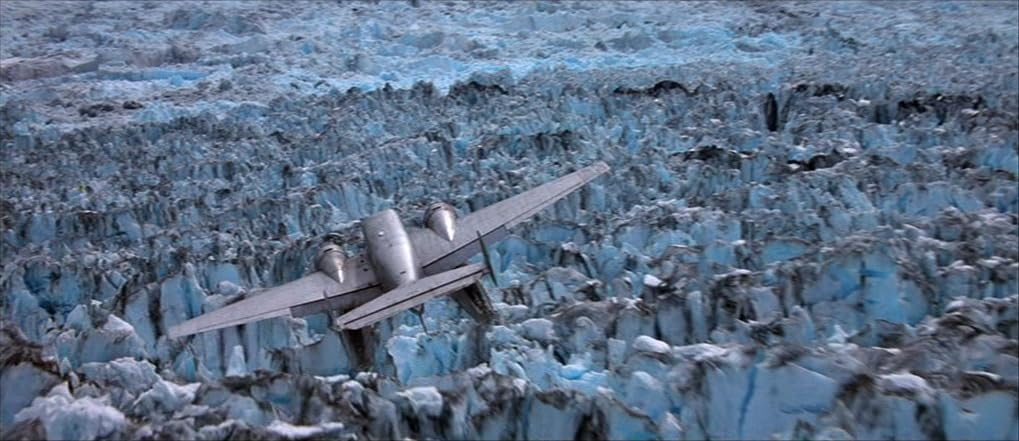
The same is true for Insomnia. Even the above establishing shot during Detective Will Dormer's plane trip looks like the sort of shot only Nolan could construct. Plane foregrounding a craggy earthen surface. The lines in the rock, the angle of the shot... It just looks like the alien landscape of Dr. Mann's planet in Interstellar.
These signifiers define the movie as Nolan's. But... they don't contribute to a movie that feels like part of Nolan's definitive canon. Anyone can have a visual taste they incorporate into their work. Anyone can have a rhythm to their stories that feel unlike anything else. But directing and storytelling is more than those signifiers.
Remake
So what brings Nolan here? Surely he doesn't want to just do establishing shots or aggressive cuts in transitions. If he did he could go be a second unit director or shoot nature documentaries or go be an editor or whatever. No. Nolan apparently loved the original 1997 Norwegian crime thriller of the same name and sought to remake it. Which... fair enough. And while I haven't seen the original (which is even better by most accounts) there is enough to the juicy premise that it makes sense why Hollywood would want its own version.
But what is this movie about?
Sorry. Backing up.
Nolan's defining thematic feature for the first decade of his career is a constant fear of losing the woman he loves. This comes to a head in Inception, but it's also the whole basis for Memento and is the thing that kicks off the major feud between Algiers and Borden in The Prestige. Batman Begins and The Dark Knight obviously have Rachel flitting about those narratives. And then Inception. Hell. Ed Brubaker's interpretation of Inception as "the dream a man has the night before he has to tell his children that their mother has died" is just rad as hell. I'm not normally one to go for the "it was all a dream" read of anything (because most movies are inherently dreams), but that one is just... it's too good.
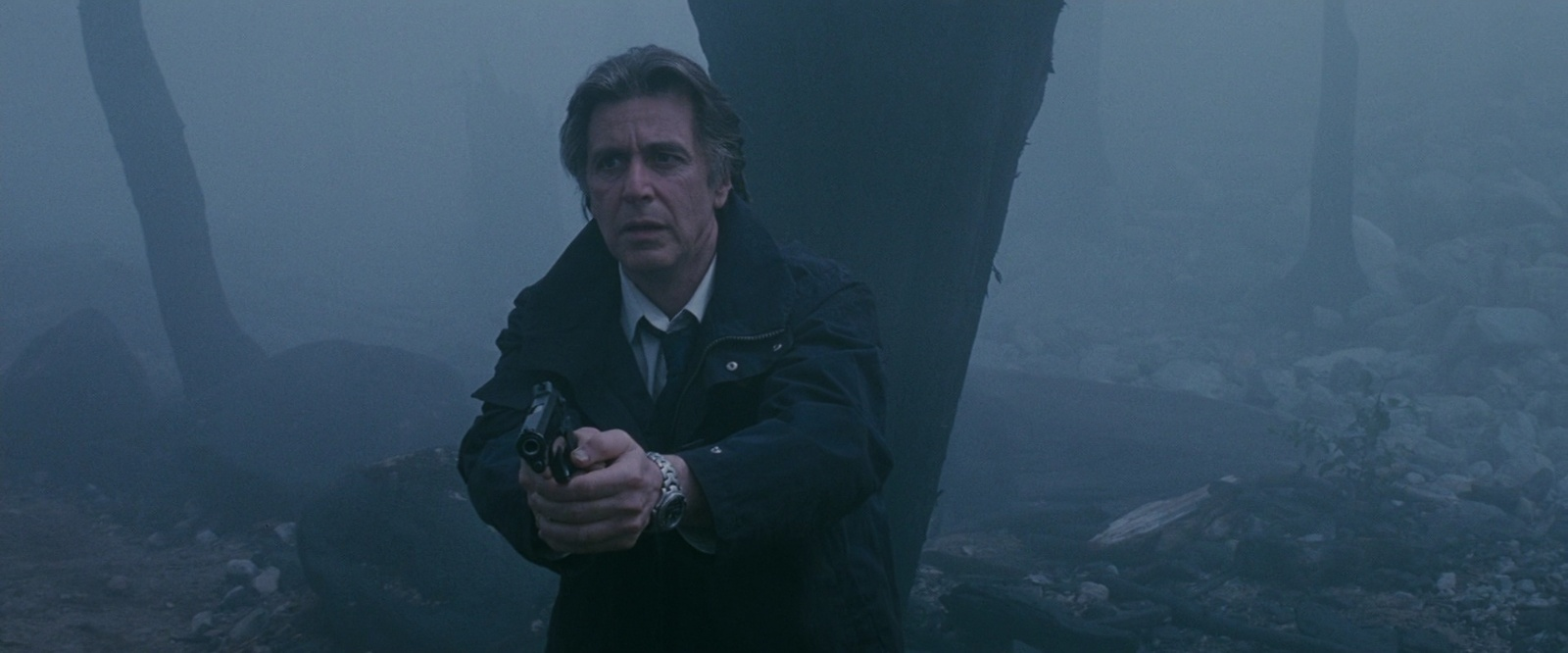
And how does this relate to Insomnia? Great question. Insomnia is about... a well-meaning-but-crooked cop named Will Dormer who goes to Alaska to investigate the horrific murder of a teenage girl. Part of his reason for being there is his trying to avoid an Internal Affairs investigation; he finds out a little ways into the movie that his partner Hap has agreed to turn state's evidence on him in exchange for immunity. And while this is going on he's losing his mind while unable to sleep in a town so far north the sun never sets.
There's no wife here. No love interest. The only one who really gets a mention is Hap's wife after Dormer calls to tell her his partner has died. Other than that, it's about a man wrestling with the righteous (if unethical) things he's done in the name of justice. The shot he fires that kills Hap comes after a sequence Nolan builds on confusion and disorientation. It's an accident. It's only after the horrific details of "I killed my partner" comes out that he starts to lose his mind and panic. Fakeing the bullet evidence by using the dog's body is the action of a man who's falsified evidence before and doesn't hesitate to do so again. To this point, he's avoided accountability for his indiscretion. Self-preservation is his major focus, but he's also running out of runway.
This puts the movie at a bit of a remove. Most of what makes it good (beyond Nolan's directorial prowess) comes from its source material. The crooked cop, the isolated setting of perpetual daylight, the accidental shooting of his partner, the bright-eyed younger investigator trying to learn the truth of that shooting... All of these make for a compelling story. It's hard to not engage with elements so inherently dramatic.
But juicy dynamics are the fuel for a story, not the engine. Themes of insanity and the endless cycles of compromising principles remain the center of this. None of these recur in any of Nolan's films after this. Even when he goes into the endless cycle of self-destruction of The Prestige, that boils down to revenge and jealousy, not desperation.
Professional talent wrangler
This isn't to say that directors can't explore other themes or that it's bad to pick up studio work because it's a job that allows them to flex their muscles. And plenty of storytellers have found ways to mold a particular story to their own interests. What makes this weird is that it's such an intellectual exercise when basically nothing Nolan does after this is.
But that ignores the practical reasons for making a movie like this: proving he can work with serious acting talent.
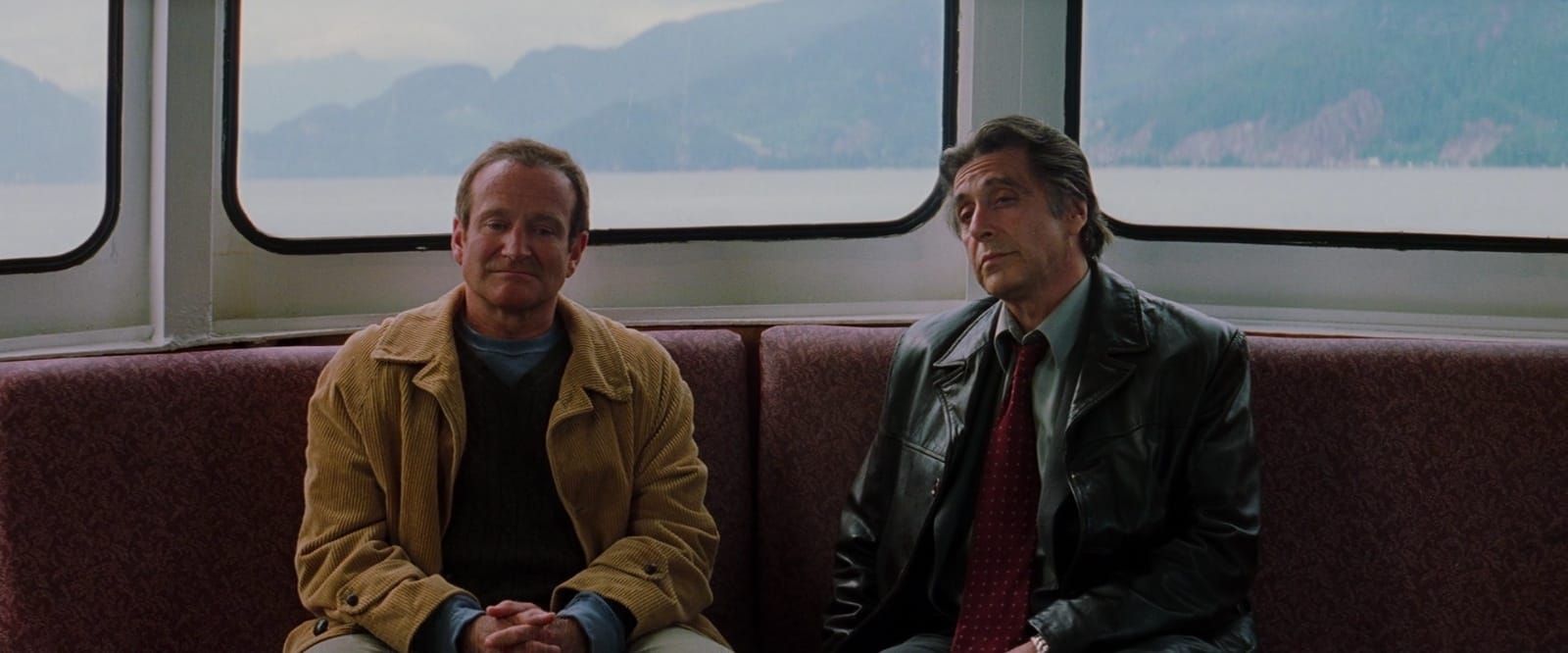
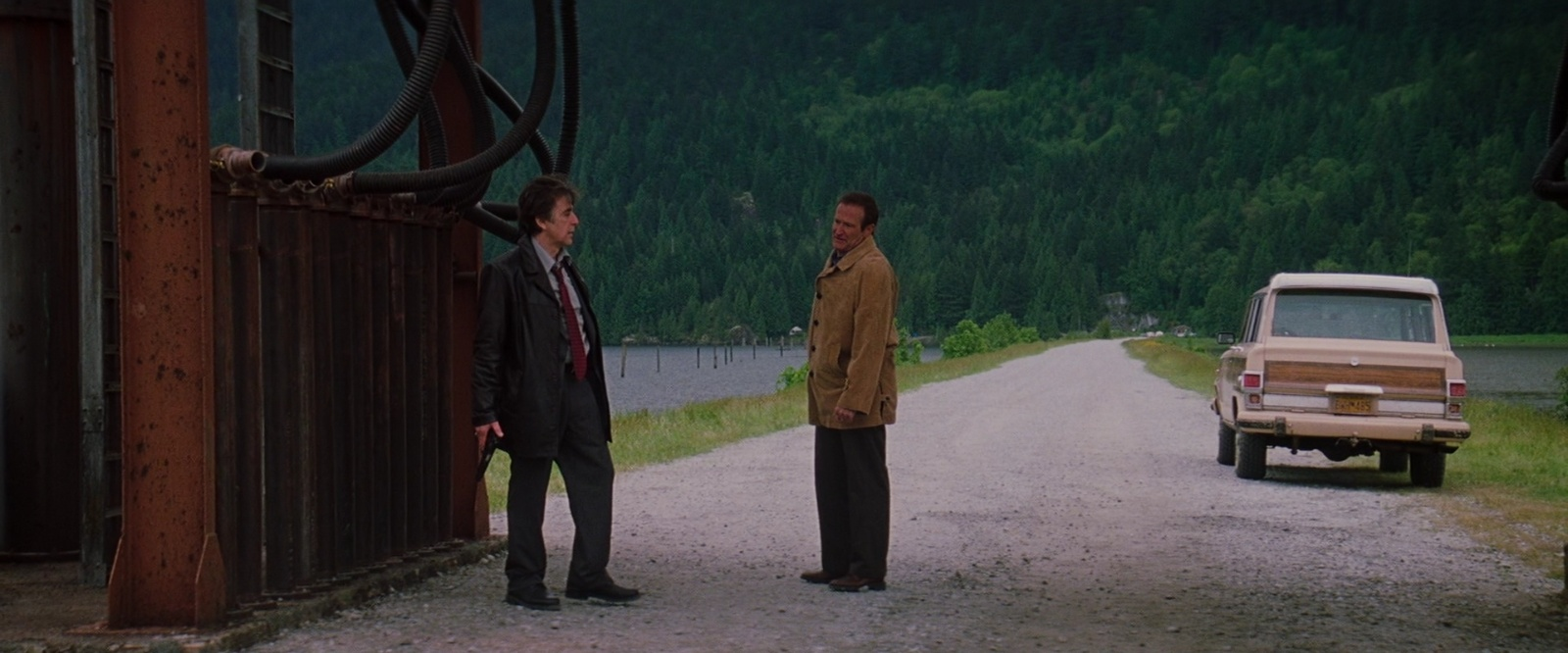
Because at the center of this film are Al Pacino, Robin Williams, and Hilary Swank, all of whom are big names with their own inherent clout.
For Pacino, it's the pivot into the what's really the last stage of his career. Insomnia is movie about getting old, and going back just a few years Pacino was playing a middle-aged lifer (with no plans to retire) in Heat, Satan in The Devil's Advocate, and Lowell Bergman in The Insider. All of those roles represent characters at the height of their powers, not a washed up, has-been on the decline like Will Dormer.
And Pacino is a major reason Nolan gets future work. It's not that Pacino is a terror or anything, but there's no way a dude with that level of talent and prestige isn't coming with his own sense of superiority in the face of this director kid who's half his age. He was 60 when he made this movie, and had won an Oscar for Scent of a Woman a decade before. And... The Godfather Trilogy, Dog Day Afternoon, Serpico, Scarface... That's intimidating. Even with all of that clout, Nolan still pulls an incredible performance out of him that... Pacino hasn't topped since? The only one that maybe comes close is in The Irishman. And that was working with freaking Scorsese.
Swank is also hitting a turning point. Following a string of hits in the 90s and just a few years away from her Million Dollar Baby Oscar, her youthful demeanor plays in contrast to Pacino's and feeds into her character's need for her to live up to these expectations.
But Robin Williams is the legacy here. Williams was always a serious actor who got (understandably) pigeonholed into "the funny guy" everyone knew him as. While he'd tried all sorts of dramatic performances before this one (and even won a Supporting Acting Oscar for Good Will Hunting) he didn't always succeed. But Insomnia represented the moment where public perception of him turned from "the funny guy" into an actor capable of performing serious darkness and psychological realism. Williams was in two other, similar roles this year, but Insomnia is the won that actually feels prestigious as opposed to a dark mania (One Hour Photo) or bizarre depravity (Death to Smoochy)...
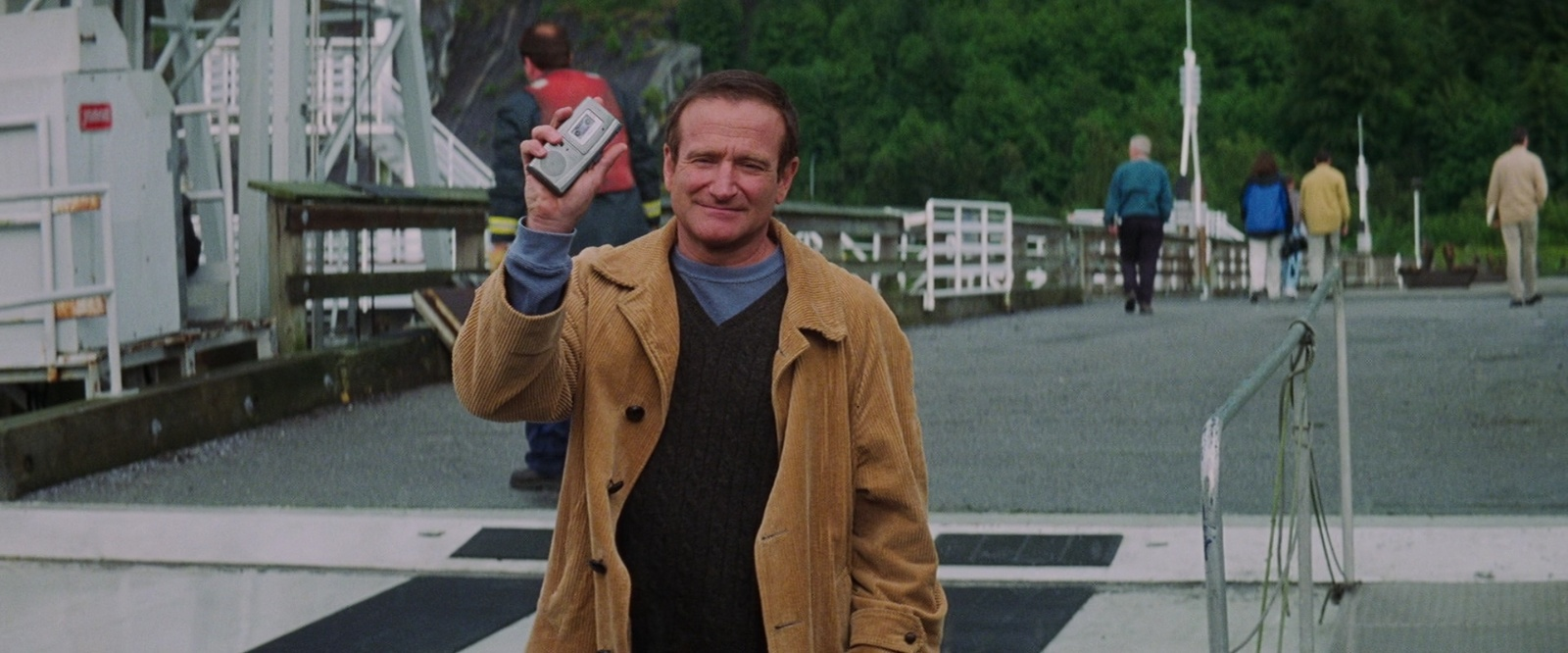
It's so easy to forget that one of the major reasons Williams's career was the way it was in the early 2000's is because Nolan cast him as author/murderer Daniel Finch, giving him the shot to prove just how capable he was of doing something radically different that wasn't just the deep pathosy drama of Good Will Hunting. Finch is terrifying, so calm, so collected. The best scenes in the movie are the ones where Finch and Dormer interact, the cat and mouse game between cop and criminal as they slowly circle each other, each man trying to get the upper hand despite feeling a kindred spirit within.
Nolan makes it look easy. Like... the dude is 32 when this movie comes out and he's pulling a great performance out of Al Pacino and sculpting what's probably Robin Williams's best post-Oscar performance.
(Not that Nolan handled it perfectly. There's a great anecdote of Nolan giving Pacino a note after a take scene and the actor replied "watch the dailies" because he'd already done it. When Nolan insisted, Pachino told him he wouldn't be able to see it with his eye. When going through the footage a few days later, Nolan saw that Pacino was right and the man had indeed given him exactly what he'd asked for.)
Stepping stone
All of this adds up to a curious artifact more than it is a great movie (and it is quite a good movie). Taken in a vacuum, Insomnia is a solid crime thriller.
But in the legacy of Christopher Nolan, this is a footnote. The reason it doesn't feel like a Nolan movie is because he's so young, and the themes and ideas that most fascinate him don't center in this movie as they do in literally every film after this one. Insomnia's thematic resonance comes from the original's ideas rather than some deep well of emotion from Christopher Nolan himself. There's a reason why Nolan hasn't remade a movie in more than twenty years and it's the same reason why this doesn't have that same sticking power.
More than anything, this is another step up towards the epicenter of Inception. A 32-year old Nolan pulling off a movie like this is enough to get the man in the room for Batman and then enough for him to leave with $150m to make a Batman movie.
Insomnia is one of only two times in Nolan's career where it feels like it's not coming from a deep well of "need". So many other filmmakers have spent their entire careers being work for hire folk, rarely getting their own personal projects off the ground. This is truly the only time Nolan performs this rite of passage, and even then it comes with a deep love for the source material. That passion enough to make a fabulous, stylized crime thriller that grossed over $100m and still has a legacy despite it not having the stamp of "oh Christopher Nolan directed that". It's enough to make this a nifty gem tucked in the corner of his gallery, but it's not enough to let anyone pretend like this is anywhere near the best of his work.
Weirdly, it's like Nolan knows this. This isn't some situation where he becomes a Spielberg who develops projects and doesn't write them, nor is he a guy who just signs onto great scripts like Soderbergh or Linklater. From here on out, Nolan is a dude who starts to make his projects deeply personal on at least some level.
And while he's basically developed his nascent style and tone, there's still another three films between here and his apotheosis. The first of those is what should have been a dumb little superhero film that basically everyone ignored. But Nolan's ascent is rapidly becoming the sort of thing that no one in the mid-00's could ignore.