
Close Encounters of the Aquatic Kind - The Abyss
It's like a second draft but by a different film maker and with a different emotional core

The following contains spoilers for Close Encounters of the Third Kind…
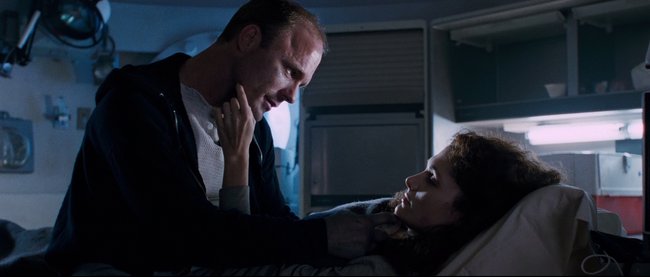
After the success of The Terminator (his first wholly original work) and Aliens (a big budget studio blockbuster/sequel), James Cameron put all his chips on a completely crazy idea: an undersea sci-fi quasi-adventure movie that required shooting 40% of its footage underwater.
That film, The Abyss, is probably the biggest misstep of his post-Piranha II career.
The Abyss is a fabulous film. But it’s not nearly the massive populist raging success of basically every movie in Cameron’s filmography after this that isn’t True Lies (and even that was a hit in and of itself).
There’s a lot of reasons for this, but the quiet part of James Cameron’s career is that he’s always pulling from other sources as inspiration. Here, though, the biggest source of inspiration for his third film would be from the master of the Hollywood blockbuster. It’s his own personal Close Encounters of the Third Kind.

Correlations
Spielberg had done quite a bit of directorial work before his theatrical debut1. His first major motion picture, The Sugarland Express, came out in 1974. It put him on the map before Jaws in 1975, and that gave him the street cred to make Close Encounters of the Third Kind for 1977. That’s a total span of about three years. Unlike those first two, Close Encounters is a deeply personal work, one that Spielberg personally wrote (the only others are A.I.: Artificial Intelligence and The Fabelmans), and happens purely based on the massive success of Jaws. Its most personal touch is in fulfilling a lifelong dream of Spielberg’s: to make a big, proper, totemic alien encounter movie.
For Cameron2, The Terminator came out in 1984 and Aliens followed in 1986. The Abyss followed in 1989 (so five years total). The Terminator and Aliens both come from his deep passion for love stories and motherhood, but The Abyss comes from the most nakedly personal place of his entire career. The deepest part of this is James Cameron’s love of the water and the sea. Making a moive so making a movie that takes place primarily underwater is the sort of audacious “don’t do this” that only a true maniac would attempt.
And in case it wasn’t clear, both films are the third films of their respective directors’ careers.
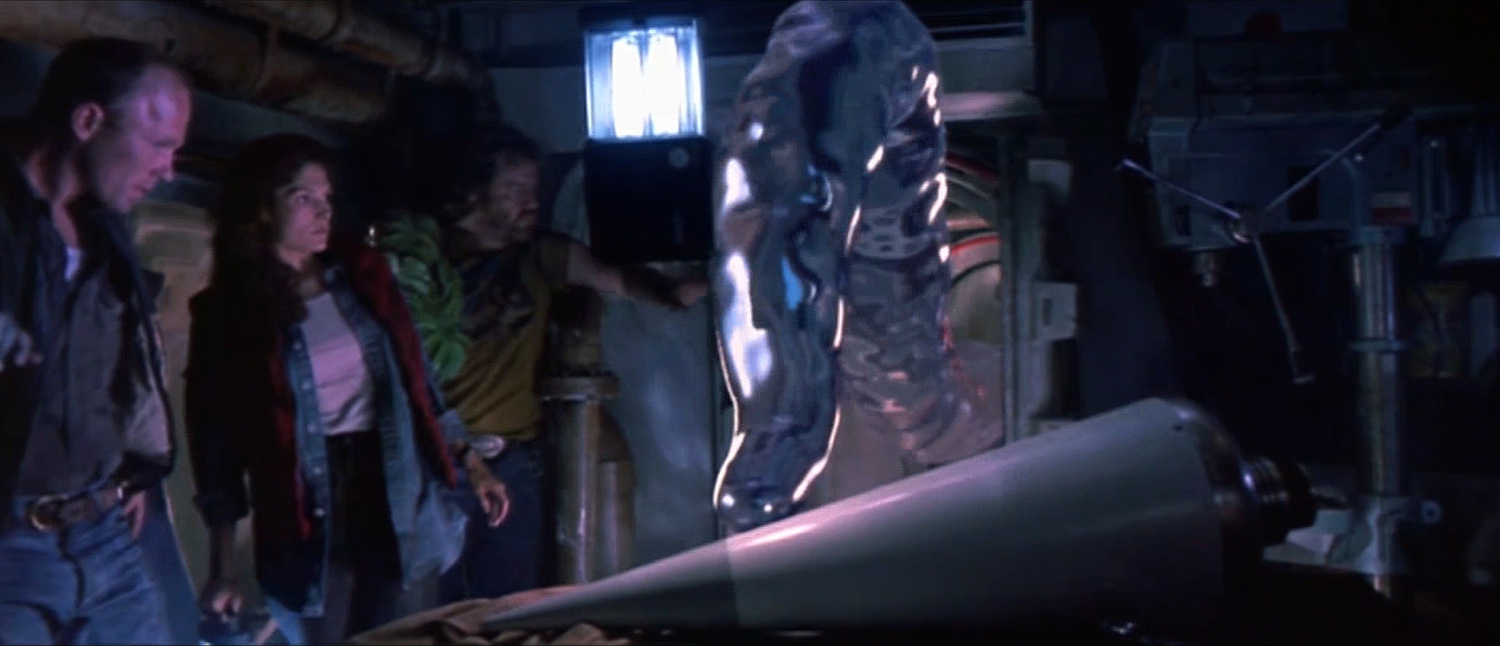
There are other similiarities. Both films deal with aliens, with the aliens only appearing briefly and in ways characters can’t really explain until their major encounter at the end. Lindsey’s being outside when the alien zips past her is similar to the way Roy Neary sees the aliens fly by his car on the highway. Close Encounters has a home invasion scene while The Abyss has a scene where the aliens manipulate water to become a quasi-sentient liquid tentacle that they can use to explore the rig. They also end with the main character coming across a massive, sprawling alien ship, some incredible feat of technology to bring to life. Their eyes fill with wonder as they personally make contact with an alien species. And this encounter gives them the just rewards of their respective arcs.
Even these, though, are mostly statistics, mapping data points to data points.
What matters most is the emotion involved. Close Encounters pleased Spielberg plenty on its initial release, but in the years since Spielberg has acknowledged the blindspot of the ending. At the end of the film, main character Roy Neary (Richard Dreyfuss) participates in first contact (along with everyone else on that airfield) but gets the rare privilege to board the alien spaceship and head out into the stars. Who knows when he’ll be back? This, however, ignores that part of Roy getting to that point involved going absolutely insane and freaking his entire family out. In the second act, his wife flees with the kids and Spielberg doesn’t give them another mention. As written (and made) Roy functionally abandons his wife and children at the prospect of fulfilling Spielberg’s childhood dream.
The writer/director has since said that had he been a parent in 1977, he wouldn’t have ended the movie that way. He blames the tunnel vision of his fantasy made manifest. And also Spielberg reckoning with his dad’s own role in his parents’ divorce, where he played the bad guy and more or less abandoned his family due to reasons it would take Spielberg decades to discern.
Until that point, Close Encounters is an amazing film, but the ending is deeply saccharine even for Spielberg. Maybe it’s my dad’s opinions rattling through my head again. Over a decade before I saw it, he critiqued Close Encounters for not showing a realistic alien encounter. Spielberg’s vision is outrageously nice, a whole buncha little greys3 coming down the walkway to do a nice little wave and maybe a handshake or two before going on their merry way. There’s absolutely no tension to the exchange. It’s two perfectly utopian cultures meeting each other for a few words between long travel sessions.
No conflict, no negotiation, no squabbling over resources, no hostilities.
How quaint.
Meanwhile, I think my dad probably thinks the alien arrival in Mars Attacks! is more in line with what he would expect.
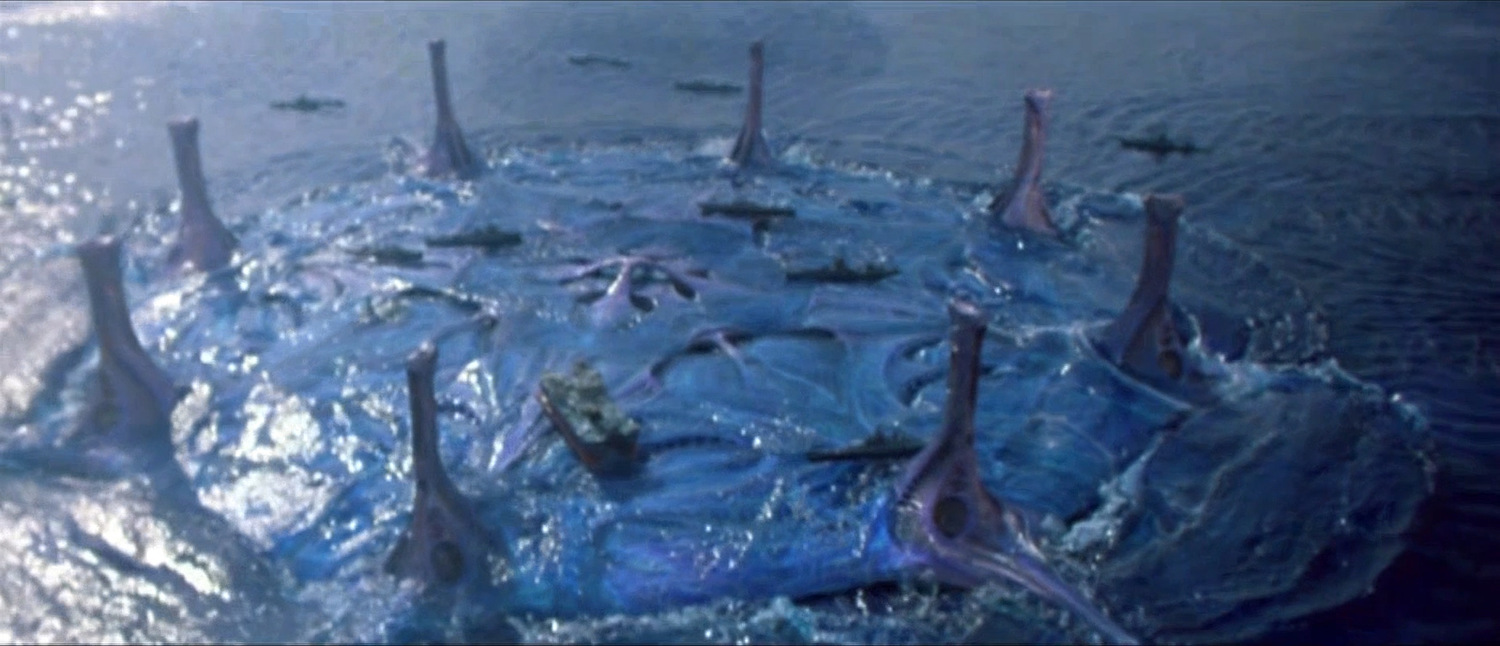
For The Abyss, Cameron fixes this particular problem. Like Roy, Bud (Ed Harris) makes it onto the alien spacecraft, but when he gets there the aliens look at him quizzically. They showcase the thousand-foot waves they’ve created, threatening to destroy all of human civilization. Their reason? They show footage of humans trying to kill other humans, escalating tensions between the U.S. and the Soviet Union. The mayhem and destruction disturbs them.
What could possibly stop them from wiping out humanity?

A wedding ring on a blue hand
In 1984, after production had wrapped, James Cameron married The Terminator’s producer Gale Anne Hurd. They worked together on Aliens to tremendous success. They then worked together on The Abyss, though the two separated just before pre-production and finalized their divorce two weeks after filming wrapped on the movie. It shows.
For those first two movies, Cameron explored universal themes. The Terminator is a great love story masquerading as an urban sci-fi slasher movie. Aliens used space marines to smuggle in a story reflecting on the power of motherhood.
For The Abyss, Cameron made a movie about a shitty husband doing everything he can to stop the woman he loves from divorcing him.
Bud is a brave and heroic character, but he’s not a paragon of virtue. He’s grumpy and demanding. He yells at people and takes it on himself to save the day. There’s a sense that he doesn’t fully understand why his marriage has fallen apart, which means he’s not clear about how to put it back together. All he knows is that his love for his partner is strong and hasn’t abated.
Because this is a fantasy, Cameron builds a story in which Bud’s love is the thing that saves him, Lindsey, and all of humanity.
Cameron is an extremely corny filmmaker. He wears his heart on his sleeve and doesn’t play emotions for subtlety. Bud throwing his wedding ring down the toilet is one of the most incredible moments in the movie. It’s a small, intimate moment, watching him return to sink his entire forearm into the chemical blue of the bowl’s contents, desperately fishing it out so he can put it back on his azure-stained finger. For all that Lindsey drives him up the wall, he can’t help loving her. And now he’s wearing the stain to prove he can’t quit her.
But when shit goes down and the umbilical pulls the crane down to the ocean floor, it causes disaster on the rig. Explosions, mass flooding, chaos. And thank god Bud loves Lindsey, because the band on his finger stops a closing pressure door from sealing him into a watery tomb. It feels like a total cliche, The Abyss’s equivalent to a book stopping a bullet. But that love literally saves his life, just like it will save his life when the aliens read his message, just like it will save Lindsey when she’s in the dire throes of fatal hypothermia. It so should not work. But Cameron puts such passion into the sentiment that the heart aches.
Unsubtle water metaphor
It’s no accident that The Abyss’s main setting is the water. Setting aside Cameron’s legendary love for the ocean and its infinite wonder, he’s also a filmmaker who plays within universal, mythic tropes and symbols, be it the motherhood of Aliens or the nuclear family of T2. Avatar made all that box office money not because of some pioneering use of 3D/IMAX technology (though those helped) but because it was a universal story that had broad cross-cultural appeal.
In narratives, water is a primal, mythic force. Most regularly, water represents renewal, birth, baptism, and rebirth. The big dramatic breath that Bud takes when the aliens finally put him in an oxygenated environment is the breath of life. And this isn’t reading into it. In the script, Cameron writes Lindsey’s coming back to life after the hypothermia sequence as though its Lindsey’s own personal birth,
And then just a few lines later:
Aside from the final moments of the Titanic’s life on the ocean, Lindsey’s “death” is easily the most harrowing moment in James Camerons’ entire filmography. It’s so engrossing that some fans watched the film for decades without realizing that one crucial shot features James Cameron’s literal hand wiping away water from the camera’s lens.
But the only reason Lindsey goes through it because she trusts that Bud will bring her back to life if he can make it back to the rig with her in time. That trust, that love is what ends up saving her life (and Bud’s really), but it’s only in the dangerous imminence of death that she realizes how much she really does love and care about him.
And this is why The Abyss succeeds in its beautiful ending while Close Encounters does not. Spielberg doesn’t harmonize the happy waving aliens with the ones who terrorized Jillian and stole her son. The incongruity feels strange. For all of The Abyss’s trappings (the aliens, Coffey’s madness, the water tentacle, the nuclear bomb), Cameron’s laser focus on the Bud/Lindsey dynamic pays dividends. The aliens’ playfulness and curiosity (the way they appear to Lindsey or create the water tendril) enables an ending built on grace. Of course Bud & Lindsey’s relationship saves the world and earns the beautiful, silent, reconciliatory kiss in that all-too-fast final shot.
It’s worth noting that for all Bud sounds like some noble chivalrous dude, it doesn’t change the moments of monstroisty, how he talks about Lindsey behind her back, or the way he screams at her, calling her a bitch when he’s trying to rescusitate her. Yes, his kiss becomes the breath of life, but the slaps across the face are violent and painful and not something that makes him seem heroic or even noble. They’re the actions of a man bereft and lashing out.
It’s not like Cameron is casting himself in a favorable light.
Even as his divorce finalized and the fantasy of what James Cameron so wanted died, he channeled all of that wish fulfillment into this ending of his last film with Gale Anne Hurd. He put the existential stakes of Bud’s life in parallel with the continued existence of the human race. The world could end? Oh yeah? Well Bud’s marriage could end. James Cameron’s did. Watching The Abyss it’s easy to see how he felt that way.
This is the magic of the movies, though. Film is a medium built on turning dreams into images and images into actual reality. Just as James Cameron dreamed up an alien civilization living in the deepest trenches of our oceans, so too did Steven Spielberg dream of flying off into the cosmos on a grand adventure. These things might only happen in the movies, and the grind of real life might be harsher than the experiences of these characters’ tumultuous for these brief spans of time. But they still work out. Cameron’s marriage to Suzy Amis is now 25 years old. Spielberg might not have gotten to join the aliens in space but he did get to start a family and raise his children. Given that he admits now that abandoning them and going into space would be unthinkable, it seems like it worked out for him too.
Neither The Abyss nor Close Encounters are fully successful. The Abyss in particular failed to connect with audiences on initial release, landing on the 1989 box office charts between Pet Sematary and Harlem Nights. It stands as Cameron’s strange movie. He never makes another film this nakedly personal, and maybe the tepid response of this pushed him into the more arch, universal stories of all his later films. Terminator 2, Titanic, Avatar… all of them have broad, universal stories that can appeal to the broadest audience possible; they’re the vehicle by which he smuggles his other thematic concerns (nuclear war, greedy corporations, environmentalism…) into the anticipatory jaws of the masses.
Back to populism
If anything, The Abyss is Cameron’s most cult movie, the one that has a small but loyal and fiercely devoted fanbase that celebrates the film’s genius. This isn’t his best movie, but it’s the one masterpiece that’s secret.
For everyone else, this is the one where maybe James Cameron is too out there for a mainstream audience. Post-The Abyss is the last, most justifiable point for anyone to bet against James Cameron and his ability to deliver the goods.
Of course, that means betting against the guy who just two years later would make maybe the greatest action sequel of all time.
Duel doesn’t count as that was a made-for-TV movie that got a full theatrical release after its initial airing. ↩
Again, not counting Piranha II… ↩
Learned recently that “greys” is the generic term for those small, oval-headed, big-eyed, grey-skinned aliens. Y’know, the kind you’re thinking of right now. ↩