That's Just the Way You Make Me Feel - Casablanca
So good, so good, so fucking real.
Over this three-year movie endeavor, the idea of movie magic has come up over and over again. It’s a lot of things. There’s the relative nascency of the artform. There’s a specific vehicle by which by which audiences must travel to engage with it (specifically: a darkened theater). There’s a whole lot of special skills that go into the final product (writers, actors, directors, composers, producers, editors, effects people, stunt coordinators, hair, makeup, props). There’s a primary author (the director) but each of those other artists make a meaningful contribution.
There’s something else to it, though. As a narrative medium, it’s the only one that more or less forces its audience to engage with it in one sitting. It’s not like a novel where you can (and almost certainly will) put it down so that you don’t absorb it all in one go. Nor is it like music, where individual pieces are ephemeral, temporal, static, and ever evolving based on performance. Nor is it even like theater, where a story of similar length will bifurcate its runtime via intermission. Cinema requires a degree of economy that encourages packing as much information and story as possible into compact packages. It promises a beginning, middle, and an end in one sitting. Dedicate 100 minutes and you can get the entirety of The Princess Bride. Three hours will get you The Godfather. And so on.
So when a movie becomes an all-time classic, is that because of how well it plays into that aspect of the medium? This full meal experience certainly must be a prerequisite to success.
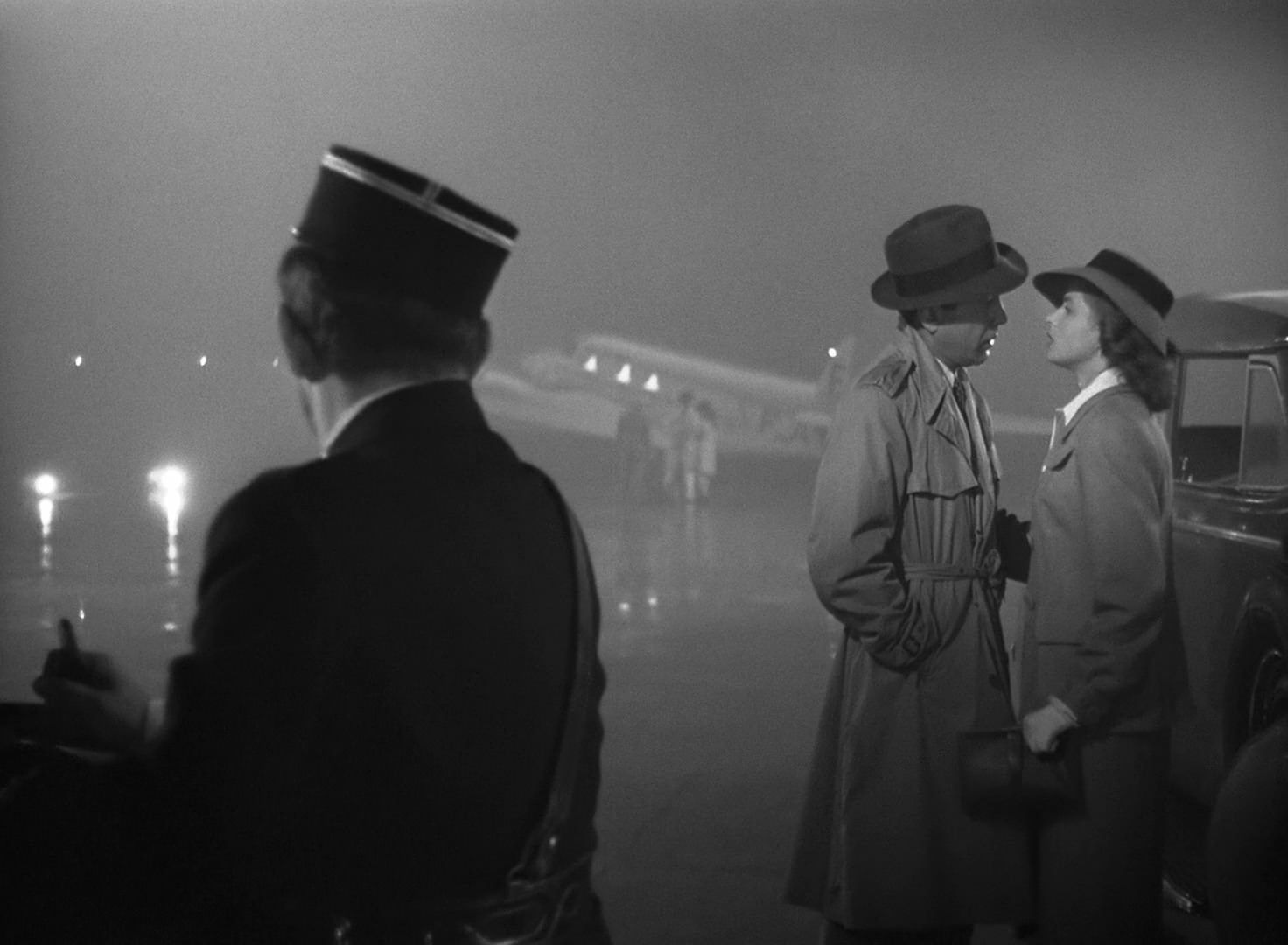
Casablanca is a film that needs basically no introduction. It’s got at least half a dozen all-time banger lines and the sweeping romance between Rick & Ilsa has captivated audiences since its release in late 1942. Not only that, but its release in that year corresponds to the height of the second World War. It came out a year after Pearl Harbor, but over a year before D-Day and the Invasion of Normandy. We look back on it now and recognize that the Allies would obviously win the war. Casablanca does not have that luxury, living in the weird tension of being topical while balancing the hopes for the future with the murkiness of the near-present.
What’s held up most beautifully about the film, though, is its intense, emotional core. Through music, montage, and chiaroscuro, the film presents and sells a beautiful yet bittersweet romance of the highest order, but does so in just 100 quick minutes. It would be a fantastic book and might even work on the stage, but it thrives in the cinema because of the way it co-opts and wields all of the medium’s best strengths to craft one of film’s singular achievements.
The Slow March to Ilsa
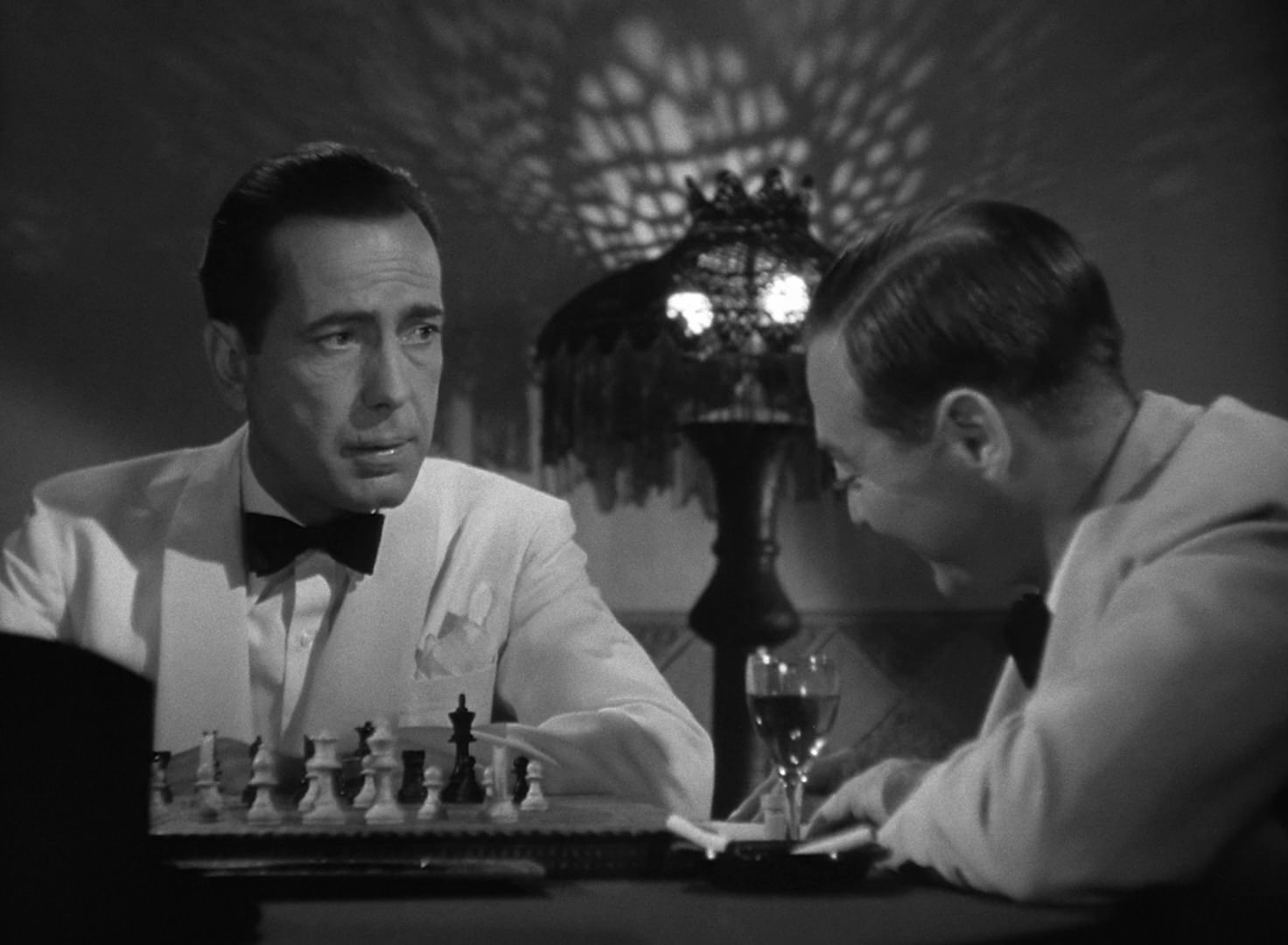
Reading Casablanca through the prism of its iconic end, it’s hard to argue that the movie is 100% about the Rick & Ilsa romance. Ilsa is a character who springs from Ingrid Bergman fully formed, and yet the movie ends without the two of them together and it’s… bittersweet and mayhap a bit devastating, but no one ever complains about it.
Why?
Well, Isla doesn’t come in until the 25-minute mark. The preceding stretch of the movie concerns itself with establishing the living conditions in Casablanca (it ain’t great!), laying out Rick’s (it’s pretty chill!), and Rick himself (bit of a grump). Events conspire to give Rick access to the letters of transit that can gets him (or whoever he wants) out of Casablanca, but other than that there’s not much of a hint about Isla or that she’s coming.
This is reality. Rick’s getting by in this place by running this little fief of his. He can have casual flings with women and throw them out because they meant nothing to him. People don’t get into his back room unless he says so and Ugarte entrusts him with the priceless (stolen) transit papers. He dines with members of the Third Reich and doesn’t feel like a major threat to them (nor he to him). He doesn’t seem happy, but he’s functioning well enough by putting his head down. Rick Blaine exists.
Despite this functionality, it can’t hide him from the harsh reality of Casablanca. This is one where Ugarte’s fleeing from police ends in gunshots just outside the club. Seconds later, the man is dead after the movie had stopped cold to lay him out as a key player.
Meanwhile, if anyone mentions Paris Rick bristles. These are small inconveniences, though. Renault says it best when he speaks to Rick just before Ugarte’s arrest: “In Casablanca, I’m a master of my fate.”
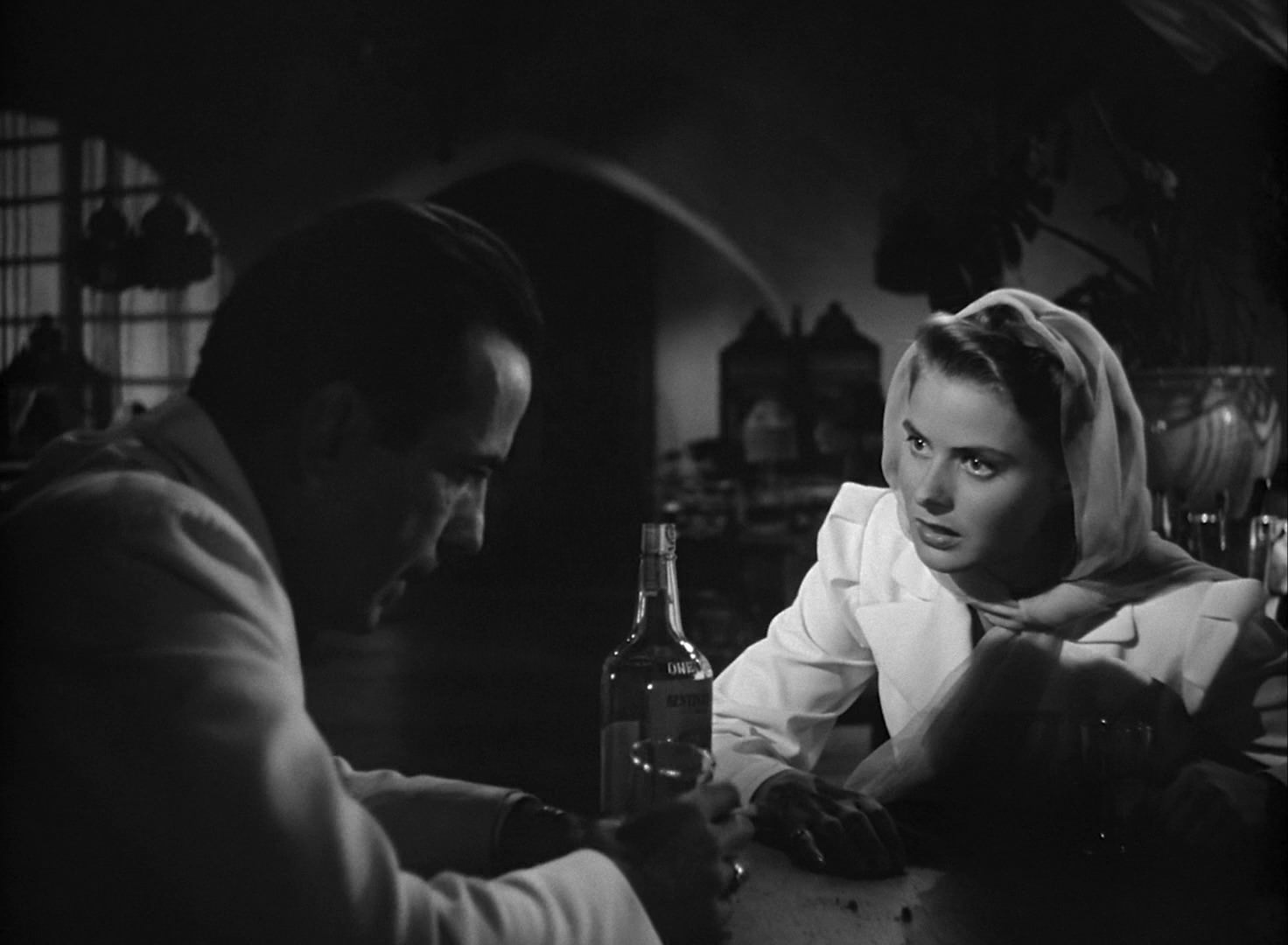
Ilsa’s entrance, though, is a dream intruding on reality.
Monochrome
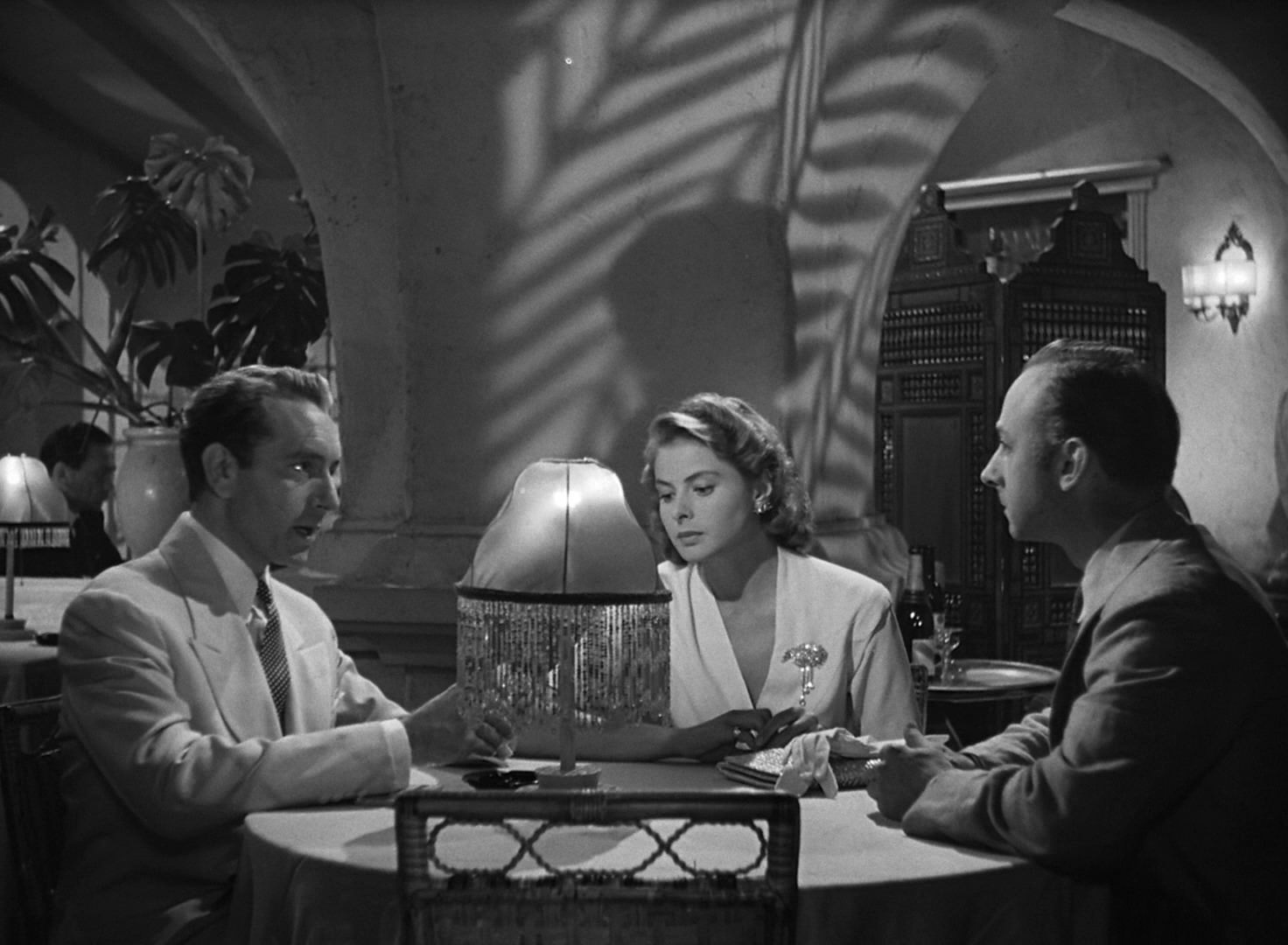
Black and white has become an arty choice by filmmakers who want to make some point. Christopher Nolan has used it as a way to delineate timelines while Alfonso Cuarón used it as a way to add to the dreamy memory of Roma.
Casablanca is one of those rare movies where being in color would hurt its quality. Never mind that the black and white photography is astonishing, the romance of the movie lives in the black and white. The world as it exists for us is in color, and that means color has tremendous flexibility. It can vibrantly splash across the screen like paint in Kurosawa’s Ran or play in deep Wes Anderson saturation like in The Grand Budapest Hotel. Quentin Tarantino used color to accent the imagery of Kill Bill while Scorsese desaturated it to avoid an X-rating in Taxi Driver. All of these play with a film’s verisimilitude. Color (even when unrealistic) is reality. Black and white is one of many barriers that can keep an audience at a psychological distance from the product. This is not reality. It is a thing people produced.
That adds to the potency of flashbacks when they start, adding to the fleeting rush of Rick’s memory as he plays his brief affair with Ilsa in fast forward.
If there’s a secret to Casablanca’s success, it’s the flashback sequence. Humphrey Bogart sells the devastating pathos of their relationship, but seeing it fly by, the beauty of it, the romance. There’s really nothing like it. But setting it against the backdrop of the fall of Paris gives it an extra flavor. Things might be going perfect, but Rick fails to realize that as this beautiful city teeters on the verge of collapse, so too his relationship with Ilsa is about to crumble as well. Just like the German occupation is the end of the world and the loss of one of humanity’s most beautiful cities, so too is Ilsa’s ghosting him. Later, Rick refers to the two of them losing Paris. Obviously, Paris is the metaphor, but he also literally means actual Paris.
December 1941
It’s a gutsy move to set the film in December 1941 when the movie came out in late 1942. There is a fallow period in cinema around this time, where the war effort made it hard for movies to know what to do and the manpower the war effort required drained art of the beneficial resources that come from an affluent society. That makes it even more audacious for Casablanca to come out in this time and to be so contemporary when the world itself is so unstable. Setting the film when it does puts it at a key moment in the war: it’s around the time of the bombing of Pearl Harbor. America was prepping to enter the war, but nothing major would happen until mid-1943 at the earliest, after this movie’s release.
And yet, the film makes several called shots that are shocking today. The first is Victor Laszlo’s history in a concentration camp, something that is probably even more potent in the wake of the war than in the midst of it.
But there’s also the defiance of the piece. 1941 ain’t a great time. The Germans have functionally conquered Europe, with only England keeping the candlelight flicker of democracy aglow. America is still playing neutral on the other side of the world. And still, the film puts Nazis in the movie and makes them both terrifying and foolish. The German soldiers attempt to squish Rick’s bar into submission with their rendition of “Die Wacht am Rhein”. But Laszlo (ever the inspirational figure) co-opts the moment to lead the crowd in “La Marseillaise”. It results in the Germans shutting down Rick’s bar.
This, though, is stronger with a bit of tabula rasa. In 1941 or 1942, there’s no guarantee the Germans would fall and that this new world order wasn’t somehow permanent. And yet here’s Casablanca standing proudly to say that Germany is the bad guy without being outright propaganda. It helps that the Allies won the war, but this still feels like a relic of that defiant world and the spirit of noncompliance.
Antifa Rick
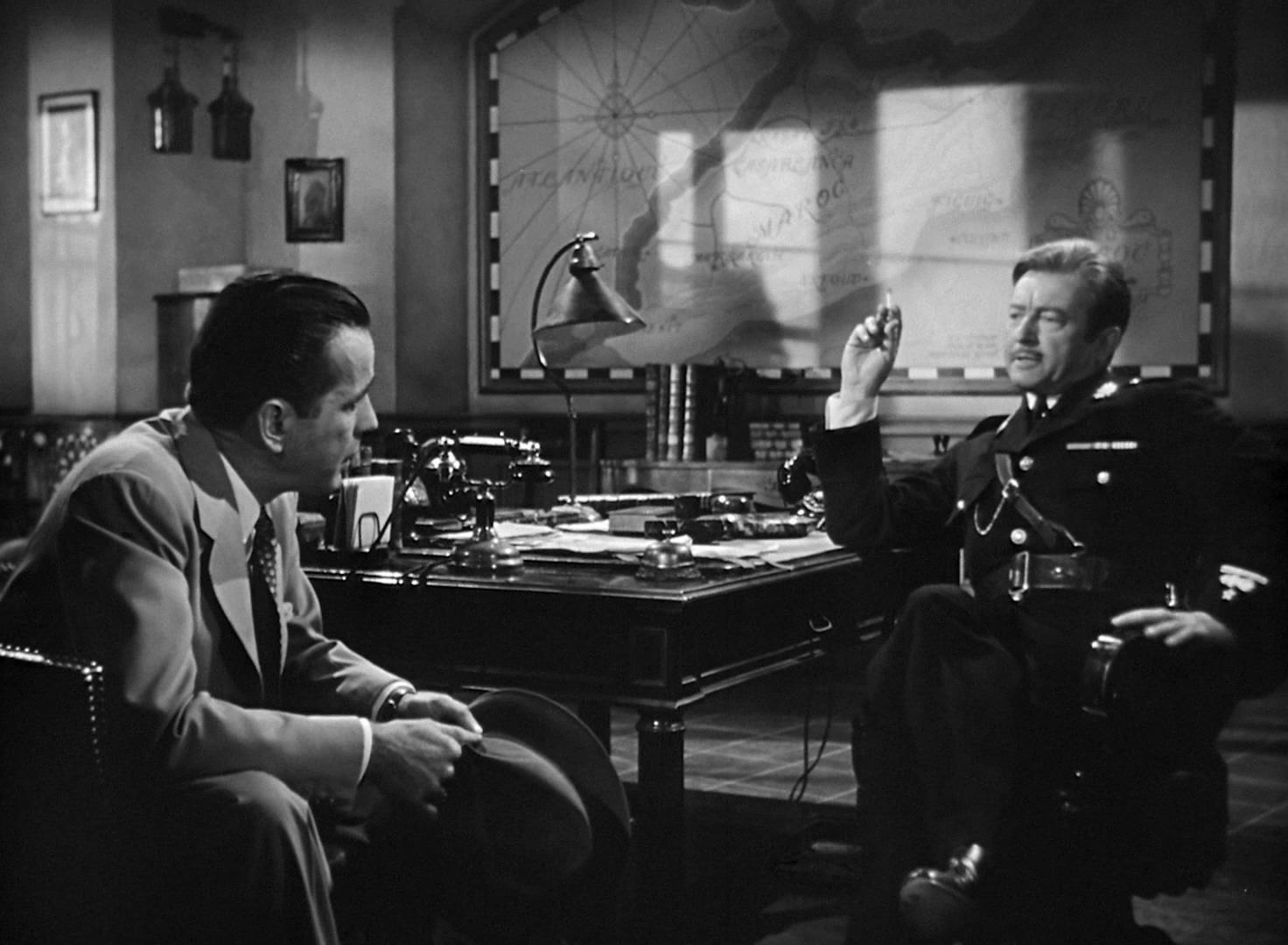
This fight, though. The one against fascism. What’s stunning about the ending is Rick moving out of Casablanca and heading with Renault to the Free French garrison at Brazzaville. Rick is no stranger to joining fights, but in Casablanca he’s trying to live under the fascism of a German occupation, keeping his head down, staying in the lines, not upsetting any apple carts.
But Ilsa makes that impossible. And Rick’s (right) acceptance of Ilsa back into his life is what directly results in the Germans shutting down his nightclub, merely for a displaced diaspora singing with national pride in the face of an aggressive invading force that wants to dominate the world.
It’s hard to jump into these fights. And after losing in Spain, after losing Paris (and metaphorically Ilsa), it makes it hard for Rick to want to stick his neck out to continue the work of his revolutionary past. The most he can do is surreptitious small actions like funneling money to sympathetic parties and small nods to allow the playing of “La Marseillaise”, but it’s Laszlo who actually leads in the singing of the French anthem. The shutdown of Rick’s is the splash damage of scared fascist overlords flexing their muscles to feel strong in the face of unshakable dissent.
But Rick’s sort of appeasement and small actions are the ones that led Europe to its World War II disaster in the first place. Bold actions, brash behavior, these are the actions that those who fight fascism must take. The fascists will act boldly. Its opponents must respond in kind.
Saying goodbye
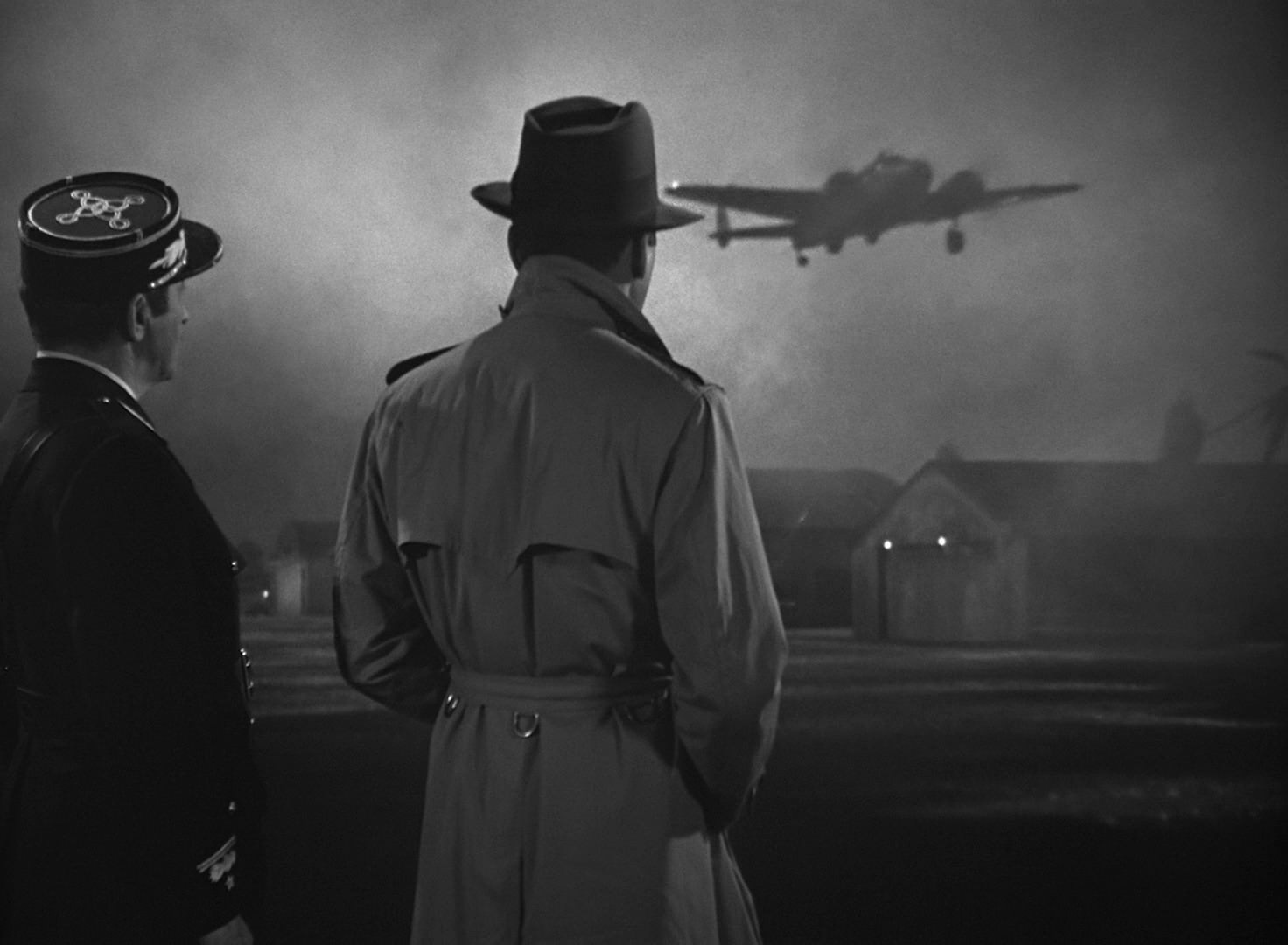
The end of Casablanca is bittersweet. Rick saying goodbye to his love forever so that they all might work together (but separately) to save the world. But the power in Rick’s sacrifice is in Ilsa’s as well. Even though he’s a supporting role in the film, Laszlo leaves an indelible mark. Despite the deep feelings she has for Rick, Ilsa supports her husband. It feels overly patriarchal (and it perhaps is), but dedicating her life to keeping him going is the sort of sacrifice that happens in times of great strife and war. The Allies need him. He needs her.
There’s no guarantee that anything will last after the fall of the Nazis. It probably won’t. But if its persistence will help make the seemingly impossible happen, isn’t it worth continuing?
Rick and Ilsa take what they can from that pre-war moment, that breath when the world is ending but they treasure the time they have. It is the bright sunshine just before the stormclouds roll in for a long sustained rain storm. It’s the sort of wonderful explosion of romance that they won’t be able to touch for the rest of their lives. It’s the sort that, just 18 months later, will have Rick opining about all the gin joints in all the towns in all the world. Existence has changed so much so quickly, but when Ilsa walks in it feels like years and years of anguish finally breaking through the hardened exterior. That threat of depression basically flattens Rick until she confesses her love and the truth to him.
The power comes not in the time they spent together but in the quality of it.
And this is why Casablanca has all this staying power decades later. It’s why it’s always in top lists and continues to thrill audiences. It goes for the gut punch by tapping into all the loves its audiences have ever lost. It never apologizes for the naked emotion of its story. Playing with that potency, it wraps the backdrop of the most significant time period of the 20th Century around the pathos of that core and tells a story that’s just as relevant today as it was then.
It uses lighting to convey mood. Actors to sell the emotions. Flashbacks to economically convey the whirlwind of a relationship. There’s not a better candidate to convey the power of cinema and all that it can do.
There will always be love like there will always be spectral memories of the past losses haunting the reality of present happenings.
There will always be bullies and there will always be those who fight against them.
There will always be beautiful friendships.
And there will always be Paris.