
Feel It - Tenet
Christopher Nolan's time travel action thriller is what if Inception but better

It's the biggest miscalculation of Christopher Nolan's career.
No, not Tenet. Tenet was never a bad idea. In fact, it was an incredibly good idea (keep reading), but it's the one time Nolan didn't grasp the scope of the problem at hand and let his own legend blind him to reality. But it's not like anyone else could have succeeded in what he was attempting...
Go back to mid-2020. The world had shut down. COVID-19 was barely treatable without any sort of vaccine. Wearing masks and social distancing was the default mode of living day to day. Theaters had closed. Movies weren't playing outside of the odd pop-up drive-in. With the explosion of streaming, studios were punting 2020's unreleased films to their native platforms, bypassing the theatrical experience completely. It made sense for children's films. Meanwhile, major upcoming tentpoles (like the James Bond movie No Time To Die and The Fast & the Furious's latest outing F9: The Fast Saga) kicked their early 2020 release dates to 2021 in the hopes that things would improve by then.
Chris Nolan, though. Ego got the better of him.
When lockdowns started in earnest in March of 2020, July was months away. Early talk hoped that quarantines would last a few weeks and things would be back to normal by mid-April at the latest. But as time went on it became clear that this was going to be far more long term. Nolan pushed Warner Bros. to treat his newest film Tenet as the big tentpole that would get audiences back to theaters. It's not an unreasonable thought. Nolan's movies had been tremendously successful to that point, and dating back to The Dark Knight every single one had been the sort of event that would drag audiences out of their homes and into the theaters every couple of years or so. Outside of major IP plays (sequels, prequels, remakes, or reboots), no one else was doing it on this scale.
Unfortunately, "global pandemic" defined the turnout more than the promise of "new Nolan". Tenet barely cleared $50m at the domestic box office, and its worldwide take made it the lowest grossing Nolan since The Prestige.
I don't pretend to be like everyone, but I was beyond stoked for Tenet and still I didn't make the trip out to the theater to see it. I didn't even entertain it as a possibility. Hell, I didn't see anything in a theater between February 2020 and February 2021. Even the draw of Christopher Nolan doing a big sexy action movie couldn't get me back. When I finally did see Tenet it was (according to my records) April 10, 2023, just a few months before Oppenheimer. Part of that was holding out for theaters, but I settled for subtitles and plugging headphones into my Roku remote. It mostly worked.
Between social distancing theaters, Nolan's usual sound mix obscuring the dialogue, and a loud grousing from those who thought little of it because of less-than-ideal circumstances (and not having people gush about/work through it after), Tenet became the major misfire of Nolan's canon. The Dark Knight Rises was not really anyone's fault. Tenet was entirely on the beloved filmmaker. And it maintains that reputation today.
Haters be hatin'. Tenet rocks.
As with so many other of his movies, Tenet is a misunderstood work of excellence. People look and they only see a perplexing time travel movie that doesn't make sense. Nevermind that Nolan himself admits he doesn't fully understand everything about it. Nevermind that early on the character explaining inverted entropy says "Don't try to understand it. Feel it." If those aren't marching orders...
Tenet is a $200m love letter both time travel and James Bond movies that demands an almost complete surrender to maximize enjoyment. There are plenty of individuals who will cross their arms and complain about it for any number of reasons.
But people did the same for Interstellar, and that one had a more clear/openly emotional story.
Tenet's is lurking a bit deeper because its is much darker. Reach down. Dust it off. And appreciate it for the wonderful gem that it is.
00-Protagonist
In 2010, screenwriter Steven Moffat gave excited interviews of how crazy awesome it was to be working on two of the three biggest UK cultural exports of the modern era. He was the newly appointed showrunner of Doctor Who and had just launched a new, modern adaptation of Sherlock. At the time, both were wildly successful, and Moffat found himself at the height of British genre television.
All that was missing, he said, was James Bond.
He wasn't the first to express that he wanted to make some great 007 adventure. The suave and debonair super spy has long since captured the fantasies of teenage boys who love big action and beautiful women via a man who regularly indulges in both. That's especially true for those who grew up in the UK. With 25 films since 1962, James Bond has welcomed a parade of creators to work on its movies (including author Roald Dahl, writer Tom Mankiewicz, director Sam Mendes, and others), and there's no reason to think that other great artists can't add to the canon.
The most high profile individual who's expressed interest in working on a Bond movie is Steven Spielberg, who lobbied for the directing gig in the wake of his success with Jaws. The Broccolis (those who controlled Bond's film rights) refused him multiple times. In the wake of 1941's crashing and burning/another round of Broccoli-sourced rejection, George Lucas brought Spielberg an idea that felt like a James Bond movie, but also drew on other inspirations. A ruggedly handsome individual trotting the globe and getting into adventures against evil organizations? Only it's a period piece and features the supernatural? Hell yes.
Funny thing is, Raiders of the Lost Ark is a better movie than literally any other James Bond film in existence. Even if Spielberg still wanted to go make the best fucking Bond movie of all time, it's doubtful it would top Raiders. Or Last Crusade. Maybe some could beat Temple of Doom, but for all that movie's issues, its shortcomings are certainly more interesting than any Bond film.
The same is true for Nolan. Given that everything after The Dark Knight Rises is all original material (rather than work-for-hire studio work), it's perplexing why he'd want to go back to less creative control and more restrictions on the final product. Apparently, when Denis Villeneuve signed up to launch Amazon Prime's upcoming Bond continuation as the first director of the new era, it took a truck load of money to get him to cede final cut. Hopefully it doesn't backfire.
It's crazy to think that Nolan might still want to do James Bond. Tenet exists as a globetrotting, high-octane action thriller, mapping onto the Bond ethos to the point where he's not even hiding how much he's ripping off Britain's most famous secret agent. There's Sator the supervillain (Kenneth Branagh) with a henchman the hero must fight/defeat in the final act (Yuri Kolokolnikov) and the crusty old British intelligence guy giving out an assignment (Michael Caine, also playing a character whose name starts with "M"). There's the Bond Girl embedded within the evil organization (Elizabeth Debicki) and the military commander guy who's also working with the hero (Aaron Taylor-Johnson). And it wouldn't be complete sexy Bond girl companion who sidekicks through the movie (Robert Pattinson).
But free of the confines of an established brand, Nolan can go so much farther.
And also add in some absolutely mind-altering time travel.
"The name's '-tagonist', 'Pro-tagonist'"
The joy of James Bond comes in the fantasy of the character. He drinks. He gambles. He flirts. He quips. He bangs. He fights. He wears dapper suits. He foils supervillain plots that can be as gratuitous/nonsensical as "global annihilation". He drives cool cars and gets involved in spectacular stunt sequences.
If the recurring feature of this series is about Nolan's deep emotionality despite people thinking he's anti-emotion or cold, Tenet is the film that most shows just how unrealistic (or immature) a James Bond movie usually is. Bond doesn't really grow in his movies and there's rarely an emotional arc as such. It's the perfect teenage boy fantasy.
(Funny how Bond is somehow more unrealistic. As though inverted entropy is some grounded idea that makes a lick of sense.)
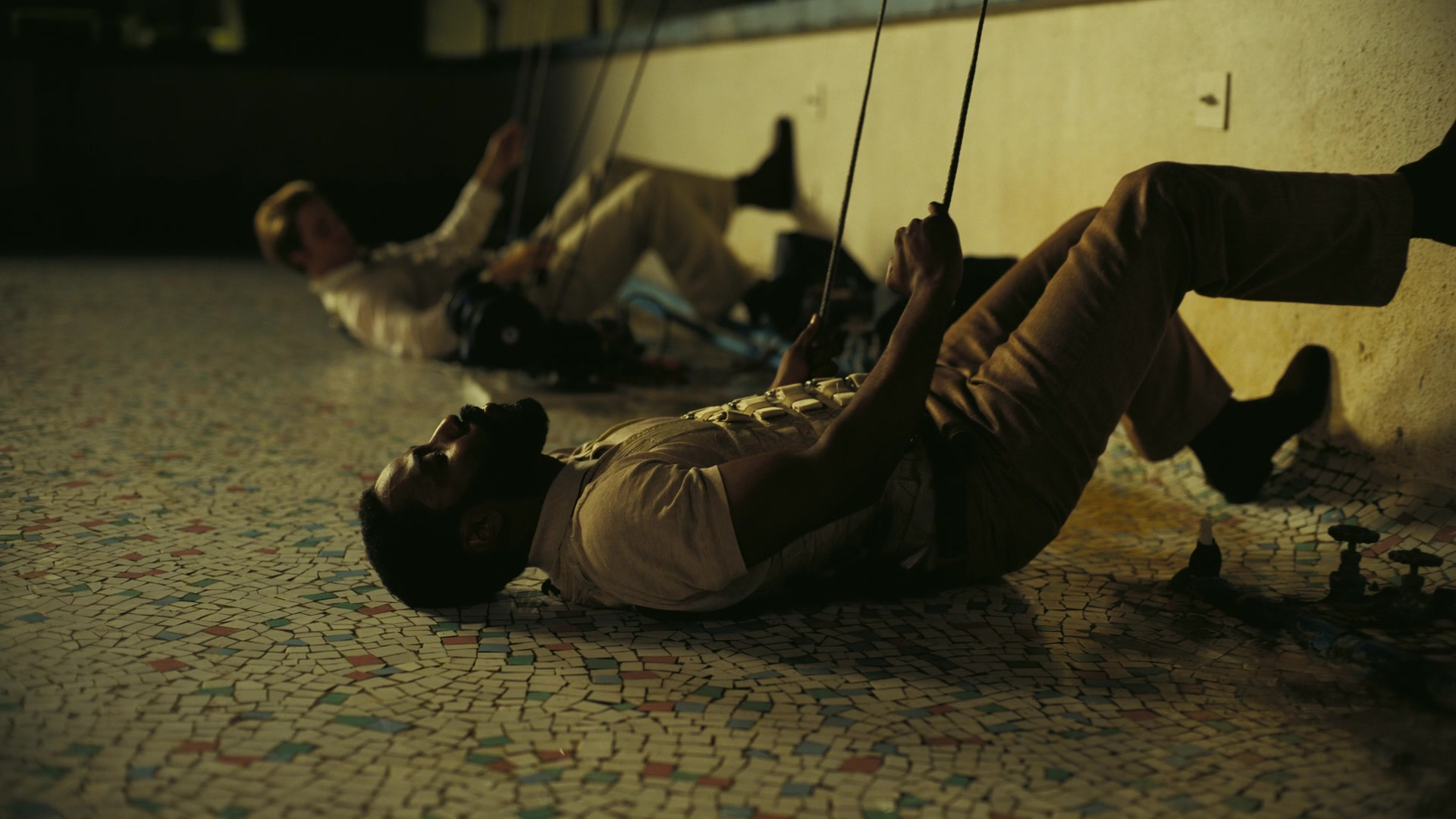
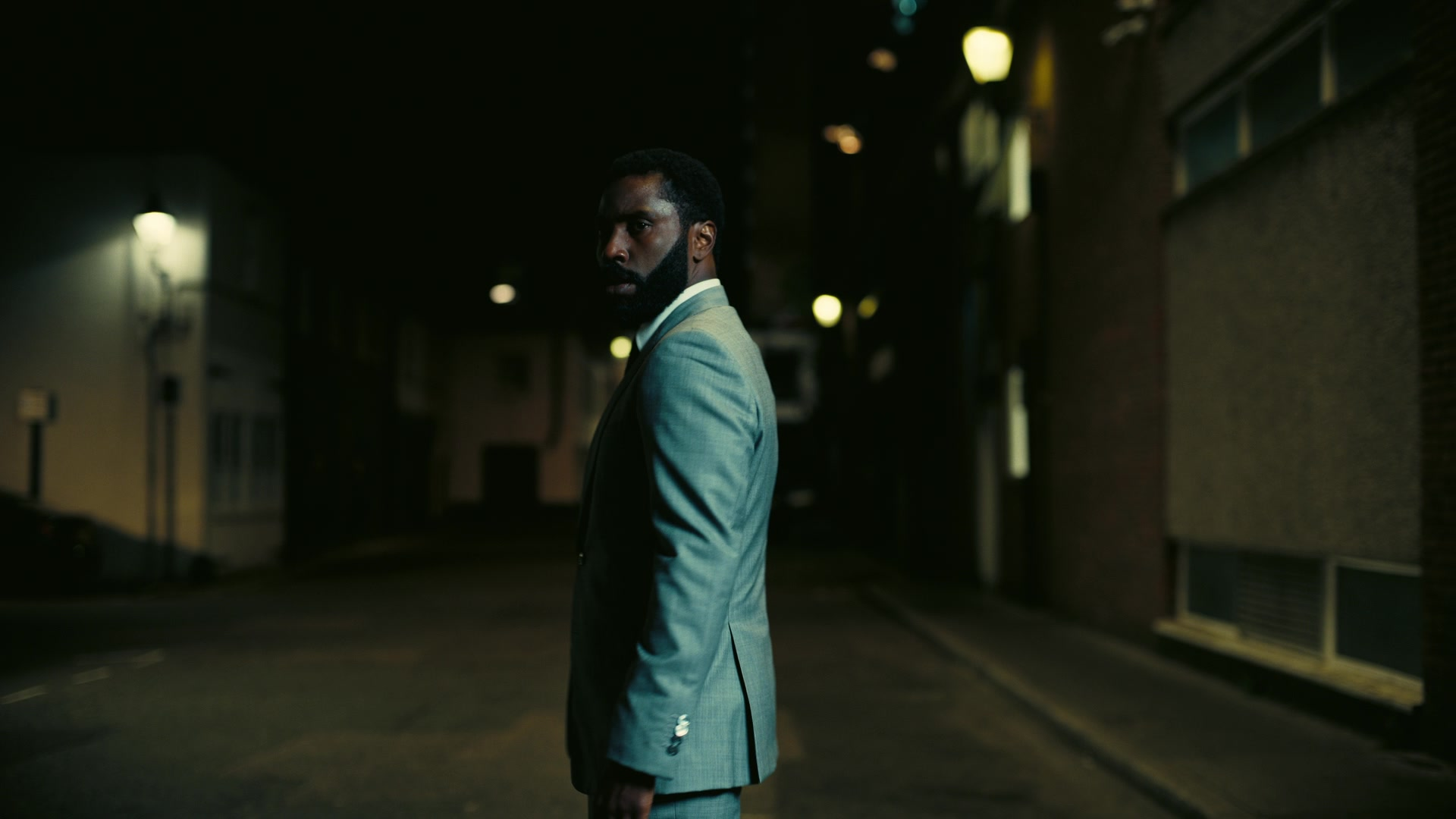
Tenet goes deeper. Sure, like James Bond the Protagonist doesn't really have an arc. He is slowly accepting the role of his moniker, growing from a nobody in tactical gear into head of the entire Tenet operation. Him saying goodbye to Neil after the big explosive climax is powerful not just because of the friendship between the two men ending/beginning, but because it's the Protagonist accepting the mantle/cost of this life he will build for himself. As for actual real, emotional change? Not so much.
This is more feature than bug. There's a read on Protagonistic theory where Bond is actually the antagonist of his movies. 007 is never the one who is changing but is instead the one who instigates change. He's the obstacle for the active protagonist (the villain) to overcome. This is why Tenet is the only Nolan film (outside of the Dark Knight trilogy) that lends itself to further sequels. It's not impossible to see Nolan returning for another Tenet that's a rad as shit adventure with different locations and even bigger set pieces.
Meanwhile, under the hood lurks a more insidious aspect of the fantasy brought to life.
Injecting fantasy with bleak realism
Much of Inception's thematic core is an exorcism of Nolan's fears of losing his wife, and how releasing that tension freed him to tell all the stories he's done since. Dunkirk is a film without female characters like at all, but The Dark Knight Rises featured Cobb's wife as a woman hell bent on revenge against the main character. The only wife in Interstellar is Tom's wife, and it's clear that he mistreats her as part of an iron fist rule over his fiefdom of the farm in Cooper's absence.
Tenet, though, is much, much darker.
As is so often the case, Nolan's film is more emotional than it appears. True, treating Tenet like a puzzle box is doable. There's infographics online explaining how the various time travel sequences work and mapping the journey for each character at any given moment. There's even explanations for how Neil manages to get the door open and tracking how the film looks from a purely objective (linear) perspective. (We could go on for a while...) And I'll admit that I'm one to read/enjoy/indulge in pulling apart Nolan's almost pornographic deployment of time travel...
But because it takes so long for her to show up, it can feel weird to see this twisting time travel narrative circle back to Kat Barton (Elizabeth Debicki) so heavily. She gets an introduction similar to Michael Caine's character (they share a conversation at a restaurant), only once she shows up the film can't ever really escape her. As much as the Protagonist is trying to stop her husband Andrei Sator (Kenneth Branagh) from indulging in a reality(?)-wide annihilation, there is just as much emphasis on his trying to free Kat from under his oppressive thumb.
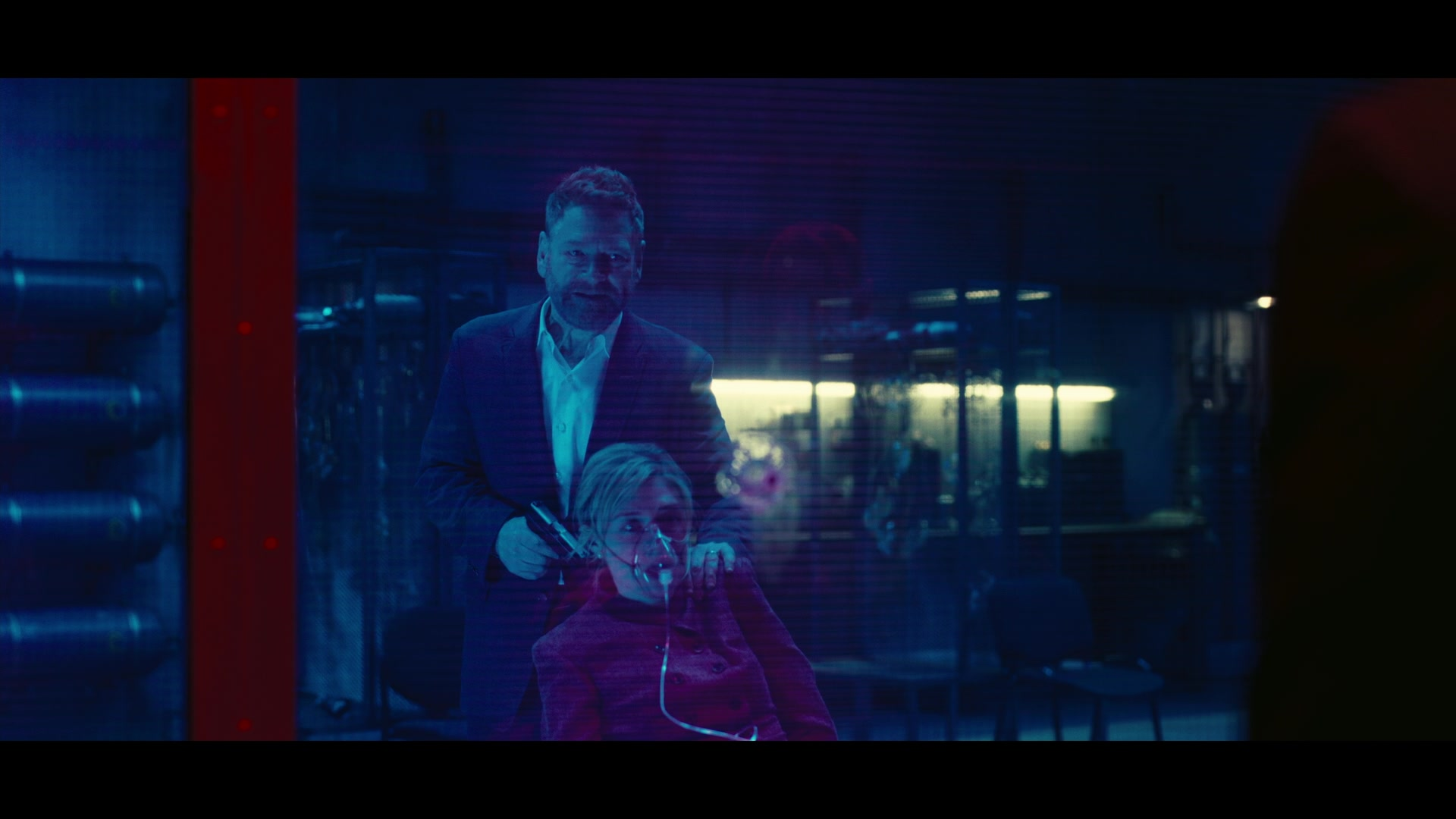
Sator himself is utterly, gobsmackingly monstrous. His first meeting with the Protagonist can be a lot of big talk and threats of slicing open the man's throat and shoving his castrated testicles in the slit. His threatening to beat Kat with the belt is certainly ominous. But Nolan takes Harvey Dent putting a gun to Commissioner Gordon's son's head and ups it with a harrowing scene in which Sator brutally beats his wife in a moment of horrific domestic violence. The man screams and kicks and goes absolutely feral before finally spitting on the mother of his child. And then just a few minutes later he shoots her in the stomach.
Branagh understands the assignment. After a very reserved performance with a stiff upper lip in Dunkirk, Nolan lets the Shakespearean legend carve off slabs of ham with every line of dialogue. He literally cannot go too big because the character himself is one of the most self-righteously extra villains in a genre that includes Auric Goldfinger, Raoul Silva, and Dr. Evil.
This all-too-real violence in a PG-13 movie slams the brakes. Imagine if a James Bond movie (a series with no shortage of women in violent situations) did something like this. The closest is Silva shooting Sévérine in Skyfall, yet even then the beat features a shot glass perched on the top of her head, pulling the moment away from verisimilitude and undercutting it via the conventions of the genre.
The entire point of the movie is not just to stop the detonation of the Algorithm. It's to get Kat (and her son) away from this vile oligarch. And it's not like Nolan makes her helpless. She is perfectly aware of the awfulness of her situation and just how much Sator has trapped her in this marital prison. On first viewing, the sailing boat race can feel like a totally superfluous exercise, the sort of big bombastic rich-people set piece that would be in literally any James Bond movie. Maybe it's just an opportunity for Bond to cozy up to the bad guy for the purpose of further infiltration. Nolan, though, uses it as an opportunity for Kat to attempt to murder Sator, seizing the narrative to free her from this hell she exists in. The Protagonist saves her husband's life, warning Kat later that there's bigger issues at play and that he needs Sator alive if he's going to figure out what this big bad plot is. This doesn't minimize Kat's situation, putting reality's safety above her own. It equivocates it. Of course he's going to help her as part of his mission to foil Sator's plans. As a hero, how could he not?
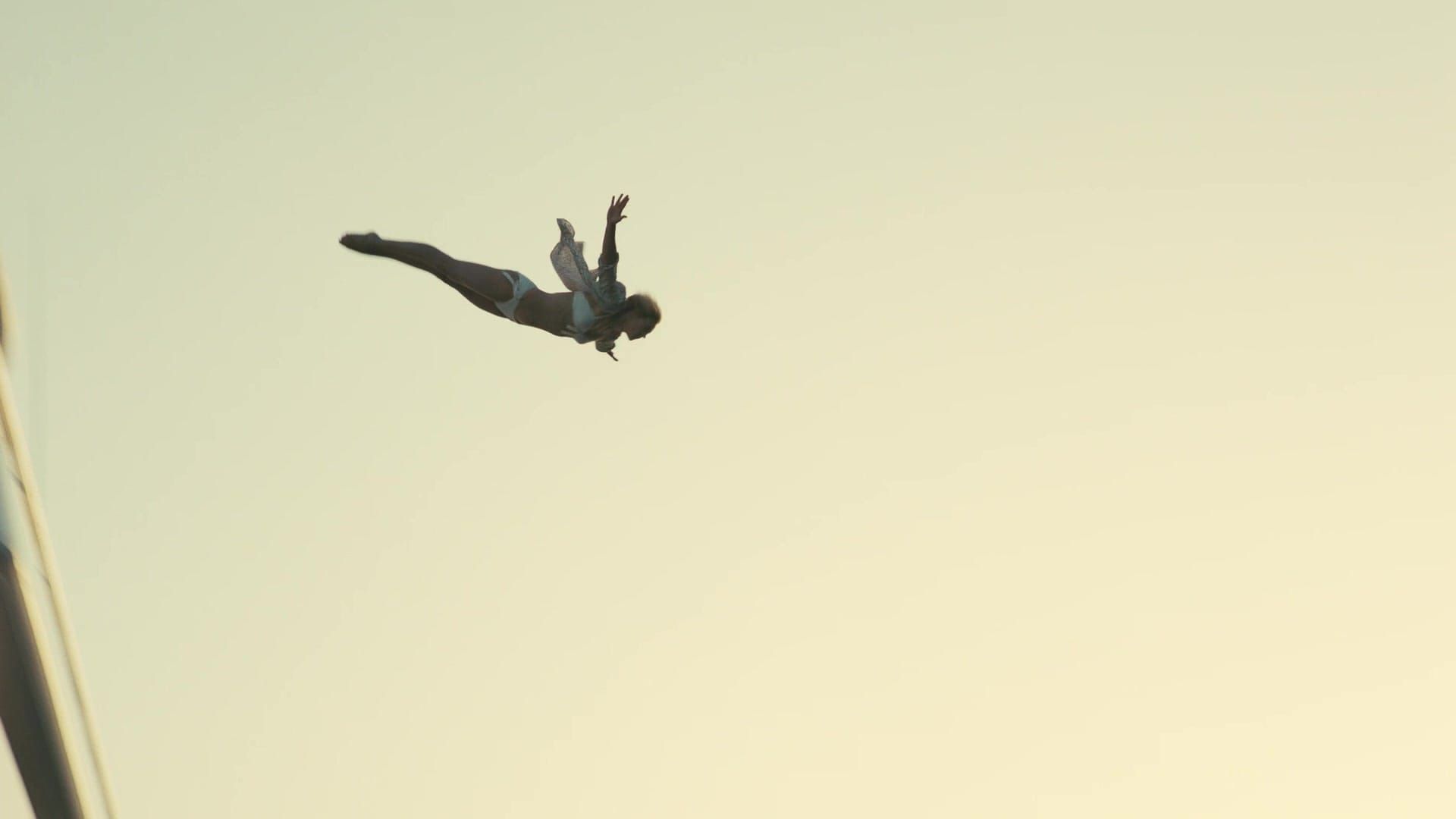
When Kat finally kills Sator in the third act, the moment of his execution is quick and almost easy. There's no glorifying it, but Sator's death is not enough to save Kat (and actually complicates Tenet's efforts to save the world). Nolan, however, makes sure to give Kat her glorious moment of salvation and rebirth. It's somewhat obvious that when Kat talks about seeing some mystery woman dive off the yacht that she is seeing herself, but Debicki plays it beautifully. Suddenly free of Sator's wrath, she looks back at her younger incarnation with a look of grace and forgiveness and pride. In performing that elegant dive she is not just free. She is setting into motion the long journey to her own eventual salvation, relishing the moment she is, in fact, the one who gets to do what she in that moment most dreams of doing.
It's one of the most beautiful moments in a filmography that contains Interstellar's Tesseract and Tommy's Dunkirk baptism as a boat drags him away from a sea literally on fire. Nolan has always been sentimental, but as he gets older and his filmography progresses, this is only growing more prevalent.
You love to see it.

A singular experience
This far removed from The Dark Knight Rises it's not exactly clear what Nolan would get out of making a James Bond movie. I guess he would add his name to some plaque somewhere, joining the ranks of such visionary/luminary household names like Guy Hamilton, Lewis Gilbert, John Glen, Martin Campbell, and Marc Forster. Hell, the most significant name to ever direct a James Bond movie is Sam Mendes, and while I do quite like a number of Mendes's films and think he can be a fabulous director, none of these people really screams "one of the best to ever do it."
Because the thing is... Nolan could go do a Bond movie. And it would probably be great. Right up there with Goldfinger and On Her Majesty's Secret Service and The Spy Who Loved Me and Goldeneye and Casino Royale and Skyfall. But would any Nolan Bond film be better than Tenet? More coherent, sure. But why water down something this batshit awesome? Nolan doesn't need to do Bond for the studio to pony up the cash for him to literally crash a real 747 into an airplane hangar. What else would he need it for?
Not only that, but I can't imagine any Bond movie pushing this deep into emotional reality. Nolan's films go for verisimilitude and tactile experiences, grounding the truly fantastical with rock solid emotional foundations. But Bond is not a character who can get there. The Daniel Craig pentalogy pushed Bond to a particular emotional and thematic limit and most grew weary of it by the end. At a certain point the character/series breaks and it's not James Bond anymore. They're too... fun without the capacity to be more than that.
The defining feature of Christopher Nolan's films is his signature on the film. He sells his movies on his brand and filters a particular story through a worldview that can connect with massive audiences worldwide. It's a concoction born of scope tethered to an emotional foundation. This combination of writing and directing makes for singular experiences that no one else can replicate.
Any action director worth their salt could make a James Bond movie.
Only Christopher Nolan could make Tenet.
Even as a part of this growing filmography it is singular and unique while any 007 movie will be just one of twenty-five (and growing). So maybe a major contemporary artist like Billie Eilish or Adele won't write a song that with lyrics featuring the film's pithy title while opening credits roll. (Not that Nolan uses opening credits.) It's not like Travis Scott didn't do Tenet's end credits song (and played the same trick back for The Odyssey).
It's unfortunate that Tenet was the last great cinematic casualty of the pandemic. Regardless of that, it will always be a gem for people discover and revisit for decades to come.
As for Nolan, this is his own answer to Inception: a high concept genre movie with complex ideas and lots of exposition, but with a much, much stronger emotional core and catharsis. Tenet is just a better movie, and the decade between the two have evolved Nolan into a much more competent and fabulous filmmaker. It's almost like while Inception was a exorcism of Christopher Nolan's themes, this is an exorcism of him making this sort of modern, real-world action thriller.
Which must mean it's time for him to produce another masterpiece...