Nothing Quite Like It... - The Dark Knight

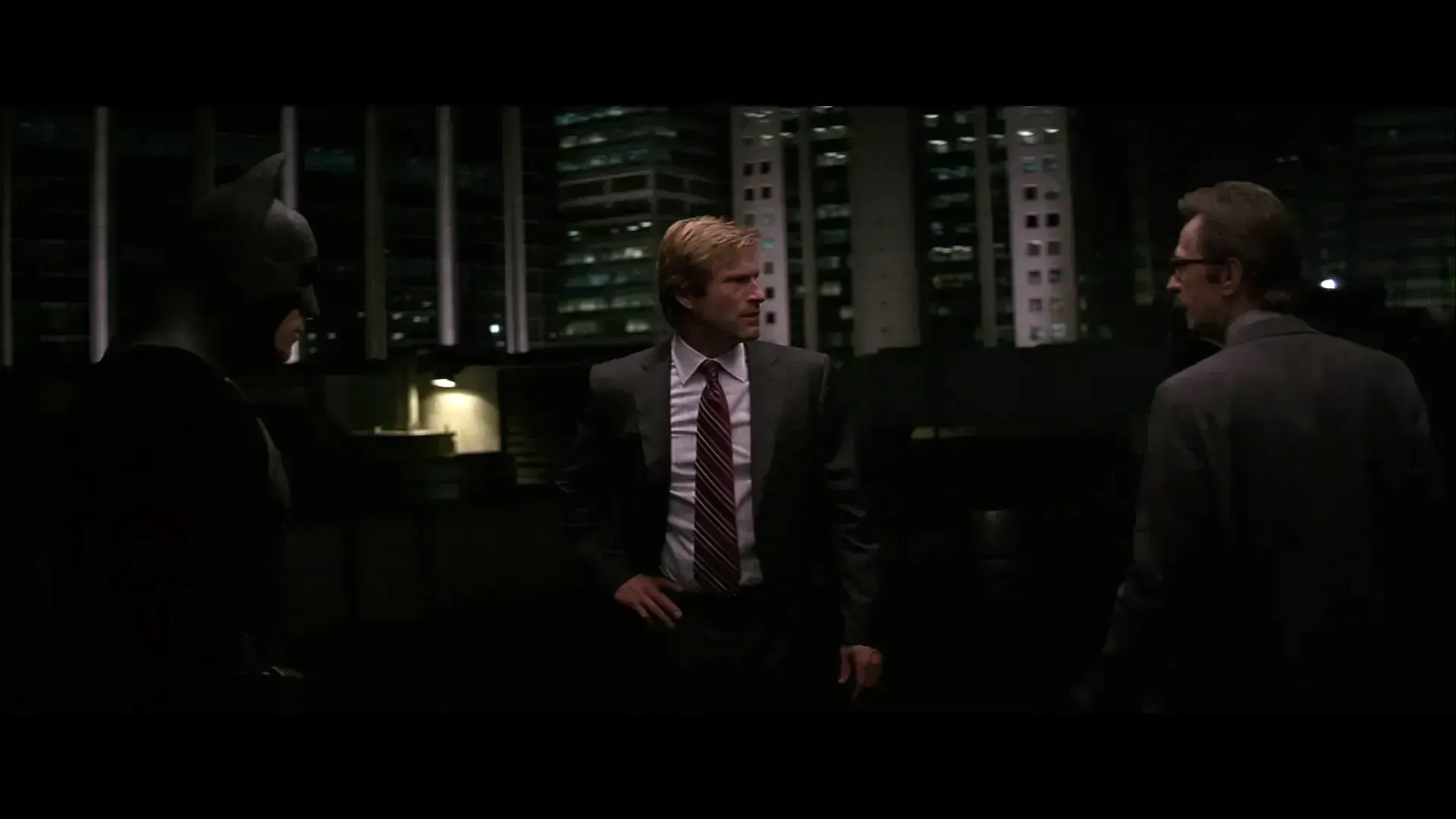
Right before my most recent rewatching The Dark Knight, I put on the opening sequence of Heat for a point of comparison.
Nolan has been very open about the influence Michael Mann's 90s crime epic masterpiece had in constructing his Batman Begins sequel, but watching it againreally is striking. An opening heist executed by expert criminals. The use of masks as a way of keeping identities obscured to the public but distinct enough that the audience can keep everyone straight. Nolan even cast William Fichtner as the bank manager who will not let the Joker's larceny go unanswered, an echo of the role Mann cast him in a decade earlier.
In the wake of the The Dark Knight's release, it drew a lot of Heat comparisons, with critics remarking that this superhero was way closer to the cat-and-mouse, cops-vs-robbers thriller than it was to any other film in the genre to date. It's what pushed me into watching the film in the first place. There's no way I'm the only one.
But watching Heat didn't exactly give the same visceral thrills that The Dark Knight relentlessly accomplishes. The film is an undeniable triumph. It changed the cultural perceptions of the superhero genre and proved so popular it reshaped the Oscars to ensure that a film this flat out good would pierce through the pretensions of Academy voters and their love of weepy dramas.
More than that, though, it is a singular work. Saying there's nothing like The Dark Knight reflects the way that nothing else will ever quite scratch an itch this specific. It's the nature of esoteric art. Heat scratches its own. Great for anyone who needs a crime epic, but it features different themes with different characters and different dynamics. "If you like that, then you'll also like this" stories can come close but never capture that full feeling of the first-loved thing.
It's not that The Dark Knight is a crime epic. Or that it's a superhero movie. Or an instant action classic. Or a Batman sequel. Or a globetrotting adventure. Or an discussion of anarchy and chaos. Or the vehicle for a supporting performance that's one of the greatest ever captured on film. Or that it flips a semi-truck end over end. Or that it shows the inevitable endpoint of Nolan's "the worst thing that can happen to a man is to lose the love of his life and the only rational response is a descent into madness" themes. Or that it is such a massive blockbuster that it guaranteed a follow-up blank check that would end up guaranteeing the rest of his career.
It's that The Dark Knight is all of these things simultaneously.
And there's really nothing like it.
Alchemy
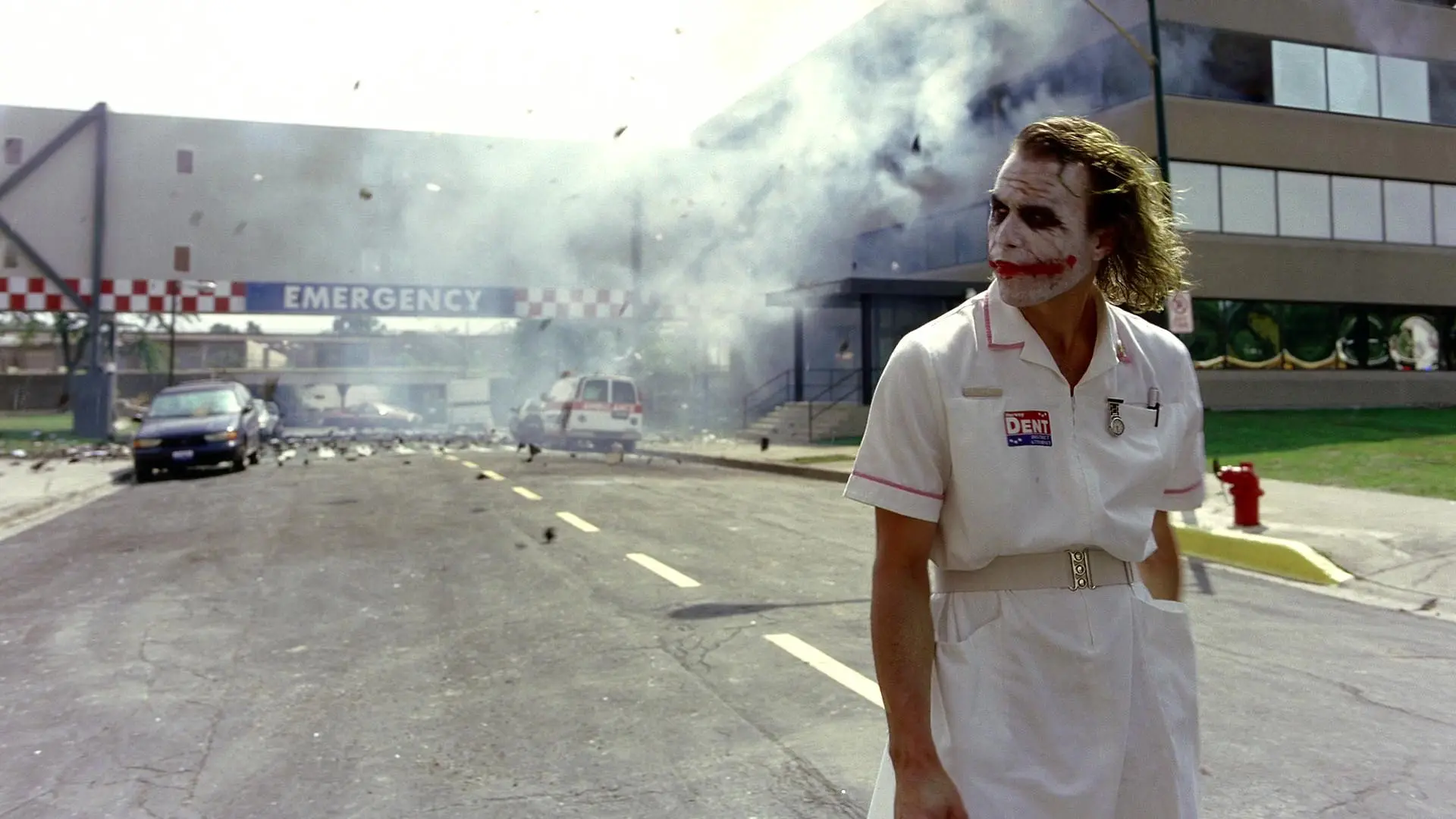
It's difficult to know what to talk about with The Dark Knight. At almost twenty years old, it's the sort of film that fans and critics have picked apart for decades. The breakout conversation is Heath Ledger's performance, obviously, but that discussion extends to Maggie Gyllenhaal's Rachel as an archetype of women in Nolan's stories, the nature of Batman himself, and how Nolan made this insane movie.
Honestly, the reason why it is so singular is because Nolan is a director of singular vision. He wrote a killer script with his brother Jonathan and based it off a dynamite story he developed with his Batman Begins co-writer David S. Goyer. He cast it insanely well, but it also feels like it comes from the same dude who made The Prestige. Stylistically, it moves the same way. This didn't come up in my discussion of The Prestige, but there are shots and cuts in that movie that feel unlike anything anyone else would think to do. That same thing happens almost constantly in The Dark Knight, where Nolan will do hard cuts from high intensity scenes to establishing shots (like The Joker's snuff home video) as a way of siphoning off a little bit of the tension, while ensuring the new image has its own dynamic movement to keep the pace up.
No one else could have made this movie. It's a perfect example of an artist using their influences and blending them into something that feels wholly unlike anything else that exists. Alchemy in art form. This film famously didn't put out deleted scenes on the home video releases because they used every piece of the script and didn't shoot anything Nolan didn't end up putting in the film. That's insane.
This is what happens when extremely talented artists get a shit ton of money and it goes towards a project they completely understand. The Dark Knight could have blown up in Warner Bros. face, sure. But Batman Begins was a proof of concept that Nolan could work on this scale with some success.
That, though, is not a guarantee. Look no farther than The Dark Knight Rises as the dark mirror of giving an insanely talented artist like Nolan a metric fuckton of money while he imperfectly knows not he wants to do with it. Visionary directors screw up big swings like this all the time.
If anything, the company that took the biggest lesson from this was Marvel Studios. Since its creation, their films have followed the same general feel and momentum regardless of director. Most of that comes down to Kevin Feige and his team ensuring a tonal consistency across all of these films. It created consistent hits by virtue of replicating a remixed version of what had previously succeeded. And it helps to recognize that the audience was willing to go back and feel the same sort of feelings over and over and over again.
At their most successful, though, Marvel Studios found an amalgamation of the Feige in-house style with visionary directors who knew what they wanted to do. Iron Man 3 is a Shane Black movie and everyone more or less agrees that only James Gunn could have made Guardians of the Galaxy. Even a film like Thor: The Dark World has a dark fantasy edge to it that plays to the strengths of the guy who was the breakout director of Game of Thrones's first two seasons. And while the Russo Brothers don't exactly stamp Captain America: The Winter Soldier as a film with recurring themes or interests, their ability to filter a 70s spy thriller through the MCU lens is what makes that movie so wildly successful.
They've strayed from that, though. And Marvel's retreats from their attempts to evolve and grow have resulted in a stagnation that has greatly diminished their cultural dominance. Over time, that delicate equilibrium between director and producer tilted towards the latter. The production team has assumed much more creative control, leaving their directors less as artists and more as traffic cops to keep the mega-budget movies operating according to their rigid schedules.
No one thinks Hollywood learns any of these big lessons about the value of great artistic vision, and certainly not with rich vampires at the top who know nothing about art except how to bleed it dry in the name of their endless greed. Artists getting the sort of freedom Nolan seems to have had here is exceptionally rare. The most high profile "this guy gets to do whatever" I can think of is The Last Jedi and that was a similar undeniable success just like this was.
Unfortunately, that's the nature of the business. And in the two decades since The Dark Knight Hollywood studio execs have not so much tightened their belts as assumed control of major levers of the production process in the name of protecting their investment. Micromanaging casting decisions, ordering reshoots, editing alternate cuts... Imagine if there had been serious meddling with this movie. Imagine if the studio had vetoed the casting of Heath Ledger or Aaron Eckhart because they wanted some pound of flesh or to further their favorite actor in the name of trying to juice the box office. Or imagine if they had said "hey it's cheaper if we flip a CGI truck so let's just go make that image in a computer..." At best it dilutes the potency of of the final product. At worst, it's poison injected directly into the bloodstream.
But enough about The Dark Knight as some magic piece of alchemy. We should at least talk about this penultimate example of Nolan's pet theme.
Introduce a little anarchy...
To track the thematic road Nolan's been traveling, his core theme (that the worst thing that could happen to a man is to lose the love of his life and the only rational response is a descent into mania) starts unassumingly enough with Memento. Leonard is mostly unwitting in the misdeeds he's doing in the name of revenge on the man who killed his wife. That naiveté helps to make the amnesiac protagonist consistently likable and interesting. Almost childlike and innocent in his wonder. Batman Begins was a more oblique take on loss, but venerates Batman as a hero even if there is some skepticism about Bruce's own sanity. The Prestige pushed this idea further, where the death of his wife pushes Angiers to ultimately die by suicide every night in the name of revenge against his archrival.
The Dark Knight, though is the extreme of this particular road. The theme-applied loss here is Rachel, of course. And while the movie takes a lot of time to emphasize how much her death devastates Bruce, that's nothing compared to what Harvey Dent does in the wake of her murder at the hands of The Joker.
When they announced the castings for The Dark Knight, Ledger's casting as The Joker was nowhere near as interesting to me as Aaron Eckhart's Harvey Dent. Eckhart was an actor who'd been working for a decade and a half before he landed the major role of Harvey Dent. He has leading man looks. Strong chin with that pronounced dimple. Piercing eyes. That smarmy smile. My looking forward to him came entirely from my enjoyment of the Jason Reitman film Thank You For Smoking, in which Eckhart played a fast-talking lobbyist extoling the virtues of Big Tobacco.
What makes Eckhart such a deadlock for Harvey Dent is not his natural charisma, but rather the danger in the arrogance he exudes. There's all sorts of hints that Dent is a loose cannon, from his punching Maroni's man on the witness stand to the scene that made David Dastmalchian a fucking star. It makes the final scene more believable, when he holds Commissioner Gordon's family at gun point, threatening to shoot Gordon's son in the head for no reason other than it's what chance dictates.
Tellingly, it's easy to lose track of Dent in the last act of the film. Once he leaves the hospital, Nolan cuts to him sparingly as he goes on a killing spree through the city. A quick beat here and there. He even pulls the camera away for the most intense moments. Sure it makes for a spectacular car crash, but it's almost like the director can't bear to witness the depths of Dent's murderous depravity. The same goes for his brief holding Ramirez at gunpoint. We never see their initial interaction, nor how he leaves her. He is simply a menace loose in a city that is rapidly descending into a madness that mirrors his own.
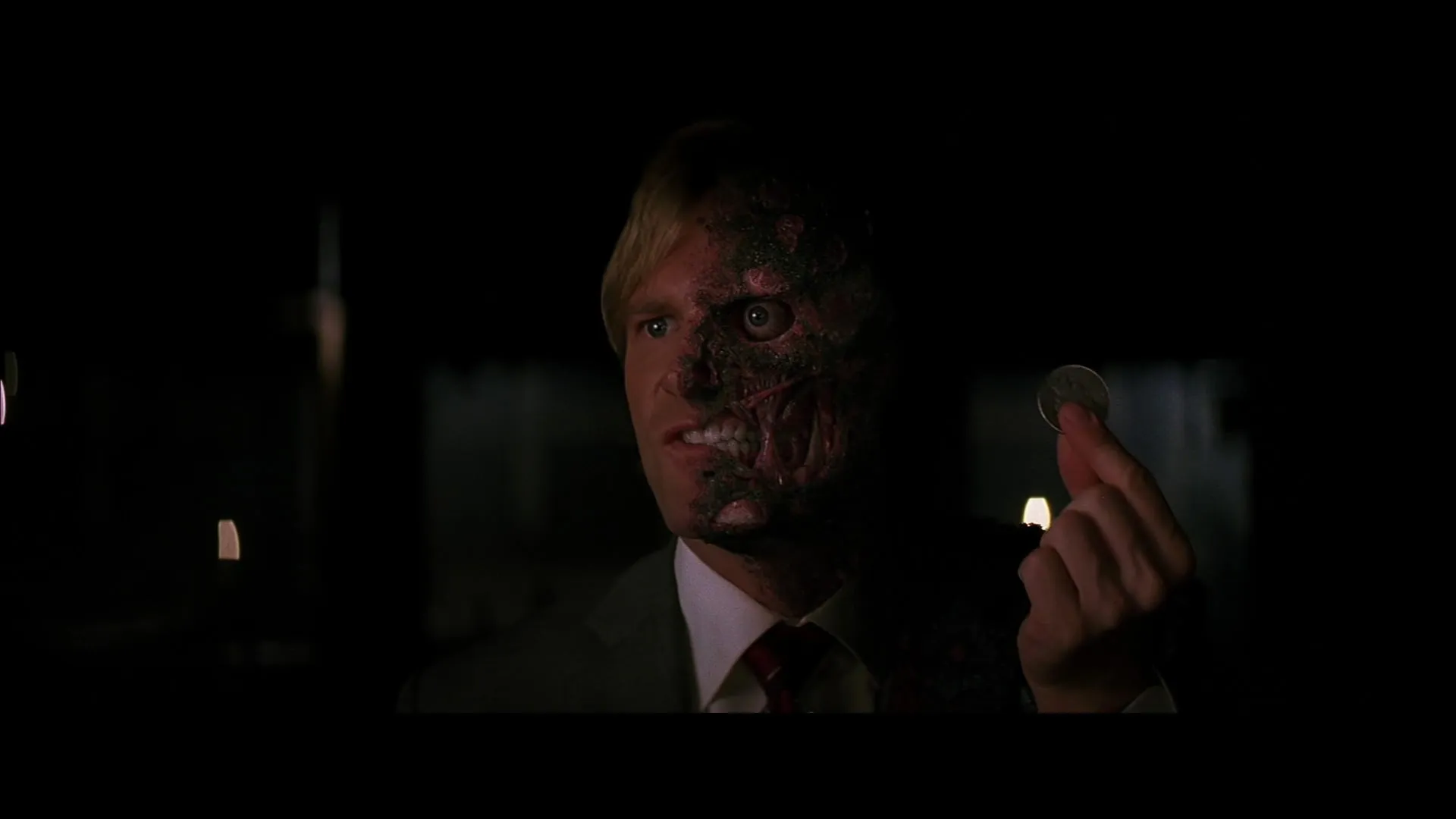
This is Nolan's theme's ultimate mania, and it makes sense that Inception proves to be the moment Nolan washes his hands of his deepest fear. Dent in full Two Face mode is utterly monstrous, yet the digital effect of his blackened skin almost dulls how truly shocking that final act is supposed to be with regards to Dent's almost demonic possession. Does the gooey-ness add to the effect? Sure. But would he be acting any differently if his face hadn't burned in that fire? He's more upset about losing Rachel than he is about having part of his mandible exposed to the open air.
Tellingly, Nolan doesn't condemn Dent in the way that The Dark Knight Rises later makes it clear Gordon should have. Instead, the director treats Harvey Dent's descent into madness as a tragic fall from grace. "You were the best of us," Batman tells him. And this is after he stopped Dent from torturing poor manic and Joker loyalist David Dastmalchian. Dent is at least somewhat not accountable for the monster he unleashes as himself. But is there anything else that Nolan can do with this theme? Where else could Nolan possibly go from here?
The answer is forgiveness. We accept the loss and attempt to move past it. That's somewhat here in the final beat, where Batman & Gordon devise a conspiracy to cover up Dent's crimes. But Nolan underlines it when he hits the turning point of his career. For that, though, he will need to descend into the subconscious and grapple with the topic directly.
And it's gonna be an even bigger smash (relatively) than this one.