
Calling Card to Make the Calling Card - Following

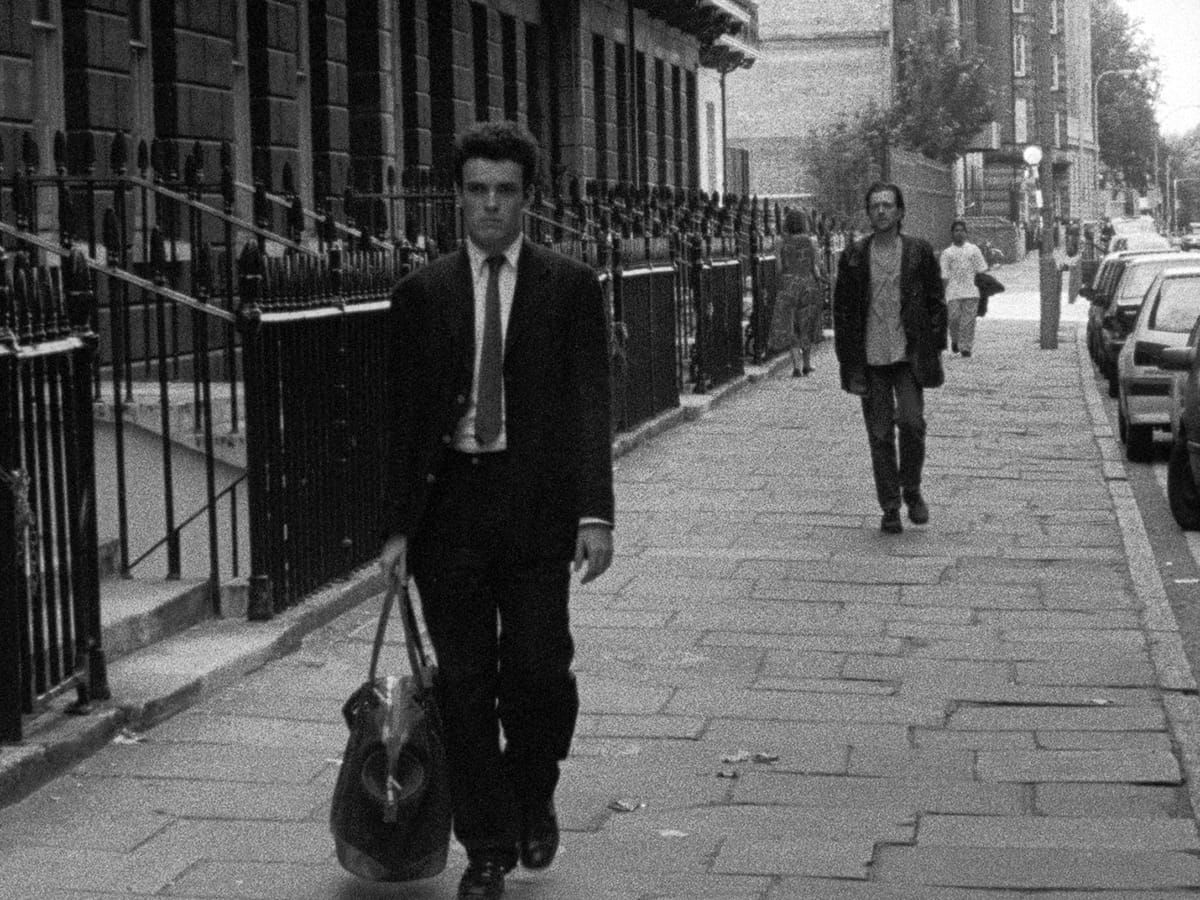
Nolan's Iliad is an ongoing series exploring the works of filmmaker Christopher Nolan and what is it that got him there...
On Christopher Nolan's first movie, his mother was in charge of catering.
That's hard to imagine nowadays, where the dude has done some of the biggest films of this century. He's flipped full semi-trucks end over end and built a hotel corridor on a revolving gimble so his actors could do a choreographed fight on the walls and ceiling. He's suspended a full plane from cables and revolutionized the use of IMAX cameras to show off model work in space. He oversaw more than six thousand extras to fill out the beaches of Dunkirk and crashed a 747 into an airplane hangar. And when it came to his small little biopic he told his stunt coordinator that he wanted to showcase the first ever detonation of a nuclear bomb practically.
But before all that, before the incredible cross-cutting of Oppenheimer or the Russian doll narrative of The Prestige or the mind-bending reverse chronology of Memento, Nolan made a small little black and white film for less than ten thousand dollars to prove that he could do it. And with a budget that small, there were no tricks for him to hide behind.
No spectacle.
No nothing.
Just his own quality script.
Following is the least-seen film of Nolan's canon (for good reason), but it lives in the curious space of first at-bats. It doesn't break the bank, it is his weakest film. Even here though, the hallmarks exist: a love of crime stories and noir, nonlinear storytelling, his early paranoia about losing the woman he's fallen in love with... Most of all Following is a personal drama built on characters and centers on their interactions. There's an insanely nonlinear plot, but like every other film of his, anything that isn't the character work and storytelling is window dressing.
And while just a few years later he traded up from his mother making sandwiches to the crafty of a proper film set, this is still pure Christopher Nolan in his most primordial form.
Nolan (as he does with all but one of his films) writes his own story, creating a writer (the Young Man) who loves following people (hence the title). One day he comes across a con man by the name of Cobb. Cobb pushes him into more nefarious acts (burglary and eventually violence) and ends up turning this whole affair into a grand con to get him to take the fall for multiple murders so he can escape into the crowd.
It's a nifty little noir, though its budget and small scope limits the potential audience. Most moviegoers want at least some semblance of tactile quality to what they're watching, and in a lot of ways this is just a few steps up from a student film. Being after he graduated, though Following is a textbook festival calling card for what Nolan could do. He pieces together a narrative and tells a rather complex story in a compelling way that doesn't ever really lose the audience. It's a proof of concept for Nolan himself, and in that it's quite serviceable.
But because that's its strength, it's hard to see it as more than that. Especially because once he gets past Memento every film he makes has a cast and a respectable budget that allows him to do more or less what he wants.
One of the recurring criticisms about Nolan (dating back to around Inception) is that he makes films that are puzzles. This is unsurprising. Nolan loves complexity and a winding narrative that tells his stories in ellipses. His films generally cut to the bone, with next to no fat on them and (under other directors) would probably move slower to convey the proper information. He's a remarkably economic storyteller.
That plus his mass popularity makes for an audience that views his movies as art to "solve". It's not that Nolan discourages this, but the staying point of a film like Inception is not that the last shot is going to always leave its audience screaming. It's that the actual beating heart of the story persists in the audience's mind subconsciously enough that it keeps them coming back over and over again. This is the same problem as last year's series on the films of James Cameron, where everything in his career has been a feast of visual spectacle and a utilization of cutting edge technology to tell his stories. Though for Nolan, there's this idea that his films are cold and emotionless, where the story is nowhere near as important as the actual rubik's cube he's twisting in front of everyone's eyes.
To use Inception as the rosetta stone again: it's the idea that Cobb's guilt over Moll is the perfunctory bare minimum necessary to get to all of the crazy visuals and madness Nolan wants to put on screen.
But these films don't carry weight in a larger context. There are directors out there who make garbage movies with insane visual flair. Paul W.S. Anderson is probably the best example here, but even he knows that it's not enough to just show cool shit. Audiences need satisfaction that is more than just stunt clips or animation showcases on youtube.
In the only movie Nolan made in the 20th Century, he can't really rely on all the big bombastic noise that's come to define him. There's no blaring Hans Zimmer score or display of stunts and wirework. There's no opulent sets or IMAX cameras. He dude doesn't even have access to color. All he has are some black and white photography, a twisty plot, and these compelling characters.
Already, Nolan shows off his propensity for nonlinear storytelling. So often writers will use this to seem clever or to try to juice the narrative with excitement or to make it feel like the audience is playing catch up. But that's not wha the does here. While a nonlinear film, there is a linearity to the way he puts events. Where he emphasizes injuries on the Young Man's face as an effect before the cause we will shortly see. This idea of a nonlinear film only exists because of the way that we experience time as a point from A to B. With Following, it's easy to understand the plot by reading a summary on Wikipedia, but doing robs the film of its enigmatic developments and intrigue. This is more than just its plot.
Indeed, Nolan is careful to put clues and hints as to where the current scene fits in the overall picture of what happened to the Young Man to make sure the audience can suss out the right order. The haircut is a prime example of this, where it's easy to miss that the hair is different until Nolan lampshades it by revealing the moment when the Young Man cuts his hair to appear more like Cobb. There's also the wardrobe choices (is he wearing a suit?) or the makeup (hang on, have we seen him sustain that injury yet?). All of these elements are guns on various mantlepieces to key the audience in on what to pay attention for. He plays fair with them, and they entice rather than alienate.
Without this careful attention to detail, Nolan probably would have had to make a movie at a slightly higher budget before diving into something like Memento. That subtle handholding enables the audience to remain engaged with the story and proves that Nolan can do incredibly complex shit without making it look too difficult.
That said, this was never a movie that was going to break out. If there's one thing I believe, it's that a film's success (especially at the box office) comes not from the sense of spectacle. That will usually get it to a half-decent level, and without a quality story it provides a definite ceiling. But to transcend that spectacle barrier, the story needs to be something that audiences will come back to over and over and over again. Following is Nolan's weakest film, but it's not like even with all his popularity people are running out to see it like they do for, say, The Terminator or Eraserhead. The former is a sci-fi slasher movie in a contemporary urban setting, a ripe concoction for a modest blockbuster. The latter is a weird as shit, abstract, twist of a film that's like the most gorgeous student film ever made. Following is... a calling card. A twisty narrative with great characters and a sense of wildly competent storytelling. With that in mind (and knowing what's next) it's hard to see it as anything other than a mission accomplished, rousing success.
This is the secret to Nolan's success, and why he has such an outsized success in the world at large. His movies might be puzzle boxes, but there's always the a spine of emotional richness powering them. For Following, it's the story of a dude who wants to be a part of something grander and ends up paying the ultimate price for it. It also features a love story of a femme fatale who suffers a horrible fate. The main character does fall in love with her, but that closeness leaves him susceptible to Cobb framing him for her murder.
As a recurring theme for Nolan over the first decade of his career, his films can't seem to escape a grand fear that the worst thing in the world is to lose your wife.
This theme is in its nascency here, and Nolan has pointed out that spousal/lover intrigue like this is a major staple of film noir. And yet, when scrounging around for great noir plots, the default mode is for a femme fatale either coming up with some plot to kill their spouse (like in Double Indemnity) or being the target of such a murder plot (like in Strangers on a Train).
With Nolan it feels different. It's hardly surprising that the main female character here (credited as "The Blonde", which sounds reductive without the context that only Cobb gets an actual plausible name and even that is almost certainly a nom-de-plume) is self-sufficient and more than capable of taking care of herself, but it is surprising that she is a victim of Cobb's ruthless plot to frame the Young Man/Bill for this string of crimes so he can get away with the money. One of the oft-critiques against Nolan is that he writes films about dudes who wear suits and where the women are almost always an afterthought and/or poorly developed. The Blonde doesn't do much to refute that, but it is worth noting that she is plenty capable all her own. She plots with Cobb to get the Young Man to take the fall for initial murder. It's hard to blame her for not seeing Cobb's betrayal, considering that he's a criminal mastermind who hoodwinks everyone he comes across. Her death is also the one thing that ends up dooming the Young Man to a murder charge that will be impossible to beat.
Yes Nolan's interests lie in the other two male leads rather than her, but it's not like she doesn't carry weight or gravitas in the film. And that comes from the writing just as much as it does the direction.
Because the thing is this: Nolan doesn't get to go out and make Memento if this doesn't work on basically every level. And no one is is going to blame him for not having the money to execute. While this is solid for what it's doing and he definitely has a sense of style and flair, the centerpiece of this is his ability to tell this really dynamic, bendy story in a way that's clear, concise, and compelling. There are moments that absolutely rock. The Young Man duct taping all the cash to his person is great, as is the bit where he has to fight the dude while it's all strapped. His first meeting with Cobb is electric and the final shot really has burned itself into my brain even if it feels so cliche to have Cobb disappear into the crowd.
Every great director has to start somewhere, and they always have to prove what they can do with no money to justify other entities giving them more to work with. Robert Rodriguez's El Mariachi is probably the most significant of these. But it stretches back to Eraserhead and encompasses Rian Johnson making Brick or (who knows) maybe even some first movie that's rocking the festival circuit this year. These sorts of films are interesting little curios, primordial mitochondria that contain the DNA of their themes and styles that will so define the rest of their promising careers.
That said, I'll never blame anyone for not seeing Following. For as solid a debut as it is (especially on a budget of like six grand), it's really only required reading for Nolan completionists. Even then, it's better to just start with Memento. The formal exercise of nonlinear storytelling is far, far more impressive there and grows ever more as Nolan adds notches of films to his belt. Films like Brick and Eraserhead are more flat out entertaining and El Mariachi (while not a great movie) is astonishing in what it accomplishes on that scale. Following is practically an art film that serves as an ur-text for everything Nolan is going to do better moving forward. It's weird to see Nolan in this vein, and for all that it's a decent movie, this isn't something I want him to return to now that he's achieved his level of success. And certainly not when he's able to tell stories this intimate at the biggest scale imaginable.
But I bet those sandwiches were delicious.