You Can't Take the Skies From Me: Revisiting Joss Whedon's Firefly
20 years ago, it was the great cancellation trauma of the early 00s. Today, accountability culture has (rightly) eclipsed its creator into disgrace. What should be its legacy?
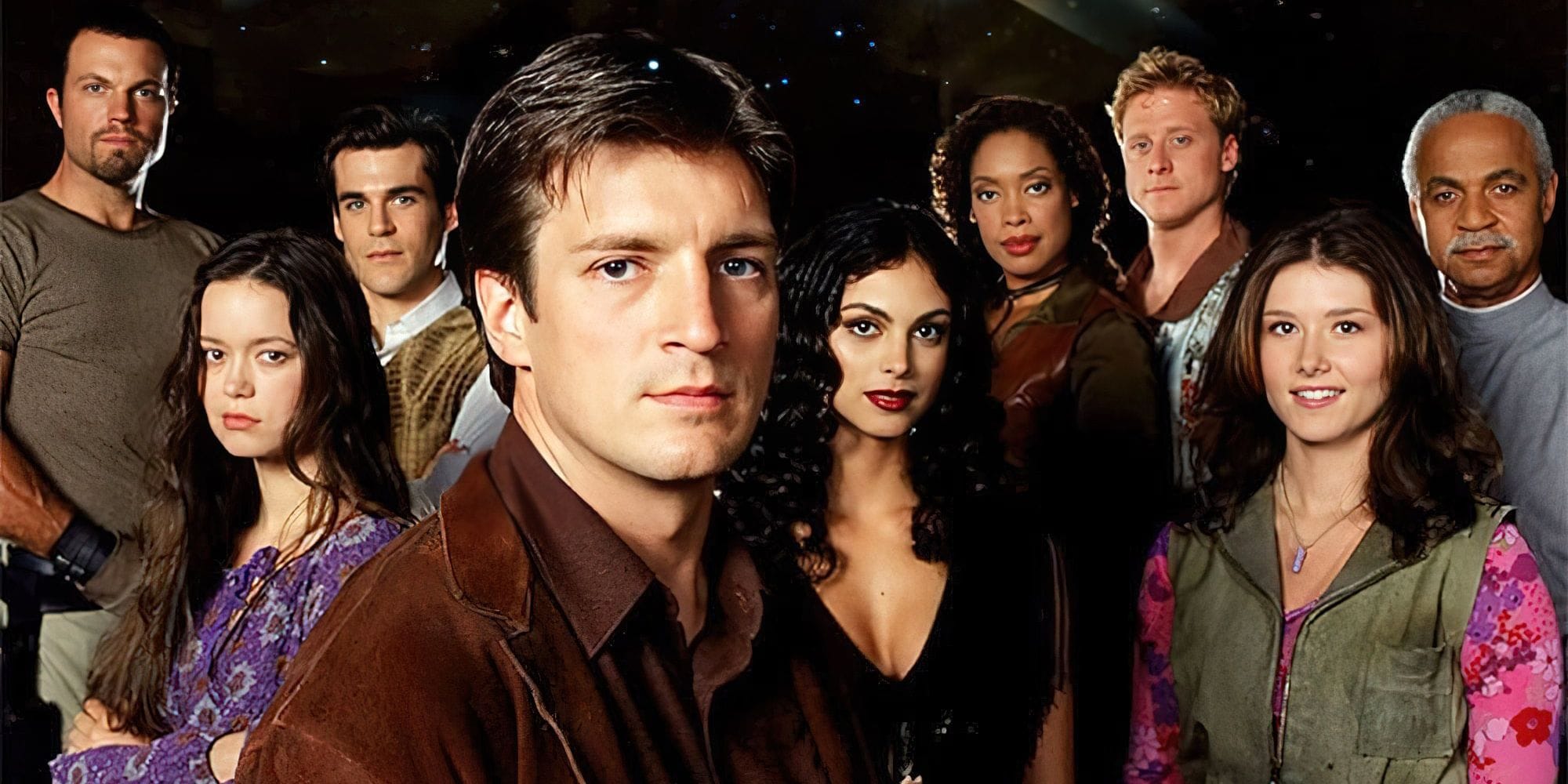
Apologies if you know nothing about Firefly. The show itself is one critics and fans have so thoroughly picked over you’d think it was the Mos Eisley Cantina in television form. If you need an all-too-brief primer, here it is:
For four months in 2002, a little space western show aired on Fox. It premiered on September 20 with an episode that served as a loose pilot after the network rejected the one its creator had made. They made demands of the show because they had buyer’s remorse and were desperate to fix what wasn’t broken, aired episodes out of order (the intended sixth episode aired third, etc), and by December had cancelled the show due to low ratings.
This show, of course, is Firefly. It should have died there, the ignoble death of a series no one watched and few would ever hear about. And yet, it persisted for two reasons:
Fans of the creator were already legion. Blaming Fox for not understanding the show, for years they held pitchforks in anger over its cancellation. Critics who’d watched heralded it as the greatest cancelled show of all time. Despite having only a 14 episode run, Fox successfully sold the show into syndication1. That ardent fandom grew and knowledge of the show only grew. It’s since spawned novels, comic books, and a movie that’s become a major cult hit. It’s the poster-child for a great show that the fandom has kept alive for decades.
When it comes to genre television, Joss Whedon is one of the best to ever do it.
Earlier this week, I wrote about Whedon. Given the shadow allegations against him have cast and how much his esoteric, undeniable voice defines his work, it’s an open question as to how to engage with his work now, let alone enjoy it. It’s especially difficult for something like Buffy the Vampire Slayer, with its sprawling narrative, years-long production, and deeply personal metaphors that explore relationships, gender, and more. Its status as a feminist text have also formed pitfalls, Whedon’s sexual impropriety a massive liability for wading back into that show2.
With its abbreviated life, Firefly might be able to survive this. It burned short and bright and remains legendary. It’s also hardly the explicit feminist text Buffy was. That makes it a great candidate to start with separating the art from the artist. Is it still as good as it was 20 years ago? How has it changed? Has it become unsavory? And is it adding fuel to the criticism that Whedon fakes his feminist credentials?
All good questions. Let’s explore.
The Whedon of it all…
Joss Whedon is the elephant, so we should start with him.
"I'm very smart" - Simon Tam, "Serenity" - Firefly s01e01
When it comes to Firefly’s two-hour pilot, I always come back to the above line, which Whedon calls out in the commentary track3. It’s the opening sentence to the monologue casting directors used to audition actors for the role of Doctor Simon Tam. Whedon had to hear it so many times and from those who didn’t capture what he thought was the essence of his writing.
It’s not unusual for actors to not capture lines during auditions, but it’s such a specific line for Whedon to highlight. The line has always felt deeply personal, the sort of sentiment that’s run through his mind for years because of how true it is. It comes from a self-righteous individual who uses his pen to say what he’s never been able to say out loud, played perfectly through the calibrated performance of a hand-picked talent. Any actor who doesn’t nail the nuance of the statement doesn’t validate the thought itself.
Now, the context has evolved. Whedon has always been a genius, but that genius now comes with an unhealthy dose of egomania and narcissism. Of course, these aren’t inherently bad traits. Plenty of laudable people in the world are raging narcissists, but Whedon was in a specific position to focus his narcissism on the show, self-righteously pulling it forward because he knows he’s making good television. He’s right, of course, and the sentiment is not bad in and of itself. It’s how that affects his actions that makes it bad.
That first episode though…
We can go at Whedon for his ego and say that he’s too arrogant for whatever it is he’s doing. There’s a problem with that, though. The first episode of Firefly (which is called “Serenity”, not to be confused with the 2005 sequel film of the same name) is a 90 minute presentation of one of the most perfectly-designed, crystal-clear realizations of a large ensemble of characters and the world around them. It’s an outrageously good episode of television, one of the great kickoffs of all time.
And it was totally wrong for 2002.
Fox had a massive freakout after Whedon turned in what he’d made. It was slow and deliberate. When Whedon pitched them “space western” they focused on the “space” and expected something Star Wars-y while he wanted to make an all-trappings western that he happened to set in space. The show’s lead was a grumpy guy who was kind of a bummer. The action was extremely limited when compared to Star Wars.
Now, full disclosure on the rest of this, but I’ve watched every episode of Firefly numerous times with a number of those viewings being of the commentary tracks on the blu-rays. There’s a lot of good tidbits in them, talking about the process of the show’s creation and the thoughts as to why certain aspects were present. Crucially, there are details I didn’t notice on first watch and might not have noticed had Whedon not highlighted them. Mal kissing his necklace in the teaser is there to give resonance to the moment he later snaps at Book over dinner, declaring a pre-supper prayer only a problem if Book speaks it out loud. Similarly, Jayne’s tough-guy, not-afraid-of-anything nature is pretext for his terror at the mention of Reavers, warning the audience that they’re the scariest thing in the ‘verse. As a moment that’s purely texture, Kaylee’s tactile appreciation of Book’s strawberry is borderline erotic, emphasizing just how rare it is to taste the luxury of a good piece of fruit.
The entire pilot is full of these moments, the sort that requires an intense amount of concentration and an engaged audience. It’s far beyond what most shows were asking of their viewers in 2002. One of the most focus-intensive shows at the time was The West Wing. At this time, most network television simply wasn’t working this hard to produce something this deceptively simple. With the hindsight of two decades, Whedon makes its density look easy even though he’s infusing every second with something that informs the world, the characters, or the story. Sure, Fox said it moves slow, but “Serenity” only moves slow from the perspective of big actions and plot incident. When it comes to the actual meat of story and narrative, it’s a freaking rocket.
Is Joss Whedon a feminist?
So let’s tackle this one. The one we all want to know. Kai Cole has her opinion, and what she says is absolutely true. He did hide who he was from her for decades. He preached feminism and treating women with respect, claiming that his insight was different from others because he had “the mind of the enemy”. While this was happening he was sleeping around and having numerous affairs, letting that enemy mind drive morally objectionable behavior. After his marriage fell apart, there are accounts of him openly dating multiple women simultaneously, not telling his various partners of this conflict, or wielding power in those relationships with the end goal of some impulsive cruelty.
Maybe that’s a bit too personal, but it’s part of the record. Whedon does not get to make intensely personal work and use it to sculpt a public image while forbidding private behavior to inform on it when it comes to light. His behavior harmed others. It is part of him.
Removing that, though, there’s a problem here that trickles into other areas. For all his preaching of feminism and raising female voices, it still stands that he would default towards male viewpoints in creating his work.
Take Buffy for instance. In season two Marti Noxon joined the writing staff and climbed the ranks, eventually becoming co-showrunner circa-season five and taking over the show fully for the first leg of season six while he went off to write “Once More With Feeling”. In season three, Jane Espenson joined the writing staff, and she’s been a consistent Whedon staple ever since, writing for all of his shows to date. Tracey Forbes was on staff for season four and Rebecca Rand Kirshner took her spot after she departed, writing for the final three seasons.
And… sure. Buffy was a show about a female vampire slayer, filled with other women like Willow and Cordelia, Anya, Tara, Dawn, and on and on. It makes sense that he’d want female voices to participate. And Buffy was such a writing-forward show that the focus mattered.
But… behind the camera? Out of Buffy’s 144 episodes… six were directed by women? And it was three women directing two episodes each4? I acknowledge that directing a show like Buffy was difficult and female directors have had massive challenges achieving parity with their male countparts. The directing constituency hardly reflects the demographics of today’s population, but it doesn’t seem like Whedon made it a priority to find and lift up female directors.
And then there’s the actual narrative agency problem for both Angel and Firefly. For all that fandom celebrated Whedon as some grand feminist, when looking at Angel, the show only had like… three women in the main cast across the entire series5? Angel was always undeniably a boy’s club.
Firefly at least gets the balance right somewhat. Five men, four women. And yet, the lead of the ensemble is Nathan Fillion and of the four women, one is a prostitute, one is the ship’s engineer (who is flagrantly the warmest and most sensual character on the ship; more on this shortly), and one is the young raving lunatic psychic girl whom Whedon introduces as naked in cryosleep. None of the men in the show are so sexualized, though Whedon (in commentary) does go out of his way to point out the men when they are shirtless. That’s something.
The thing is that Whedon’s “brain of the enemy” was always present. And… sure. The female characters on Firefly are incredible. The writing draws them beautifully and the cast plays them exquisitely. It doesn’t change the fact that Firefly had an intensely male gaze and perspective. He could get into the female headspace, but by the time of the show’s cancellation, neither Zoe nor Kaylee had gotten an episode with the opportunity to really explore their characters6. Again, it’s easy to miss all of this. The show worked overtime to make sure that if a character was present they had some role in the story or got something to do. Dating back to the pilot, the ensemble felt fresh and lived in, which is down to the show’s writing and acting.
None of this means Whedon isn’t a feminist. I believe he is. But one of the core tenets of feminism is acknowledging the patriarchy’s baked-in foundations in society’s infrastructure and the inherent societal-wide misogyny (or male supremacy) that comes with it. It requires intense, regular, active interrogation. It’s easy to assume that Whedon slipped quite a bit in the desperate attempts to keep Flirefly on the air.
Sex in space
Within Firefly’s limited run, it was unafraid to have more openly sexual content than, say, Buffy. Part of that was the network and the looser rules in terms of Whedon making an “adult” show (as opposed to one that was teen-friendly). Because so much of Whedon’s indiscretion is based on his sexual proclivities and sex/love addiction, it’s worth exploring how that manifests here and changes the conversation.
Inara
First, there’s Inara, a “companion” who rents one of Serenity’s shuttles. Being a companion means working with a guild that has legalized galaxy-wide sex work and prostitution, giving a gloss over the profession. Inara proves herself more than just some sex object into which men can pour their desires, but that doesn’t change the nature of the job.
Thematically, Inara fits perfectly in the little township that is Serenity. In building the ensemble Whedon used Inara to fill a traditional western role. It’s no different than Book being the local pastor or Simon being the country doctor. Where Whedon lifts it up is how dignified he makes legalized sex work. When Atherton Wing threatens Inara at the end of “Shindig”, she turns the tables on him, saying that she’s the one who gets to blacklist him with the guild, not the other way around. We can critique Whedon for perving out on Inara. He still makes the job one that empowers those who practice it.
Even if there’s a complaint that Mal might show disdain for Inara’s profession, those issues stem from his intense romantic feelings for her and the resulting jealousies. The show also makes it clear that Mal’s behavior is out of line with the sort of dignity and poise of her position. Inara’s the most cultured character on the ship. Whedon did not have to make her so.
Saffron/Bridget/Yolanda
Christina Hendricks’s YoSafBridge (as fandom has taken to calling her) is a recurring character who first appears in “Our Mrs. Reynolds” and later returns in “Trash”. Both episodes are excellent, but “Our Mrs. Reynolds” is a wild sex farce and outrageously horny. The taboo is the joke, of course, and it turns out that Saffron is weaponizing her inherent sexuality to further nefarious ends.
There’s nothing wrong with the bawdy humor of Whedon’s wickedly hilarious script. Sex jokes are hardly new (Buffy and Angel both had plenty) and date back millennia, but seeing them deployed so easily here does reflect Whedon’s intense (and overpowering?) libido.
Again, this isn’t a crime, but it’s worth observing that it does recolor the episode somewhat. I know for me when I watched this episode in high school, it felt edgy and cool and adult. Without the sexual content, this episode is lesser. For all that Whedon’s tastes and behavior are at issue, it’s hard to slam an episode when it’s fully cognizant of the themes and boundaries it’s playing with.
Kaylee
CW: the following contains discussion of sexual assault.
As I said before, Whedon designed Kaylee’s character as inherently sexy and sensual. He puts her in passionate colors and paints the engine room a red-orange tint. Everything about her screams “heat”. Even through the series, she spends a good amount of her time pining over Simon and speaks multiple times about how much she needs to get laid. Hell, the first time Mal meets her (in the “Out of Gas” flashback) it’s while she’s having sex with Serenity’s then-engineer.
I mention all of this not because it’s wrong. Kaylee is a terrific character, and Jewel Staite elevates her so much that you can totally miss that she’s the most underserved character on the show.
No, the problem is “Objects In Space”.
In the show’s final episode, bounty hunter Jubal Early infiltrates the ship in search of River. He slowly neutralizes the entire cast. On the episode’s commentary, Whedon speaks candidly about how Early’s subduing of each character reflects something he reads about that individual and speaks to their larger existence. For Mal, Early acts quickly and with violence. For Simon, he utilizes wordplay to prove he can outthink the smartest character on the ship. For Inara he acts like an indignant john, willing Inara into a more submissive role. Like Mal, he attacks Book with violence and then tells Simon “that’s no preacher,” a hint at Book’s secret past.
For Kaylee, though, Early corners her in the engine room and asks if she’s ever been raped.
Staite’s performance in this scene is incredible, and yet the threat of sexual violence has aged extremely, extremely poorly, especially in a post-Game of Thrones world. To threaten the warmest, most sensual character on the ship with such a grotesque violation is utterly galling.
Now, Whedon makes it clear in the commentary that he does not endorse Early’s actions. So, too, it’s clear (especially in retrospect) that Early has no intention of committing sexual violence against Kaylee so long as she cooperates with his need to tie her up so she can’t interfere in his operation. The suggestion is merely a tool, hinting at what he’s capable of should it come to it.
It’s still a remarkably vile moment, one birthed (as Whedon admits on the commentary) of the darker parts of his mind:
“This is one of those scenes that y’know...you write and then you worry that maybe you’re not as good a person as you hoped you were. You film this scene and everybody kinda wants to avoid you for the rest of the day. It really is just as creepy as possible.”
Yeesh. Talk about coming across different now.
Whedon has talked like this before. The pivot point for Buffy is the episode “Innocence”, in which Angel loses his soul after Buffy sleeps with/loses her virginity to him. The underlying metaphor, of women who date men, sleep with them, and find out those men are monsters who just wanted sex is a powerful one. In the scene where Buffy sees him for the first time, Angel is a real asshole. In the commentary, Whedon said:
“I wrote this scene; I actually felt like an ugly person. I didn’t know how I was able to write this so easily. It felt icky that I could make him say these things. It felt icky and kind of powerful; it was very uncomfortable and very exciting for me to do.”
Again. Concerning. But at least he’s always been honest that those dark corners of his mind are there and that he is willing to tap into them to write compelling narratives. The flipside, of course, is that he turns out to be kind of a dick and now the moments in question feel especially true because we know what he’s capable of.
Given all of that, I would much rather be in a world where someone was honest about this contemporaneously. It’s far better, than, say, reading Kai Cole’s letter exposing Whedon’s parade of affairs while you’re watching “Conversations With Dead People” just minutes before Buffy confesses to Holden that her dad cheated on her mom. If there was an option, having Whedon be honest about who he is has always been far preferable to what he hid.
For all of that, Early’s threat of sexual violence still sits in a deeply uncomfortable place, especially considering Kaylee’s role in the ship. Were Whedon to redo this episode, I’m curious as to if he would change this or figure out some other way that doesn’t so wholly exploit a character who fits into this series’ particular niche.
Whorehouse on a backwater moon
“Heart of Gold” is an episode that’s always been difficult. Its premise of “the crew teams up to defend a brothel” can be both the sort of storyline that fits into Firefly’s western genre trappings and also a sort of puerile glee at being able to do sex jokes. It’s not that Jayne “just wants free whore sex” isn’t funny, but it’s other moments like when the town’s evil landlord Burgess gets Chari to betray the establishment in front of the town’s menfolk and then demands she perform oral sex on him in public. It’s weird and strange and off-tone. The show is trying to see what it can get away with. The answer is “quite a lot”, but there are definite lines past which Whedon can’t go.
The promise of Wash and Zoe
As a final piece to all of this, Serenity’s married couple also reflect something specific about Whedon’s worldview. Knowing that by this point he was well into his string of affairs, it can’t be an accident that Whedon chose to put a married couple on the ship. He’s always been clear that Wash and Zoe were always going to be married and for so long as the show was on, he would have kept their marriage intact.
In commentary7, Whedon sells their relationship as an example of something that long-form narratives rarely showcase, opting instead for a “will they/won’t they”. That’s probably true, but I’d posit this couple was some north star for him to strive for. Perhaps Whedon in a monogamous relationship is impossible, and maybe this is all just fanciful wishcasting, but Wash/Zoe does feel like something sacred to him. Were it not for the film, there’s no reason to doubt Whedon’s asssertion that their marriage gave them plot armor for the entire series’ run.
Where it does change slightly is in the Whedon identification character. He’s been open about how each character pulled a different aspect of himself, but Wash as the pasty nerd who cracks jokes and seems wholly out of Zoe’s league (but he earns her hand anyway) feels like a deep surrogate for Whedon and his insecurity. To be honest, it’s not so different from Xander on Buffy, where Xander is clearly Whedon’s avatar on the show: a horny nerd boy who wants friends and desperately wants to be as cool as everyone else even though he’s not8. In the world as it is, the allegations have very much colored the work. That said (and this is a low bar), it’s hardly like Whedon’s output is as skeezy as, say, Woody Allen’s Manhattan, where Allen’s 42-year-old character is dating a 17-year-old Mariel Hemmingway. It’s not much, but it does count for something.
Big damn final verdict, sir
Outside of The Avengers, Firefly is the easiest Whedon project to re-evaluate through this lens of him as a “fake feminist”. There are moments where it crosses over into the controversies around him and provides additional shading to the man and his work.
Yet watching it again from the beginning, having not gone through in maybe a decade, it’s remarkable just how easy it is to slip back into the world and the characters. The show was under threat of cancellation from as soon as Fox screened the pilot, and it forced Whedon, Tim Minear, and all the writers to bring their absolute best to every single script. Sure enough, all of the episodes are funny, entertaining, and exciting. The characters sparkle (which they would have anyways) and there is a sense that they’re trying not to let the cancellation define the stories they’re trying to tell. If anything, the last few episodes of the series feels like the show has locked in even more than it did initially, finding its groove and just getting started. As there’s no point where the show drops in quality, it’s easy to imagine the show being infinitely good, with a quality graph that climbs upwards into infinity. Like there’s no limit to what it would do or how good it would get. Regardless of Whedon, Firefly was always an amazing show. It deserves its reputation.
This, of course, is the danger. Abusive or toxic individuals who wind up in positions of power can make tremendous art. It’s easy for that art to subsume the mythology of these creators. For Whedon, this was especially a problem. Showrunners undeniably had power before him, but he was the first to ride that to a stardom of its own. He allowed his fans to deify him and the power of these myths to insulate him from anyone exposing him lest the facade crumble. Whedon himself has acknowledged how scared he was of people (like his wife) discovering or revealing his indiscretions. His fall from grace has only justified this fear.
If there is a cautionary tale with Whedon, it’s that the people who make these shows are still people, capable of pettiness and casual cruelty. Had he been as perfect as he seemed he was absolutely worthy of the deification. He was not some perfect god to which people (like me) should aspire, but it is in his humanity that so much more is possible. His voice might have been singular, creating incredible characters, emotional stories, populist thrills, and pure entertainment. Yet there are others who can do similar work without the toxicity. Admittedly, no one’s work has ever spoken to me (much less universally) as much as Whedon’s has, but the question remains on if the pain was worth the output. For something like James Cameron’s Titanic, we see the result of a mad genius making film sets into war zones in the name of an all-time banger. And like… it’s hard to say that it wasn’t worth it (though I’m sure Cameron would do things differently if he had to do it again). Art does require some modicum of suffering. Flaggelation is acceptable. What we should never accept is hurting people in the name of creating great art. It’s simply not worth it.
In 2018 I met one of my dearest friends. I’ll never forget that one of the first things she ever said to me was about how Whedon is “one of the primary reasons we’re all here”. In the wake of this crisis, I remember speaking with her, detailing the implications of Whedon’s abuse and misbehavior and what it would take to get him back to a place where he could produce film and television again. His preferred media are ones that require intense collaboration and managing hundreds of workers under a singular vision. It is a creative job, but it’s a management job too. Based on past precedent and concern with nuance, tone, and details including hair, makeup, & wardrobe, there’s no way Whedon would consent to not being at the top of such a project. In the abstract and taken purely on the basis of Whedon as a visionary creator, there’s not a problem with that. But given the management implications, to allow him back in without any sense of reconciliation, assumption of guilt, contrition or plan for the future would be deeply irresponsible. It’s simply not worth putting cast or crew in danger of any sort of torment in the name of art, especially not now that we know what we know. The suffering is not worth it. To put him at the top of such a production, we decided, would necessitate a rehabilitation and/or someone monitoring him in a probationary capacity. How could that even happen?
At least now we know that Whedon is human, and we can view projects like Firefly and see that they don’t reflect poorly on him so much as color in details. For a man who tried to keep his public and private life separate, it is remarkable how much that’s true here. Hell, it would probably be harder to watch something like Dr. Horrible’s Sing-Along Blog, which contains a character like Penny (Felicia Day) who gets shaggy characterization while the two men at the center (to different degrees of toxicity) vie for her affection.
But watching Firefly was a delight and a relief. In a world where Joss Whedon is no longer the deific creator his fandom (and I) treated him as, it’s a different experience watching this knowing that he’s just an imperfect individual with lots of demons to still work through.
That’s the thing about people, though. Gods might be unflinching and unchanging, omnipotent nexi around whom the ‘verse spins, but humans are imperfect and small, capable of both miracles and pettiness. Humans, though, have the ability, capacity, and potential to grow, change, and learn from their mistakes. We evolve. It might be overly optimistic, but based on the work that made him famous and the words in the wake of actions that tore him down, Whedon is entirely capable of a return under the right circumstances. The question stands of if he will.
Something like Firefly will live as a reminder that difficult people can make incredible art and that art will outlast them. In this case (as in others I’m sure), the art transcends the problematic roots of the mind from whence it birthed. Maybe one day it can also exist as a monument of someone who fell from grace but made the difficult, hard evolution to atone, remaking himself in the image of the myth he perpetuated about himself.
I will happily live in that hope.
This is a footnote, obviously, but before the streaming era, selling episodes into syndication was the goal for every TV show. Make it to a hundred episodes (but in actuality they could do it around 80) and the show would live forever in rerun form. All of that investment turned into a machine that practically printed money. ↩
Again, just imagine what it’s like to try to do this for Dollhouse. Yeesh. ↩
To give you an idea of how deep in the Firefly trenches I was, I’ll point out that I’ve watched every commentary for every episode of the show, with the Whedon commentaries in particular being ones I’ve watched multiple times. ↩
Ellen S. Pressman directed 109 “The Puppet Show” & 204 “Inca Mummy Girl”; Marti Noxon directed 510 “Into the Woods” & 517 “Forever”; Marita Grabiak directed 716 “Storyteller” and 721 “End of Days”. Apologies if I missed any. ↩
One of those four is Mercedes McNabb, who only got added to the main cast in the back half of Angel’s final season despite her playing a character who’d been in the season to that point and who dates back to the pilot for Buffy. ↩
Mal had a bunch; Jayne had “Jaynestown” and also “Ariel”; Simon had “Safe” and “Ariel”; Wash had “War Stories”; even Book had a bit of something in “Safe”. Zoe got a good bit in “The Message”, but she was also splitting time with Mal… ↩
It might not be the commentary; I’ve read a lot about the series and I don’t remember where I heard some of these things… ↩
And also wants to fuck Buffy, but that’s a different conversation. Also, while you’re here: no Buffy episode has changed in my mind more in this post-allegation world than “The Zeppo”. Like… that episode was good but yeah it makes a lot more sense now. And also woof. ↩