
When Four Hours Isn't Long Enough - Baahubali: The Epic
The biggest 2022 theatrical release (for me anyways) was S.S. Rajamouli’s RRR, a major milestone in Indian cinema that crossed over to a global box office and took cinephiles by storm.
RRR is a crowd pleaser, the sort of batshit insane high octane sugar rush that can get audiences screaming in pleasure and literally dancing in the aisles. It opened that year’s Beyond Fest at the Chinese Theater in Los Angeles, selling out the thousand-person seat theater in a matter of minutes. Even though it was my sixth time seeing it (in a theater no less), being in that room was like being at a rock concert, one of the craziest, most thrilling theatrical experiences of my life.
The day after that, my friend Chris and I went to another Beyond Fest event. Captializing on RRR fever, the festival programmed a triple feature of the three Rajamouli films that preceded RRR: Eega, Baahubali: The Beginning, and Baahubali 2: The Conclusion.
It was a thrilling and excellent day at the cinema, albeit long and exhausting. For all that Baahubali was an experience exactly like what I was looking for (Rajamouli doing a sword and sandal epic), The Beginning was slow and plodding, mostly setting up for The Conclusion’s relentless bullet train. It didn’t help that both films followed the magnificent Eega, which Chris and I agreed was the best of all three (and still my vote for Rajamouli’s best film).
Because of this, the full five-and-a-half hour Baahubali experience was overwhelming. I wanted to give the film another shot, and given the slowness of The Beginning, I felt like there must have been a more economic cut such that first half didn’t feel like such a slog.
Fast forward to this year, the tenth anniversary of The Beginning’s release. Rajamouli announced a fully recut Baahubali: The Epic, smashing both films together by trimming a hundred minutes out of the combined runtime. This sort of recut is always interesting, though I had no idea how he was going to justify excising the rough runtime of The Princess Bride.
On the one hand, he was right that the original Beginning/Conclusion duology is still the best way to experience the Baahubali tale. On the other, even cutting back a ton of the film can’t slow down Rajamouli’s propensity for maximalism or the thrilling tale of politics and revenge at the center of the story. The Epic might be the more palatable experience, but the duology is still Baahubali’s strongest form.
Where did the hundred minutes go
Having only seen Baahubali once in a fever dream of a crazy day, there was plenty I didn’t remember. Moments stirred up memories, but a lot of it was stuff I didn’t notice.
This isn’t true in the first half. In The Beginning, once Baahubali climbs to the top of the mountain, he meets a girl named Avanthika and ingratiates himself into her organization of freedom fighters who fight against Bhalla’s evil rule. Within this sequence is a musical number of the two falling for each other as well as some of the small adventures they have as he kinda figures out what’s going on in the world above.
The Epic blasts through this with a quick voiceover and a whole lot of montaging yada yada.
Essentially, it’s a quick fix to cut a good 20-30 minutes out of the movie. Pulling out Avanthika opens up room for other things, though once the voiceover starts, the movie plays out in what feels like fast forward all the way up until we’re well into the Bhalla/Baahubali flashback that dominates the back half of the narrative. I vaguely remember it feeling like this in The Beginning, but so much of that first half is just trying to figure out what the hell is going on By the time Mahendra Baahubali enters Mahismathi for the first time and his clothes kind of burn off to reveal his father’s armor, it’s not obvious that this is more metaphorical than literal.
There’s nothing wrong with leaving characters in the dark, especially because so much of the narrative prioritizes Baahubali’s perspective. He is in the dark, so we’re (mostly) in the dark. We have some insight into the larger picture of Mahismathi’s upper level politics, but it’s mostly to set up the struggle against Bahalla and his rule.
While cutting Avanthika feels like the right choice for the larger story, it diminishes Mahendra’s centrality. The Conclusion spends its entire first half building up the relationship between Amarendra Baahubali and Devasena to maximize the tragedy of his descent towards death. Mahendra does not receive such courtesy, where Avanthika’s irrelevance to the post-flashback part of the story leaves Mahendra’s story as one of revenge. At its most altruistic, Mahendra is trying to set right what Bhalla’s ascension to the throne made wrong.
As it stands, it feels like Rajamouli needs her present to justify the fight where the soldier sees Baahubali (and reports it back to Bhalla) and then to help explain why Baahubali needs to infiltrate Mahismathi in the first place.
Structurally, though, without the Beginning’s interval, it means the film has a span of oddly paced sequences that begins with Mahendra’s approach to Mahismati and rockets its way through massive action set pieces until Kattappa can start to relate the story of Amarendra. It’s extremely disorienting. The montage alone is a tacit admission Rajamouli makes, showing that he’ll light story on fire to squeeze everything into a run time. It makes it hard to trust that when he slows down the narrative next he won’t floor it again the second he needs to.
Compare that to the second half, where it’s harder to discern all of Rajamouli’s cuts.
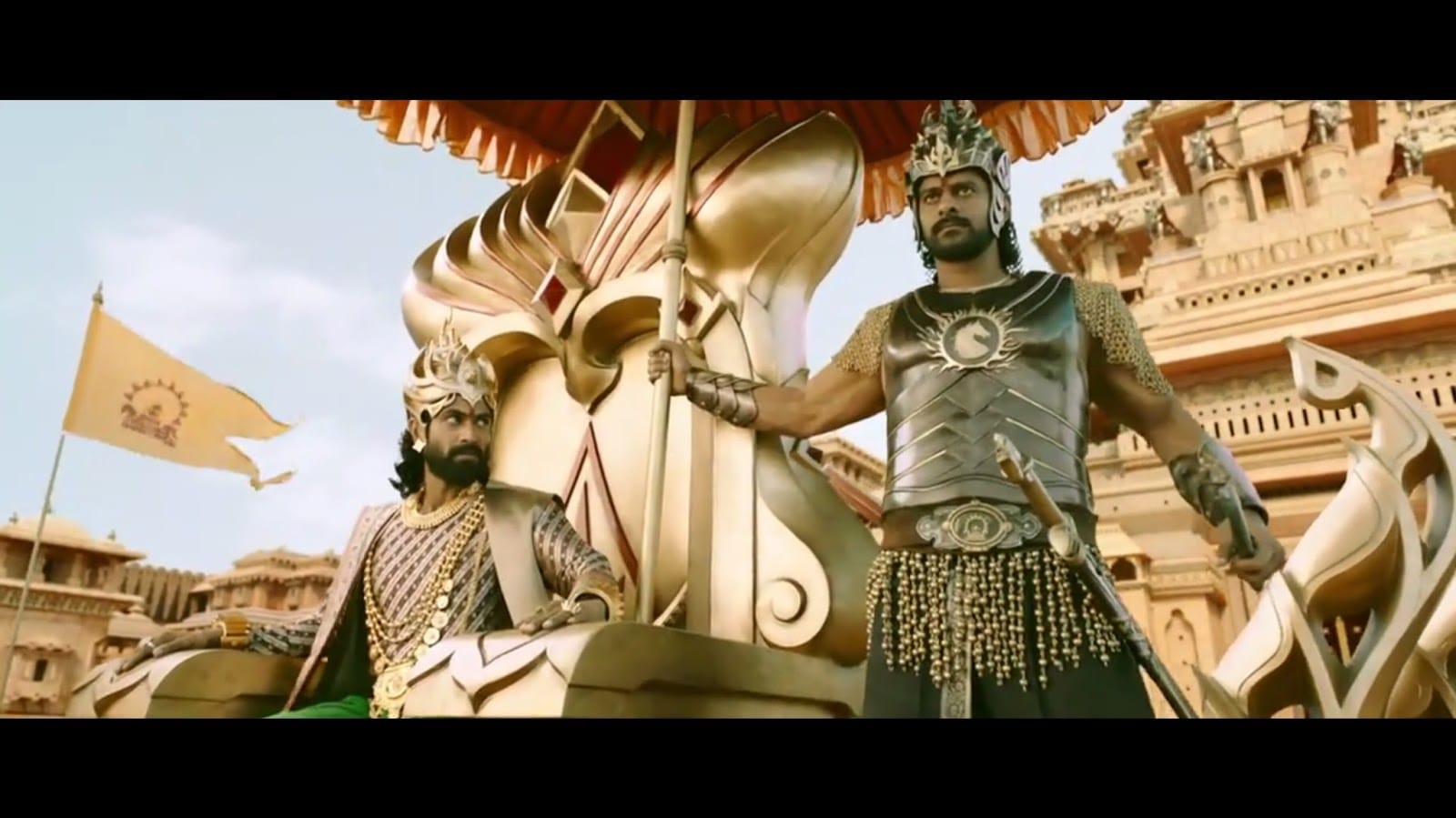
At The Epic’s interval I remarked that “all the good stuff is in The Conclusion.” Watching again, that stands even truer. The back half is the movie expect Baahubali to be. Courtly politics and political intrigue and some truly insane action. Mahismati’s ruling class scrapping for power. Gorgeous sets and lavish costumes.
But most wonderfully, it’s the half where Baahubali and Devasena meet and fall in love. Their love song (“Hamsa Naava”) mirrors the one for Mahendra/Avanthika (“Pacha Bottasi”), though Rajamouli cut that latter one for the sake of tiem. Without a comparable parallel, it only further minimizes Mahendra in the scope of the narrative.
Talking politics
That being said, there is an aspect to Rajamouli that I wrestle with.
This came up during RRR, but a subtextual thread running through that movie deals with internal Indian politics that might not be readily apparent to outsiders. Briefly, while Ram and Bheem are ostensibly equals, the narrative doesn’t quite treat them as such. Bheem comes from the forest and his myopic quest to find Malli is a noble one. But the film makes it clear that while Bheem is fighting for just one little village, Ram’s quest encompasses revolution and the liberation of India from colonialist overlords. Throw in the bit where the movie ends with Bheem asking Ram to teach him how to read (despite that never being a facet of the real person whom Rajamouli based Bheem on) and there’s a conservative bent to the film and its politics. Bheem might be rad as hell, but it’s Ram who gets the biggest moments in the back half, and it’s hard to not view this as Rajamouli being more invested in him than the illiterate country bumpkin.
Baahubali suffers from an even bigger problem.
For starters, the film centers on kings and bloodlines. The entire question of who will rule Mahishmathi is central to the film’s stakes. And while it is a sword and sandal epic and the chances of democracy are basically zero, this film still does end with the idea that a benevolent tyrant descended from royal blood is probably the way to go here.
Once Mahendra shows up and makes a play for the throne, it’s no question that Amarendra’s son should be king. It is his birthright and now he has to take it from his uncle (who seized it by dishoorable means). More importantly, every single person who comes near him treats him like a divinity returned. This acquiescence empowers and enables Baahubali to take the throne at the end. Yes, it is a victory and he promises to rule with fairness and to uphold the law, but it’s still the sort of wishful fantasy that George Lucas talked about when he said the ideal form of government was a benevolent dictator. Based on this, it wouldn’t be surprising if Rajamouli felt the same.
The counterpoint to this isn’t Bhalla (who is a raging bastard in every respect), but rather Baahubali’s mother Sivagami. She does enough to maintain the kingdom and enable its prosperity, but arrogance and pride are the major factors in her downfall. It’s not that she upholds the law poorly or has too much self-interest, the problem is she upholds the law without taking into account contexts outside of it. Yes, the law should dominate this particular conversation especially when it enables societies to function. But it’s all too easy for snakes like Bhalla to manipulate her into wielding the law in ways detrimental to the natural order.
Compared to Devasena (who has little respect for the injustice of inherited wisdom) or Baahubali himself (who abdicates his duty in the name of love for Deva and devotion to Sivagama), it’s easy to see not only why the Queen mother falls so hard from grace but also the flaws of her rule in the first place. A good ruler cannot be so narcissistic.
(And none of this touches on the unfortunate decision to make Bijjaladeva physically disabled, building the character with a left arm that prominently doesn’t work. It’s pretty grossly ableist, and I wonder if the scene where Bijjaladeva punches stone off a pillar has anything to do with emphasizing that the man is more than his deformity…)
Larger context
If these conservative themes play into Rajamouli’s work, it’s worth interrogating them as potentially noxious or regressive when considering that his work has broad appeal. Having directed two of the top five highest grossing Indian films of all time, that cultural footprint comes with a modicum of responsibility.
Like RRR, Baahubali is not immune from concerns about Rajamouli’s nationalism. A major joy of Baahubali is seeing a vision of ancient India brought to life. The palaces and citadels are grand and opulent. The locations are lush and gorgeous. Even the metallurgy has a place within this. All of these pieces are gorgeous separately, but together they build a vision of Indian strength and prosperity dating back millennia. It might not be real, but Rajamouli builds the film as a grand epic straight out of Indian myth. It’s hard to not be proud even by proxy.
There is a difference, though, between national pride and nationalism. What makes RRR so successful internationally is its universal themes of friendship & revolution and the way it utilizes western imagery . Baahubali, on the other hand, builds so deeply off of Indian lore and culture that it should feel alienating to an international audience. But outside of not knowing the difference between Shiva and Vishnu, all of the aspects here can play to a non-Indian audience.
As a pretty bog standard white boy, I confess that this ancient Indian ethos is one that intoxicates me. It feels so different from the staid feudalism of Europe or even the samurai cultures of Japan. India has a thriving culture and society and has existed consistently for thousands of years. They conducted wars and the ruling culture lived in the opulence that power permits. Baahubali has entire scenes in locations where I’d just want to live and explore, walking around like some archaeologist or something.
But acknowledging the nationalism is as far as I’m prepared to go. I don’t know the ins and outs of recent Indian history. My current understanding of Indian politics extends to a loose knowledge of Prime Minister Narendra Modi and a couple of policies he’s implemented as an avowed Hindu nationalist. India’s affairs are India’s affairs, but it’s also good to have a finger on a film’s larger contexts, especially considering that Indian cinema is a wildly robust industry.
This ignorance, though, allows for enjoyment of the movie as it exists. Free of context this is a zipping yarn, with opulent locations and simmering tension at all times. I also am not at risk of weaponizing Indian nationalism. I can watch this and appreciate India and its culture and want to go explore more of these perspectives and cultures.
Keep it Epic
Walking away from The Epic, it made me appreciate all the larger contexts of Baahubali in its original duology form. Losing out on the pieces of Baahubali makes The Epic an inferior product, focusing as it does so much on Amarendra’s story at the expense of Mahendra’s.
It’s still plenty good, and if it’s the only way to get someone to watch it, it’s hard to think of a better way to do it (besides making people go see it in theaters and telling them to trust that it’s going to pay off; hard to do with a duology that has a run time pushing almost six hours. But it’s a nice taste test for the larger scope of Rajamouli. When I saw it in theaters, my friend who’s never seen RRR was riding high on the Tollywood pixie dust while the one who saw RRR in theaters multiple times found it largely underwhelming.
Not sure how much of that is the aforementioned skipping story. It can’t have helped.
What does matter, though, is that Rajamouli massively levels up in Baahubali, and even The Beginning and The Conclusion feel markedly different when it comes to his level of confidence. The Conclusion has tremendous swagger, adn that comes across in The Epic. Without that confidence, The Beginning feels pluckier than it does while The Conclusion, swings its dick with the swagger of a dude who feels lik he’s on top of the world. Without this movie we don’t get RRR, and given how massive RRR is, I can’t wait to see what he comes out with next.
Because nothing hits like a Rajamouli film, even when he’s taking an axe to his own plot. He’s such an incredible crowd pleaser, and Baahubali is so completely worth everyone’s time.