
We Haven't Got Time - Merrily We Roll Along
The new pro-shot of the recent Broadway revival unlocks the full potential of Sondheim's hidden gem masterpiece
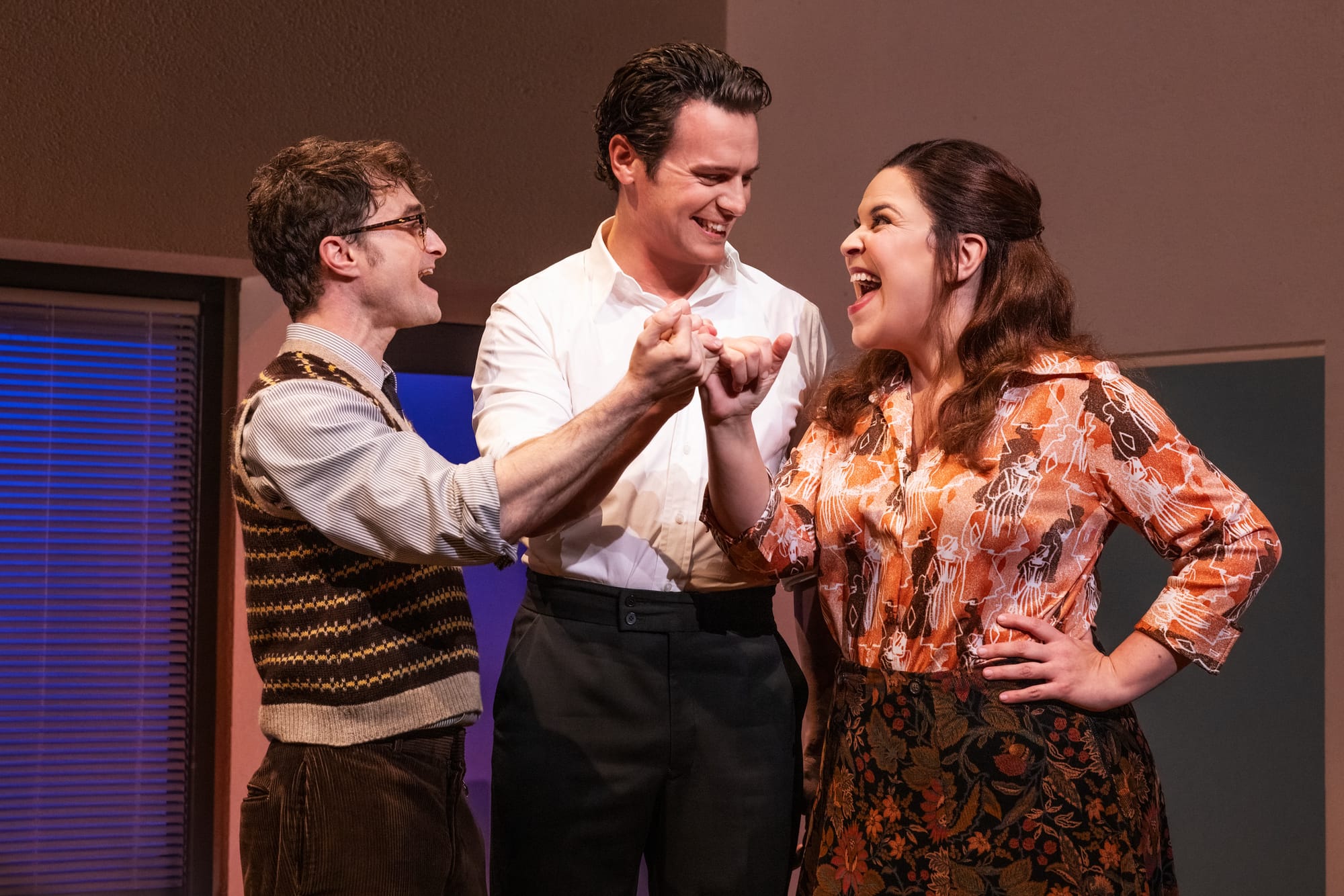
In 2025, a professionally shot version of the 2023 revival of Merrily We Roll Along hit theaters. Given Sondheim’s death, this is the first presentable “final” version of the man’s most high profile failure.
In 2023, more than four decades after that original production the Off-Broadway revival of Merrily transferred to Broadway, marking the first time the show played on Broadway since its original closure. Starring Jonathan Groff as Franklin Shepherd, Daniel Radcliffe as Charley Kringas, and Lindsay Mendez as Mary Flynn, the revival was a hit. The production won the Tony for Best Revival of a Musical, and Groff and Radcliffe won awards for their performances (with Mendez and director Maria Friedman picking up noms as well).
In 2021, Stephen Sondheim died. Though he had spent his entire life tinkering with his shows after their initial release, he had spent decades trying to fix Merrily. He excised songs, wrote new ones, modified lyrics to some of the ones that stayed in. There were even productions that removed the show’s signature structure, playing Franklin’s life in chronological order. With Sondheim’s death, Merrily We Roll Along ceased to be a living text.
In 2003, a long-gestating Sondheim musical called Bounce opened in Chicago and Washington D.C. Directed by producer/director Hal Prince, it marked his first time working with Sondheim in over two decades.
In 1981, Merrily We Roll Along premiered on Broadway. It closed after 44 shaky previews and 16 performances. After a decade of being untouchable, Stephen Sondheim fell to earth. It ended Sondheim’s professional relationship with Hal Prince for over twenty years.
In 1970, Company premiered on Broadway. It was the first major partnership of Sondheim and Prince, and set off a decade of smash hits including Follies (1971), A Little Night Music (1973), Pacific Overtures (1975), and Sweeney Todd: The Demon Barber of Fleet Street (1979). That 10-year span enshrined Sondheim as one of the greatest composers in the history of musical theater.
Some 40 years after its opening, Merrily has moved from the small list of Sondheim’s failures and into his “quiet masterpiece” category. The road to get there wasn’t easy.
The sweet smell and the bitter pill
When we first meet Franklin Shepherd in 1977, he is a big shot movie producer, living it up in Malibu with his beautiful famous wife Gussie and throwing a big Hollywood shindig. We don’t know it yet, but on paper this is everything he ever wanted.
Before the scene is over, though, Gussie throws iodine in the face of the star of his latest film (who he happens to be sleeping with) and leaves him. His relationship with his longtime best friend Mary seems broken beyond repair. It ends with Franklin telling a young writer “don’t write what you know, write what you know” (referring to his head and heart respectively). As it turns out, Franklin Shepherd is dead inside.
When the show leaves Franklin two and a half hours later, it’s on a rooftop in 1957. His best friend Charley imparts the same wisdom to him. Twenty years later, the Franklin who has lost seemingly everything still remembers it perfectly.
The musical itself travels in reverse, which allows the show to start with that bleak opening and gradually shed all the layers of calcified cynicism until the final half hour is practically euphoric. “Opening Doors” explores the elation of being young and in one’s 20s and creating and having no money and trying to get your feet under you in early adulthood. “Our Time” is even more optimistic. With the night sky spread out before them on that rooftop just before sunrise, it feels like there’s nothing Franklin, Charley, and Mary can’t do. Despite all the misery of the preceding two hours, it’s almost impossible to leave the theater without that infinite promise buzzing like the ecstasy it is.
It’s miraculous.
There was no moment
Sondheim isn’t subtle about his themes here, repeating the key ideas over and over: “how does it happen?/Where was the moment?/When did the road behind disappear?/How did you let things slip out of gear?” Complicated questions, none of them simple.
The first scene in 1976 starts with basic plot mysteries like “when did Charley and Franklin break apart”, but if the second scene in 1973 makes anything clear, it’s that the two lifelong friends have long since passed the reconciliation point. Shifting back to 1968 doesn’t help. There are cracks there, but Charley is even then still optimistic about working with Franklin. It’s hard to imagine the “Franklin Shepherd Inc.” meltdown that happens just five years later. They seem fixable.
As time runs backwards, the two men grow closer together. Each scene features a stronger Franklin/Charley combo, to the point where by the end it feels like the scenes in the 70s are more bad nightmare rather than ominous future.
The truth is that there isn’t any specific moment where their friendship crumbled. “Franklin Shepherd Inc.” was just the moment Charley finally snapped. But all through the past there are signs that the two aren’t on the same page: the option agreement in 1968, Franklin offering Joe Josephson “Good Thing Going” in 1962 without consulting with Charlie first, working on Musical Husbands to get their foot in the door rather than staying dedicated to their own work… and all the times Franklin unilaterally decides what the two of them will do next.
This is what happens when collaborators aren’t on the same page.
Reading the barometer of success
What makes Charley and Franklin such a doomed pair is that despite their wide-eyed optimism an synergy on the 1957 rooftop, they are measuring their success in different ways.
For Charley, success is easy to define. By 1977, it feels like he’s reached the goal he’s always wanted. Free of Franklin’s influence he finally gets his own show on Broadway and it’s getting great buzz from the critics. All throughout, Charlie defines himself as a proper artist, someone who cares about the work and has things to say and thinks he can change the world.
For Franklin, though, that’s different. The Franklin of 1957 doesn’t want to create art so much as he wants to have success, wealth, fame, and recognition. This sounds pernicious, but he wants it through the prism of Charley declaring him a terrific composer. What Charley is saying is that Franklin has a real talent to make something beautiful and success can spring to that. What Franklin hears is the endorsement of a springboard that can be his meal ticket to success.
This isn’t… bad. But it means that when Franklin finds different signposts to his success, they deviate from Charley’s.
Charley meets Evelyn in 1957. They soon marry, and by 1973 they have four children. There’s a stability to Charley’s life that seems to bring him fulfillment even if the life of a starving artist who’s trying to provide for his family is hard. His life is very simple.
Franklin, though, writes songs until his divorce from Beth in 1967. The songwriting in 1968 feels euphoric because he is discovering in real time the joy of creation. Despite this, within a few minutes he’s thrown all of that (and what turns out to be the last opportunity to reconcile with Charley (which, to be fair, neither of them could recognize)) in the name of finally marrying Gussie.
Gussie
Gussie threads the entire musical, appearing in every sequence save the final one. If there’s an antagonist, she is it. That, though, is unfair. Gussie’s only sins are knowing what she wants and having the ambition to get to the top. She probably really does love Franklin, but given the way she casts aside Joe the second he isn’t a useful producer anymore, there is a sense that she is utilizing her spouses more than she is building something meaningful with them. Considering Franklin’s own dreams, the two really are a good match for each other.
They were always going to get together, though their flirtation dates back to the big shindig in 1962. It’s through her that Franklin and Charley get their first gig, but more than anything she represents the success that Franklin so desperately wants. He wants the fame and the fortune and the glamour. Winning her in 1968 end up being his downfall because it kills his creative outlet of writing music. After that he’s a producer making and selling projects so that he and Charley can make the money that symbolizes their success.
This, though, isn’t bad. It’s easy to look at Franklin and read him as the villain of his own story. But there’s nothing wrong with shifting career gears and becoming a producer becuase that’s more engaging. In a perfect world he keeps an open dialogue with Charley. He could have told Charley he doesn’t want to write songs anymore but that he’ll produce Charley’s plays and they can build their success together that way.
It might not have worked. Charley’s identity as an artist doesn’t seem amenable to Franklin’s evolution and growth. He might be right. His best friend might focusing on the wrong things like fame and money and success rather than soul-enriching creation and friendships to rely on, and yet if this is Franklin’s bliss his friends should support him in following it. What makes Franklin so despondent in 1977 is that for the first time in 20 years he is truly alone, with no one in his corner.
He went for all these things he wanted and it has left him with nothing.
Friendship
By the time the curtain falls, the scene in 1977 feels like a far-off nightmare rather than the end of a road Franklin had been traveling down from the moment he started flirting with Gussie in 1962.
If there’s a joy in the end, it’s that anything that happens after 1977 is entirely up to the audience to believe in. With Gussie out of the picture, maybe Franklin can check his ego enough to return to Charley and make amends with Beth. Or maybe that static ending is just the cynical ending to a show that cloaks itself in darkness. Maybe Franklin lives a Scroogey life now that everyone has finally abandoned him. Maybe that was always the intent of the show. After all, the original vision of the show reiterates the older Frank standing on stage with his younger counterpart. In theory, this is some hopeful reconciliation, but all it does is tie the boundless optimism of his early days to the bleak cynicism death spiral that opens the show.
But there is another reading, one that Sondheim almost certainly couldn’t have predicted in 1981.
Life imitating art
Following the show, Sondheim and Hal Prince ended their decade-long partnership and went their separate ways. They believed in Merrily We Roll Along and probably saw some of the issues but thought they could get past it. But going from the run they had to “it ran 44 previews and 16 performances” had to have been devastating.
It took them 20 years (basically the diegetic runtime of Merrily itself), but they did work together again when Sondheim finally got Bounce of the ground in 2003. After all the pain and anguish, time healed that rift between them and let them set the past aside to try to build something new. Bounce was no success, but it surely wasn’t the acrimony of the crumbling from Merrily.
Age can make people more cynical, but it can also smooth out the hotheadedness of youth. Franklin spent twenty years being a well-meaning dingus who almost never managed to see past his own cupidity. If anything would wake him up, it’s the events of 1977.
Following Merrily, Prince and Sondheim had their own separate successes. Sondheim found a new collaborator in James Lapine and made three more musicals, with Sunday in the Park With George an undisputed masterpiece and Into the Woods not far behind. Prince continued to direct shows, including the original production of Phantom of the Opera. They both worked out okay, and maybe their breakup was for the best. Better to have it over in one painful night of “this isn’t working” than the long drawn out decline of Franklin and Charley.
In the the 2023 revival, director Maria Friedman opens the show with Franklin alone on stage, with the cast singing to him. It grounds Groff as the emotional center, and it’s easy to look at that quiet opening minute as taking place after Gussie’s departure, after all the chaos of his 1977 Hollywood party. The entire show becomes him reflecting on his life, how he got here, and all of these decisions that led him to being this alone and melancholic. He works his way backwards, trying to figure out where he went wrong.
There is no simple answer. Life is not some video game, nor is it a simple path with clear forks in the road. It’s a long stretch with small deviations that might turn big the longer it goes on. In looking back, the only thing Franklin should have done better is recognize the pitfalls of his relationship with Gussie. Putting so much stock in her and what she represented is what tanked him in the end. Even with all of that, though, he’d probably do it the same all over again.
What’s left, then, is remembering the wonder and joy of those early days. Looking back, these moments of joy and euphoria with his friends were the ones that really mattered. Him returning to his piano in 1968 or Musical Husbands’ opening night in 1964 or the whirlwind early days of “Opening Doors”. These moments seem so far away in 1977, but the joy of art and creation is there’s nothing stopping Franklin from going to the piano and starting to write again. His writing might come to nothing tangible and no professional success, but it would bring him closer to Charley and help facilitate whatever reconciliation might be possible.
Franklin’s hard lesson about what is priceless in life is a hard one to learn. But Sondheim conveys it beautifully. This life experience might be specific, but it relates themes anyone can relate to. There are things we cannot change1. But we can reflect on where we went wrong and try to correct the ship.
In the end, the most hopeful ending is that Franklin does just that and finally uses his wealth and success to build something he can truly believe in. Rather than living for the trappings of existence, maybe he can finally live for himself. That inner peace is all he needs, and he’s gone long enough without it.
That’s what I choose to believe.
Like being in love with someone who will never be in love with you. Poor Mary… ↩