The Zombie Apocalypse Makes Parents of Us All - 28 Years Later
More than two decades later and it's still pretty gnarly...
When it comes to zombies, George Romero casts a long shadow. From Romero, zombies became a metaphor for mindless consumerism, a screed against the sort of groupthink that comes with societies when they stop questioning its underpinnings. Romero’s zombies (and others) were slow, easy to kill, but hard to deal with in large groups.
In 2001, Alex Garland wrote the script for 28 Days Later, making the radical change to turn the zombies into not the undead, but rather humans infected with a rage virus, capable of relentless speed. One-on-one they were impossibly dangerous, in a group they were simply impossible. To direct, Danny Boyle came on board, licking his wounds from The Beach. The result was an instantly iconic post-apocalyptic zombie movie.
With new mechanics came a new metaphor, one that showed humanity at its basest, most uninhibited. The only thing that separated humans from the infected was a need to explain themselves before committing horrific acts.
The original film was a rough watch, not just because Boyle shot it on a camcorder, which gave it a smeary, low-res quality. There’s a brutality to it that’s difficult to watch, and gazing into the darkest pits of humanity is bad enough without having to witness the savagery that comes with the rage virus.
Garland and Boyle have returned for 28 Years Later, yada-yada’ing over the sequel they had marginal involvement in and putting into motion a planned trilogy. This gives the film a slower pace, doing a lot more to setup this new world than the previous installment. The rules are different, the situation more evolved. Boyle himself is as fearless as ever in showing this grotesque reality.
It’s been almost a quarter-century since the original film. Boyle and Garland are still older, their thematic focus different and more specific. That makes this a richer film, even if it’s one I can’t imagine wanting to watch over and over again.
Worst father-son camping trip ever
The film opening with Jamie taking Spike to the mainland immediately establishes this relationship as a key cornerstone of the film. Normally, I balk at father-son stories, but this one works surprisingly well. Maybe it’s because Spike is 12-years-old (he should be 14 to go on his first kill) or because Aaron Taylor-Johnson digs into Jamie’s more thorny aspects from the beginning. This might seem like some warm loving relationship at the start, but by the halfway point of the movie Jamie has betrayed Spike’s trust and the story leaves him behind, focused as it is on the son and his journey into the future.
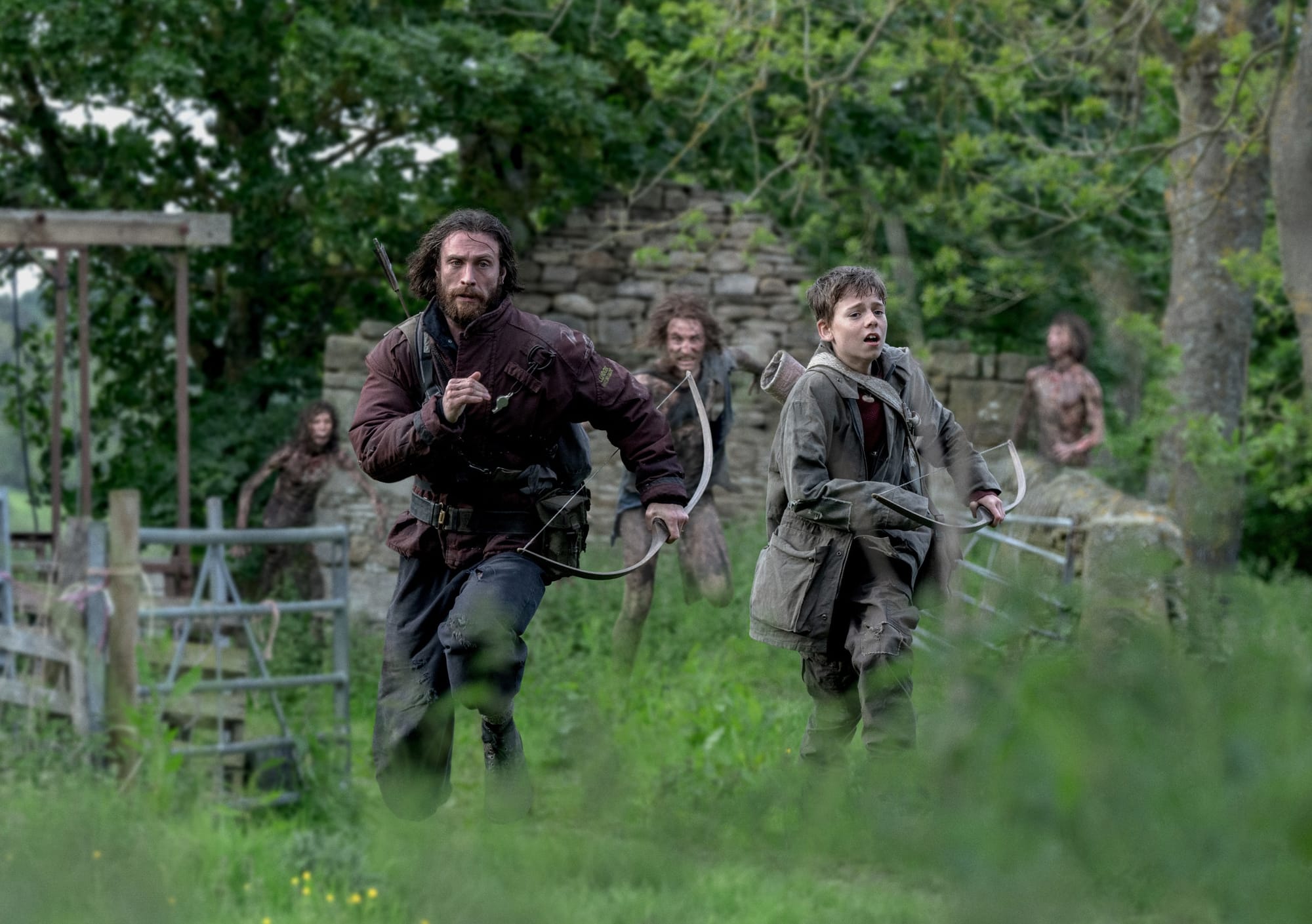
And yet, once the film is over, this first half of the movie really does feel like the first half of the first act. Yes, all of the big infected action is big and exciting. The discovery of the ritual sacrifice who has since become Infected is tense. The introduction of the Alpha is iconic and ominous. The fight to get to the shelter of the house captures the chaos and terror of a world where the best you can do are the limited arrows in your quiver. The race across the isthmus is heart-pounding.
None of that, though, is as interesting as Jamie when the two return home from their successful trip. More obviously, there’s the affair with Rosey, one that colors Spike’s perception of his father and leads to a break of trust between the two men. It’s douchebag behavior enough to have an affair, worse still when the affair is while one of the party’s partners has cancer. It disrupts Spike’s family unit. Things seemed fine when his father was keeping it together. Now it turns out that everything is a lie.
Yet, it’s more interesting that Jamie begins to build the myth of his son. He starts calling him giant killer, a reference to the alpha that they barely managed to survive when it chased them down the tidal causeway. It makes Spike uncomfortable, knowing that he only had the one kill and couldn’t make any other shots for the rest of the excursion, especially not when they were on the run for their lives.
For a film loaded with human moments, seeing Jamie’s pride in his son, regaling the town with stories is extremely human. While Jamie believes this is a good thing for his son, that it will boost his ego, and that it will curry him favor with the town, it only serves to push Spike away. Indeed, the fact that the next thing Spike does is follow Jamie only to discover his father’s infidelity makes the latter event have more impact. He just watched his father lie to the whole town.
If there’s a reason the father/son relationship is so tired, it’s because it falls into this sort of dynamic, one where sons have to reject fathers. Not that this should encourage sons to go into full rebellion. All it should do is force the question. Fathers are not saints. They’re just people without a guidebook and who are doing their best. Sometimes they’re good. Other times, they’re Jamie.
The Alpha and the non-zombie baby
This parenting metaphor extends to the middle of the movie, where a very pregnant infected woman gives birth on a train. In a moment of lucidity, Spike’s mother Isla helps out, making sure to take and care for the child after the soldier traveling with them kills the mother (she was about to attack; it’s justified).
Perhaps this is ridiculous, but it feels like the Alpha who’s chasing Spike after this is the parent of this child. For all of the violence and the big swinging dong, there is a sense of self-righteousness that isn’t present when we see him hunting before this. When he’s hunting down the squad that washed up on shore, it’s more chill. But this Alpha is on a mission, and not the one that sent the other across the causeway.
As the world has evolved, so too have the rules of the infected. This baby is strange and it won’t surprise anyone if it pays off later. But the Infected breeding is a really bad, ominous sign for whoever’s left on the mainland. If they’re able to breed, who knows if this will ever possibly end.
The Doctor who has a bottomless supply of morphine
And, of course, there’s Ralph Fiennes’s bone palace. The great thing about Fiennes is it’s not clear who you’re going to get. Someone intense, surely, but are you getting the malice of Amon Goth or perhaps the more dignified snark of Laurence Laurentz?
Given the production/promotional stills showed him as unclean (just like… covered in whatever), I’d assumed he would be some zealot. But that’s not what happened here. His character, Dr. Ian Kelson, is perfectly rational if not a little lonely. He’s covered himself in iodine and was once a practicing physicians. In the decades since the collapse of civilization, he’s spent a lot of time burning dead bodies to remove flesh and viscera, leaving the bones for him to create beautiful monuments to the horrors of the world.
It’s here where Spike’s mother dies. Afflicted as she is with cancer, her death is quiet and muted. Lovely, even. But this is one of those moments where Spike has to grow up a little bit. Without his mother, they would not have found the child he brings back to the island. Without his mother, he would have had nowhere to go once he’d discovered his father’s infidelity.
Garland having the cancer metastasize to her brain adds to the underlining. She speaks in odd references to the past, rarely completely present. She refers to Spike as her “daddy”, something that makes Spike uncomfortable. And yet, this is exactly the sort of situation that happens for people all the time. Parents raise children, then grow old. They get cancer and sometimes become sick and approach death. As that happens, the dynamic shifts. Children become caretakes for parents. Spike, having rejected his father, becomes the primary caretaker for his mother.
In a way, that is him becoming her “daddy”: someone who can care for her and work his ass off to get good answers. Spike’s journey in this movie is remarkable, even if it’s crazy that the character is only twelve years old. While he starts as a child, by the time Kelso takes his mother into the night for a quiet, easy death, Spike becomes a full adult in a short time span.
The arc is solid. The themes ever present.
Onto the Bone Temple
In the end, Spike finds his way to a random gang who are more than capable of taking out the infected chasing him. The final images are of the leader’s crucifix, the same as the one the kid receives from his father at the beginning of the film before he dies a senseless death. Again, we have another child with his father, the latter of whom is more than happy to die.
Yes, it means this movie doesn’t end so much as stop. The movie is functionally over when he brings the baby back and then sets off on his own to work through whatever shit he has to work through. This coda is the sort of mid-credits scene that Marvel would do, only Boyle & Garland make it part of the text.
This makes sense. There is a sequel. Nia DaCosta directed it. It’s coming next year.
As films have grown more serialized, this multi-film arc has grown more and more prevalent. Avatar is doing the same thing. It helps to sand off the edges of this that might feel dissatisfying. There’s more to come, but it’s not clear if this theme of parentage will continue on or if it’s merely the in for this movie. Maybe the next one will be about friendship.
All in all, despite not being a huge fan of the original film, this wasn’t nearly as rough a watch as I thought it would be. The iPhone footage was good and clear while the violence was overbearing. I don’t think I would have been able to stand Fiennes as some vicious sexual assaulter (which is a concern in the original film). There are still moments that were harder to watch and the tension was good throughout.
Weirdly, I’m really interested in The Bone Temple and whatever comes next. Maybe this whole thing will all come together in some grand Lord of the Rings style climax and denouement. As long as Garland is bringing his sense of anger and grossness to it I might be wary, but I’ll still be more than happy to see how he handles things next.