Stoikey Muzhik Values - Bridge of Spies
Spielberg's 60s Cold War drama depicts the American justice system at work and is more relevant today than it was on release ten years ago.
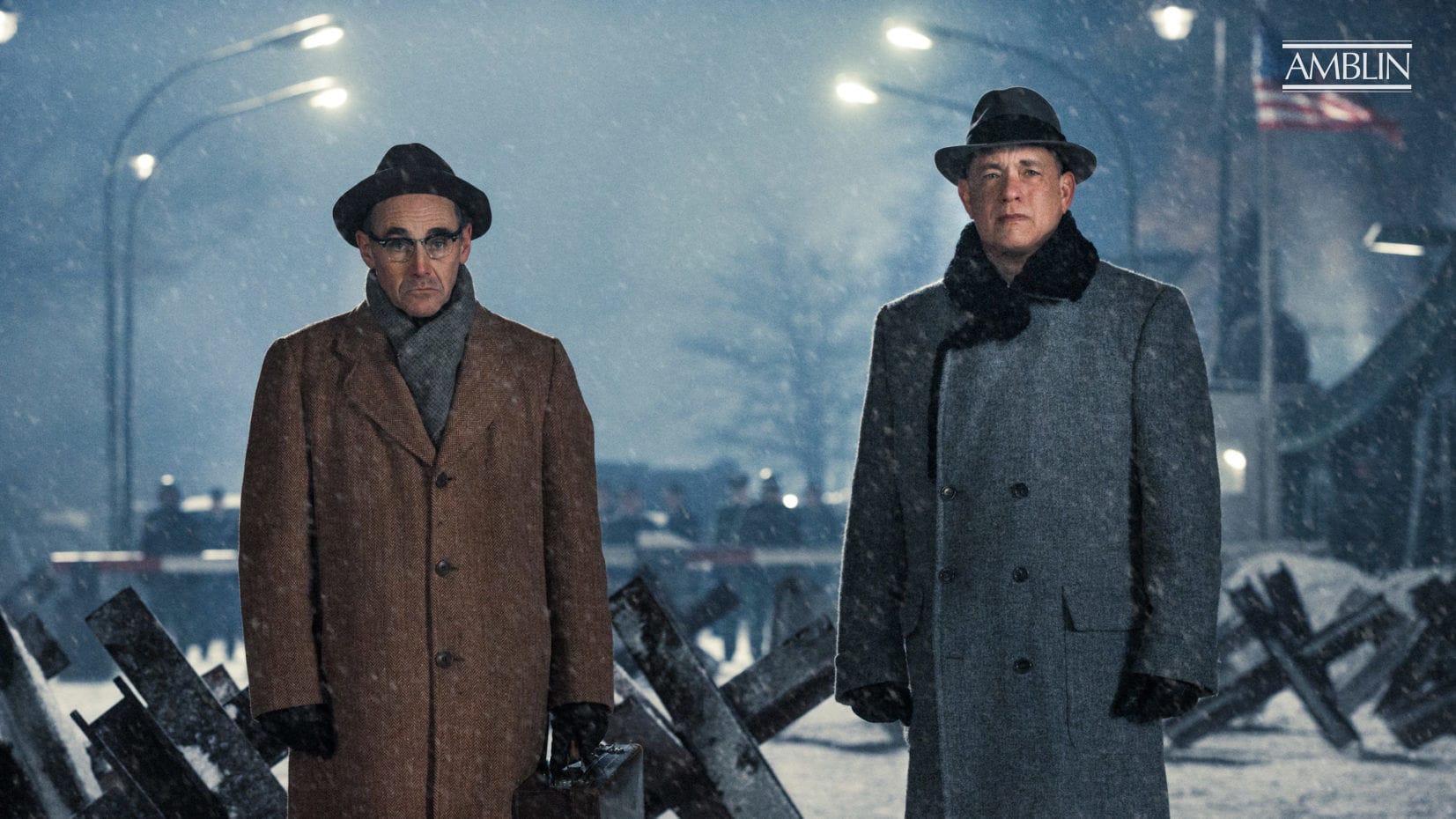
“It means, uhh… ‘standing man’.”
In 1770 British soldiers in Boston fired upon a mass of protesting American colonists, killing five. When the Recdcoats stood trial later that year for their participation in what became known as the Boston Massacre, John Adams defended them in court. Adams himself went on to become a prominent figure within the American Revolution and eventually ended up as the second President of the United States. But it’s that defending of the British Redcoats that’s my favorite part of Adams’s legacy. I’m some grand sympathist to the occupying British soldiers who fired upon the colonists, nor do I think Adams believed the trial was an unjust prosecution (he didn’t). It’s because Adams believed in the defendants’ right to a counsel at a fair trial. When no other legal entity stepped up to fulfill that right, Adams took it upon himself.
That predicate became the 6th Amendment to the U.S. Constitution and thus enshrined as one of the fundamental rights afforded to those lucky enough to live under the laws in this country.
Steven Spielberg’s Bridge of Spies came out in 2015. Set amidst the Cold War in 1957 and based around a real-life prisoner exchange that happened in 1960, it tells the story of one man, a lawyer named James B. Donovan (Tom Hanks) who takes up the case of one Rudolf Abel. Abel isn’t just an accused Soviet spy. His is an open-and-shut case. Every person with whom Donovan interacts makes it known what they all know to be true. This includes random passers-by, the judge assigned to the case, Donovan’s colleagues, his own wife, and Abel himself (who never denies the charges against him).
The parallels to Adams’s defense of the Boston Massacre Redcoats is intentional. The defense of Abel has its roots in this tradition. The film is not particularly subtle about it. What’s most impressive, though, is that this film came out ten years ago, over a year before the election of Donald J. Trump and the morassy quagmire we live in, where the president and his sympathizers have systematically worked to disregard various constitutional protections in the name of power and turning America away from its foundations as a beacon of democracy.
Director Steven Spielberg was ahead of the game when he made this film. He portrays Donovan as a beacon of heroic patriotism, a man who can set aside his own personal beliefs in the name of embodying the country’s grander values. Watching it now, this sort of upstanding moral backbone feels like something we’re rapidly losing in the face of a piss-poor authoritarian strongman. That makes it all the more powerful, pertinent, and valuable in these uncertain times.
Late Spielberg
With a filmography as long as Steven Spielberg’s, it’s not a stretch to say his career has ebbed and flowed based on his interests. There’s the plucky, hungry filmmaker of the 70s who’s finding his voice within themes of childhood, parenthood, and broken families. There’s the long quest to prestige recognition that culminates in Schindler’s List. There’s the general unmooring of the post 9/11 order that results in nebulous, inconceivable evils like War of the Worlds and Munich. Eventually he turns towards more patriotic fare like Lincoln and The Post.
With Bridge of Spies, Spielberg makes a film that is his most nakedly political. Donovan suffers the slings and arrows that come with defending a Soviet spy and applying America’s system of due process to a man who many feel does not deserve its rights and privileges. Even today, there’s a discussion of this two-tiered system of justice, where immigrants and those without legal status should not be those to whom America extends its privileges. More on that in a bit.
Spielberg himself has made very important movies with clear message: Schindler’s List, The Color Purple, Amistad, even The Post. He’s rarely subtle in those efforts, and most of his films lean towards the most populist direction. To aid in this, Spielberg has always cast his films very well, often finding actors and actresses just before they score their big breakout hits. Likewise, he has been able to get top-shelf actors for lead roles. With Bridge of Spies, he solidifies Tom Hanks as the actor with whom he has most frequently collaborated (and this isn’t even the last time they’d work together). Given Hanks’s cultural standing as “America’s Dad”, Spielberg understands the man’s career well enough to know that he can be an upstanding American character. Casting him as Donovan gives an air of untouchability and moral clarity to the central character.
If there’s a failing to the film, it’s that Donovan is basically a boy scout, where his biggest flaw is caring too much about the job his country calls him to do. He does this with seemingly little caring about the family he’s putting at risk. When an unseen assailant fires shots into the Donovan home, endangering his daughter, Donovan is outraged, but there’s never a sense that this attack deters him in any way from the duty he feels.
Hell, at times he shows more affinity for Rudolf Abel than he does for his own wife.
Espionage
To briefly touch on Mark Rylance, this movie doesn’t work without his stunning performance as Rudolf Abel. It’s his first collaboration with Spielberg and he absolutely deserves the Supporting Actor Oscar he won. This was only the second time Spielberg had directed a performance to an Oscar win (the first being Daniel Day Lewis as the eponymous Lincoln in 2012; the only other is Ariana DeBose’s win for West Side Story in 2021).
Appreciating Rylance is easy. He plays Abel with a disarming charisma, both soft-spoken and enigmatic. But he’s really gone for the back half of the film once Donovan heads to Berlin to ochestrate the prisoner exchange. It feels like there’s more of him because he dominates the film’s opening sequence, where we watch in silence as he paints a self-portrait and then visits a dead drop. The intelligence he obtains definitively proves he’s a spy. Of course, when law enforcement finally arrests him, he is without pants and acts the dottering old fool, so perfectly oblivious that even though the audience has seen him actually perform spycraft, there is a second-guessing that takes place. When he gets a second to himself we see him destroy evidence of his espionage, a brief but perfect slight-of-hand.
And yet, despite the proof we’ve seen, it’s hard to not care deeply for the man. Indeed, it’s probably part of why Donovan fights so hard for him in the first place.
That, of course, is what Rylance brings: humanity. Abel’s existence as a complex, multi-faceted, yet soft-spoken individual underlines the importance of the system Donovan is fighting to protect. Abel deserves a fair trial because everyone, regardless of how onerous, deserves a fair trial.
The diametric opposition to Abel is Francis Gary Powers (Austin Stowell), an American pilot whom the Soviets capture during his mission in a U-2 spy plane. Unlike Abel, Powers confesses to parts of his mission and the Soviets convict him in a big public trial. In his first meeting with Donovan, KGB operative Ivan Schischkin (Mikhail Gorevoy) points out that Powers’s actions (if true) are tantamount to an act of war. Even Donovan in one scene refers to Powers as the most hated man in America (aside from Abel and perhaps himself). To both sides, Powers is a tremendous liability. Indeed, Spielberg makes Powers sympathetic, but hardly provides to him the level of pathos he gives to Abel. Even in the end, when Powers is telling Donovan that he didn’t tell the Russians anything, there is a sense of him in pure self-preservation mode.
For the purposes of history and the plot of the film, Abel and Powers (alongside innocent American college student Frederic Pryor) are pawns in a game of global espionage. They’re tools, with value based on how much they have and have not revealed to the enemy. Based on Donovan’s interactions with his CIA liaison Hoffman (Scott Shepherd), the system has reduced these men to a value that has nothing to do with their actual humanity.
Indeed, the Soviet carceral state is awful, dragging Powell out of bed in the middle of the night and forcing him to answer questions under duress. Meanwhile America at least treats Abel with the barest level of dignity it can afford to a human being. They give him a trial and incredible legal counsel in James Donovan. He receives paints and a radio and a gentle rousing to wake him up for his extradition. Powers gets water to the face. Even Pryor gets the shit treatment, forced to walk around his cell, trying to stay warm, an armed guard peering down on him atop the chain link fence ceiling.
This is all unacceptable.
Justice is blind
Watching this film in 2025 is a very different experience than it was in 2015. Back then, the Soviet and East German dispensation of justice played differently. This is just how “those societies” operated. What makes them so different from us? Well… constitutional protections, I supposed. But that was always a nebulous idea, buried under stratified laws and codes that make up our patchwork system. Given that the due process and rule of law of the United States has been operating procedure for centuries, it was so easy to take all of that for granted. It was enough.
That simply isn’t true anymore.
Americans are currently living in a country whose government is actively attacking the rule of law in every aspect of life. This can be as sympathetic as wanting to deport illegal immigrants who commit violent crimes or as unconstitutional as the President singling out a woman he doesn’t like and saying he will strip her of her citizenship and deport her simply because he doesn’t like the way she talks about him.
The reason the Bill of Rights happened was as an addendum to include all of the things the founders left out of the original founding documents. They built a three-branch system of laws and order and structure, making sure that none could have dominance over the other two. What they failed include were any protections for the citizens from their government. These included the rights to free speech, public protest, and religion. They codified due process and specific rights for those who found themselves on the wrong side of the American legal system. It might not have been the intent at the time (the founders explicitly wrote slavery into the Constitution after all), but these protections were to apply to all equally. Without that guarantee, who knows what knots the government would tie itself into in order to win the outcome it wanted.
To be perfectly fair (and this is true for any state), the state has very little interest in treating anyone with fairness. The state’s goal is always to further the state’s aims, whatever those might be. The protections it affords to its citizens are a concession the government has made as part of its social contract. As far as the state is concerned, a person within a state is only as valuable as what it can extract from that them.
For all that the citizenry views Powers as a wretched, detestable individual because of his actions while in the line of duty, the American government/intelligence community values him far more than some unjustly detained kid like Pryor. Pryor was in the wrong place at the wrong time and otherwise devoid of wrongdoing. The American government is more than content to let him rot away for his foolish actions. As for Abel, the only reason the judge presiding over his case doesn’t condemn him to the electric chair is because Donovan convinces him that something like the Powers fiasco might happen.
Even as Donovan is trying to make this complicated prisoner swap happen, Hoffman tries multiple times to jettison Pryor from the deal. We, of course, know that Donovan is making progress in the negotiation, but it’s easy to see where Hoffman is coming from. All he cares about his Powers. Even on a human level the man admits that it sucks what happens to Pryor but he doesn’t prioritize that base level of his own humanity and empathy. What matters is the job. The government has entrusted him to protect America’s concrete interests in the Cold War, not the soft power of American ideals.
America’s justice system might have protections for those who work their way through it. Sure, there’s a right to prevent unreasonable search & seizure, to confront one’s accuser, to not provide self-incriminating evidence, and to have a trial with a jury of one’s peers, but America has worked for decades to twist and distort those protections where it can in the name of expediency. Criminal prosecutors will throw every conceivable charge they can in order to deter the accused from taking their cases to trial. It doesn’t matter if someone did what they’re accused of or not. It doesn’t matter if they could probably beat it in a trial. The state’s goal is always to procure a conviction (as is the state’s prerogative). They have the capacity to make an lengthy litigation as difficult as possible.
This leads to a tiered system of justice. Most defendants plead guilty. Others have money and the ability to pay for high-powered attorneys. With those resources, a defendant has every incentive to drag out their defense all the way to an acquital. It’s what happened to Trump in the four years between his Presidential administrations. Nevermind that he was a former President. Most defendants don’t have the ability to burn money like that, rack up insane legal bills, and then bill them back to the Republican National Committee or the followers who believed him to be some victim.
All of this is to say nothing of the current crisis as the Trump Administration has started deporting individuals. Doesn’t matter if they’re an immigrant or a refugee. They might be a naturalized (or even born) citizen or have gone through the steps to procure some sort of legal status. The Trump Administration’s current argument is that processing all the people it wants to deport is “too much work”. Bringing them before a court of law and affording them due process is “too time-consuming.” Just trust them, they say. These are bad people. Take their word for it. Ask Kilmar Abrego Garcia or the dozens of others rotting in foreign gulags how that’s working out for them.
It’s this exact thinking that Donovan is fighting in Bridge of Spies. These protections apply to all peoples in the country regardless of status. That’s the point of freedom and equality. The state must entitle everyone to the proper protections as part of its compact. It is the right thing to do. Once we start depriving people of various rights for… any reason, the question becomes when does that stop. It is much harder to do it this way, but this is also the flipside of Justice being blind. That blindness doesn’t just mean equality within the dispensation of justice, it also means equality has to come before the powers that be even consider the justice itself.
Justice cannot make a determination prior to the process. She is blind.
Inalienable does not mean assumed
For all the adversity Donovan experiences over the course of this film, in the end it is his humanity that allows a system as benevolent as America to work its magic. Everyone tells him to drop it. To them, Donovan’s role is merely the fig leaf to add legitimacy to what everyone knows is a fait accompli. They’re correct in the end. The jury convicts Abel. The judge denies Donovan’s immediate appeal and the appellate court also denies overturning the conviction. Yet, paying lip service to core, inalienable rights presages our allowing them to slip away. These rights cannot be perfunctory. They cannot be something we only do for appearances. We cannot assume them. That’s why we wrote them down in the first place. Over the last two and a half centuries, they’ve formed core values of who we are. The second we start treating them as anything less than that, we start sliding down a slippery slope that calls every right into question.
Bridge of Spies is an incredible film for this reason. The most consistent critique of Spielberg is about his schmaltz, sentimentality, and optimism. But what is more patriotic than using quixotic fantasies to demand more? Spielberg’s values… those are patriotic values. Showing us America at its absolute best, when its finest citizens demand it live up to its values no matter how difficult? Nothing is more patriotic than that.
In the final scene of the film, Donovan sits on a train. It’s an echo of the scene from earlier in the film when he was a social pariah for his full-throated defense of Abel and his constitutional rights. At the end of the movie, a woman notices him and gives him a faint smile of recognition and pride. Donovan returns the look, but then goes back to staring out the window. The reward for Donovan’s heroism is not glory but anonymity. In the end, he’s just a citizen, taking pride in the duty he does for his country. The job over, he returns to civilian life.
America has no shortage of upstanding individuals, its Washingtons, Lincolns, Tubmans and Roosevelts. But it’s also got millions upon millions of Donovans: kind, anonymous patriots, who represent the best that America can be even when so many others fall short of its lofty promises. America’s incredible slate of values begets citizens capable of embodying them.
Right now is a bleak time. At best we currently take those values for granted. At worst, we shit on them so others can lie and returns us into some past version we never were. These people wish to make America smaller, lesser, and far less remarkable than its infinite promise.
Instead, we can be the country that Donovan tries to represent. All it takes is a little patriotism, the courage to believe that it’s possible, and the conviction of Stoikey Muzhik.
The [Midnight] Run to 250
Like so many of these movies I’m writing about, this wasn’t in my 2022 Top 100. Given my reaction to it now, there’s no way this isn’t making it. Hell, just going back to it for this has bumped it into my Spielberg Top 10. Last time, only four Spielbergs made the list. Now… maybe a dozen will be in the final version? Can’t imagine this doesn’t make it, especially in this political climate.
Next time… a double act for the ages: De Niro is a bounty hunter and he Kerouacs with Grodin. It’s time for a Midnight Run.