"The Story & the Engine" - Doctor Who s15e05 Review
Gods, Monsters, & a Giant Spider? Must be Saturday...
When was the last time Doctor Who went to Africa?
Ever since watching the trailer for this week’s episode, that idea has been pacing through my brain. Season 11’s “The Demons of the Punjab” was the first time the series (on television at least) had gone to Asia at all since… “The Abominable Snowmen” in 19671? More interestingly (shamefully?) Doctor Who has stayed extremely western civ-centric since the end of that first season. If they go to Earth, it’s almost always euro-centric (with America slotting into that western-civ aesthetic).
But Africa? Has the show like… ever been to Africa? “The Daleks’ Master Plan” has an episode that’s set in Ancient Egypt, but that’s just a stop over for one episode as The Doctor, Steven, and Sara Kingdom try to run away from the Daleks.
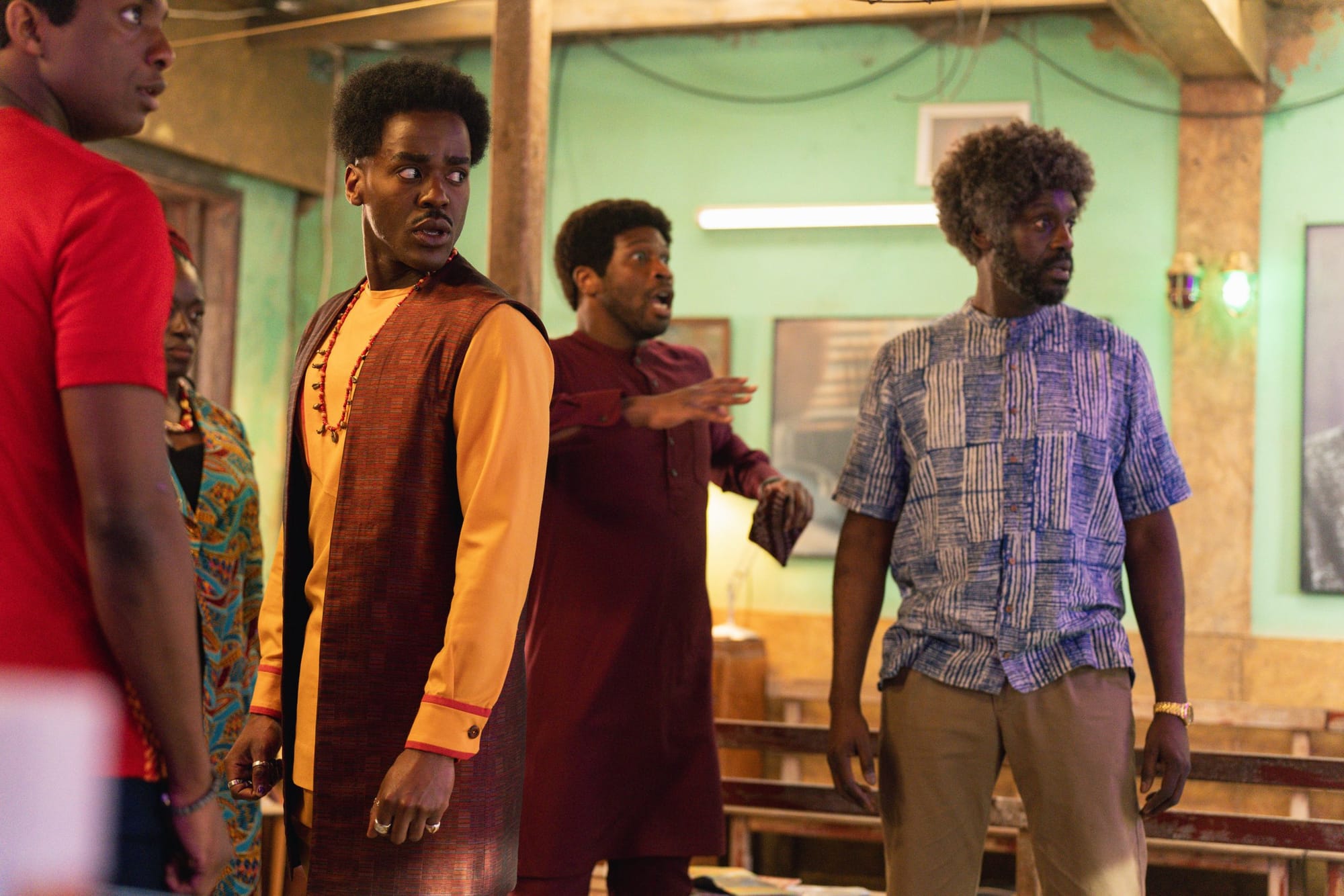
Yet, here we are, with Inua Ellams (the first black male writer in the history of the series) writing a story set in a barbershop, which itself is located in Lagos, Nigeria. It’s about an evil barber who forces his customers to tell him stories. Those stories power a giant spider. The spider is
Is there a better example of how Doctor Who is when it’s operating at its best like this?
Business as usual
I don’t remember the last time an episode of this show left me so utterly bereft for what to say about it. Despite watching the episode on Saturday, I spent the rest of the night staring at the screen just trying to figure out what to even say. Even now, I just rewatched the episode to try to pull more things out of it. Alas, I am still here, stumped as to what I could possibly add to this conversation.
Because the truth is that this is basically everything Doctor Who does. At a very base level, The Doctor arrives at a location with a problem, he works through it, devises a solution, and then saves the day. That’s really all that happens in this episode. And while that can get repetitive over the show’s six and a half decades, there’s usually enough interesting story elements or wrinkles to make that not an issue.
And… yeah. This has plenty of new all over it. The African setting is unique, and using it as an excuse to show Ncuti Gatwa in an environment that so fundamentally accepts him is a far cry from the episode in this position last year2. The joy on his face is exuberant, the connections he makes so warm. We might not spend a lot of time in Lagos proper, but it stands out as a location simply because of the novelty of the thing.
So, too, an episode with aa “no Whites” cast has…. never happened in Doctor Who? And they do it without ever once bringing attention to it. They simply tell this episode as it needs to be told.
Not only that, but this episode is almost certainly “a cheap one”, considering that it consists of mostly one set and aside from the visual effects of the giant mechanical spider stalking across its web. In this respect, this is a story that The Classic series could have done (though more drawn out, certainly). Yet Inua Ellams never makes the story feel small, bouncing around the characters to give it a grand feel and having a moment of action in the middle by treating the entryway to the barbershop as an airlock.
New voice
And yet, this feels so far from normal, playing into the meta aspects of narrative as it does. The Doctor likens himself to a story, bumping right up against the very soul of the series itself to make the meta argument that there simply isn’t a better television program in the history of the medium. The only story The Doctor tells while he’s in the Barber’s chair is of Belinda going through a normal, average day, yet almost immediately the engine charges more than usual and the spider accelerates. It ends with The Doctor consolidating his life down to a six-word story and the argument that the series itself will never end because it can never end.
“The Story & The Engine” is just the most recent in a long line of stories that play with the idea that Doctor Who as a show is self-aware of its own existence as a narrative. The obvious choice in this respect is “The Mind Robber”, where The Doctor, Jamie, and Zoe find themselves in the Land of Fiction. But we’ve also go Moffat’s entire run as an even better example. In “The Big Bang”, Amy’s memory of The Doctor pulls him out of her brain and into her wedding, which itself comes just shortly after The Doctor says to her “we’re all stories in the end. Just make it a good one.”
And also, “Lux” this season played with this several times, in case those are all too far back.
Really, the remarkable thing is how effortless Ellams makes all of this look. The relationship between the Barber and Abena is rich despite it being fairly sketched out. So, too, the relationship between The Doctor and Abena is utterly delicious, buttressed as it is by the wonderful cameo of Jo Martin as The Fugitive Doctor. There’s a tremendous economy in this without it ever feeling shortchanged, and the way The Doctor eventually gets Abena to betray the Barber is excellent.
But then there’s like… the amazing things this episode does, from the sheer concept of a barbershop that works like this to Abena weaving the layout of the Barber’s labyrinth into The Doctor’s hair, making his head its own map for how to find the heart of the Barber’s evil scheme. Again, The Doctor is coming up against Gods, which doesn’t just include The Doctor fighting Lux, Maestro, or the Toymaker, but also dates back to the 7th Doctor’s dalliances with the Gods of Ragnarok, Fenric, or even Huitzilopochtli in the novel The Left-Handed Hummingbird, and the 4th Doctor’s fight against Sutekh and the Black Guardian.
Only… the twist that the Barber is not, himself, a god is a magnificent one. It helps to show just how powerful humans can be when they harness the power of narratives for their own particular end. Stories are the basis for our culture, society, and even morality. To control the narratives and what we talk about is to help inform who we all are. Weaponizing that is an idea derived from staggering genius.
Also, all the hair in this episode is unreal, including the Barber’s, where it starts up and tall and by the end has morphed into this ultra chic swoop thing. God it’s so good.
New blood
The hype was real for this episode. Gatwa cited it as one he was so excited for the rest of the world to see. And he’s right. But this is what happens when the show pulls from wildly diverse voices. While I’m a big fan of the original Davies era, there’s always room to bring in these new perspectives even if it does add to the work of “make it producible”. There are times when it doesn’t work, but when it does you get stuff like Christopher Bailey’s “Kinda” or Richard Curtis’s “Vincent & The Doctor” or even something like Vinay Patel’s “Demons of the Punjab”. While not all episodes work for all people, being able to pull from all the different corners of the earth is only going to strengthen this show as it moves towards the future.
Thank god Davies recognizes this. If he didn’t, this episode never would have happened. Without it, we wouldn’t have the show, once again, expanding what is possible.
That’s all I want from Doctor Who. It’s all I ever ask for. This gave me that and all I want to do is hug this episode close and let it never go away. It’s not even going to be my favorite episode of all time. Might not even end as my favorite of the season. But in terms of what Davies has done since the show moved to Disney+, this is the episode I certainly cherish most in this respect.
God I’m going to be so sad when this show is cancelled.
And… yeah. I’m shifting some stuff around in the rankings. IT’S A LIVE RANKINGS.
Season Rankings
- The Story & the Engine
- Lucky Day
- Lux
- The Well
- The Robot Revolution