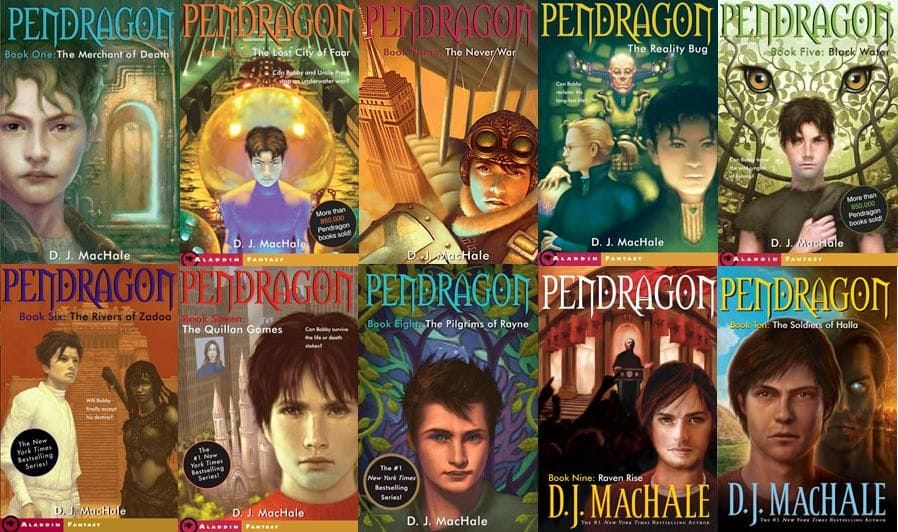
The Pendragon Series by D.J. MacHale - Foundational Texts
Sometimes, you should never meet your heroes
This is the first in an ongoing series of essays about texts, narratives, and the like that formed my views, perspectives, and philosophies. While many of these are some of my favorite things ever that I could endlessly gush about, this is a reflection on artifacts from history, the impact they’ve had for good and for ill, and the lessons I walked away with when they were finally complete.
In 8th grade, my school had a book fair. While I was still a voracious reader at the time, it was always easy to get overwhelmed whenever all the carts rolled out with shelves lined with endless volumes. It was like going to the nearest mega bookstore but better. At a book fair, there was nothing outside of what we could handle.
A friend went before I did. While he was there, the attendant had recommended a book to him. She said if he liked Harry Potter1 this was the new fantasy hotness and he wouldn’t be able to put it down. It was almost 400 pages. By the time I walked into the book fair, he was already over a hundred pages into it. He’d started the night before. He couldn’t put it down.
The book fair had the first two books in the series. When it was my turn to go, I made a beeline and picked up both, planning to pick up the third when it came out in a few weeks. Looking back now, over two decades later, the person writing this right now is jealous at that younger version of himself. That 13 year-old had no idea what was about to happen. I had just picked up a book that would change my life, setting me on a course that would define every subsequent moment. More than even Harry Potter2, The Merchant of Death, the first volume of D.J. MacHale’s Pendragon series is probably the singular most important book I’ve ever read.
The journey started in 2002 with the promise of a crazy, mindblowing adventure. On the first pages, a boy wrote a journal entry. He wrote about traveling across the stars to a different world of castles and creatures, kissing the girl he liked just before he left, and preparing for an epic war between good and evil. It was the first of may, many nights where I stayed up late because I couldn’t stop reading.
By the time I reached the end in 2014, the promise had shattered into fragments crushing disappointment.
An Epistolary Start
I think I read The Merchant of Death in three days. I remember reading it while my mother drove me to piano practice and I remember reading it on the drive home. I remember comparing notes with my friend the following day and us being neck and neck on who would finish first. I stayed up past my bedtime reading, transported to another world.
The basic idea is simple: Bobby Pendragon is a Traveler. In the first book The Merchant of Death, his Uncle (also a Traveler and from whom Bobby derives his special powers) takes him to a very traditionally classic Western European sword and sorcery fantasy world called Denduron. While there, he learns about a big fight between good and evil, in which Bobby and his fellow Travelers try to save these various worlds (territories) from the machinations of the evil Saint Dane. His goal? To sow chaos and destruction in these territories, tipping them into discord.
The Travelers always arrive near the time of some great tipping point. They must figure out Saint Dane’s plan, stop him, and save the territory. Fail to prevent whatever his plans are and the territory will tip to chaos, destabilizing the fabric of the universe. There are ten territories, one for each book.
It’s not like this is some revolutionary idea. Good and evil. Chosen one narrative. Interspace/transtemporal travel. But originality does not have to be some litmus test of quality. We might have seen a thing before, but sometimes if it’s just well done and unique enough it can speak to us. For all that I will end this by shitting on D.J. MacHale probably harder than he deserves, the dude tapped right into my 13-year old brain and completely re-wired it.
The novels take the form of an epistolary (that’s a fancy term for basically a series of one-sided letters). It’s all written from Bobby in retrospect, him taking time to journal in the middle of the adventure to recount what had happened to get him here. He sends these journals to his best friend Mark Dimond, and we read them as he does. Very early, Mark corroborates Bobby’s story with a popular girl named Courtney Chetwynde (the hottie Bobby makes out with at the beginning of the first book), and when she confirms that, yes, she was the last person to see Bobby before he left and that they did, in fact, make out like Bobby had claimed, it helps the two of them confirm that Bobby’s adventures are real. We follow them as they follow Bobby. And gosh was it gripping.
As these stories go on, the mythology gets bigger and bigger. Whenever I got my hands on the next volume I devoured it. The second book (The Lost City of Faar) takes place a giant ocean-covered planet and plays in dope aquatic-sci-fi Atlantean setting. The third (The Never War) takes place on Earth in the 1930s, threatening to destroy Earth’s entire timeline, including the time where Mark & Courtney are contemporaneously reading and a territory that’s just far-future Earth. The fourth (The Reality Bug) takes place on a planet that has developed virtual reality so believable that no one wants to live in real life any more… And that book rules because it’s the first time Bobby and his band of Travelers straight up lose. They don’t save the day. People fully embrace the VR tech. That Territory devolves into chaos as society collapses. Saint Dane wins.
At no point could I willingly put these books down. I had to know what would happen next for these characters I so deeply cared about. Bobby losing was like watching Empire Strikes Back. It was like seeing something remarkable happen before my eyes. I had to know what happened in the end.
And then I went to high school.
And all my fun recreational reading stopped.
This happened to everyone, right?
As the English classes piled up, as the homework grew, as more and more television took over my life, all the reading that I did as a kid quickly dropped away. I remember getting the fifth book (Black Water, which is the one with the talking lions) when it came out, and I remember it teasing me for years. It’s not that I didn’t want to read it, but I just didn’t trust myself with these books eating up my time. If I started reading it, there was no way I would stop until I finished. Given the unpredictability of high school, it fell away.
But then… something happened. Pendragon stayed in my brain, acive and gnawing. I don’t remember what it was, but I had an idea that was deeply similar, that played on the same imagery and was a flagrant freaking ripoff only with a bit more Sliders to it. Basically, it was “what if Pendragon were Sliders?” but with a few barely different tweaks to it. And that… is the first thing I ever wrote. I wrote the five page first chapter. I showed it to my 9th grade English teacher and she said liked it and that it was promising (she was almost certainly being very nice). I showed it to my friend who’d read Pendragon and he said “dude this is just Pendragon”.
But I didn’t care. Because… it felt good. And that first thing I wrote turned into a 150k word project I turned as my primary project for senior year, encompassing the first three worlds my characters went to. I had more planned— still do, truth be told. For all that it’s changed in my head in the two decades since I graduated from high school, the actual marbles of it still bounce around in my head on a regular basis, wanting to come to life. The underlying conceit is similar, but the mythology has greatly evolved. Yet the characters themselves, their arcs, where they end… a lot of that is very much still the same.
It’ll happen for real. Some day.
But that’s just what I read…
I read the fifth book, Black Water, at some point in college, while on a summer vacation. Gosh I remember it vividly. I picked that book up and it sucked me into the narrative again, reading late into the night for the first time since Harry Potter3 had ended. By this point, that humble beginning as a doodling writer had evolved to college courses and an effort to seek it as my career/profession.
Being more mature, I recognized the more cheesy aspects of the story, but that was excusable for what it was. Maybe I was outgrowing the books, but that was okay. I was back with my friends and this series.
Well after college, after all the books had come out, I decided to pick them up again. Without the excuse of papers and classes and work, it seemed like the time was right.
The sixth book (The Rivers of Zadaa) was a solid outting until a cop-out ending, while the seventh (The Quillian Games) was a trite and predictable romp until an excellent twisty final act. The eighth book (The Pilgrims of Rayne) was a snoozefest until about the halfway point, at which point MacHale reveals it to be a sequel to the fourth book (the first time Bobby lost and his first great haunting shame). The revelation was staggering and I remember losing my freaking mind about it. Ten years after I first read that fateful ending and the prospect of an adventure secretly set in the aftermath still set my brain on fire. Hell, it still does.
The ninth book (Raven Rise) was set on contemporary Earth and followed the actions of a cult leader threatening to destroy the world. Spoiler alert: he does, and the book ends with Earth being destroyed, cast down into some weird ass portal or something and leaving the readership on an insane cliffhanger. For all my misgivings, I vividly remember finishing that book and (while I was frustrated with MacHale’s annoyingly regular mythology obfuscation) being thrilled to see how it would end.
Never meet your heroes.
One day, I’ll start yet another never ending series of Substack posts, only this one will try to figure out when it’s possible to determine a narrative’s exact moment it isn’t going well and/or going to get better. Sometimes, it doesn’t take very long (maybe even the first shot), and others, it’s a slow descent as the film slowly reveals itself.
With the tenth book The Soldiers of Halla, it was clear almost immediately that there was a problem. One of the frustrations with MacHale’s storytelling throughout the series is the constant obfuscation of what’s really going on in the mythology. The previous generation Travelers would tell Bobby and co. to wait. Saint Dane would constantly lord threats of “boy you have no idea what’s really going on here, do you?” over the hero. It felt like walls thrown up for the sake of it. Finally. Book Ten. The finale. Answers.
So MacHale gives answers. By spending the first 75 of a 600-page book on long monologues to explain the series’ mythology to this point. Finally. Answers. In exposition dump form.
The second problem is the complete lack of stakes. MacHale wanted the big finale to matter, and so he made the penultimate book about what his readership thought the final book would be about: contemporary Earth. Bobby’s home. In doing so (and letting that Earth fall), he created insane stakes, only to find that the final book was about… a future Earth that might just keep everything stable enough for the universe to survive. The problem? Why would his audience care about the Earth of the far future?
While the book does have fun sequences (there’s a point where Bobby skips across worlds that’s pretty neat, only possible because he now knows the secrets of the universe), there is never really a sense of peril or danger. When Bobby confronts Saint Dane early in the book it’s all quips and making the evil villain look pathetic and unthreatening when like… I don’t know. Maybe there should be stakes. The rest of the time is Bobby acting like the arrogant sot he always was, only this time he also knows everything, meaning that there’s no way to undercut that arrogance.
In the end, the climax of the book is a ten page fist fight between Bobby and Saint Dane. MacHale tries to make it interesting. There’s cool imagery like them falling between worlds as exchange blows but… it’s still a fist fight. And Bobby wins the fist fight. Because… fist fights have to have a winner.
When Bobby brings Saint Dane forward to hold him accountable for the crimes and him having lost, it turns out that the rest of the plot just slotted into place behind the scenes while Bobby was doing his fist fight. So. That’s cool. And then Saint Dane just kinda… dissolves because it’s a fantasy series. Because the whole book is a lecture about how he was never going to win because that’s not how this story goes. Even though…. we saw him win. Multiple times.
To cap it all off, the book then gives Bobby his happy ending… by resetting the timeline and jumping decades into the future where he’s on his death bed. We read over a few pages all the things that happened over a life we never saw (or cared about). He married Courtney (obvious) but Mark died really young and unexpectedly because shrug that’s just life I guess. In the end, his Uncle arrives and gives him his journals again (all the books we’ve just read) so that Courtney can read them to him and he can know what his real life really was.
To put it lightly, D.J. MacHale’s narrative spun so wildly out of control that his series completely fell apart. He delayed mythology reveals for the sake of doing so and ended up having to dump it in dozens of pages of exposition just to catch up. Maybe if I had been a teen I would have loved it, but I also like to think that maybe I would have thought it was a waste of the precious little time I had left with the characters. He so completely screwed the universe in the name of stakes that he needed to hit a reset button on the end, but instead of giving us the promise of what these characters’ lives would be, he restricted it to a world of what they would have been instead. Happy, yes, but not a life he’d spent thousands and thousands of pages writing about. It’s relegated to the last five pages4. And this timeline doesn’t even have one of the three central characters of the series. Just because. Because that’s life, apparently. People die. Nevermind that it’s MacHale’s choice that that happened.
It was, to put it mildly, Pendragon is the most disappointing narrative in my life.
In my head I threw the book across the room. I don’t think I did, but it’s the closest I’ve ever come to it.
The Lesson
MacHale’s Pendragon series is still on my shelf. From the weathered copy of The Merchant of Death (which I did re-read before jumping back into it as an adult) all the way through to the Soldiers of Halla. I can’t bring myself to part with them, and despite all my frustration and the knowledge that I don’t think I could ever bring myself to re-read something that has so fundamentally shattered backwards from its ending, I don’t plan to.
Because the thing is that within Pendragon I find the richness of a whole narrative experience. I’m sure there are plenty of people out there who love the ending and thinks it’s perfect. I’m sure there are parents my age who are handing the books to their kids so they can get them hooked on reading something that’s written to be mad addictive.
For me, Pendragon is the promise of writing, that one thing that expanded the possibility of what life could be. I owe this series more than just about any of these other foundational texts for the simple reason that it’s the one that first quantified that writing was a thing I could do. It made it seem possible. Others might have gotten me there when I got to them eventually, but that’s not the life I lived.
On the other, it’s the sting of infinite disappointment. I’m a defender of many, many story endings that are controversial (just wait until you hear all my takes on LOST), often times analyzing and evaluating the artist’s intentions to determine they thought most important to the story. But in the end it’s clear that MacHale was only interested in this series at its most visceral, superficial level. There’s barely a theme, no overriding perspective on the universe. It’s just an innocuous tale of adventure that ends in a knock-down drag out fist fight, where the only thing that matters is that it’s fists connecting with bodies.
In the end, this series is the great disappointment of my narrative-ingesting life. Its reality is such that it will never not be a cautionary tale of how stories can burn bright and then crater far beyond what was possible. As a foundational text, it is almost entirely a dark cloud, tinged by the barest glint of silver that brought me to this moment and all moments.
May we be so lucky to have narratives that, despite being as overly simplistic as Pendragon, can contain the wondrous multitudes of such complexity.