The Michelle Williams Back Tattoo - Synecdoche, New York
It's so much more than a trauma metaphor
Drop into any minute of Synecdoche New York’s 124 and there’ll be something to glom onto. Barely any time will go by before the movie’s strangeness hits a breaking point and there will need to be a brief pause to double check that this is really happening. To collect oneself.
The reveal I keep coming back to happens at the 48 minute mark. At that point, Caden (Phillip Seymour Hoffman) is squabbling with his wife Claire (Michelle Williams) about the guilt he has over not being in his daughter Olive’s life. The Olive thread is a massive knot of abandonment guilt and a larger metaphor for the grief of not seeing her grow up. To explain this, he points to a magazine picture of her. “She’s tattooed,” he repeats.
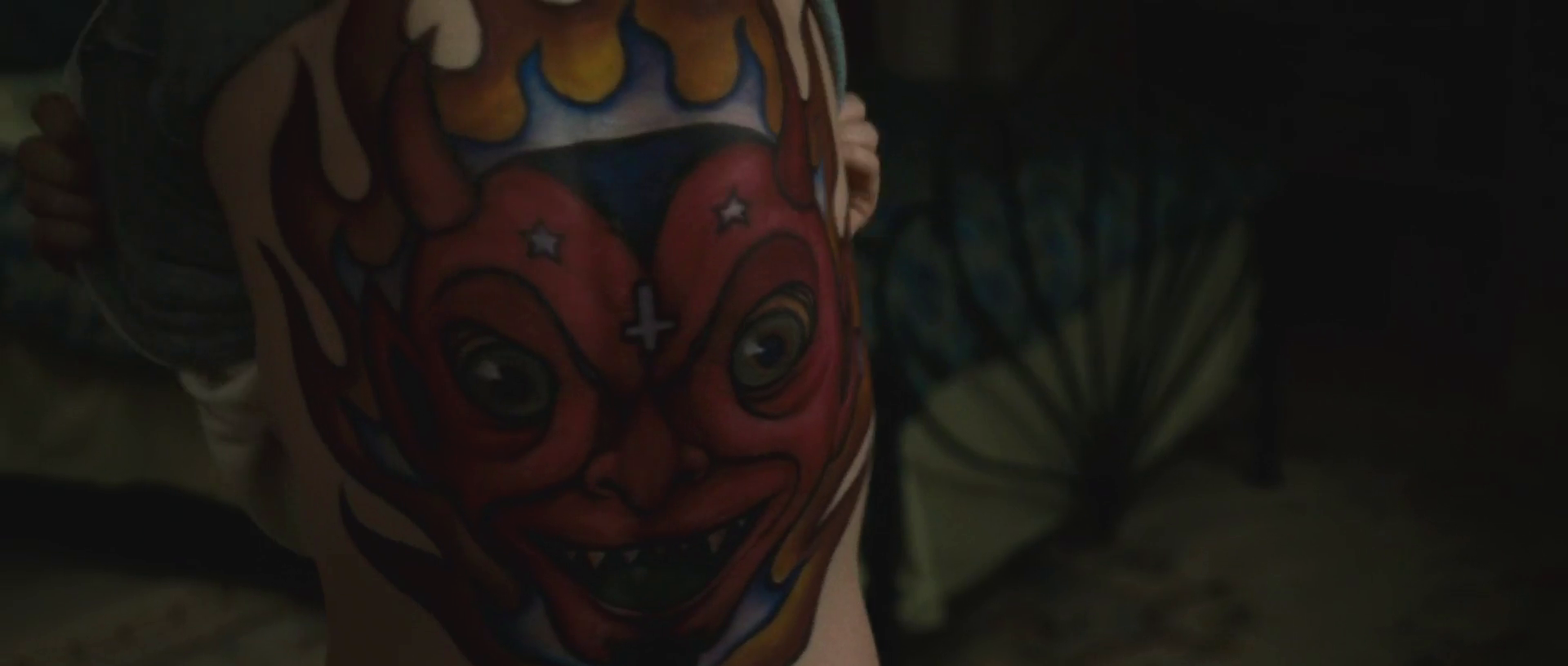
To which Claire replies “everyone is tattooed!” She turns around and lifts up her shirt, exposing a massive red demon face, with sharp teeth and an upside down cross in the center of its forehead. It’s surrounded by blue and orange flames. Despite being on screen for maybe 36 frames, the arresting visual leaves an impression. It can’t not.
Caden’s response: “Okay well I’ve never seen that before.”
There are a million moments to talk about in Synecdoche, New York, tons of similar visceral images that are simultaneously grotesque and beautiful. There’s the euphoric and the tragic, the surreal and the sublime. But the tattoo leaves an impression. Obviously because writer-director Charlie Kaufman isn’t talking about tattoos.
He’s talking about everything.
Opening meaning wide
Is I get older, I find myself drawn to stories that have more open meanings. This love of grand metaphors is perhaps that’s why I’ve recently gravitated to the films of David Lynch or thrived in Erin Morgenstern’s The Night Circus and The Starless Sea. Most craftspeople worth their salt can weave a complete narrative together. They can even make it beautiful. But that doesn’t mean most can create narratives with a foundation in an open meaning.
This idea of open interpretation came up in a Shakespeare class in college, where the professor explained that one of the reasons Shakespeare has lasted in the canon for so long (amongst many others) is because he did not sow definitive meanings into his work. His plots might be solid, but he left a lot to interpretation, a lot for the actors themselves to fill in. His use of language punned bawdy jokes that most audiences nowadays can’t catch. Modern ears hear things in a different but no less valid way.
As stories have grown more sophisticated, this idea of opening meaning has likewise matured into something able to be far more abstract. Artists have always had an interest in using open metaphors to reckon with human existence, but given the post-modern world we live in (and god are we in need a new era), abstraction has become easier and easier for artists to exploit.
To use a counter-example, Edgar Wright’s The World’s End features a Swiss watch of a plot, one that cleverly uses the idea of a one-night bar crawl to serve as a metaphor for Gary King’s (co-writer Simon Pegg) own road to recovery from addiction and also as a more practical representation of his inability to move on from being a teenager. He can’t grow up. And so each bar represents some step on this journey, but their names literally foreshadow and reflect what’s going to happen when they visit each one.
That also makes it extremely easy to remember the plot of the movie in retrospect. Just remember the bars in order and bam. That’s the movie.
It’s a finely woven plot. But there’s something… perfunctory about it. On the night I saw The World’s End, there was a post-screening Q&A with Simon Pegg and Edgar Wright. At some point early in the discussion, Pegg explained all of this as the actual intended text of the movie. Convenient as this is, a text’s author putting his thumb on the interpretation scale robbed the film of its discovery and other possible reads of the film.
Now, in Pegg’s defense, there isn’t much more to the movie than what I described, but it makes it hard to break away from other interpretations. But the metatext of a piece matters to interpretations, and authors stating definitive truths about their work colors audience perceptions and dilutes the work’s inherent potentcy.
This makes for boring stories. It closes off meaning. Stories do not exist to answer questions. When people say they want answers, what they mean is they want resolutions to the extraneous bits of incidence that needle their brains. Typically, this is a construct of plot, where viewers will glom onto tangible aspects of events rather than the larger, more nebulous, more subconscious power of emotional turmoil, character development, and thematic resonance.
Synecdoche, New York is Charlie Kaufman going all in on those last three, while giving narrative logic the bird for two straight hours.
Overrating narrative logic
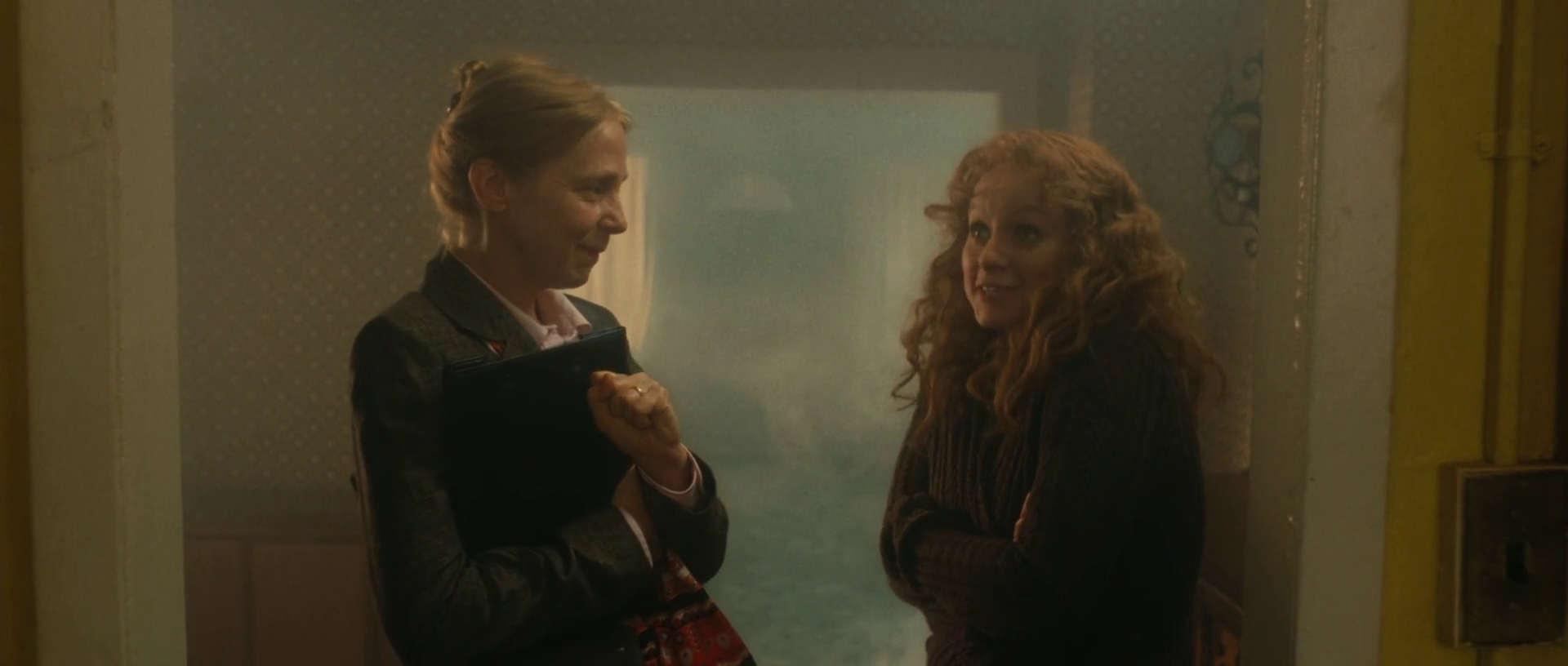
Early in the film, Hazel moves into a house that is perpetually on fire. Part of her decision to move in comes with the knowledge that she is selecting the method of her death. She does it anyway and later dies of smoke inhalation after many years of residing there.
None of this makes logical sense. By all sensible thought, no one would move into a burning building, much less let it continue to burn for the rest of time. Doing so, though, immediately plunges the story into metaphor, informing Hazel and her existence far more economically than Kaufman could otherwise. It avoids exposition by going entirely for something strange and abstract. She chooses to live in something that will always remind her of how shitty her life is and that her house will eventually kill her. Her personal life exists in a state of perpetual incineration and disintegration. Is happiness possible outside of her job? Especially if (as we find out later) she’s always been in love with Caden and he never seems to give her a second look?
And this is just one image in a film full of them. Every scene bounces to some insane idea, be it Olive demanding Caden confess to abandoning her and to being a homosexual (the former is true, but the latter is not) or the absurdity of his therapist and her ability to be present all the time. Nothing in the film is as it seems, and yet everyone speaks directly to each other in ways that feel incredibly on the nose. This cocktail of the oblique and the direct puts the entire film in an inherent tension.
It’s remarkable that the film works at all considering its broad scope and insane ambition to create a life portrait via tone poem. Kaufman wields the language of cinema like an expert fencer, from composition (Sammy being regularly in the background) to editing to score. It’s like an experimental film on an indie-studio budget.
Telescoping
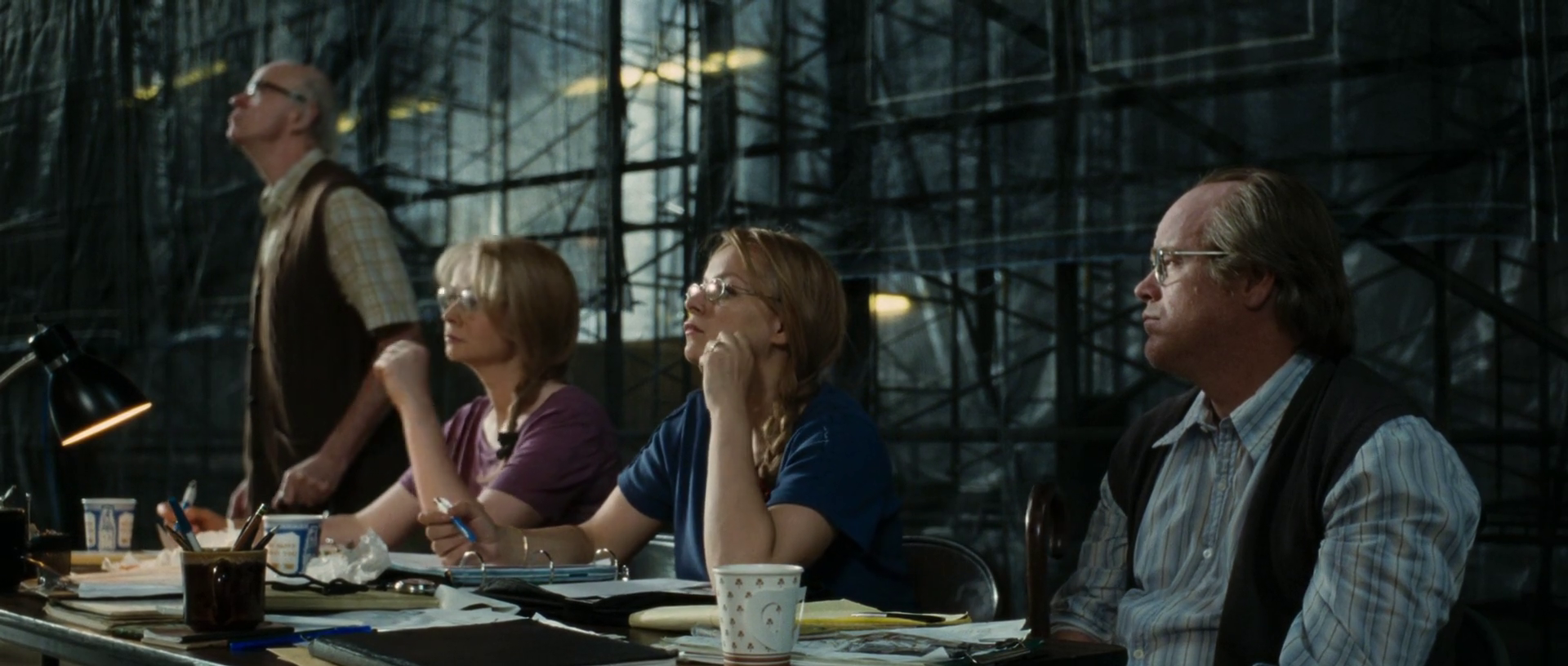
Following Caden’s separation from Adele and passive abandonment of Olive, the film’s plot circles Caden’s attempt to create a play that adequately represents real life. He takes over a warehouse and starts to recreate New York in meticulous detail, where the diegetic actors start taking the roles of real people in the real world. There’s not really a sense that it will be over, and according to the characters (and Caden’s deterioration) the actual rehearsal and creation of the piece drags on for decades. Caden’s notes always remark on what feels inauthentic, trying to get to a place where the art in front of him perfectly mimics and represents life in the real world.
This concept of capturing reality via art dates back centuries. Look no further than the history of painting to see how the religious Christian art of the Middle Ages gave way to the more realistic perspectives and lines of the Renaissance to the pure colors of impressionism. It’s not that one form or style better serves up reality. It’s a different means of representation, where it caters to a particular taste and sensation. The form designs how that art makes an audience feel.
Even within film, the idea of cameras capturing real life dates back to the very first shorts the Lumiere Brothers ever shot. As they filmed the workers walking out of the factory, there is a sense that many of the workers are aware that something is watching them. However subconsciously, what the directors captured was some level of performance.
Decades later, Chronicle of a Summer tried to documentary-capture real people discussing real life issues, and then circled back once the filming was complete to ask its subjects to evaluate just how real and accurate their own footage felt. William Greaves’s Symbiopsychotaxiplasm also plays in this space, having multiple documentary crews document the same events from different perspectives in an effort to get to some “truth” that ignored the camera’s existence.
When Caden realizes he needs to cast someone to play himself, it’s only a matter of time before that spirals completely out of control. That actor (Sammy, played by Tom Noonan) takes on his role as Caden seriously, hiring his own Hazel to help him organize thoughts and keep the overall image straight. Eventually, Sammy then hires another person to play himself playing Caden, the recursion ever deepening and widening. It only really stops once Sammy jumps off a building to die by suicide. The reason? Because Hazel does not love him the way Hazel loves Caden. For a man who believes himself to be Caden, inadequacy in such a pure love is simply too much.
It’s even more shocking when Caden finally makes it to Sammy’s corpse. “But I didn’t jump, Sammy! I didn’t jump!” he cries. Nevermind that there was a point earlier in the movie where seeing Hazel led him to nearly jump off that same rooftop. It’s just that someone managed to stop him before he could.
When it came his turn to save Sammy from himself, he watched it happen.
These introspections reveal innermost truths. As imperfect humans, ignoring or denying uncomfortable, unsavory aspects is a common practice. But in stripping away all logic and reason, Kaufman relies on emotion and chaose to reveal the deepest, darkest aspects of these characters. Caden seems strange and awkward, but he is sex-obsessed and a borderline womanizer. It doesn’t seem this way at the beginning, but choosing Claire over Hazel is opting for young excitement over a stable companion. He and Claire get together, breakup, get back together, have a kid, and ultimately stop seeing each other, leaving him sad and alone. By the time he gets to Hazel, it’s too late. The smoke inhalation has already claimed her. It’s just a matter of time.
Kaufman leaves out the straight lines that make up the picture. This is closer to impressionism, where the colors bleed and look good from far away, but appear strange and random when up close. It invites audience to draw their own conclusions. All are correct. Nothing is off the table.
Demon Face
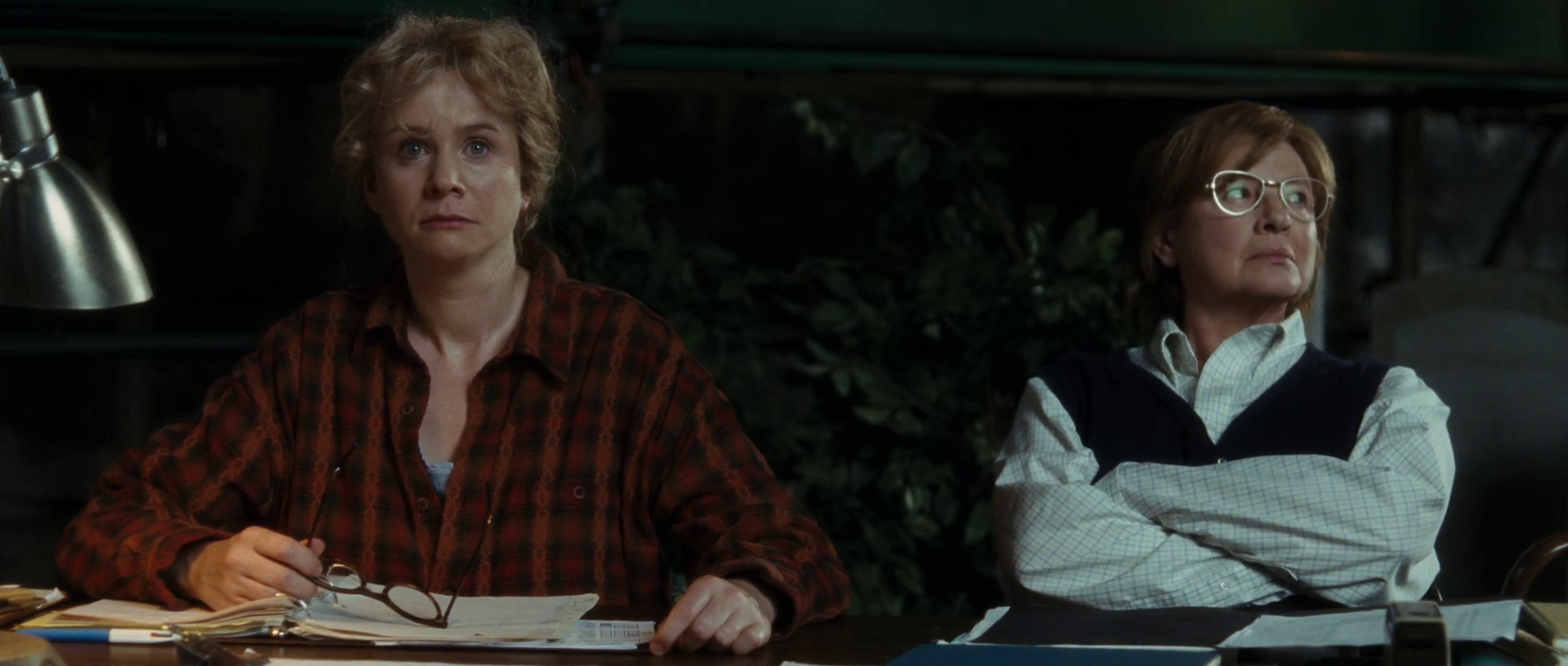
Claire’s tattoo could mean anything. Most directly, it’s a literal representation of metaphorical trauma. Something in Claire’s past happened that left her with the garish and beautiful image she will never be able to remove. While haunting, it is beautiful and defines her. Caden might never have seen it before, but that could simply be because it never manifested before that moment. Maybe he never realized that’s what it was. Maybe it wasn’t there until she was ready to show it.
But this tattoo is a direct connection to Olive and her rapidly evolving into the woman he doesn’t recognize. As life happens to her, Caden misses out on defining moments of he life. By the time he sees her in person as she dances naked in the stripper booth. She blows bubbles. Her body still has the tattoos: roses and vines trail up and down her body. Bare naked, there’s nothing to hide who she is. It’s easy to focus on the tattoo or her curvy form, but focusing on the tattoo as some scar makes it sound like Olive is in some way unhappy or imperfect or a survivor of some wound. Really, that’s just Caden’s perspective imprinting onto the audience.
Taken in a vacuum, though, is there anything wrong with Olive? Only if it seems like being involved in sex work is some great shame for a woman who does not seem to think so. She seems empowered and comfortable with what she does. There doesn’t seem to be any trauma involved, and Caden is hardly some reliable narrator to know what’s happening with a woman with whom he has no relationship. Who says that the tattoos she has have to be sexual trauma at all? The film does not say that. If anything, it’s a representation of Olive’s own sexual awakening, which is perfectly normal for a girl who is evolving into adulthood.
The most obvious tattoo metaphor in context is trauma, but taken more abstractly, tattoos represent events. They mark moments in life, facets of personality, fascinations, loves, and cares. People get tattoos of important individuals. It can be the irrational impulses of new love or the grief and wistfulness for those who’ve left this earth. Would Caden care as much if Olive’s tattoo was some ornate calligraphy of his name?
With this but one scene amongst many, Synecdoche, New York is one of the richest texts of the 21st Century.Film audiences could watch over and over and over again and still pull out new details every time. I’d forgotten just how critical Dianne Wiest is to this film, but I love the moment where Caden sees a representation of her in one of Adele’s miniature paintings, remarking how similar he looks to Ellen. Ellen alone is an entire farm for reaping metaphor, trying to figure out who she is, where she came from, and all of the ways she completely takes over the production after Sammy’s death.
That I can add one aside and already feel myself having to pull this back from being an entire novel says a lot about the way pure uncut Kaufman operates. With this rich a text, it almost feels like a work that defies true explanation and thrives in mastication. I could watch this over and over again, every single day and still pull out new moments, new implications. This is a perfect gem of a film, one that we hold up so the light can refract through. It will catch our eye differently depending on an infinite number of factors.
These are the best stories. And we’ll always have need for them.