The Last of Us Part 2
A very timely take on a game that's almost half a decade old
As my plate piles up, video games usually go on the backburner pretty quickly. I’m usually focusing on film/television, podcasts, and books. It’s easy to get sucked into video games and lose an entire life to them, and I know that a lot of people emphasize the medium as their primary. Me, not so much. There’s exceptions. I focus on narrative games and/or open worlds, places that are more immersive than puzzle or life-sim. Games with endings. Etc.
Upon its release, I was not going to play The Last of Us Part 2. The first game is an excellent game from Naughty Dog and its director Neil Druckmann, wedding their capacity for level design, adventure, and excitement to a horror survival environment. It was also a super bummer, extremely dark, extremely bleak. My first swing at it it was in mid-2020 in the midst of the pandemic. Horrible headspace. Terrible timing. I went back later and finished it before the first season of Craig Mazin’s adaptation for HBO.
In the intervening five years since Part 2’s release, I learned about the big conceit of the game (which happens very early in both the game and has already happened in the new season which aired its third episode this past weekend), but knowing that moment hardly damages experience. It is the premise, after all, the springboard from which the rest of the story leaps.
With the second season premiere imminent, I finally broke out Part 2 in the hopes of finishing in time to watch live. It took longer than I wanted, but what I found was everything that people promised. An incredible story within one of the most violent video games I’ve ever played.
To discuss, I’m going to talk around what spoilers I can, but I will be abstractly discussing the game’s ending. So… for those who don’t want to know anything, this is your warning.
Violence in video games
Upon its release, lots of digital ink spilled about how the game would put players in situations where dogs would be hunting Ellie. Your choice? Either avoid them or kill them. However you deal with them, there are consequences. Kill the owner and the dog will whimper and move around their owner, trying to wake them up. Kill the dogs themselves, and the NPCs would cry out in anguish (in addition to dogs’ own death whimpers) in the same way they made comments about finding dead co-workers. These voices would give names to the fallen and hint at a life beyond this intersection with Elli’e destruction. Whenever anyone died, the effects were graphic and the gurgling sounds of their deaths were horrific.
Now… I don’t want to kill dogs, even digital ones. So that’s a turnoff.
It is, though, in some ways, silly. The director of Bioshock and Bioshock Infinite Ken Levine has gone on the record saying a lot of his work in those games is about testing players’ humanity. He talks about how the game forces you to make choices when you kill the Big Daddys who protect the Little Sisters (who are just small Edwardian-era girls who wear ribbons in their hair and don period-appropriate dresses). When you free them, you have the opportunity to save them (returning them from their weird, creepy state for a small boost of your own power) OR you can harvest them, viciously murdering them, eviscerating them so you can add their power to your own.
For Levine, this isn’t a reasonable choice. Obviously you harvest them. It makes your character better, and these little girls are just lines of code running through a computer interface. If I remember right, he viewed this aversion to digital child murder as a peculiarity of humanity. Most players (who so often like to min-max games to get the best possible result) would save the little girls even though they weren’t real and it would give them less of a boon in this game.
Setting aside the deranged sociopathy of not understanding the boundless empathy through which human beings connect with simulacra, Levine is at least correct that it is (academically) something worth noting. When playing videogames, most players have no reservations about committing violence on a near-cosmic scale and where they draw the line is fascinating. Druckmann is just one person exploring that idea.
And yet, when the time came and the dogs showed up… of course I killed them (IN THE GAME!). The necessity of survival is such that it makes people commit horrible acts in the name of safety. It sucked to do, but the game put me into that position and I knew that it would going in. Social contract dictates that I employ a bit of that Ken Levine morality to remind myself that none of it was real and I was just trying to do the story.
Ellie’s journey
Killing dogs is just one aspect of the larger project. The game Druckmann and his team made is intense and violent and devastating. It springs from the original game, where Joel’s actions give birth to Abby’s, and when we meet her those plans are in their final phas). Those in turn fuel Ellie’s blood-soaked revenge tour. It’s a perpetuating cycle that has truly no ending.
This thematic idea is the core of everything that happens. Her quest consumes her. There are moments where she commits truly horrific acts of violence and afterwards finds herself in a state of shock and loss at what she’s done. When you think it can’t get worse, the game escalates its dilemmas further. It’s heartbreaking to watch, even if there are moments where the situation is so desperate you think there’s no way forward.
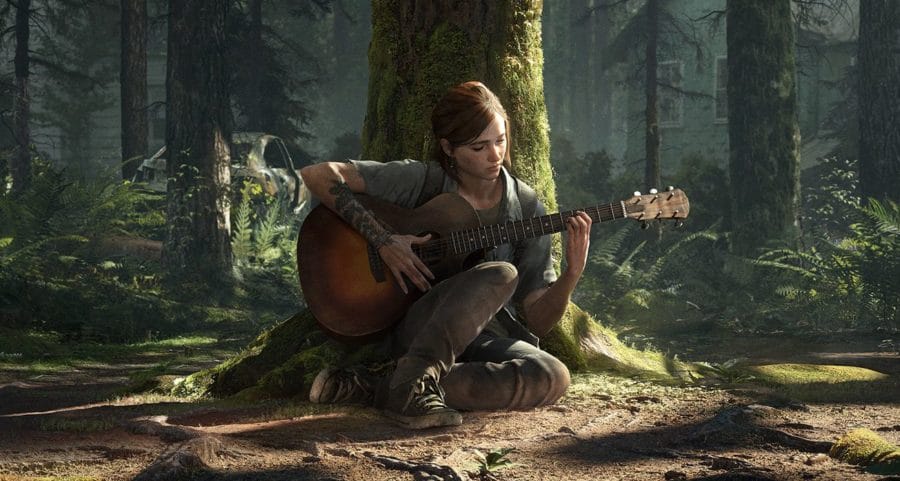
But even despite this, Druckmann knows that it can’t be perpetually bad all the time. There are moments where Druckmann leaves a guitar nearby, allowing the player (as Ellie) to stop and strum for a while. To get better at playing the chords. To mess around. To make music. It’s a fantastic gimmick, made all the more powerful by the hindsight realization that Druckmann will never, ever tell the player to stop playing1. It’s not like after hours and hours of playing Ellie will mutter to the player “I should get going” or “that’s enough for now probably”. It’s not like the player is forcing Ellie to do anything she herself doesn’t want to do.
Of course, there was a point where I did stop playing the guitar so I could get through the story (I have places to be!). Hell, there’s at least once where I skipped strumming altogether. Even in those moments I knew I was falling directly into Druckmann’s trap.
Because that’s the point, isn’t it? We wander through these games in search of the next stealth puzzle or moment of action, quick to ignore all the different spaces free of enemies. It’s these moments of silence where we can explore all the textures of the world or the notes left behind. These elements make the world vibrant and beautiful, a window into the intimate moments of people in the past who wished for something different as their imminent end raced towards them. None of them say they wished they’d spent more time doing the violence that led to their ultimate end. z
That is a lesson that takes Ellie far too long to learn and costs her far too much2.
Abby and the road to empathy
Videogames are far past the point of treating meta understandings as some novelty of the medium. Early in the game, before we know anything about Abby, Druckmann shifts the POV and the player gets to play as her. Inherently, this forms a bridge of empathy. In keeping her alive and guiding her through perilous situations we start to grow connected despite Druckmann intentional shrouding her in mystery. When we get to the early turn and we learn what it is Abby is trying to do, it’s easy to feel it’s some sort of betrayal of how the game has worked. What happens in that moment is shocking and horrible and awful, every bit as upsetting as I’d ever imagined it to be.
This is why (and like… spoilers on this one) when the game shifts to Abby’s POV halfway through and showcases what she does over the three days that Ellie is butchering her way through Seattle, it’s Druckmann once again weaponizing the inherent strength of the medium. Ellie’s third day in Seattle ends on a cliffhanger. If you want to know how it’s resolved, you have to hear Abby’s side of the story.
As you start playing as Abby, it’s easy to keep Ellie in the forefront of our mind. The two have different skillsets (ugh I did not miss having to conserve shivs) and the game plays very similarly. Various characters will enter the narrative and we will know that in just a few diegetic hours they will meet their end at Ellie’s hands. Hell, at no point in Abby’s journey is she even marginally aware of Ellie’s presence in her city. And yet, Druckmann plays so hard on what we, as Ellie, have done that it becomes harder and harder to ignore that Ellie’s journey is misguided. The final words that Abby says to Ellie in the mid-game cliffhanger is her righteous indignation that “we let you live”.
This missive rang in my ears all throughout the second half of the game. Abby also commits horrific violence, but she herself is not out for revenge in any real way. Like the killing of the dogs, it is in the name of survival rather than in some deranged retribution. As Druckmann puts Abby through the big final setpiece at the end of the third day, it’s easy to look at what happens on the Seraphite island as a screed about these cycles of violence and how they self-perpetuate if you’re not careful. While the events there obviously cost Lev everything, it makes Abby’s vow to him (“You’re my people now”) all the more powerful. She has no idea she’s about to return to the knowledge that because of Ellie, she truly has no one else in the world.
As Abby and Lev return to the aquarium, once they’ve gone through that hell, she finds herself the victim of the sins of her own past having come due at the hands of an out of control Ellie. Laden with all this knowledge, the game then keeps the final major confrontation be between these two girls in Abby’s POV. Hell, the whole sequence reminded me (intentionally I’m sure) of Ellie’s fight versus the lead cannibal mayor guy in the first game, the tables having flipped almost completely. It’s the final test of empathy.
As hard as it was to witness and perform, Ellie became the villain of a game in which she is the main image on the front case. There’s no other way to read that sequence.
“Enough.”
As the game reached it denouement and Tommy returned one last time to seduce Ellie into finishing what they had once started but left uncompleted, it was heartbreaking to watch the story play out. The traumatic events that cascaded from Abby’s visit to Jackson so haunt Ellie that she’s unable to separate her desire for revenge from grace and forgiveness of the the escape. Abby might not have wanted to, but it was in her compassion towards Lev that Ellie, Dina, and Dina’s unborn child survive the ordeal. Again, Abby lets them live.
For as glorious as the final sequences of the game are, how easy it is to revel in the basically wanton violence and destruction of the final leg of Ellie’s quest to finally confront Abby, I spent the entire time praying that our hero had come to some sort of different conclusion. Maybe she was going to apologize for the pain and anguish she caused. Maybe she just wanted to bury the hatchet. Maybe in saving Abby’s life, when finding Abby at her nadir, Ellie can return the difficult mercy her nemesis showed her.
This was foolish, of course. After it nearly cost her everything (including Dina’s life, mutliple times), Ellie, still cannot let go of this wrong done to someone else. It’s almost like she blames her for the darkness and the visions and the trauma. To watch Ellie demand their final confrontation, I stared in horror at the screen. Ellie coerces Abby into a fight to the death, threatening the life of Lev in the process. It began.
Like Ellie, I was beaten. Tired. Weathered. There was a point where I stopped hitting Abby when I could, just dodging and weaving and hoping that maybe one of the two of us would give out and say enough is enough. Maybe if I dodged enough Druckmann would grant me mercy to let it all end.
I let myself get sloppy.
I stopped smashing buttons.
I showed the mercy I so wanted Ellie to give.
And Abby killed me.
What makes the game so profound is how much it makes the player complicit in Ellie’s actions as a cost of doing business. Want to see Ellie survive and thrive? You have to accept her for all the good and all the tragic, tragic ill. You’d think that seeing Abby tied to a pole, basically vertically crucified and left for the gulls would be enough to get her to say enough is enough. Maybe her getting earlier stabbed in the side by a tree would have been enough. Maybe were it not for the final intervention of Lev, knowing that Abby (fully aware of Dina’s pregnancy) really was going to slit Dina’s throat would be enough. Not for Ellie. Not for this girl who didn’t learn everything until it was too late.
The one thing we can’t get back
As the game ended, as Ellie returned home after completing whatever task she set out to get, I found myself utterly bereft. People talked about Ellie’s arc and what she might have learned. Druckmann saves the best two flashbacks for last, the ones that focus on quiet and salvation. One of the last things Joel says to Ellie is something he says with full conviction. “I would do it all over again” is the worst thing he can say to her in that moment, knowing what it will mean. But he can’t pretend with her. He won’t. Life is too short and too precious to lie to those we love in the name of fracturing a relationship we love into a rickety one. She doesn’t forgive him, but she does say she would like to get there, someday.
In the end, this is what the game is about. It’s about time healing these wounds. The cycle of violence and the brutalization of fellow humans is such a tremendous waste of time and energy. It puts Ellie and those she loves in danger. It costs her everything save her own miserable life. And for what? What good is living and life if there’s nothing to live for.
In the end, the unspoken subtext of Abby’s “We let you live” is not just some grand act of mercy. It’s Abby attempting to break the cycle. All Abby wanted was to reach the point where she could find the one person who doomed the world and hold him accountable. It’s important that Abby isn’t some lone wolf in her operation. She might be there for revenge (she definitely is), but others are there, former fireflies who don’t have the same connection she does.
In letting them go, what Abby did was give Ellie and everyone around her time. Time to live. Time to love. Time to be. Ellie might have had to live in the wasteland of Joel’s action’s consequences, but there’s a reason “such and such wouldn’t have wanted this” is as potent as it is. What our loved ones want is to take the precious, extremely limited time we have and make the most out of it.
In the end, Joel did the hardest things in the world. First he saved Ellie, then he ended up telling her the truth about it. It cost him everything, but what did was gave Ellie the chance at life, and then the freedom to live it on her terms, even if that meant he would not be a part of it. As a parent, it is an impossible final sacrifice. To Joel’s infinite credit, he never hesitated in any of it.
In his absence, and despite Abby’s own actions, Ellie squanders this gift.
It is such a waste, and yet such a beautiful story.