The Intersection of Art & Commerce - Hacks Season 4
HBO Max's hit comedy explores a timeworn theme...
The following contains spoilers for Hacks Season 4. This is the warning.
Hacks is the great success story of the HBO Max era. Starting in 2021 as the humble brain child of Jen Statsky, Lucia Aniello, and Paul W. Downs, the show stars Hannah Einbinder as Ava Daniels, a young, woke comedy writer who pairs up with aging comedienne Deborah Vance (played by the always excellent Jean Smart) in an effort to revitalize the older woman’s career and kickstart her own. It’s a rich premise, pitting Ava’s youthy, inclusive, millennial sensibilities against Deborahs’s “funny is funny” Joan Rivers-esuqe brand of comedy.
That premise, however, is just the start. As the show has gone on, it’s narrowed its focus on the relationship between the two women as they push each other in their own ways. Deborah is a particularly ruthless individual, hardened by a level of success that is above average, but less than what she knows she’s capable of. As her protegé, Ava is a bright-eyed individual who proves she’s more than capable of her own intensity, though most of her anger and frustration is a reaction to the horrible way Deborah treats her. By the end of season three it is clear that nothing and no one is stop Deborah achieving their dreams. In return, when Deborah tries to kick Ava to the curb, the younger woman muscles her way back in, sacrificing what’s left of their relationship in the name of her ambition.
Smart and Einbinder are an incredible double act. Smart’s won an Emmy for each of the first three seasons. There’s every chance she’ll win it again this year. Given the caliber of that performance, it’s incredible that Einbinder can match her at just about every turn, alternating from wildly funny to intensely emotional.
The most recent season wrapped last week. Watching it over the past few days, it’s proven itself capable of exploring themes far greater than just the difference between these two women and their pursuit of creative freedom and recognition. By the end of the season, the show feels like it’s hit a breaking point, interrogating the very underpinnings of the entertainment industry, exploring that intersection of art & commerce, and finding creative fulfillment within it. The back half of this season in particular is incredibly moving, wonderfully surprising, and a far cry from where the previous one ended.
Most interestingly, though, the show tackles these topics in ways that speak to the larger cultural forces simultaneously without sacrificing a deep focus on these characters.
The Ava/Deborah Double Act
At the end of season three, Ava’s blackmailing gambit wins her the job of head writer on Late Night but also earns her Deborah’s full ire. Season four spends the first half of the season relishing this tension as the two go to war with each other over the show’s direction, mutually disgusted at what the other has done.
It’s a great payoff to what the previous season promised. We always knew Deborah was capable of stabbing Ava in the back, but Ava using a very specific, demeaning moment of weakness as leverage is staggering to watch. Thankfully, this animosity doesn’t last the whole season and the barbs and japes turn into a sort of game that makes the two of them such a dynamite pairing. The HR representative who has to be present at every moment the two are in the same room is fabulous and hilarious. The show wisely uses this antagonistic fight to strengthen the bond between the two women.
And like… god. When was the last time a major show had an aging actress as a lead like this? Jean Smart is obviously fabulous and deserving, but older women so rarely get leading roles like this on TV show, much less roles this well-written. She’s earned those Emmys. Einbinder too should get more recognition for just how good she is (though in the supporting category, which can be more chaotic). But their chemistry is so engaging, so fascinating. Deborah has been a true monster to Ava, taking her for granted and using her the way she uses everyone else. Their reconciliation is breathtaking and it leads to an incredible trust between them. For all the fun and games of the beginning, there is a a point at which we as the audience want to root for Ava and Deborah together. That tension is unsustainable long term.
The big bad business man
Tony Goldwyn’s Bob Lipka is a standard network suit. There’s nothing remarkable about him, and Deborah’s reckless decision to sleep with him in season three doesn’t earn the show’s judgment. There’s a scene early in this season where he briefly conveys to her that their tryst didn’t happen. Ava knowing about it is a bit of a ticking time bomb, but the show decides to leave that gun where it’s at and focus on other things. It’s already hurt Deborah enough.
Deboray’s relationship with Lipka comes to a head in episode nine. In the previous episode, Deborah (sick to death over Winnie Randall (Helen Hunt) breathing down her neck for some spinoff) calls Lipka and asks he get Randall off her back. Lipka fires Randall and takes a more active hand in Deborah’s Late Night (which has just reached #1). He institutes small but amoral moves in the interest of the studio. He asks that Deborah have a particular actor as a guest; when Ava protests because of credible accusations of sexual misconduct, Deborah brushes them off. While interviewing him, Deborah goes off script and briefly makes a joke about his secret Snapchat; the network orders them to cut the joke out of the show. Deborah complies. This pisses Ava off enough that she blabs about the censorship and coverup to a former boss. This blows back almost immediately, resulting in Lipka’s demands that Deborah fire Ava. Instead, Deborah utilizes a live after-Oscars broadcast to decry the censorship she’s facing and her own complicity in covering up the aforementioned misconduct. In standing up for Ava, she loses her show, the greatest dream of her professional career.
The hallmark of Deborah is always that, when it comes to achieving her dreams, she will not let anyone stand in her way. Joining arms with Ava is one of the great moments of the series (which does a terrific job faking out that Deborah will fire Ava1). And yet, in that moment, during Deborah’s anti-network monologue she mentions the way studios play it safe, the influx of Big Tech money, and the imbalance all of this brings to the art v commerce debate. Hacks goes all in on this topic, which is one of the most defining issues of the industry of now. At what point does the art suffer in the name of commerce?
This was also a topic Seth Rogen and co covered on The Studio, where Rogen’s character earned the top exec job and then immediately has to create a Kool-Aid movie rather than bankrolling some passion project, the sort he came to this town to champion. This divide has always existed, but as the iron fist of capitalism has squeezed the entertainment industry like it has over the past decade, it’s added roadblocks to create=ing quality work. Look at what Lipka tries to protect. It’s not like this actor is some grand individual of his generation. He’s just a dude who made a movie that will probably be a decent box office success. Deborah is a coup for the Late Night television realm. Both are interchangable to him.
Now I’m not in the business side of things, but it doesn’t help that the world as it exists builds itself so easily on art’s commodification. Yes, these studios are companies. They’re here to make money. But at a certain point, if everything becomes about bottom lines then there reaches a point where morality becomes just a formula on a spreadsheet. This variable can hurt a film’s value, but when hundreds of millions of dollars are on the line and sexual impropriety can have an impact on that bottom line, it makes sense why they would want to censor, to coverup.
In a perfect world, all of these pieces of the business slot together and point in the same direction. Sexual Misconduct Guy makes a movie, he goes on Deborah’s show, Deborah’s interview promotes the movie, more people go see it, it makes money to make everyone else money. Repeat.
That, however, means making people complicit in this compromised morality. Deborah is making good money doing this show. Ava is too. But everyone is making an amount of money that makes them vulnerable to “then shut the hell up”. Everyone, though, has a breaking point. Ava’s is as soon as the first ask comes down. It takes Deborah longer to get there. She’s followed requests from management her entire career. But as this spirals the line isn’t excising the joke from the episode, it’s when Lipka orders Ava fired. It’s crazy to think that Lipka’s line is “whenever this guy makes the balance sheet go from the green to the red.” What’s worse is then when it comes to this sort of moral foundation, Lipka’s barometer is the general operating principle. Lots of canceled people still have careers.
Hacks is aware of this, and it’s easy to have someone like Deborah stand up and do the right thing, especially considering it’s the culmination of several seasons of her arc. It’s more complicated for this rebellion to trigger the non-compete clause Deborah signed as part of her Late Night contract. She can’t perform for 18 months.
Again, this is the same problem. To the studio, Deborah’s voice and entertainment life is some commodity for them to monopolize and own. To her, it is her life. She might not have planned for this particular blaze of glory, but it does leave her with nothing. As she slowly acclimates to the droll life of boredom, it’s like watching her waiting for death to arrive. She can’t do anything aside from finding a loophole.
Wasting away in Singapore
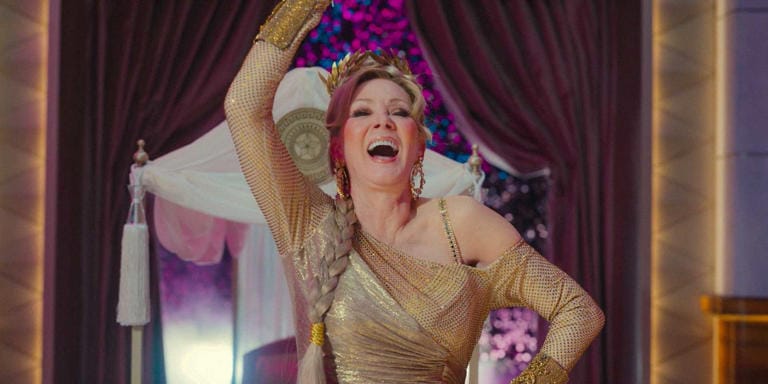
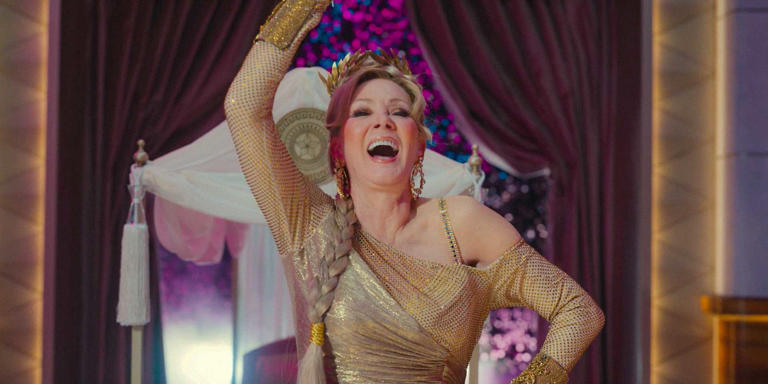
The loophole Deborah finds is extremely limiting. She’s only able to perform on a stage where all of her jokes have to run through a translator. The country she chooses? Singapore. Ava goes with her, trying to write new material, but there’s a sense of Deborah withering. It’s hard to watch as Deborah’s residency at this casino rapidly brings her back to the stale existence she had back in season one, only she has little control over her delivery. The gorgeous dancing Jean Smart does on that rooftop is a glorious, empty celebration of the hollow half-life she’s managed to carve for herself.
This exploration of creativity and the drive to be an entertainer/artist is one of Hacks’s great strengths. This blackened pit of compromise might start okay. The first few nights of this eventual residency are exciting enough, but Deborah flags eventually. By the end, she’s falling asleep on stage because of how rote this whole process is. The difference between the commodifiers and Deborah is that she doesn’t actually need money. Performing is her life and her calling. She needs it like she needs air.
This seems like a simple thing, but in a world where money has grown to mean everything, Deborah’s life in Singapore is proof that sometimes nothing short of that oxygen is enough. In theory, Singapore can be an excuse for Ava and Deborah to write new material, to work in the morning and perform in the evening. That doesn’t happen. It’s a mark of Deborah’s narcissism that she can’t even see that she’s wasting away while Ava can tell almost instantly. It’s also telling that when Ava hits a breaking point and tells her mentor about the problem she’s seeing, there is no anger or malice but rather a profound disappointment. Deborah has always been a raging narcissist, ready to center herself in any situation, so of course she lashes out. It’s heartbreaking to witness.
The price of freedom
Within the realm of late capitalism, the mad scramble to purchase commodities is a byproduct of the bottomless greed abyss that runs this system. It’s crazy that within the realm of society a studio can purchase something in the name of doing whatever they want. It’s insane that they can purchase Deborah’s ability to be herself and live her truest life just like it’s insane that Matt on The Studio can purchase Martin Scorsese’s script about the Kool-Aid Suicides with the express purpose of burying it so it never sees the light of day.
It’s horrifying because it’s so anathema to the concept of freedom. Freedom is a difficult concept to grapple with, and it might be impossible to be truly free. Sure, you can sell whatever you want, including your ability to perform, but there are already so many roadblocks to a pleasurable existence. Having artistic talent is an incredible, singular gift. Of course people, corporations would want to purchase that and wring it out for all the money it can. Of course artists should take the high pay that comes from the recognition of that talent. But it is also true that artists should be careful about what it is they give up when the time comes. There are things more important than the money. Or, at least, we’d hope so.
Knowing all of this and wrestling with all of it, the next season of Hacks has a lot going for it. The show is not afraid to dig into these thorny topics and it is always careful to center its characters within these themes. Take Winnie for instance. The reveal that Winnie never wanted the spinoff she was asking for is a surprise given how often she asked about it. She also insulated Deborah and Ava from studio interference, an incredible additional detail that reveals just how dangerous Deborah & Ava’s situation is. For all of this art v commerce discussion, Winnie focused on the art and tried to minimize the commerce as much as humanly possible. It makes her exactly the ideal studio head, willing to slowroll the brass in the name of something she believes in. Deborah is a key in her firing.
If only there was more of a trust on the art side. It is so easy for the commerce cabal to use their funding and organization to build a robust infrastructure that justifies its own existence. If only Deborah, Winnie, and Ava had known enough to be an allied force rather than an antagonistic one, maybe all this was avoidable.
Easier still, if Deborah (or even Ava) had stood up for herself and not compromised on the original request, none of this would have happened. But Deborah knows it’s hard to say no to the ones with the money and the power. It’s far easier to put a head down and get back to work while the rest of the world crushes in. She learns it quickly, but it costs her almost everything. It takes an obit for her to realize she still has work to do.
That work might not pay money, but by this point Deborah has figured out that money isn’t everything. Nor, for that matter, is perfunctory performance. She’s a terrific individual and one of the great voices of the now. If there’s a price on something that intangible, what isn’t there a price on?
Even though it is unbelievable that in the middle of an Awards broadcast Deborah would want the freaking head-writer/showrunner away from the production itself, just a matter of hours away from a high-profile live broadcast that capitalizes on their recent #1 status. Like come on, Ava. Girl. I know you trust Deborah but not reading the room is fucking insane. ↩