The Illusion of Freedom
In Sinners, Ryan Coogler uses B-movie schlock as a vehicle to explore what it means to truly be free
I didn’t need it, but the thing that sold me on Ryan Coogler’s latest film came from film critic David Ehrlich’s review:
It’s also a ridiculous and horny-as-hell creature feature that leverages Coogler’s enduring love for multiplex favorites like “The Faculty,” “The Thing,” and “From Dusk Till Dawn” in order to convey the hope, heartbreak, and humanity of Mississippi sharecroppers in the Jim Crow South.
As a fan of all three of the movies he cites, this was far more exciting than the trailers that gave little away (though I did see one of the later trailers that spoils the nature of the film as well as key… casualties). Coogler is one of the brightest stars of his generation, though it feels wasted that everything he’s made after Fruitvale Station (his feature film debut), has been based on existing properties. The prospect of Coogler submitting an entry into the canon of schlocky B-movie horror is too enticing to ignore, especially when you consider that his films are soaked in pathos and humanism, wholly unafraid to tell Black stories in ways that are unflinching yet also deeply populist.
To say that Sinners exceeds all expectations is to undersell just how stunning the movie is. It’s the sort of original film Hollywood used to regularly make as a responsibly-priced blockbuster. In this, case however, it’s a unicorn’s unicorn: within the bounds of its constraints, it’s a masterpiece.
Anchored not just by Coogler’s direction but an ensemble of truly stunning performances, not the least of which is Michael B. Jordan playing twin brothers1, the film manages to perfectly balance its schlocky thrills with deep, aching emotion, a film whose sucker-punch lands in (almost as an incredible “fuck you” to Marvel) a post-credits scene. This last beat so wholly recontextualizes the entire film, that Sinners will only work as a simple B-movie on that first watch. Subsequent viewings will be different because Coogler doesn’t tell you what movie he made until the very final beat of the film.
This is god-tier filmmaking. This is what happens when a generational talent weaponizes his storytelling talents, using a schlocky b-movie as a vehicle for smuggling in humanism, empathy, and joie-de-vivre to a mass audience.
**Full spoilers ahead…
We need more creator-driven films
Studios have completely ceded the ground of esoteric, less-than-four-quadrant, mid-budget films like this to smaller studios like A24. Much as A24 produces truly great films, they aren’t able to make films at a budget like this. Not only that, but even if studios had managed to start from the premise of “make a movie set in the Jim Crow Prohibition South in which a speakeasy falls under siege by horrifying vampires”, it takes someone with Coogler’s level of talent to take that basic premise and create something this humanistic and beautiful.
This shouldn’t be a surprise. Ryan Coogler burst onto the scene in 2013 with the excellent Fruitvale Station, but immediately fell into the world of IP blockbusters. Let’s set aside Wakanda Forever as a blip in Coogler’s career. Barring pulling it from the schedule and re-building it from the ground up, that film is an impossible. Instead, let’s note that it’s a mark of his gifts as a storyteller and that something as populist as Creed and Black Panther feel as vividly personal as they are..
Sinners is his first solidly original film in over a decade, and the biggest takeaway is how incredible he is when he’s allowed free of the chain of studio demands and can just follow his bliss. In just two hours and twenty minutes, Coogler not only sketches a vivid picture of an ensemble that exists to be slaughtered, but he plugs them all into his underlying themes. For being a film dealing with such big ideas, it’s insane that this story takes place over the course of twenty-four hours and that (in the second half) doesn’t escape the confines of its primary location.
Genius.
And those big ideas are…
Freedom isn’t a reality so much as it is an ideal towards which we should strive. Whenever we feel free it is usually a momentary illusion, smothered eventually by some responsibility or societal limit. This is most obvious in employment. Is there some job I could have where I wouldn’t have to report to anyone? Where I could do what I want and not be beholden to some overlord who’d get in my way? I’ve been remarkably lucky with the freedoms of my professional life, but any rung up the ladder has to report to someone else. Executives can be beholden to boards. Even the President of the United States, ostensibly the most powerful person on the planet, is beholden to the courts, Congress, and the American citizenry2. Everyone should bow to the rule of law.
This is the basic compact of governance. At its best, it means sacrificing small, personal freedoms like, say, the freedom to commit murder, in the name of certain securities like, say, the security that fellow citizens will not murder you. If we tip towards some Animal Farm system where all animals are created equal, but some animals are more equal than others, it unbalances this equilibrium.
The reason the end of Sinners is so powerful, the reason it made me cry as the credits rolled is because it recontextualizes the entire film in ways films rarely do. We might think we’ve been watching this movie about a harrowing night for one young, talented artist who ended up okay, but what Coogler’s really made is a film celebrating a practically utopic community, how its fragile nature of it can shatter in an instant, and the disparity between those two things can change the course of one’s life.
And like… full spoilers on this. You’ve been warned.
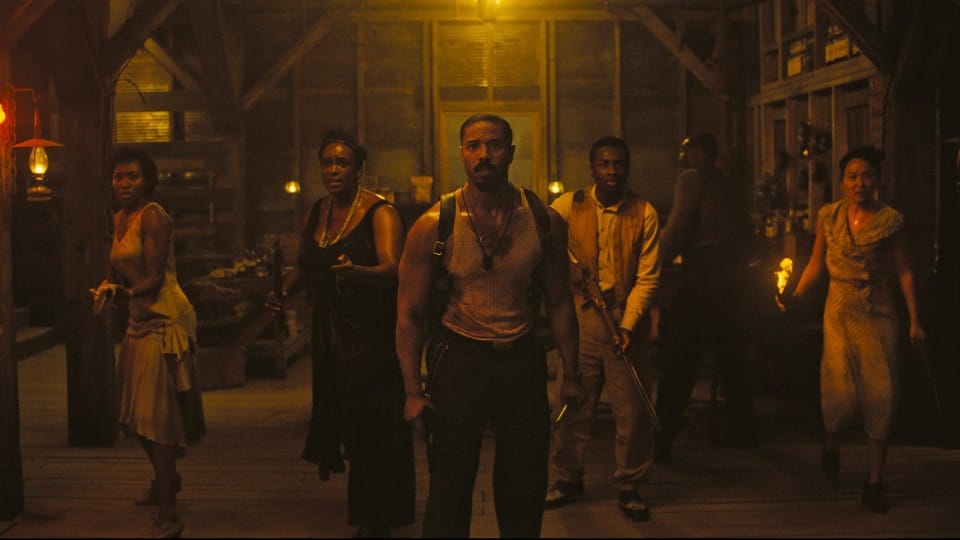
In the final scene, the one that plays after the credits have started rolling, Sammie, old and weathered meets Stack again for the first time in 60 years. Faced with the offer of eternal life and still bearing the scars from that dreadful night, Sammie talks about how it still haunts his dreams once a week. And how couldn’t it? The night of the vampire attack on Club Juke is harrowing, violent, and all-consuming. For us, it’s the reason we all showed up to the damn movie in the first place. It’s the thing that will keep us watching this movie for years to come. We wanted vampire violence and then we wanted to see Smoke slaughter all those white supremacists who tried to mass lynch him and his community. Coogler, ever the populist, gives the audience the blood we’re here for.
And yet, that’s not what Sammie (and Coogler by extension) focuses on. His admission that what we just lived through was the best night of his life is staggering. For him, it was the night his talent liberated him, the time he played his purist and best music, sound that transcended reality and bridged space and time. Stack agrees, and his admission that it was the last night he was truly free is astonishing. It was the last night saw the sun, the last night he saw his brother. While they wound up on opposite sides of the conflict, they both arrived at the same eureka. Coogler then intercuts these reflections with beautiful instances of the cast, dozens of people in their last hours of life, as they create something truly wonderful. They cook. They laugh. They dance. They share in the intimacy that comes from the community around them.
It’s an incredible trick. We spend so much of the film’s runtime thinking about, dreading, and wanting that vampire attack to happen that it’s beyond easy to miss what Smoke and Stack were creating with their little speakeasy. At one point, Smoke reams Stack for accepting wooden plantation money. Did that even matter by morning? Or should we celebrate that the man got alcohol in the midst of prohibition, and his hard day’s work paid for a few glorious hours of revelry and fellowship?
Creating such a free space within an existing society and celebrating it as practically edenic is the sort of story that wouldn’t occur to the average director. It’s simply not their lived experience, a revelation that stems from living within society’s black spaces. It functions much in the same way the doppelgängers in Us reflect a particular dread within black culture. People wrote about it at the time. Doppelgängers are something white people aren’t typically terrified of. I’m personally not worried about some unknowable underbelly snatching me from existence and replacing me with some lookalike. But that is (apparently) a fear within black culture. Jordan Peele, fresh off the success of Get Out brings something even more esoteric to a mass audience. And… while it wasn’t the success of Peele’s first film, lots of people (myself included) loved Us. Like Jordan Peele, Ryan Coogler is Exhibit A in why elevating diverse voices is so important.
For an industry so focused on commerce, they really are myopic in the audiences they’ll appeal to. In a perfect world, the success of this movie will continue to chip away at this closed-minded approach to mass media.
Why it’s not enough to watch a film once
The best films are those that ripple backwards through time and reveal themselves as something totally different from what we just experienced. On the next watch, it will be harder to look forward to the vampire violence and lead me to treasure these delicate moments of setup and human connection.
In a world where I can’t watch Sinners again for the first time, the film will ache in entirely new ways. Small moments will not be cute, but rather seismic, ones where these people are truly free. Club Juke will be a one-night community built on letting your cares go even if you can’t afford Smoke & Stack’s stolen liquor. Be it the casual oppression of Jim Crow or with fear towards the consequences of alcohol larceny, the law dissipates in these moments where the world is open and wonderful, where the dancing is intimate, and nothing matters but the wonderful blissful clarity of individual moments. The incredible shot where Ryan Coogler connects the past and the future through the power of Sammie’s music is going to be one of the major lasting legacies of this film. That moment is a drunken revel that contains in it the multitudes of eternity. All stretches in time can have these moments that are carefree, that transcend space and time and become eternal in our minds. True freedom might be impossible, but for brief instants we can glimpse the infinite, moments that become memories that can eclipse the horrors of the worst night of our lives.
No day is truly perfect, but if we take stock as we go, we can find hold these perfect moments close. They can power us. The scars might last, but scars are physical manifestations of memories past. They’re only as bad as we let them be.
And for all that we curse the scars, who knows what might happen with them someday? Maybe a reminder will emerge from the darkness. Instead of fear, maybe we will find ourselves blessed by the wisdom of time. Maybe we embrace what we once saw as a malignant force, recontextualizing it as an experience that contains within it all the complexities of our existence.
What a fucking film.