
An Easy Road That's Paved With Good Intentions
What do a 400 year-old play, Netflix's first original TV series, and a YA book from a couple years ago have in common?
The following contains spoilers for Ryan La Sala’s The Honeys and a play that Christopher Marlowe wrote more than four hundred years ago.
Halfway through Doctor Faustus, I turned to my partner and asked if this was the first usage of the Good Angel/Bad Angel dichotomy. A quick google search revealed that no, that core idea dates back to at least early Christianity possibly as early as 150 AD. Kit Marlowe might have been a genius, but that was just him continuing a centuries-long tradition. In fact, his most famous play is famous simply because it plays all the hits, riffing on contemporary culture, and delving into universal themes of the seven deadly sins.
The production of Doctor Faustus I saw this weekend is the one currently playing at Griffith Park in Los Angeles. It’s fabulous. The adaptation is very modern and very populist without losing the stuffiness of Marlowe’s language. The Saturday night crowd was as full as I’ve ever seen it. Crazy for a show that comes out of The Independent Shakespeare Company that is also very much not Shakespeare. They’ve done not-Shakespeare in the park before: a few years ago put on a production of Francis Beaumont’s Knight of the Burning Pestle. But Doctor Faustus is different. Anyone who’s spent any time in literature circles knows of the play where the main character sells his soul to the devil. It’s as ubiquitous as the best of Shakespeare’s work.
As with Shakespeare, though, Doctor Faustus is about more than just the salacious details of watching a man sell his soul and then (spoilers I guess) watching him eventually beg and plead and scream as the contract comes to call and literally drags him to hell. Kit Marlowe is playing with deep, rich themes about human avarice and the tiny minds of even our brightest luminaries.
It might be four centuries old, but Marlowe’s point is one humanity has explored for centuries and will continue to explore forever.
John Faustus would have loved the internet
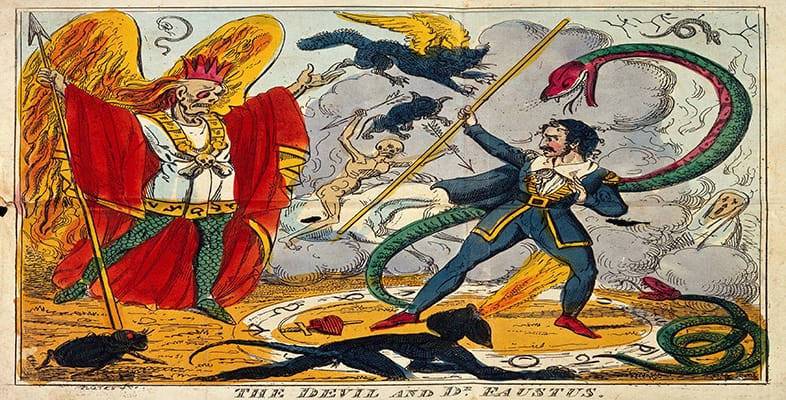
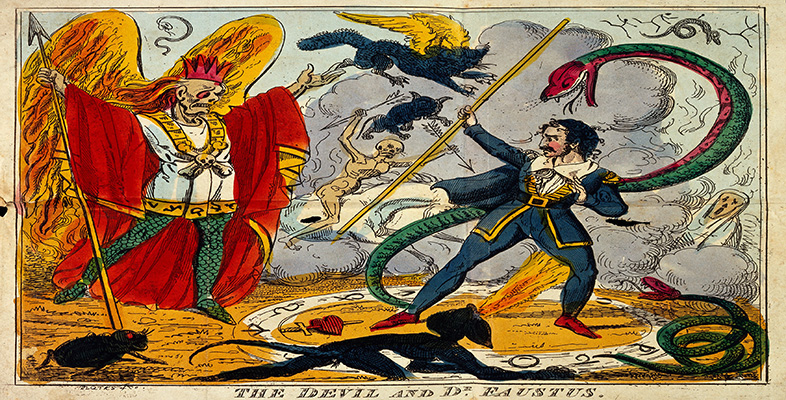
Faustus signing away his soul in blood starts a clock that will last twenty-four years. In that time, the demon Mephistopheles will be his servant in any way he sees fit. When the time is up Faustus’s soul will belong to Lucifer for all eternity. It’s wild to watch Faustus sign his soul away so readily, and yet the entire opening of the play is about the man’s arrogance and boredom with having learned all he cares to learn. He doesn’t want to study science or medicine or law. Those subjects feel like ones society has solved. He wants to study the forces that go beyond human comprehension: magic and necromancy.
That youthful arrogance leaves him vulnerable to Mephistopheles’ (and by extension, Lucifer’s) manipulations. They will give him 24 years to do with as he pleases and all it will cost him is eternity. For him, this is a fair trade: dominion over the earth he thinks. Limitless power. Infinite knowledge. But thinking that way is so small potatoes. Lucifer (like God) measures his plans in millennia. Mephistopheles can put up with Faustus for a quarter century. That’s barely a lunch break.
What’s most shocking, though, is how Faustus acts once he’s signed the deal. Because his first question says so much about how ill-prepared he is for all of this:
“First will I question with thee about hell. Tell me, where is the place that men call hell?”
Like… wow John Faustus slow down there, son. You’re moving way too fast for all of us. Slow down with the big, existential topics.
Only…. what a ridiculous first question. First of all, Faustus just wrote a contract and signed it, all in his own blood. And you’re telling me… his first question… is where it is he’ll end up going?
Secondly, I’m sorry. Hold on a second. John Faustus… Doctor John Faustus, a scholar with a doctorate in theology is wanting to know… where hell is? Bro, I’m sorry, open a freaking book. Come up with a theory. Consult… other people. But… you’re just so lazy that you have to… sign your soul away to Lucifer so you can be like “hey settle this bet for me?” Only that’s not fair, because it feels like this is an academic conundrum in his head and he’s never shared the thought with literally anyone else.
Everyone knows hell is down below. It’s like… literally canon.
You can practically hear Mephistopheles cackling at the foolishness of the question when she retorts:
MEPHIST. Under the heavens.
FAUSTUS. Ay, but whereabout?
MEPHIST. Within the bowels of these elements,
Where we are tortur’d and remain for ever:
Hell hath no limits, nor is circumscrib’d
In one self place; for where we are is hell,
And where hell is, there must we ever be:
And, to conclude, when all the world dissolves,
And every creature shall be purified,
All places shall be hell that are not heaven.
Faustus, son. Ya got played.
And yet, this is all the protagonist does with the rest of the play. He’s always asking questions of Mephistopheles and Mephistopheles is always answering, divulging some pithy secret of the universe. At one point, Lucifer shows up and puts on a grand ol’ show with the Seven Deadly Sins (in the ISC adaptation they did a full on rock concert, ending in Faustus ripping a guitar solo; it was awesome). But the man has no intellectual curiosity himself. He sells his soul so some random demon will be his own personal (censored) google search. The questions happen over and over again. And Faustus learns and learns more and more knowledge that will only be useless. Quickly, he’s bored out of his brain. There’s no learning, it’s just absorbing information. Knowledge is more than just the input of information; it’s the processing of the same.
By the back half of the play, he’s mucking around the Pope’s private chambers and playing all manner of tricks on him and his staff. It’s extremely funny, but also like… this is what you sold your soul for? So you could prank the Pope with cheap parlor tricks? Same is true for when he visits the German Emperor and performs some magic for him. Good work, Faustus you wonderful magician. You made an apparition of Alexander the Great appear. Know who else did that? Christopher Marlowe when he wrote the play Doctor Faustus. Oh look. A representation of Alexander the Great.
What happened to all this bold talk of you being Emperor of the world? Mephistopheles convinced Faustus to be slothful instead?
As the play goes on and Faustus becomes more wistful and remorseful of the foolish deal he made in his youth, it becomes clear that what undoes Faustus at all is his own inherent weakness. As the hour approaches he grows more and more desperate, but there is weird sense throughout that maybe he’ll repent and we’ll get some resolution where he learned a nice big lesson about greed and pride and all the rest but God swooped in to save the day because of the Blood of Christ etc etc. But no, the lesson is that Faustus gets sucked to hell. Faustus doesn’t get to learn the lesson. He never learns anything.
We the audience learn the lesson.
Which is… what, exactly?
End results
Over the weekend I started and finished Ryan La Sala’s book The Honeys. It’s a great horror YA novel about summer camp and an almost-adult named Mars who finds themself stuck embroiled in a conspiracy that involves their dead twin sister (this happens in the first chapter), a summer camp, and a great big tapestry of space-time called “The Lace”.
As the book reaches its climax and the plot unfurls itself, La Sala reveals (spoiler alert) just how deep the rot at this camp goes. It implicates a whole host of others, not the least of whom are Mars’s own parents, who’ve done everything for the power they’ve accrued over decades of connection to this camp.
Talking about The Honeys this way is not the most fruitful. Ideally this would be a nice big discourse about how Mars’s gender fluidity is critical to understanding the inherent gender binary in place at Aspen. There’s all sorts of details like Mars buzzing their head to fit in with “the boys” at camp and how they get placed into “Bear” group. There’s the normalization of Mars wanting to do “girl activities” and the disconnect they have even when traveling amidst the circle of the eponymous Aspen group. It’s extremely well done.
Normally I’d mention this as a small “hey good book!” update. But what struck me about the climax here was how squarely this fit into the themes within Doctor Faustus. Mars’s mother is a senator, the sort of high-profile person slightly-dialed-in individuals might know. The staff at a random Applebee’s in the Catskills recognizes Mars and their family when they make a pit stop.
This is fully outside the book’s scope, but Mars never goes into the things that their mother does as a Senator. There’s talk about how she crafts and sculpts the public behavior of her and her family. There’s mention of meeting and knowing constituents… but… why is Mars’s mother a Senator?
The answer ends up as a vapid question for power and status in a world that values those attributes. There’s no sense of what Mars’s mother hopes to accomplish in the world, what policies she’s putting forward, how she’s looking to make the world a better place. She just wants the power, and she’s willing to possibly sacrifice her only remaining child to do it (and it’s already cost her the other).
This is a major issue in American politics right now. The entire system is so broken that voters are desperate for immediate solutions to all of the problems that have slowly piled up over the past forty years. With this level of desperation, Americans are happy to turn to demagogues, people who will promise the world because talk is cheap. These people stand for nothing but their own goals. This is true for (especially) Donald Trump and his cohort, but it’s also true for people on the Left who don’t seem to understand that people want solutions, not talking points.
To extend this out further, this was always the biggest problem with House of Cards. Frank Underwood (Kevin Spacey scandal absolutely noted; fuck that guy) was a vapid, venal individual who cared about nothing but his own climb from Majority Whip to the Oval Office. In a world of American politics, the first two seasons focus almost entirely on that lust for power and prestige, with hardly any discussion of what it is Frank wants to do with the power he seeks. (I never made it to season three.)
It’s within this mindset that many politicians find themselves. They have incentives to keep their jobs, but very little of their jobs seems to have anything to do with accomplishments while in office. No one even pretends like Congress can or will get anything substantive done. Without an incentive to help constituents, politicians fall back to tropes and fearmongering. They complain about all the many ills within the country, but fail to prescribe the sort of comprehensive (or even piecemeal), full-scale remaking that the country so desperately requires. Diagnostics without solutions is not helping anyone. And often times even specific diagnostics are difficult for politicians to say cleanly.
Wanting things is easy. It’s easy to look at the world and demand something specific, basic. It’s easy to sell your soul so you can get a couple of cheat sheet answers. It’s easy to sell your soul to be a troll and get one over on the Pope for an afternoon. But thinking about history’s long game has tremendous value. The hard work of doing a thing yourself and finding meaning in your own life is intrinsic to our very existence. So many people out there take shortcuts. Those can be fine, but we should be aware of what we sacrifice when we do so.
Faustus sells his soul to the devil and gets 24 years of his life to do whatever he wants. That’s really great in the first decade, but every day closer is another step to none of that mattering at all. By the end it’s basically smothered him. Incredible power is a wonderful thing, but it’s hardly worth the price of eternity.
This isn’t something anyone can directly really relate to. There’s not a lot of people out there performing necromancy and summoning Mephistopheles and signing blood pacts with the devil (okay maybe there are but these deals are hardly binding probably). But what people can relate to is cutting corners and the foolishness of jumbled priorities. Faustus believes he is trapped in this bargain, but based on Christian mythology all he’d have to do is repent, mean it, and salvation would be his. Even when it seems like too late, the only thing holding him back is a bunch of demons yelling at him. He backs off easily because he’s a weenie and extremely misguided.
If only he’d opened a book. All Doctor Faustus needed to do was open the freaking Good Book™ and read a bit about salvation and what it’s all about. You want magic? Christ died for humanity’s sins and that sacrifice has washed away all of humanity’s transgressions. That ain’t science or math. That’s freaking magic, baby.
But no. Faustus took the path of ease and least resistance and never thought for himself. What a colossal waste he was in life. What a glorious, unquestioning servant he will be in Lucifer’s eternity.
Let’s not be that.