Small Actions Become a Cascading Avalanche: Star Wars's Cassian Andor Prequel Trilogy
The Empire's greatest strength is a weakness the Rebellion exploits
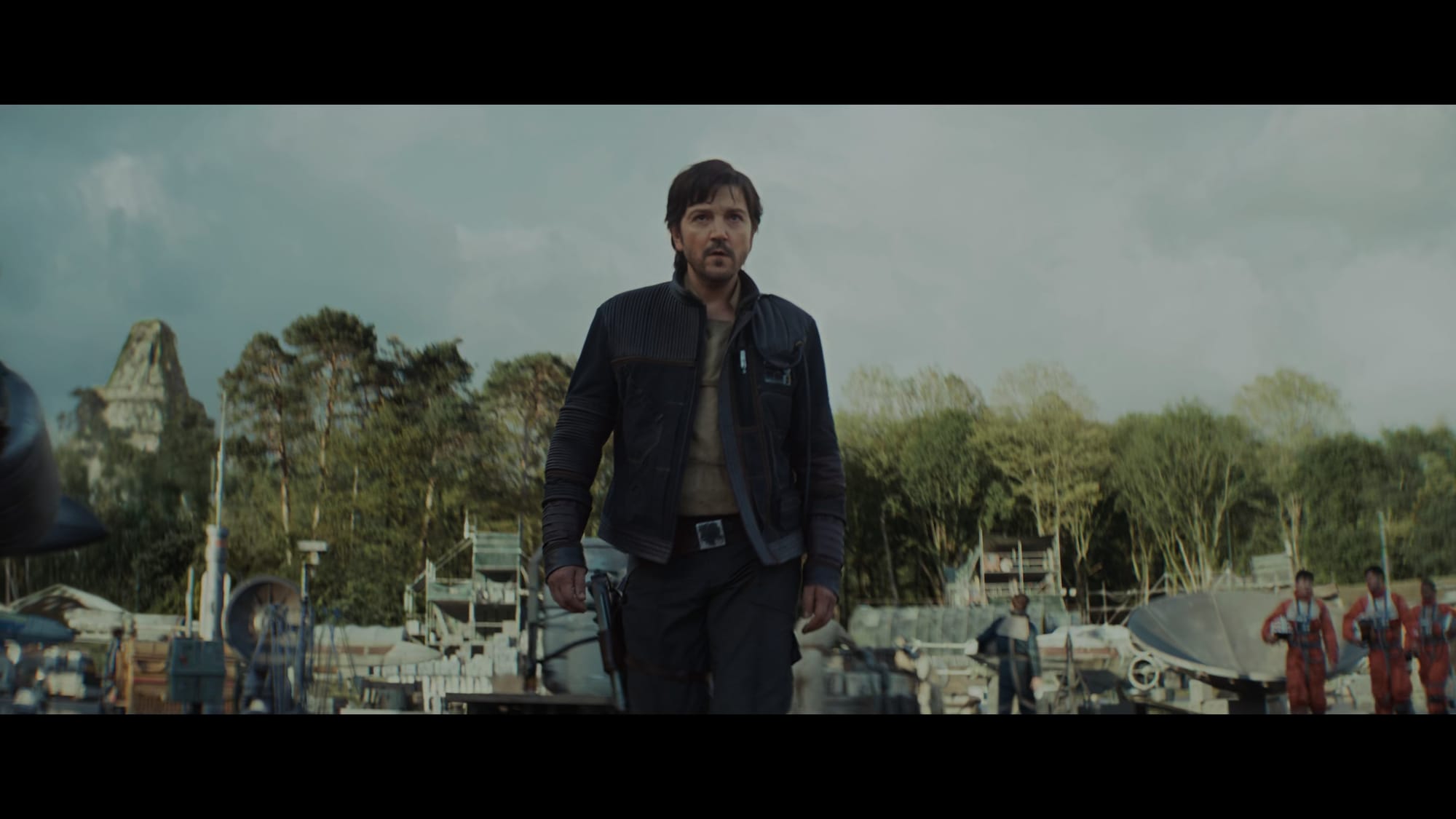
In the denouement of Rogue One: A Star Wars Story, Darth Vader marches down a darkened hallway. He is an unstoppable force, the Emperor’s personal iron glove, single handedly slaughtering nearly a dozen Rebel troopers as if they are nothing. It’s the Empire in synecdoche: when it turns its focus on the opposition, that antagonistic force is barely tissue paper in the way of it crushing its enemies under foot.
But within that is another event, one that plays in the tension of the moment, but whose breadth only crystalizes fully when taking this prequel trilogy in the full scope of how it works. The ensemble is dead. Jyn Erso, the film’s ostensible hero is dead. Cassian Andor, the subject of a 24-episode television series that leads him to his final moment is dead. There’s no one left to root for. We’re just watching a slaughter of nameless Rebels by one of the most iconic villains ever.
In that moment, one of those Rebel troopers, one who’s desperate to escape his own imminent death, bangs on a jammed door for what’s felt like an eternity. He screams for salvation and then, in a moment of desperation jams his hand through the narrow crack, handing off the Death Star plans to another nameless trooper. That trooper runs, barely escapes, and gets the datacard into the hands of Princess Leia, perfectly setting up one of the most influential films in the history of cinema.
But it’s that hand sticking through the door. That desperate man has no idea just how seismic that one small action is in trying to keep this chain of events alive. He’s unaware of all the pain and suffering it took to get there. As viewers, we understood it given we’ve just sat through two hours of Rogue One. But now, with the full two-season run of Andor complete we have a full picture of everything that led to that moment. It’s incredible to think that all of the work might have been undone right there if that one nameless human doesn’t do that. Would any of the other troopers who died in that hallway been as brave, noble, and sacrificial in that moment? What if he doesn’t get his hand through that door? What happens to the Rebellion?
Andor quietly revolutionizes Star Wars, recontextualizing it from Campbellian monomyth into a struggle of incremental progress by a diverse coalition of random individuals. In 1977, a Rebel victory comes about by Chosen One. He starts as a moisture farmer and ends as the Rebel Hero who went on a Trench Run and made an Impossible Shot. In 2025, a Rebel victory is a critical mass of disparate elements working together to build a long chain of successive events. These elements might not be aware of each other, but they are working in a quiet harmony. Altogether, it amounts to ordinary people performing small acts of bravery and sacrifice. These moments become themselves mythic by virtue of the eventual result. In Andor, heroes are not arbitrarily Chosen by some grand Force. Small nudges at key moments add up to an avalanche that ends up changing the face of the galaxy.
With its perfect 24 episodes, Andor slots in with Rogue One to not only give Star Wars its best trilogy in more than 40 years, but also to provide a roadmap for the future. That it does all of this while serving a clinic on how to make a prequel makes it all the more astounding. It eschews flashy, mastubatory canonical references. It derives a theme from its creator and focuses that theme through its characters. It paints a new and riveting picture of both the Empire and the Rebellion, portraying the galaxy in ways we haven’t seen before. Quite frankly, it should be the template for Star Wars moving forward.
I hope to god it is.
BBY 4 - The Disparate Threads of Rebellion
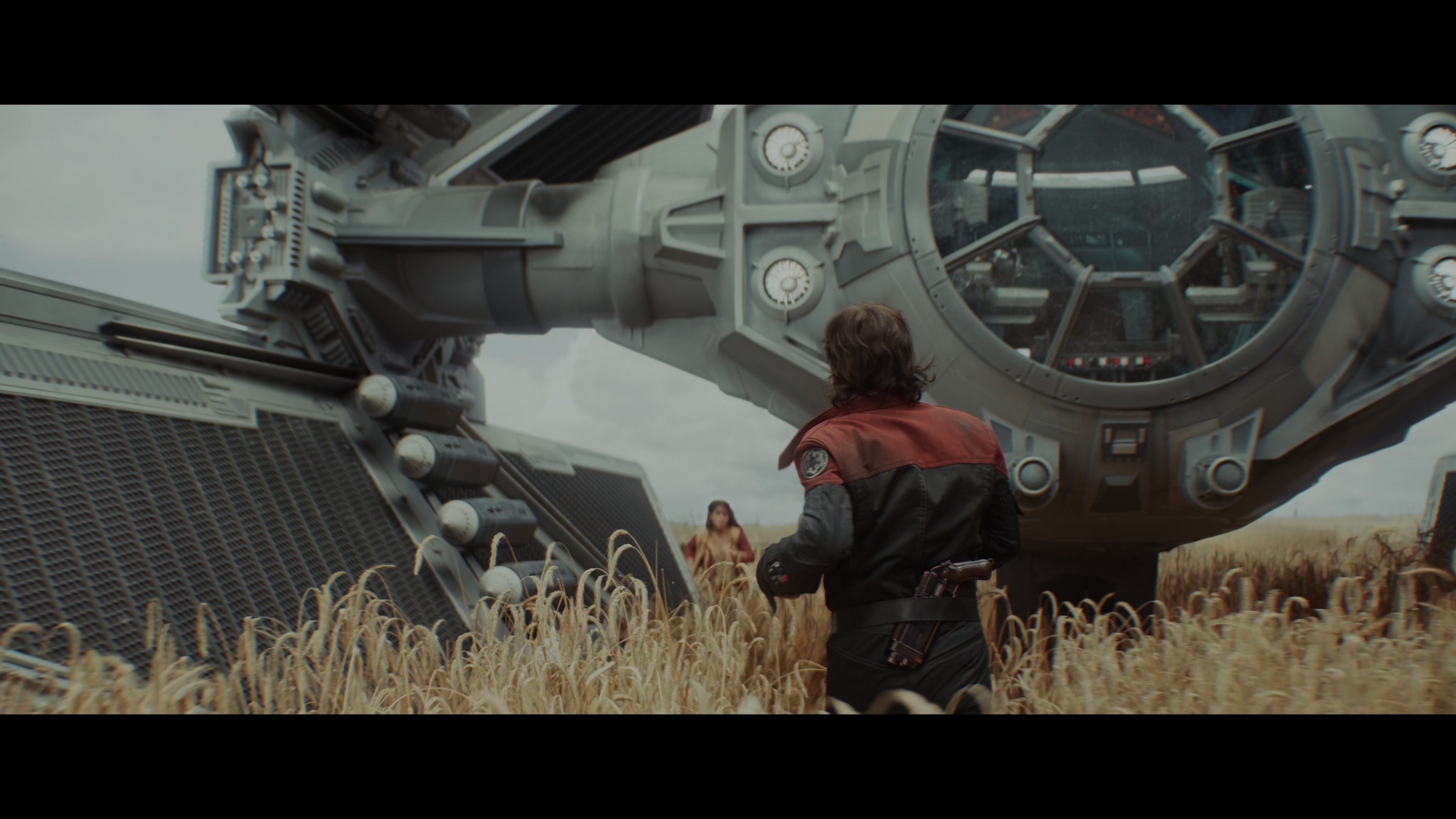
The first three episodes of Andor season two center around Cassian coming across a band of guerilla fighters on Yavin IV, the efforts to get Bix off Mina-Rau, and the wedding of Mon Mothma’s daughter. It’s a lot of setup, with the wedding taking a surprising amount of screen time1, but they end up layering in the series’ themes.
The Yavin IV Maya Pei Brigade’s ideological purity tests
By BBY2 2, Yavin IV will be a thriving Rebel base, but as Cassian comes across them two years earlier, the group living there is so tenuous it quickly splits into two rival factions who try to kill each other. Ostensibly, they’re on the same side, fighting the same Empire, but it doesn’t take much for them to take up arms. It’s the complete opposite from how the Empire operates, which presents a unified front despite all the cracks within the system’s competing internal factions.
While the Maya Pei Brigade’s in-fighting is stupid, it’s also true to how these fragile coalitions function. How many times will the Left devolve to infighting over small issues despite 90% agreement on the large, major questions. This threat of excommunication over some intangible purity is a poison in the bloodstream of any coalition. The Rebellion is stronger as a unified fighting force and should set aside its differences in the name of victory. As the season will go to show, Luthen might have tremendous capacity to run a galactic information hub out of the Capital, but that is hardly what the Rebellion will need to destroy the Death Star once that superweapon becomes a threat.
Bix and the No Good Very Bad Evil Imperial Officer
Poor Bix. While I blanch at the previous decade or so’s over-deployment of it as a plot device, putting an attempted rape into a Star Wars program and having it not feel completely off tone is a remarkable achievement. Watching Bix go through this, especially after the horrible torture she underwent in the previous season is the most sickening moment in the entire series.
And yet, the thing I keep thinking about is how it continues to feed into Gilroy’s themes about bureaucracies and unchecked governmental power. Imperial Officer Lieutenant Krole is clearly abusing his office when he assaults her, but the underlying problem is that the Empire could give a shit about his actions. Is he hurting the Empire directly? No. Is he aiding in the oppression of a local populace thereby discouraging dissent by threatening random, reasonless violence? No problems the bosses can see. These individuals are free to do what they want so long as they’re not hampering the Empire’s ultimate goals.
Simply, the Empire doesn’t care about Bix at all. It answers to the Emperor, not her or anyone else for that matter. She’s merely in the way.
Before Andor, the Empire was an abstract evil, a force of oppression because it blew up a planet one time and attempted to kill the narrative’s heroes. But Andor shows that the Empire is a malevolent force because of this callous, uncaring suffering it so casually dispenses throughout the galaxy. If the social contract with a government is that it provide a duty of care for its citizenry in exchange for obedience, is there anything scarier than this being the result of that exchange? Thank god Bix manages to kill him, but he’s just one dude. Imagine all the targets throughout the galaxy who are not so capable.
Mon Mothma threw an expensive wedding but at least she got to drink and dance a lot
It’s easy to dismiss the wedding as needless fluff, but in a season that’s so firmly about stripping away Mon Mothma’s safety net and forcing her to action, the point of all this is to watch her get slapped around. In the first season, Senator Mothma is a cautious individual, working to keep her delicate life in balance. She keeps her Rebel loyalties secret from her husband and clandestinely funds Luthen’s operations. Above all, she operates in the shadows and is limited to that capacity. It’s probably the right move, but it is terribly frustrating for her.
Her daughter’s wedding is Mon Mothma at her most powerless. She is powerless to stop her daughter from marrying the son of a man she calls a thug, all in the name of securing funds to help her stave off financial insolvency. She is powerless to stop Luthen when he says they must execute her childhood friend, the one who’s kept her afloat through all of her activities.
But this is the cost of her actions. If she’s going to operate in the shadows, it diminishes her ability to act with direct agency. The war the Rebellion wages against the Empire is fundamentally about freedom against oppression. If Mon Mothma is going to fight for galactic freedom, what does it say when her own actions encase her in a cage that oppresses herself?
BBY 3 - Ingratiation
Syril Karn’s exciting new assignment
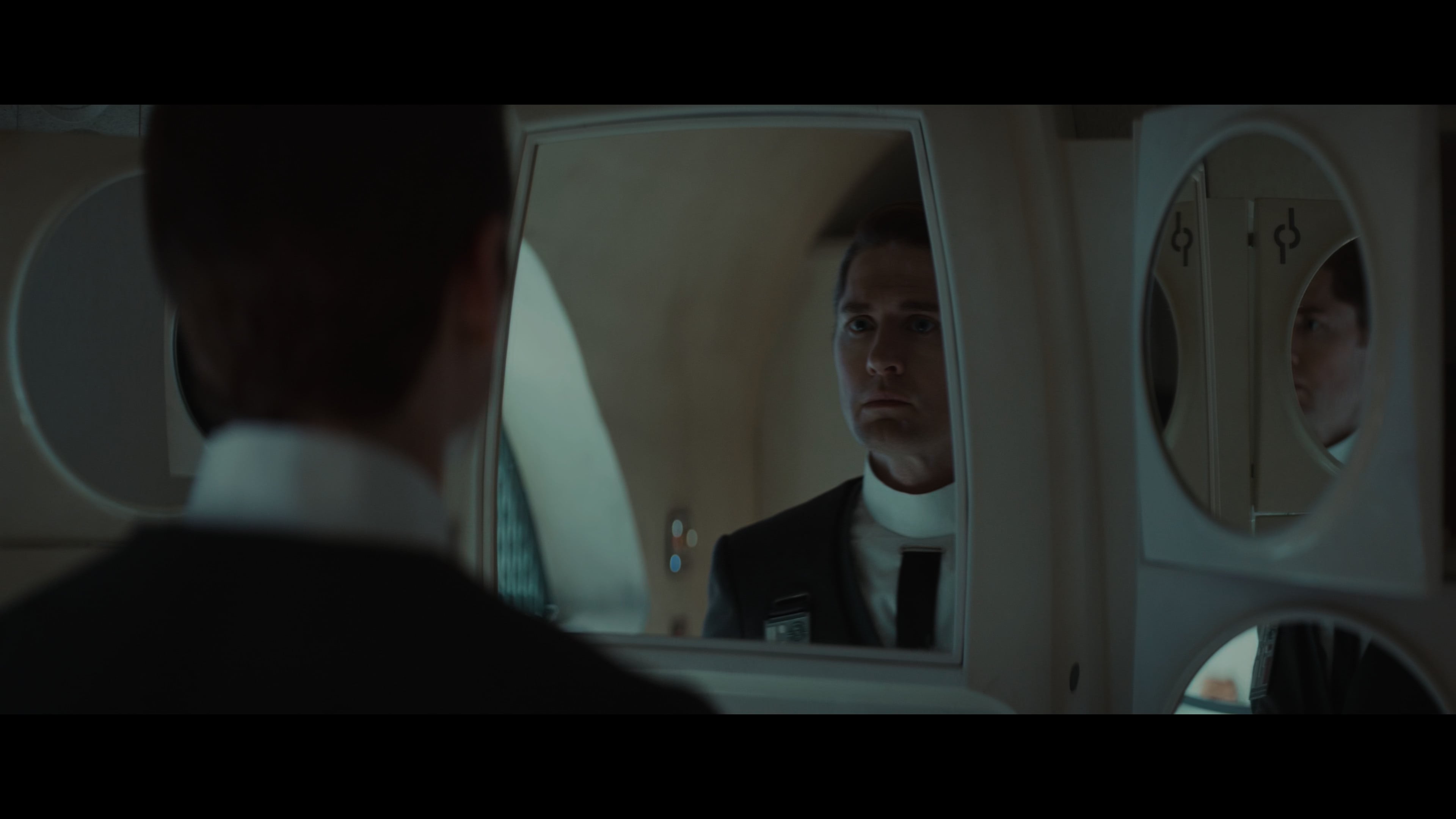
What a fascinating character Syril turned out to be. After a full season of chasing down Cassian, he finally gets the girl (Dedra) and a plum posting on Ghorman. Sure, he’s an unwitting patsy for an ongoing ISB plot, but that added layer of intrigue is exciting. His mission to surreptitiously infiltrate the insurgent sect in Ghorman’s capital is one he relishes.
Of course, he doesn’t have the whole picture. This is an opportunity for him to cosplay, to wear a briefcase, and to continue his affair with Dedra. What’s fascinating is the way this (and the events of BBY 2) recolor what we’d previously thought about Syril. For all that he was driving plot in the first season, in retrospect, Syril has always been simply a loyal soldier trying to do the right thing in the administration of justice. He’s not an exceptional worker or someone cut out for the ruthless actions demanded by the ISB under Major Partagaz. He’s dangerous because he believes in the Empire and is always pushing for it to be the benevolent vehicle it claims to be. This optimism becomes a feature for the ISB to exploit, manipulating him into abetting their long-term plans for Ghorman.
What makes it all the more tragic that in Dedra using him, he’s blind to all these issues until it’s too late. As he starts to ingratiate himself with the Ghorman rebels, he starts to see them as people and not some faceless, violent insurgency. Their cause is righteous, but how can that be true while the Empire is behaving as it does? That tension is contradictory and irreconcilable. It will end up destroying his life.
The collapse of Luthen’s Coruscant cell
Central to episodes 4-6 is a small but significant plotline where Kleya (and Luthen by extension) must remove a bug planted in an antique they sold to Davo Sculdun (Mon Mothma’s new thug brother-in-law by virtue of her daughter’s marriage). It’s a solid piece of spycraft, but it portrays the Kleya/Luthen duo as desperate, barely capable of functioning while the Rebellion rapidly outpaces them. To execute the plan, Kleya puts Lonni in a position that might fully expose his treachery, all in the name of removing some random listening device. It’s extremely risky, and sure it works out but it very easily might have not.
It’s a bush league moment. Between that and Luthen’s visit to Bix to encourage her to rejoin the fight, it’s clear that Luthen’s power and influence wanes. Now that the Rebellion is starting to develop its own military, Luthen’s cover as an antique dealer feels sad and retro, like he’s hit the ceiling of what he’s capable of. And… by the following year, Cassian is functionally out of the Luthen game. Luthen taking advantage of Cassian’s mission to Ghorman as an excuse to talk to Bix behind his back is simply too much for the other man to abide.
At a certain point, all things reach a moment at which they become old hat. Luthen never stops fighting and becomes an integral early point in the Death Star chain that eventually turns the tide of the war. But that comes long after Luthen has become irrelevant. It begins to show here.
Bringing a blaster to a no-blaster party
It’s remarkable that the first operation by the Ghorman rebellion goes off without a hitch. Of course, unbeknownst to them, Syril’s infiltration coupled with Dedra & Partagaz’s influence means this falls right into the edifice the ISB is constructing.
In the middle of it we have the death of Sinta, a minor character whose actor has since become a dope ass Doctor Who companion. It’s heartbreaking not just because of rekindling her relationship with Vel, but also because it’s so needless. She instructed the rebels to not bring any blasters. Despite that, Sinta gets hit in the crossfire, and the op is a Pyrrhic victory.
What’s incredible about this small moment is how much it reflects the larger narrative. In a way, Vel is asking a bunch of randoms to trust her (and to them, she is a random herself), ceding their freedom in the name of her edicts. It’s unsurprising one random dude brings protection. That’s what happens when you’re cosplaying as a serious insurgent and don’t know what you’re doing: you come armed. Isn’t this dude here to tear down the evil Empire? Insurgents prepare themselves for violence. Better safe than sorry.
But the weapon wasn’t necessary at all, discharging as it does only because of a random passerby during the robbery. If it had been the Empire, and the Empire had mandated “no weapons”, weapons would not be present. It’s the difficulty with a militaristic leadership. Orders inherently constrict the freedom of the ordered. Isn’t the Rebellion fighting for that sort of freedom? It requires a delicate balance, but tragically, Vel was right in the end. She knew exactly what she was talking about. But that knowledge doesn’t matter a jot if her lover dies in the process.
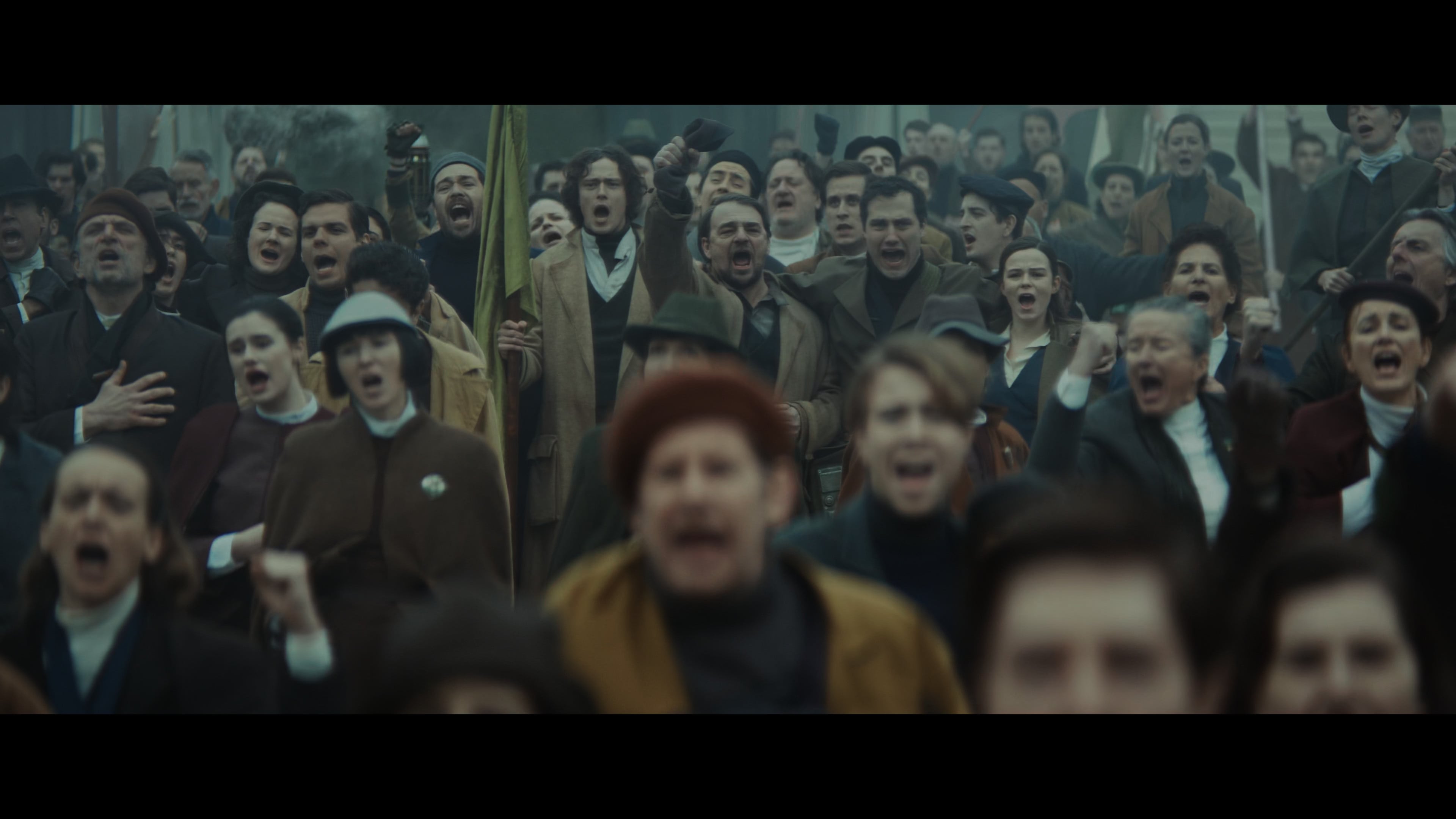
BBY 2 - Do you hear the people sing in Space France?
There’s nothing witty about the Ghorman Massacre
While the legacy of the first season is always going to be the prison arc, the legacy of season two is almost certainly going to be the events in the year of the Ghorman Massacre. This event is something Tony Gilroy and co pulled directly out of existing canon3, tied as it is to Mon Mothma’s exile from the Senate, her public, full-throated opposition to the Empire and Palpatine, and subsequent support for the Rebellion and the fallen Ghorman civilians.
Watching the Massacre happen is a true nightmare, the most harrowing and visceral experience ever committed to Star Wars film. While the series spent the second block of episodes establishing the planet and society, it did so via a lot of narrative shorthand to directly link Ghorman to France. The Ghor language itself is a twisted simulacrum of French and a noticeable number of their Rebel sect wear berets and clothing that evokes French society. By the time they’ve amassed in the town square for that fateful demonstration, they wave giant flags, they sing an anthem. It directly invokes the sort of iconography you’d see in the second act of Les Miserables.
None of this is accidental. One of France’s greatest legacies in the modern era is as the birthplace of democratic revolution. It’s not just that France threw itself into a decade of turmoil between the overthrow of Louis XVI and Napoleon’s coronation, it’s also that these mini revolutions kept occurring in France for decades afterwards. Once the seed of freedom took hold, it didn’t take much for the French citizenry to rebel against subsequent governments. More than that, it became not just a key foundation of France’s cultural identity, but also its own spark that inspired dozens of revolutions around the globe throughout the 19th Century4. Not all of these were successful (hell, you could argue that France’s wasn’t successful given that the anarchy and carnage of the 1790s culminated in an imperial tyrant like Napoleon), but once a citizenry acknowledges that life can be better and the only acceptable solution is armed insurrection, it’s hard to put that toothpaste back in the tube.
Invoking that imagery here is a powerful connection between history and this episode. The Rebellion unequivocally lose on the day of the Ghorman Massacre. The Empire crushes Ghorman under its heel, and their propaganda arm starts working overtime even before the shooting starts. It’s why they make sure to show a pro-Imperial journalist reporting from the scene. Nothing has happened, but he’s already calling this peaceful protest an armed insurrection. In episode nine, the Senate goes through business-as-usual, with various Senators giving pro-Imperial speeches, praising the Empire’s actions as necessary in the name of subjugating an out-of-control populace.
Despite these lies and misinformation, everything about the attack is a false flag, from intentionally bringing inexperienced riot pacifiers to using a rooftop sniper to fire the first shot at an Imperial helmet. It’s a carefully orchestrated plot, one years in the making. Dedra confesses as much to Syril just before the blood starts flowing. In the end, it’s unclear how much of the Empire’s role in the massacre is something the Rebellion will uncover down the line. But you can’t hide dead citizens. The government can only obfuscate the truth so much. Eventually, truth is inescapable.
There’s a complaint that’s been floating around since The Force Awakens. It says that the First Order of the Sequel Trilogy rising from the ashes of Palpatine’s Empire means the Original Trilogy accomplished nothing. This is nonsense. It’s insane to say that actions to disrupt suffering don’t matter if there will be more suffering later. While the current Trump administration is a moral abomination and a stain on America, it absolutely matters that Joe Biden was president for four years. While imperfect, Americans’ choice in 2020 prevented an unknowable but consequential amount of suffering. That has to matter. To argue that the actions of Luke, Leia, Han, and the Rebel Alliance were ultimately inconsequential is to ignore all the pain they abated for at least a time. One Ghorman Massacre is enough. How many other Ghormans would have happened if the rebels had done nothing? How many other planets would the Death Star have destroyed in the name of control? How many more suns would Starkiller base have had to eat to fully consolidate Snoke then Kylo Ren’s grip over the universe?
I, too, am disappointed in the collapse of the New Republic and the rise of the First Order. We’re never going to get everything we want, but everything ends eventually. The small victories can beget big ones if you keep them up for long enough. It is morally reprehensible to let the slaughter of hundreds of innocent Ghormans go unanswered. Every single act of resistance matters regardless of how small.
Luckily, the galaxy would imminently have such a moment. Perhaps most fortunately, its act was not small.
Mon Mothma’s first stand
Mon Mothma had been critical of the Empire before Ghorman, acting as a straw man for the Empire to justify its actions. She was even critical to Krennic’s face in Sculdun’s gallery. But Ghorman is the moment at which silence is no longer an option. She’s been playing a dangerous game of subversion to this point, but in her eyes this line in the sand makes for a leap of faith that’s worth taking.
That comes from a sense of moral righteousness, where what is good and what is evil is undeniable. It’s the sort of clarity that comes from seeing a superior military force try to wipe a claimed enemy off the map through a war of attrition. In our modern age, it comes from cell phone videos of collapsed buildings and buried civilians. It’s witnessing children pulled from rubble, dismembered and burned. It’s mass starvation as a weapon of war and a blockade to restrict the inflow of international aid. Self-defense is an acceptable pretext in certain respects, but how many dead children is enough to satiate a country whose leader will not be satisfied until that state’s entire population is wiped off the face of the planet? How is that self-defense?
Despite not being the ones who pull the triggers, who fire the bombs, there is a moral outrage that comes when a populace witnesses the carnage they’re funding with their tax dollars. Mon Mothma might not have been in that town square firing weapons, but she once took part in a perfunctory vote that endorsed the Empire’s actions. She is complicit in this moment. As a woman with some amount of voice and power in the galaxy, it’s her moral imperative to speak up.
And, weirdly, she has very little to lose in that moment. She barely trusts Luthen. Her husband is a nonentity5. She’s already sold off her daughter to a man she herself described as “a thug” for financial stability. Her daughter rejected the one escape she offered, refusing to absolve her mother of the guilt of her actions. The severing of all these ties slowly puts her in a position where standing up and calling out the tyranny around her is the only self-actualization she has left. With her personal life in ruins, she throws herself into her work and dedicates her life to unifying the rebellion.
To the rest of the galaxy, her personal business is not a contributing factor to her political bravery. What matters is her sacrifice when she starts speaking. By stepping forward and calling out the Empire’s inequities by name, she puts her own safety on the line, giving others the space to join her.
Compared to Bail Organa, the difference is stark. At no point does he seriously consider standing up and doing the right thing, even though a public, two-pronged assault would almost certainly strengthen the Rebellion’s hand. And yet, he does not. One year later he’ll be taking full meetings on Yavin IV anyway as part of the leading council. Unlike Mon Mothma, he is unwilling to cast aside his family (which includes Princess Leia, hard to argue if I’m being honest) or his position in the Senate. In the end that makes him a martyr. Had he given up his life and gone into hiding, maybe he wouldn’t have been on Alderaan when the Empire vaporized it as their first public display of the Death Star’s awesome power.
The political courage of utilizing one’s platform to affect change is the ultimate wish fulfillment for a society that wishes its leaders would stand up and make the difference they expect. In such a world where people are starved for a savior, it’s easy for a populace to turn to some populist ubermensch (like Emperor Palpatine), glomming onto whoever has the narcissism to believe themselves worthy of claiming the throne. I’m sure that on the flip side of that there are many who would deify Mon Mothma as some grand savior, but she is a person who speaks openly about the way she can’t do it alone. She might not be that grand leader, but she can still use her empowered voice to turn the tide.
And her reward for this bravery? In the immediate, it’s her years of trust with Luthen paying off as his orchestrates her exfiltration from the Senate. The vehicle for this is a narrative collision we’ve waited for more than twenty episodes: Cassian Andor himself. It’s an incredible sequence, the nearest thing she has to a trial by fire as she puts her life in the hands of a man she’s never met. Within minutes she witnesses him gun down two people in cold blood. One of those two is her own driver, a man she’s known for years and who’s been compromised without her knowing. She might have thought herself careful, her existence insulated from the Empire’s creeping tendrils, but even without knowing the full extent of her Rebel activities, the Empire has completely infiltrated her life without her knowing. Now that her opposition is more direct, and more visible, the Empire returns that visibility in kind, freed of the need to hide anymore. It’s a far scarier existence she steps into, but it’s also built on more truth. With all of this, Mon Mothma earns the sort of freedom that she has only ever had that one time at her daughter’s wedding, when she drank and danced and tried to pretend her life wasn’t slowly smothering her.
It’s an empowering proof that everything in her speech was worth the saying. It’s the grandest, most direct moment of opposition in the entire series, and it comes from a normal person who just happens to have set herself up perfectly for the moment.
BBY 1 - Links in the chain
The unstoppable massacre machine that is the Death Star
For the final three episodes, the show swerves directly into the imminent deployment of a fully operational Death Star. Given that most everyone watching has seen A New Hope, it’s easy to take for granted that the Empire’s new superweapon exists. It’s only so much of a threat in our minds, given that just two hours after the opening crawl Luke torpedoes it into space dust.
Here, though, they take the ominous intrigue of Rogue One and dial it even further. The Emperor’s secret energy program is so close hold that even knowing about it is a potential death sentence. Look at the trail of bodies in its wake:
- Upon learning about the Death Star, Lonni Jung burns his bridges and tries to escape Coruscant, cashing in on his years-long relationship with Luthen. Luthen, knowing he’s too much of a liability murders him at the end of their conversation.
- Within a day of learning about the Death Star, Luthen himself is dead, having attempted suicide. It’s only because Kleya sneaks into the hospital to finish the job that the Empire fails in keeping him alive.
- Kleya leaves Coruscant, her work as Luthen’s closest confidant over. It isn’t a literal death persé, but more on this (and Dedra) in a minute.
- Dedra Meero learns about the Death Star and is quickly swept up in Krennic’s crackdown on keeping the information quiet. She’s shipped off to a labor prison.
- Major Partagaz speaks the words “Death Star” and minutes later kills himself in the ISB board room.
- Saw Gerrera helps to corroborate Death Star intel through his own information network; he will be dead along with the entire population of Jedha in a matter of days, victims of the Death Star’s first weapons test.
- Cassian Andor, desperate to keep Luthen’s sacrifice from being in vain, gives everything he has to ensure that the Rebellion has a chance of stopping the Death Star.
- And the entirety of the Rogue One strike team, the only team that believes the Death Star is a threat worthy of the sacrifice all die on Scarif.
Like Rogue One, this only intensifies the awesome power of the Death Star. Sure, it can blow up planets, but this battle station is also dangerous even in its infancy. It is a massive project, one decades in the making. And yet the first Luthen hears about it is just days before it goes online.
The following chain of events that result in the plans falling into the hands of Princess Leia is staggering. So many things needed to fall perfectly into place. It required a bond between Kleya and Luthen that was akin to parent and child. It required the loyalty of Cassian Andor, the pulsing of a random beacon enough reason for him to break numerous protocols for a cloak and dagger excursion to Coruscant. It required the faith of Mon Mothma that this lead means anything at all.
If anything goes different it all falls apart. If Lonni doesn’t tell Luthen, the plans never go out. If Kleya doesn’t ensure Luthen’s death the Rebellion’s Base is likely compromised before the Battle of Yavin. If Kleya doesn’t call Cassian without being detected, the information stays on Coruscant and dies with her. If Cassian doesn’t come, it’s for nothing. If K-2SO isn’t there6, Cassian and co probably don’t make it out of that apartment. If Cassian hadn’t saved Mon Mothma’s life during the exfil (through Luthen’s careful planning), she probably wouldn’t give credence to his protestations7. If Bix doesn’t leave Cassian maybe he really does abandon the Rebellion. Hell, if Jyn doesn’t get to the records room, they would never be able to filter through the records necessary to obtain Project Stardust. And on and on and on. It’s a remarkable sequence, where all the pieces barely work together enough to give the impossible a glimmer of hope.
The withering of Kleya & Dedra
As the series wraps up, the show figures out a perfect ending to the story of these two female characters. Both suffer a death of some kind, even though the deaths are not literal.
For Kleya, it means falling apart until she’s barely a raving husk, the power of speech having left her so she can only mutter the same sequence of words once she finally speaks to Cassian. Her life on Coruscant is over, as is the intel ring that manages to set off the impossible task. By the time she finally reaches Yavin she’s practically catatonic, almost non-verbal. Words escape her and she only really comes to when Vel uses Luthen’s codephrase (“I have friends everywhere") to tell her that this is a place she can truly trust.
The last we see of her is the promise of some form of rebirth. Reviled as Luthen and his network was by the end, the Rebellion might be slow to trust her. But there’s the likelihood that they will find some use for her. It’s one of the most hopeful endings of the entire series, a resurrection and a second chance at life. The Rebellion is impossibly lucky to have someone like Kleya. She is Luthen’s final gift to the cause.
For Dedra, it’s a similar dissembling, her uppity-tightness completely crumbling as she gets too close to the hot stove that is the Empire’s secret energy project. It’s her curiosity and ambition that proves her undoing, with Krennic lording over her the fact that her hacking into the vague rumblings of the Death Star resulted in the biggest intelligence leak in Imperial history.
But where Kleya’s end is rebirth, Dedra finds herself on the wrong end of a stick she’s been using for half a decade, narratively dead forever. As a liability to the Empire, they quietly bury her in a prison akin to Narkina 5. Dedra might not be literally dead like Luthen, but if life is one’s story, her story is over. That her narrative death is this baked into the Empire’s ruthless tyranny makes it impossibly delicious. Despite her loyalty, it showed her none. It only serves the whims of the Emperor.
Barring some random Rebellion or New Republic jailbreak, this is where she dies. If she manages to survive and reintegrate into society, would anyone even bother to trust her on the level to which she has accustomized herself?
K-2SO’s surprisingly minor role
Given Rogue One, there’s an expectation that K-2SO would be some grand sidekick for the entire series. Unfortunately, the realities of television means such complex motion capture is not practical for a series regular. By necessity, they can only really have him in the final few episodes to establish his relationship with Cassian.
While this might seem disappointing, it makes their relationship far more fascinating. The final three episodes make it clear that their relationship is nascent, that K-2SO hasn’t really gone on many missions and his relationship with Cassian is hardly special. They might trust each other to some extent, but that shading means that in watching this and Rogue One, what you’re watching is a relationship that is rapidly maturing in a compressed timespan. It makes K-2SO’s sacrifice even more powerful, and helps explain why there’s just that little animosity between the two when they converse.
That K-2SO is also a living reminder of both Ghorman and Bix’s departure is an incredible touch. It builds an inherent tension as to what he represents and the promise of redemption and rebirth. It leaves Cassian keeping him at arm’s length. Despite this, they are friends in the end. How tragic.
ISB Enforcers in plasteel armor
This isn’t really anything significant, but it’s something I found fascinating. Throughout the final episodes, they show many Imperial fighters in Stormtrooper armor, but without Stormtrooper helmets. It’s an arresting image. With the helmets on, the Stormtroopers are an anonymous force of oppressive violence. With the helmets off, the ISB Enforcers are more intimidating. They are free to act with authority and impunity and if you know who they are it’s not going to matter. It’s one thing to have a police force that wants to stay masked while conducting malfeasance. It’s quite another to have one that doesn’t care.
A fractious Rebellion, in need of unification
As the series comes to a close, the events on Yavin underscore something important. As the Rebellion has grown, it’s decreased the organization’s flexibility. The reason Luthen is so effective in the end is because his operation is lean and minimal. He can maneuver his pieces (often himself) easily, but at the expense of being robust enough to direct meaningful change. He is incapable of fomenting an armed insurrection that will topple the Empire.
While it might seem good that Mon Mothma, Bail Organa, and others are working together on Yavin IV’s small council, the infighting locks them into stalemates. While she’s more inclined to believe Luthen, the others in charge are quick to dismiss the intel as some trap that might jeopardize the Rebellion’s precarious beginnings. It tows that line between freedom and oppression, and there’s a moment where the Rebellion feels like it’s begetting the sort of bureaucracy that makes the Empire such a malevolent force.
The difference is in the council’s willingness to trust and gamble in the name of progress. Mon Mothma goes to her cousin Vel in order to determine if she’s right to believe Cassian enough to send him out on the mission. Bail Organa might not like what he’s doing, but he gives Cassian the license to take K-2SO and work as a lean duo that might accomplish something significant, a Luthen style operation with the backing of the larger Rebellion’s resources.
As the series’ final montage plays, and we see all the various appendages of the Rebellion, it did something in my brain. For as long as I’ve been able to speak, I’ve been able to talk about the Rebel Alliance in Star Wars, but what I never realized until this show is that the miracle of the Rebellion is that it’s a series of competing interests who all come together in the name of that one common goal. They’re not just Rebels. They’re an Alliance. It’s why Kleya assimilating into them matters so much. If they squabbled like the Maya Pei Brigade, they’d never get anything done. If they compartmentalize like Luthen and Saw they limit their capacity. By working together, the Rebel Alliance eventually evolves into a strong enough gestalt to finally defeat the Empire.
It’s why Cassian Andor, Mon Mothma, and others succeed where Luthen and Saw Gerrera fail. The Alliance leaves the older men behind, relics of a smaller, more hopeless fight. It’s why Kleya looking out at Yavin is so powerful in the end. Despite his rejection of it, this is the house that Luthen helped to build. Now she can add to that alliance and make an even bigger difference that she would have otherwise.

BBY 0 - The Tragedy of Cassian Andor
It’s the mark of a show like Andor that the text is so rich I can run through the entire season with only minimal reference to the eponymous character. But here we arrive at Rogue One, the culmination of all they promised, and a reframing of Cassian Andor’s rich, meaningful death as the result of a complex, beautiful life.
Captain Cassian Andor, the Rebellion’s Rebel
The thing that most stands out about Cassian in Rogue One is the insubordination and rugged maverick-ism in everything he does. For all that he’s given orders, even after he’s fully embedded himself with the Yavin IV organization, he’s regularly acting independently. He steals a ship to respond to Kleya’s distress call despite all of the dangers that go along with it. His communications box could potentially compromise Yavin IV’s location. He questions the conventional wisdom of the Council because he knows what is right and will fight for what he believes. When he has the perfect kill shot to assassinate Galen Erso, he hesitates and doesn’t take it despite explicit orders to do so.
As Rogue One begins, Cassian seems like some trusted individual, the kind the Rebellion can rely on for such a critical mission. But we’re looking through Jyn’s eyes and seeing what she’s seeing; that’s not really what’s happening. Contextually, he’s doing okay, but the Rebellion is still fractious and doesn’t wholly believe him even when they return from Jedha with the most proof they’ll get until the destruction of Alderaan.
He’s the tough guy, but that is all scar tissue from someone battle-hardened and headstrong.
“Erso? Galen Erso?”
As a prequel Andor enhances Rogue One. It expands on the film in fascinating ways, opening up possibilities rather than just closing them down.
Take, for instance, his introductory scene, where he speaks with his informant. Like Kleya, the man is a rambling, shambling mess, only able to spit out buzzwords that relate to the Death Star. But the moment he says “Galen Erso”, there’s a way that Cassian perks up, his ears alert to one of those precious buzzwords. It corroborates what to this point has been unverified intel. Were this just some bog standard prequel this would be an easy connection to make, but now that we’ve seen the end of the show, we know the hell that Cassian went through to get those two precious words. It’s not just Luthen’s death and his exfiltrating Kleya from Coruscant, but also the way that Bail Organa and other members of the Yavin IV council refused to put stock in the information that Luthen died for. The only reason they relented at all was the possibility that this much mounting evidence might not be some Imperial trap.
Were but all prequels so fascinated in building emotional turmoil and strife into their reference moments. The Star Wars extended universe builds off these castaway lines, taking random beats and weaving entire books out of them. It’s the EU that went into the slavery history of Kashyyyk to explain why Chewie reacts so violently to handcuffs when Luke tries to restrain him for the prisoner ploy in A New Hope. But that’s the sort of fanwankery that tanked the Prequels. Making these connections is not enough. Pointing at a reference might as well be a text message of Easter Eggs you missed. That is not the hard work of making a story that will make these connections emotionally resonant.
Rogue One, on the other hand, is full of those “Galen Erso?” moments. They only resonate because Diego Luna dug into a character the writers had broadly sketched out and infused every possible moment with pathos and choices about who this man is. When the time came, Luna’s work off the foundation Weitz, Gilroy, Whitta, and Knoll wrote provided a rich tapestry for the Andor team to gaze at. It’s only possible because of the nuances of Luna’s performance. When he talks about fighting the Empire from when he was six years old, it speaks to his mother and his life on Kenari. When he references the cell in Saw Gerrera’s base, saying he’s never been locked up like that, it’s a reference to the prison arc. That was a real proper prison with electrically charged murder floors. This weird alcove behind an iron grate? Bro, it doesn’t even have a food tube.
The film might not be a movie explicitly about Cassian, but it’s an incredible tale that weaves in the culmination of all of those moments that led him here. It’s a remarkable achievement in the canon of prequels.
Leading the Rogue One squad
As Jyn mounts up to take the fight to Scarif for the big third act, Cassian pulls together a team to support her. On initial viewing, Cassian mounting up this squad feels like him standing up for the relationship he’s built with Jyn. That might be true, but post-Andor it’s more than that. Cassian isn’t some good boy of the Alliance. He’s a man who will stand up for what he believes in , who will defy orders in the name of doing the right thing.
With that, Cassian proves himself the perfect representation for the Alliance. If the point of the Rebellion is to wrestle freedom from tyranny, it’s independent thinking that proves the most precious quality of all. The Alliance’s budding bureaucracy proves a hinderance to what needs to be done. Their precautions would have doomed the galaxy to the Death Star’s oppression, setting the cause back by decades.
Soon after, Cassian and the rest of the squad die anonymous deaths, their remains entombed on a Death Star-vaporized Scarif. But the cost is worth it, Cassian proves his instincts correct, and he dies with a quiet humility.
“Your father would have been proud of you”
The final thing Cassian says is the above line. In the context of Rogue One, it’s the final validation of Jyn finishing her father’s work and completing her revenge against the Empire.
And yet, knowing what we know, in his dying moments isn’t Cassian just saying what he himself wishes someone would say to him? Something he knows to be true of his own life? Cassian might not have had a father figure (Luthen doesn’t fit the bill), but he did have a mother. By the Battle of Scarif, Maarva has been dead for five years, but one of the last things she said to him in person was that despite her age she intended to fight the Empire until her last breath. Cassian’s leaving her for his paradise planet means he never saw her again; she died during his incarceration on Narkina 5.
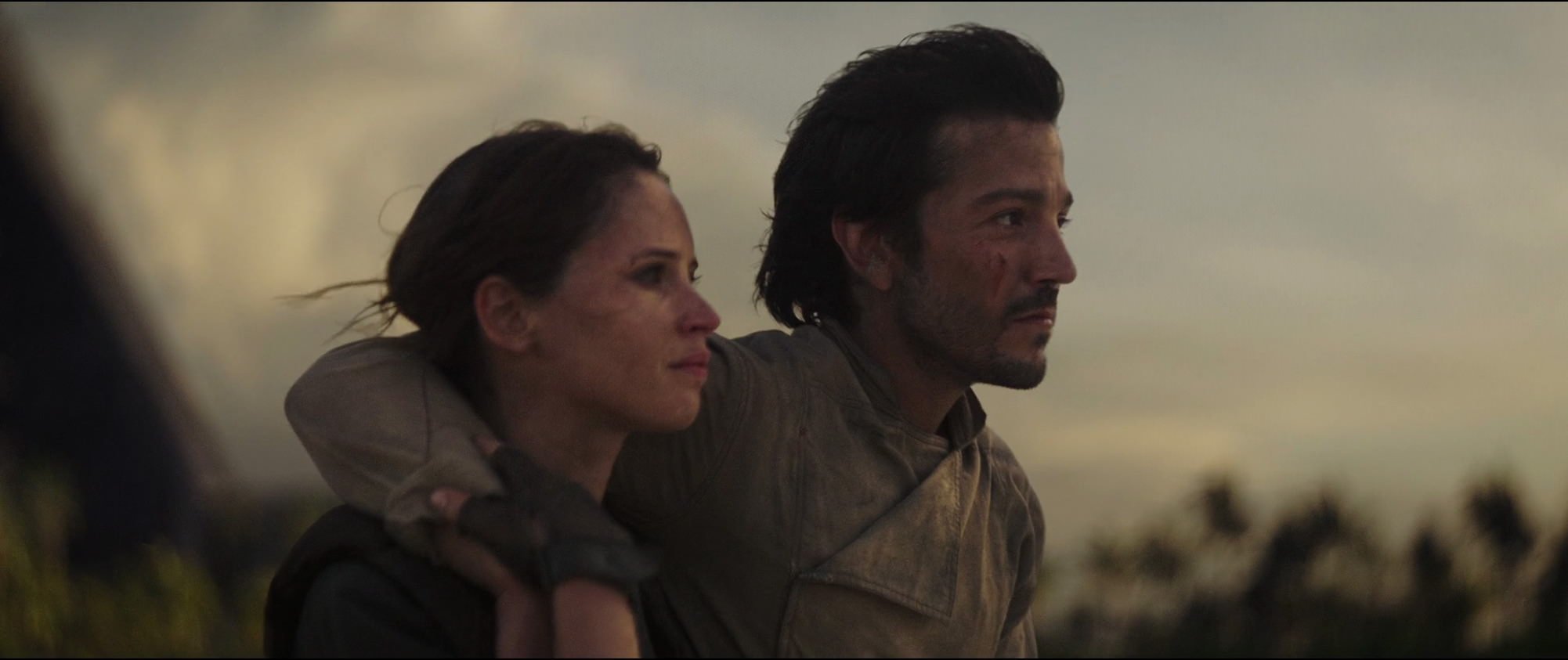
But god dammit would she have been proud of him. Standing on that beach, watching oblivion race towards him, I can almost imagine her, right beside him, beaming with pride as he gives his life for the most important thing in the galaxy. It’s even more devastating than it was in the theater, an incredible balance of cynicism from his death and hope from the life he lived.
Heroes
In my previous write-up on this show, I referenced that Rogue One and The Last Jedi showed the promise for new kinds of Star Wars stories. In the wake of Andor, that’s even more true. This is a show that demonstrates just how sublime Star Wars can be when it’s allowed to be about something that isn’t itself. It’s new without breaking the mold of the original films. It tells a story of heroes who fight oppression, but the heroes it shows are hardly the mythic creations of George Lucas. None of these people were chosen. They’re normal people who found a calling and answered it. They did the right thing in the right moments. Those moments became a chain reaction that reshaped the face of the galaxy.
It’s a far more believable representation of how the world works. It’s one that doesn’t fall into the allure of tyrannical/fascist ideas and demagogues. We save each other. The rebellion would survive without Mon Mothma. It loses Cassian Andor and only thrives more. Every person has some role to play if the Rebellion would just enturst them with the space.
Yes, there’s work to do, and the Rebel Alliance will beget a New Republic that falls to the First Order, but the fight is worth it. All of these small improvements snowballed into something far beyond the scope of what was conceivable even just a few years previously. For the first time, for this brief shining moment Star Wars is a both celebration of democracy and a damning condemnation of fascism, tyranny, and the all-consuming apathy that follows in their wake. Since the Sequel Trilogy ended, Star Wars has been a series for Star Wars fans. It’s a myopic, ever-shrinking constituency that might never die, but it will inevitably collapse into a vacuous circle-jerk unless it’s bold enough to change like this.
Finally, for the first time in decades, Andor turned Star Wars into a cultural juggernaut, the sort that speaks not just to the history of revolutions but also the world as it exists today. It is prescient and relevant. Maybe one day Star Wars can get back here again. Maybe one day it can do something this bold, daring, and exquisite. Maybe one day it can feel as new as this feels, as new as it felt in 1977 and 1980, or even 2017.
I just hope we live long enough to see it.
In my discussions about these episodes I did compare the extended three-episode wedding to the opening half hour of The Godfather. Kinda apt, no? ↩
BBY means Before the Battle of Yavin. That’s the battle at the end of OG Star Wars. The show never explains this, but in case you were confused it just means that’s how long until Luke makes Death Star kaboom. ↩
The aftermath of the Ghorman Massacre appeared in Star Wars: Rebels episode 318 “Secret Cargo”. ↩
Without this being a history lesson, the reason it’s the French Revolution and not the American Revolution that inspired global rebellions is because the American Revolution was for independence from a far-off tyrant. Yes, the French took inspiration from the Americans, but they went much farther in their ambitions. Unlike the Americans, the French actually did march on Versailles, arrest the King and and try him for crimes, and commit public regicide in streets of Paris all in the name of freedom. France’s complete toppling of its own government changed the realm of what was possible. It became a model other societies around the world could understand and implement. Before that, revolution was the pipe dream of crazed anarchists. After 1789 (and not 1776) it was a reality any global citizenry could conceivably manifest. ↩
And winds up drinking and alone with some other wife. Loser. ↩
And Cassian hadn’t brought him home from Ghorman… ↩
(Assuming she even got off the planet at all…) ↩