Populist Civics Edutainment - Twelve Angry Men
When guilt is not the point.
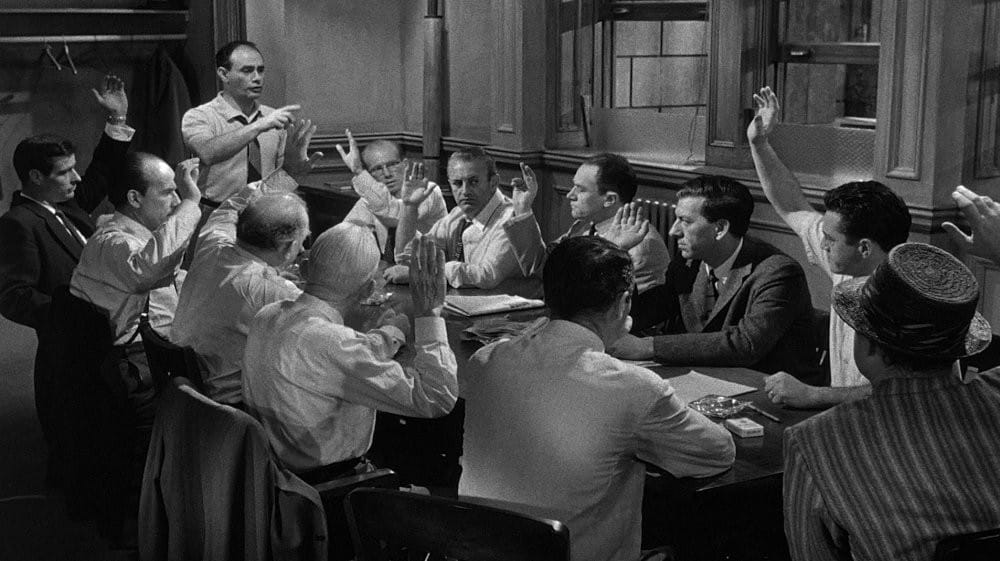
Henry Fonda went and found that knife.
Acting as the first moment that derails the fait accompli of this jury’s deliberation in a murder trial, Sydney Lumet’s 90 minute, one room thriller blazes right by Juror #8’s unethical and questionable contamination of the case’s evidentiary integrity. Not that it matters. No one goes to Twelve Angry Men to see the tedious machinations of a jury as it wades through the tedious technicalities of a trial case. They show up to see a deliberation that takes less than half the time it took to acquit OJ Simpson.
Movies and television futz with reality all the time, and there’s an entire cottage industry of YouTube series in which experts evaluate these based-in-real-procedure stories for accuracy. No one cares, though. The punchline is that none of it matters. When the options are “fidelity to reality” and “narrative excitement”, the latter should win out every time.
That being said, at a certain point, society’s texutal literacy feels like both less and more than it should. At times, audiences can get ahead of “whodunnit” while those same audiences could sit on a jury and demand more forensic evidence because they’re huge fans of CSI. Never mind that the case might not have curated enough forensic evidence to satiate the demand.
On the one hand, it’s good that audiences are open to expanding their minds and learning about how their society works and applying that to the parts of their lives they know nothing about. On the other, creators should recognize that audiences are learning from their stories, and that storytelling can warp the way that they look at the world.
And there’s no amount of narrative that can really replace a good civics lesson.
Rule of Law
As we enter our second decade of Donald Trump being a public menace, I’ve been reflecting on all the elements of American society and how much we’ve taken them for granted. When students learn about the Constitution and the subsequent Amendments, it’s easy to look at them as an addendum to a system of government. But really, the Constitution is a work of radical thinkers trying something completely insane. So much of America’s infrastructure comes from radical thinkers who try to make something that changes the rules of the world. This is how the 14th Amendment happened, where a bunch of Northern radicals took advantage of a fractured and reconstructing South to pass one of the most radical rights declarations in the history of the country. In order to rejoin the Union, the southern states had to ratify.
What Twelve Angry Men celebrates is not just the freedom that the Constitution grants, but also a fable about that system nearly failing were it not for the courage and conviction of one man. The judge dismissing the jury alternates from their service opens up a parallel timeline. Suppose Juror #8 has to leave the jury because of illness or because he illegally bought a knife or any other relevant reason. Imagine that any other Juror steps out and they’re even more obdurate than the holdouts, or even worse: more rational than the naysayers and thus able to shutdown the questioning. There’s a world where none of this sequence of events happens. By all appearances this would be an open and shut case.
Any right that the Constitution bestows becomes a protection for the citizenry. But these inalienable rights are static. They exist until the government tests them. The 4th Amendment provides a standard procedure for searches and seizures, and law enforcement should have guardrails in place to prevent themselves from infringing on that right. But should that infringement happen, the law as written gives the citizenry the tools by which to defend themselves from government overreach and oppression.
For the defendant of Twelve Angry Men, though, no amount of the system working is going to stop the inevitable. He might have a lawyer (6th Amendment) and does not need to testify against himself (5th Amendment), but those don’t help him against what seems to be a sure conviction. The system might weigh itself heavily towards the defense, but that is imperfect and sometimes it will get the wrong person. It happens.
Yeah but did he do it?
Twelve Angry Men conveys that the accused did not murder his abusive father. Or, at least, it creates a situation by which audiences will assume that it’s not definitive.
To destabilize the inherent certainty, Juror #8’s reasonable doubt infects the entire room over the course of the run time. And this is the system working like it should. The defense doesn’t seem to have mounted much of a case and the prosecution’s evidence falls apart quick scrutiny. The actions of purchasing the knife also opens the rest of the Jurors to extrapolate based on their own uncertainties.
Take the eyeglasses reveal. By the end of the movie, the critical piece that turns Juror #4 around is supposition based on Juror #9’s connecting a pinching of the bridge of his nose to the testimony of an eyewitness. He backs up the assertion with a memory of indentations from where the eyeglasses sit, and then extrapolates about the eye witness that she must have worn eyeglasses and because she was sleeping, there’s a chance that she couldn’t have seen clearly, and that means her entire testimony is in question.
They could be absolutely right, but considering just how meandering and listless the men in this room are, Juror #9’s “I remember her doing this” proves remarkably powerful considering it’s all basically a mandela effect. Few have the level of conviction necessary to turn this ship once it’s in process. Maybe she really was far-sighted and could see the murder clearly. Maybe she put on her glasses to see. Or maybe all of this is in Juror #9’s head. They’re taking his guesses as gospel while arguing that the eyewitness testimony is suspect.
This, though, is the point. The film doesn’t make the argument that the accused didn’t commit the murder. It merely states that the evidence as presented is not enough to obtain a conviction.
Meanwhile, it might be outside of the scope of the film, but no one presents an alternative narrative to how the murder happened. Like with OJ, there is a valid argument of “well if not him, then who?”
Lone wolf
At the center of all this sales pitch is Peter Fonda, a dude who played white hats for truly his entire career. He’s the sorta dude who walks on screen and everyone inherently trusts him. This isn’t a bad thing, but his inherent charisma is enough to start turning the tide in his direction slowly at first, then all at once.
Where this runs into a problem runs alongside the idea of American exceptionalism. America builds itself on the foundations that while we might have special and remarkable people in society, all are equal under the law. But that fair treatment doesn’t play a role in this jury room. To the contrary. One man takes it upon himself to see justice carried out as he sees it, all because he takes this particular civic duty with all the proper import. He must decide if he’s willing to condemn a man to death (which does run into an 8th Amendment question) and if he’s going to make that choice, he has to be 100%. As deliberations start, he isn’t.
It’s only when he says this that people start to come to his way of thinking. Every other individual in the room has dismissed the case as open-and-shut, and to them this isn’t dispensing justice so much as it is getting back to their lives. The callous disregard for the life of this young boy is not a damning indictment of them, but rather a commentary on how flippantly the citizens of this country take their constitutionally-delegated responsibilities. In a court room, citizens have power over each other, and our founding document empowers juries (not judges) to determine the course of justice and law.
But where I bristle is in this idea of the lone good man standing up for the right thing despite the adversity.
What #8 does here is a classic story of the good man standing up to save the day. He is a superhero, where his brain and reasoning defeat the apathetic toxicity of those around him who don’t take this seriously. Sad as it is, a man like him is necessary in the face of these eleven other men, who abdicate the requisite investment they should make in whether they should send this kid to the chair. Without really engaging with the world as it exists before them, this easily goes the other way.
But to balance that apathy, #8 takes the extraordinary step of going into the neighborhood and buying the knife, inserting himself as some investigator, when that’s not his role in the process. By all means do analytics work, but by taking matter into his own hands, he’s completely compromised himself and the jury pool as a whole. He has introduced his own bias into the consideration. A judge can order jury members to forget something they’ve seen, but that larger context will still inform their judgment however subconsciously. Now, this is far worse. They’re now party to extraneous evidence that isn’t what the proper procedure presented. #8 might have been right that all of the evidence is far more circumstantial than direct, but the initial method of getting there is suspect.
And because of that, #8 has inserted himself into the narrative of the investigation and then casts a summary judgment based on that bias.
Civic duty
Failure to do one’s duty is a byproduct of being flippant about civic responsibility. Juror #7 only switches his vote because he sees which way the others are swinging. He always pivots to join the majority, wherever it is. This probably happens every day in courtrooms all over the country. It’s still shocking and disappointing to see justice fall on the whims of whichever direction the wind happens to blow.
To bring it around to the beginning, it’s disappointing to see just how much we as a society have always failed basic civics. Part of the social contract of both democracy and dispensation of justice is everyone having to do their part. We have failed in this task. I count myself as very dialed into civics as a subject, understanding the ins and outs of our government, the responsibilities I have to be a responsible citizen, and the obligations to do my part. I vote in every election and try to keep up on the current issues and understand how anathema they are to our society and how it currently operates.
But while I like to think I’d be terrific on a jury, I can’t pretend like it’s not a major inconvenience to partake in one. Even as I preach this, my brain wants to say that “I am lucky enough” to never have served on one.
There is the hope that juries would be exciting. Maybe it’ll get one with a Peter Fonda as the voice of reason and it’ll be a masterclass in the system actually working to exonerate either guilty or innocent parties if the evidence isn’t there.
All too often, though, the system doesn’t work this way. The system is a necessary tapestry of boring interlocking pieces that grind together the machinery of government into something that functions (or should) for everyone. Juries are one facet that should operate with order and understanding to keep the justice system everything moving. This gestalt is not some sleek Porsche that’s here to entertain. It’s a reliable Volvo that doesn’t break down and should run for long past the usual life expectancy.
For all this, though, the joy of Twelve Angry Men is seeing the system not working and the hope that one day maybe any citizen can set it on the proper course. This means people can watch films like this or shows like Law & Order to better understand the ins and outs of the civics in our society. Ideally, this should make a stronger country. But there should also be a way for these narratives to be accurate enough to set expectations and help to educate the populace. In balancing the edutainment nature of how the world works, there might be a way to help supplement the lack of civics education and knowledge that has always plagued our society.
We take these things for granted, and that means we’ll probably be one of the eleven and not a lonely #8. But this engagement means we can aspire to be the Fonda, and the world could always use more of them.