October 2025 Check-in
Spooky season arriveth...
Happy October!
Gosh it’s already October.
Somehow September flew by. I really wanted to get more done, but lo and behold I hit the halfway point of the month and found myself way behind on stuff. Chris and I recorded a Sandee Boyz that I have to finish editing so it can get out into the world. In the meantime I finished Isles of the Emberdark so as soon as the Sandee Boyz braintrust can get our shit together we’ll record that one too. Also wanted to finish this Lynch rewatch, but it’s way more sluggish than I want it to be. Also the Twelve Angry Men essay goes out on Friday and I only re-watched it on Tuesday. After all the talk of wanting to get ahead, it’s still a goal I’m reaching for.
That said, the pieces themselves are going well and I hope all y’all are enjoying them. I’m really proud of the Cameron pieces, and these Friday essays about classic films are proving to be a good exercise to continue improving this whole format thing.
Seeing Way of Water on Saturday (can’t wait!) and Back to the Future in a theater at the end of the month. I’m also anxiously waiting for the Baahubali tickets to go on sale so I can get that on the books. Apparently Rajamouli has done a proper cut down to get the 6 hour, two-part original down to four hours or something. Stoked to see the final product.
This is also not pertinent to what we’re usually talking about but as I write this I retired my Harrower Geminate in our Frosthaven campaign. Looks like we’re scheduled to run another scenario next week and I’ve yet to paint what I’ve selected for my next class (codenamed “Meteor”). So that’s going to be a big push to get it table ready for Tuesday. I haven’t painted anything in quite some time, so that’ll be good to get to.
Anyways. Here’s some quick hits on what I’ve been up to this month.
Alien: Earth
Was planning to write a whole piece about this, but as I’m going through it I find I have less to say than would merit a whole big piece. That might change as I finish these last three episodes, but c’est la.
As a show with rad Alien action, Earth definitely hits (especially the fifth episode), but mostly what creator Noah Hawley finds himself interested in are the main Hybrid characters. With synthetic bodies into whom Prodigy has placed the brains of dying children, there’s a lot of thematic interest in the nature of humanity, robotics, and the next stage of evolution.
Like with Fargo, I keep wanting to read this show as in conversation with other works by its original creators’ other source texts. At a certain point, Fargo features a recurring UFO motif, which calls back directly to the weird alien thing going on in the background of the Coens’ The Man Who Wasn’t There. So too here, the fascination with sentient not-human intelligences feels more like Blade Runner than Alien. It’s not unwelcome, and I love the way that Hawley is building these adaptations not as direct from the source material, but rather as a piece that springboards off a larger library of material to create something in the spirit of the original, which shares thematic DNA, but is absolutely doing its own thing.
The Leftovers s2
Finished rewatching this season and have since moved into season three. It’s wild to watch a show that only kinda worked in season one completely recalibrating under Damon Lindelof & co. They pivot super hard into something sublime.
Season two follows the Garveys as they move down to Jarden, Texas, which the U.S. Government has designated as Mirace National Park because of its status as the largest no-Departures community in the country. It’s a great idea for a season and the storyline focuses around the nature of grief percolation. No one in Jarden should be having the same issues as all the people who deal with the psychological/emotional trauma of directly losing loved ones (or knowing those who etc etc), but the lingering weight of the Sudden Departure means the township feels special and blessed and that haughtiness has infected the local populace. This is a town where a dude recreationally slaughters goats in public because Jarden superstitiously doesn’t know if that’s what saved them. A woman still wears her same wedding dress four years later. She does that every day because maybe it was enough to keep the evil away.
The standout episode of the season is “International Assassin”, the one that (without spoiling) features Kevin on… a bit of aspirit quest. It’s probably the most famous episode in the entire series because of its out thereness and strangeness.
But if I were to highlight one episode I would highlight “Lens”, which centers on Nora Durst (Carrie Coon) and Erika Murphy (Regina King), setting them on parallel tracks that collide in the episode’s second to last scene. In it, Nora conducts a mock questionnaire, prepping Erika for what the Department of Sudden Departures will ask her as they investigate her daughter’s mysterious disappearance. It’s a bravura performance for the series’s best character (Nora) and the season’s breakout smash (Erika). Just two women in a room, being directly indirect about all of their hangups and issues with the world, how imperfect it is, and the bubbling secrets they’re hiding inside themselves.
Many people gave up on the series somewhere in season one, but everything after is tremendous television. It’s worth pushing through the slog of season one (which does have a couple high points) to get to the excellence of the rest of the show. Every episode hits.
Twin Peaks episodes 14 & 29
Lynch rewatch this month was almost entirely the second season of Twin Peaks. Struggle bus season. The studio forced Frost & Lynch to solve the central mystery of who killed Laura Palmer, and it left the entire series without an engine by which to operate. It also doesn’t help that Lynch & Frost stepped away after the reveal, handing showrunning duties off to people who do their best but can’t possibly capture the magic sauce of what made the show work to that point.
The two best episodes of the season are the final two that David Lynch directed before the show’s unsurprising cancellation: “Episode 14” and “Episode 29”. The former is the one that fully reveals the identity of the killer (without resolving the mystery entirely), while the latter is the series’ final episode.
Of the two, everyone remembers “Episode 29”, which features an extended sequence where Cooper follows Windom Earl into the Black Lodge and experiences an unrelenting parade of nightmare imagery. It’s pure uncut Lynch surrealism, the kind he hasn’t really done this potently since Eraserhead. It’s almost like making the episode unlocks his ability to more heartily embrace this aesthetic in subsequent projects.
The episode is magnificent, one of the series’ best. And yet, it’s almost a relief that the show ends where it does. This burst of madness and terror is not something the show could sustain week-over-week, and certainly not in a 22 episode format. To return to the soap opera format (as the show outside the Black Lodge was settling itself back to do) would be to pretend the toothpaste never came out of the tube (even though it’s dribbled piles in the sink). Were it to return for a third season, there’s no way it could live up to just how weird and fucked the show had spent its finale getting. Anything after it would have been a disappointment. But it also means that when those came back 25 years later for The Return, it could pay off this purely nightmarish spectacle on premium cable.
But the best episode of the series is “Episode 14”. As I rewatch these major shows, I do mini reviews for episodes to keep them fresh in my mind and reference later. Here’s what I wrote for this one (and spoilers for who killed Laura Palmer…):
This is an astonishing hour of television. It’s hard to not talk about the shocking final act and have that take over the full discussion. But David Lynch (behind the camera for the last time before he returns to try to save the show from cancellation at the end of the season) carefully lays out the pieces that tee it up. The image of Harold having hung himself, Audrey learning about her father’s sexual relationship with Laura (before she died), the way MIKE freaks out when Cooper and co investigate the Great Northern Lodge. Bobby and Shelley’s ineptitude at being caretakers for Leo starts to affect the rest of their lives, with Shelley having to quit working at the Double R and Bobby trying to figure out what to do now that his life is changing so quickly. The tape in Leo’s boot is a good development, but it’s not clear what that means yet. The strange gross-out aspects that come with Lynch’s style manifest too, from the mess Nadine makes when she shatters her milkshake glass to the incessant drooling that leaks from Leo due to his catatonic state. There’s also a sense of victory in the arrest of Ben Horne, even though when it happens it feels like this particular guess as to “who killed Laura Palmer” is way, way too easy.
All of that, though, is just teeing up for a truly shocking and horrifying ending.
As it starts Lynch’s strange, surrealist direction indicates something unsettling is afoot. It starts simple enough: Julee Cruise performs a song that incorporates Angelo Badalamenti’s title theme. The dreamy aura subsumes the show. And then Sarah Palmer is crawling across the floor of the Palmer home. The ceiling fan spins. Lynch’s camera tracks over the carpet. And then it reveals Leland, staring at himself in the mirror. In that one shot, the show plays the single biggest card that it has.
What follows is one of network television’s most terrifying scenes, as the show reveals BOB’s possession of Leland and proceeds to have the two murder Maddy in cold blood for no discernible reason. Leland was always Lynch & Frost’s answer to the mystery, but pushing this hard into this much horror feels like the awful truth of what the show has always been trying to say: evil is real. It can live in anyone at any time for any reason, and no amount of idyllic, edenic, verdant green northern logging town can hold it at bay when it manifests. And so... Lynch uses his style to smuggle the reality of violence and murder and viciousness into every television set in America. Audiences can’t possibly have prepared themselves for this even though the brutal murder of a teenage girl has always been at the very heart of the show from its opening minutes. Narrative violence can feel so abstract until it becomes sickly, grotesquely tangible. These punches are simple but fierce. The blood is everywhere without being comic. Season one might have had the introduction of the Red Room in the Black Lodge, but this, finally, is the purest distillation of David Lynch and what he can bring to television. In theory, no solution could ever live up to revealing the murderer of Laura Palmer. Lynch proves that wrong.
And then to have it end back at the bar, with the music still dreamy and the senile waiter apologizing to Cooper. Donna begins sobbing for seemingly no reason (though we know why). It’s an incredible moment for the audience to catch its breath, to soak in that what they witnessed is real and horrible and the sort of thing that really breaks the world. Twin Peaks has always been supernatural, but this is the point at which the show becomes an open pain valve that connects and harmonizes with its audience. As Cooper looks up, trying to figure out what’s gone wrong, the audience alone understands that discovering it will only make it worse. 10/10
PaulQuentinThomasTarantinoAnderson-athon
Finished up this little film series. Here’s some thoughts:
Phantom Thread
PTA’s reunion with Daniel Day-Lewis was always going to be a hell of a project, but the thing about these movies is they never really work in the same way I expect. Because my introduction to PTA was with There Will Be Blood it’s hard to escape the preconception that his movies aren’t crime-based or violent. But it’s such a delightful surprise to get something this potent, a romance between two people in love with each other but who find it difficult to get along because of who the other is.
One of PTA’s biggest strengths is his understanding of characters and realizing them as fully formed beings. Having an actor of Daniel Day-Lewis’s caliber at the center of two of his movies helps to make these two collaborations tremendous portraits of incredible characters. I loved this more than I thought I would, but that’s because PTA is a gifted cinematic talent and can make a film about an ornery 50s fashion designer mad compelling.
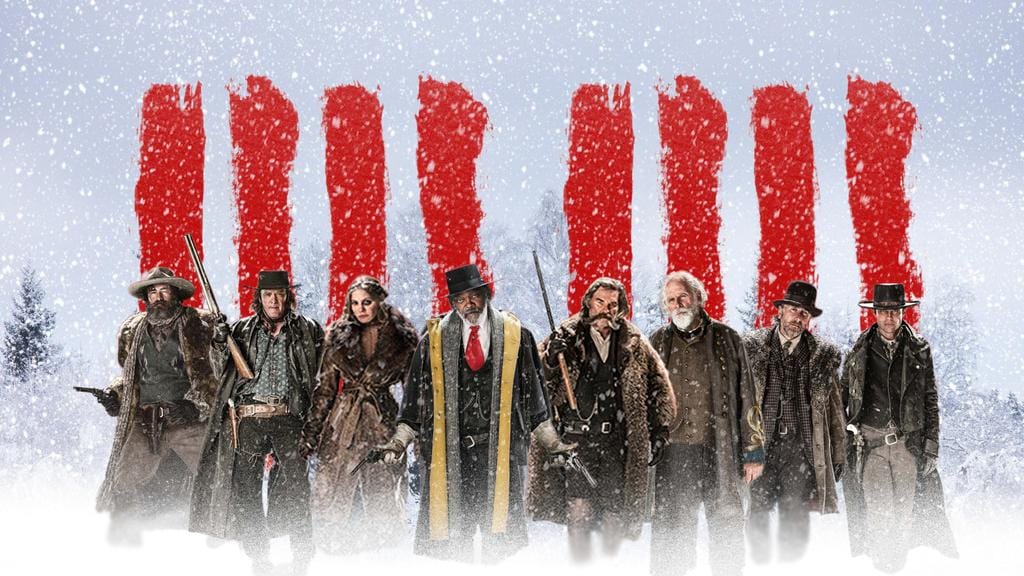
The Hateful Eight
It’s hard to gauge the response to Tarantino’s 8th film. The prospect of him doing a western was so exciting (especially coming off Django, which was only so much of a western), but then to see him turn that opportunity (and the big 70mm push for its roadshow releases) into what amounts to a play is mad off putting. We expect vistas and vast open spaces, and instead the majority of the film takes place in a cramped house-store haberdashery.
Watching it again, though, man it’s good. These characters are all dynamic and interesting and it’s an excuse for Tarantino to let his dialogue sparkle as he reveals who these people are and unwinds a mystery surrounding Daisy Domergue’s arrest, arrival, and conspiracy to free her. If it’s one of Tarantino’s weaker outings, it would be because his entire filmography is so outstanding. The dude hasn’t made a bad movie, and while The Hateful Eight does descend into grizzly violence (specifically in the second half) and the midpoint does feature a description/depiction of sexual assault there is a softening of his rougher edges that has made his career’s later work impossibly engrossing. All of that vinegar and fire that made his early work so kinetic has evolved into trusting the medium to execute on something that’s incredibly slow but totally engrossing. If there’s a weakness it’s that the vinegar and fire manifests as it does in the back half, where Sam Jackson gets shot in the dick and Daisy Domergue’s increasingly distressed face bears more and more wear and tear (and her broken teeth are GNARLY).
Licorice Pizza
Weirdly, this is the PTA I was most worried about. When it came out, the movie’s rep centered on the weird exploration of a flirtatious relationship between a 15 year-old boy and a 25 year-old woman. That’s certainly a questionable choice, but it helps that Alana Haim plays Alana as emotionally younger than 25 while Cooper Hoffman plays Gary likewise older than 15.
But the story itself is the sort of sweeping coming-of-age story that I’m a total sucker for. PTA cited Fast Times At Ridgemont High as a major influence, and the overall vibe was one that could have gone on for hours. Both Alana and Gary are wonderful characters and PTA bringing the whole movie together with that montage of running swept me up in the romance of it all. God. I just loved it.
Once Upon a Time In Hollywood
Tarantino has cited this as his favorite movie and it’s easy to see why. Unlike all of his other films, this really doesn’t play in a crime space until the final bit when the Manson family attacks. It’s just Tarantino painting a picture of this small window at the end of the 1960s, just as his formative years are about to erupt into the 70s. Without the crutch of playing within genre, Tarantino has to drop the trappings and rely on his own skills as a filmmaker. It’s like how Stanley Kubrick stripped away all his genre experiments for Eyes Wide Shut, making an intimate, dream-like character piece about strange and dissatisfied people. Without those to lean on, the great movie he made had nowhere to hide any seams.
The same is true here. It’s a shame that Tarantino has vowed to only make one more movie before doing literally anything else for the rest of his life. It feels like he’s finally reached a point where he can be more than the flashy dude who slipped into genre pastiches after Jackie Brown, and the cinema available to him is functionally endless. Thinking about how skilled artists become as they transition into the twilight of their late careers, that Tarantino is limiting himself to never make a Fabelmans or Killers of the Flower Moon or Eyes Wide Shut feels disappointing. Maybe he wants to be in complete control of his filmography and doesn’t want to dilute the brand like late Carpenter or the ups and downs in Spielberg’s canon. Maybe he has so little left to give, but based on his work to that point Once Upon a Time In Hollywood feels like it unlocks infinite possibilites. Few would believe he could do something like this. Who knows what else he’s capable of? It’ll be a shame to never find out.
One Battle After Another
Planning to give this a full review early next week, but the short answer is I loved it and I expect it will probably end up my movie of the year. Everyone go see it and in theaters if you can!
107 Days
This is Kamala Harris’s new book about the 107 Days leading up to the 2024 election, when Joe Biden’s dropping out of the race thrust her into an impossible task with the highest stakes imaginable. At times, this is a hard read. And I spent a good chunk of it remembering just how much her campaign swept me up in hope for the future and the idea that we’d finally be able to put Trump and other Republican onerousness in the rearview. I really miss that bright optimism.
But as she says in the book, there’s still work to do and this isn’t some pity party about how things shoulda been. I can’t imagine what it must have been like to go through all of this and maybe the Democrats were always due for a whooping in 2024. What remains true is that Joe Biden is a major factor in the loss and he’ll almost certainly never admit that. But Harris and everyone else who’s paying a bit of attention knows that following the Midterms, every second he didn’t drop out was a second that more guaranteed Donald Trump’s return to the White House.
When reading Nixonland, I marveled at LBJ and his accomplishment at creating the Great Society. His domestic successes were astonishing and I didn’t understand why Democrats didn’t cite him as a dude to emulate. But then the book talked about Vietnam and all of the drama that came from the way he conducted that war and the huge mistakes that turned the public against it (and him for prosecuting it). In a lot of ways, Biden’s arrogance will prove the same. All of his stunning legislative accomplishments and stewardship of the economy will not matter in the face of his tacit enabling of the genocide in Gaza, nor will it help that Trump’s re-election is primarily the result of the arrogance of both Joe Biden and the team of sycophants and obfuscators he surrounded himself with. No one was honest about both what was going on behind closed doors and what the numbers were telling him. That information bubbled has done tremendous damage to this country and it’s a shame that it will be his legacy.
I still hope it didn’t cost us everything. It’s bad enough we might never have a President as qualified and capable as Kamala Harris. Knowing that all of this might have been avoidable is still distressing to think about.
Star Wars: The Empire Strikes Back - From a Certain Point of View
I haven’t finished this yet, but I got through the many, many stories set on Hoth. Like the first From A Certain Point of View, this follows ancillary sideplots and storylines that orbit the narrative outskirts of The Empire Strikes Back. In a perfect world this collection creates a perfect negative space to understand the contours of this story by obliquely referencing without ever digging fully into its intricate details.
My partner read this when it first came out and bemoaned just how long the book spends on Hoth. It made sense to me, though. Hoth is a major chunk of the first 40 minutes or so of the movie, which means it should take up about a third of the book.
Finally getting to it, though, the problem comes from the betrayal of its premise. It begins with a probe droid operator (as it would), but then proceeds to cover the entire stretch through the Battle of Hoth. After that, there’s almost a dozen stories that somewhat cross the same territory, frontloading it so the first 5-6 all cover the same stretch of time. It gets a bit easier as it goes. The one that takes place entirely in Admiral Ozzel’s head as Vader force chokes him to death is mad compelling. But it feels like the editor really took their foot off the gas when asking for specific vignettes that only covered small spans of time. The Wampa’s story is a no brainer, but we don’t need to see the Wampa witness the Battle of Hoth itself (or its aftermath), nor do we need the full history of its time interacting with humans prior to the start of Empire. Ideally, we’d be getting little flavors of these characters intersecting with this larger tapestry and expanding the galaxy of what is possible.
To have so many feature Han and/or Leia and/or Luke in prominent minor roles centers that trio in ways this ancillary text does not need. I’m not reading this collection because I want more of those three. I am excited for it precisely because these treat them as intersection points. There can be an ion control person who swoons over the flirtatious relationship between Han and Leia, but that’s not enhancing the text of Empire. It’s providing commentary on a movie that fandom has already picked to death. Not that helpful.
Coming soon…
Quick rundown of what’s I’ve got planned for the month:
10/3 - Twelve Angry Men
10/6 - One Battle After Another
10/8 - Avatar: The Way of Water
10/10 - The Wolf of Wall Street
10/17 - Seven Samurai
10/24 - The Treasure of the Sierra Madre
10/31 - The Grand Budapest Hotel
And who knows what else will strike my fancy? Got lots of space.
Thanks for reading!