
Live Together, Die Alone - Mission: Impossible - The Final Reckoning
For Ethan Hunt, it takes a village.
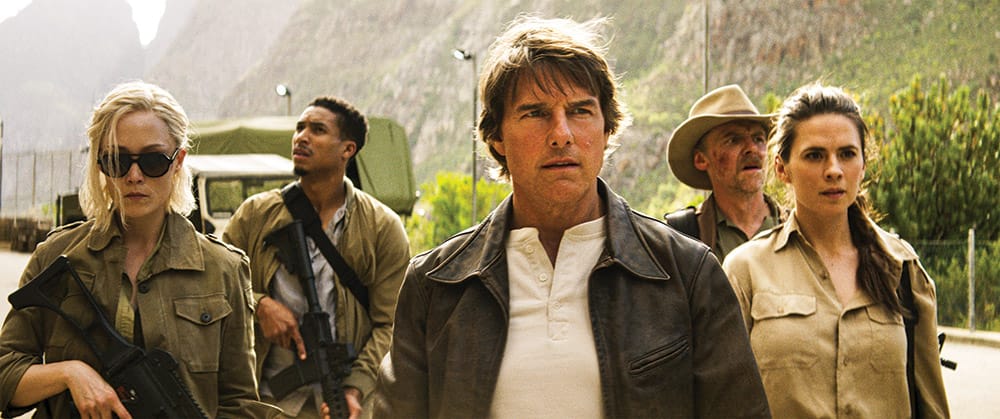
In the big final setpiece of Mission: Impossible - The Final Reckoning, there is a moment where a subset of Ethan Hunt’s squad of super spies has to defuse the bomb. It’s not the first bomb in the movie and we remember because that one ended poorly. Those who stay behind know of the imminent sacrifice they’ll probably have to make. As they start the disarming sequence, they don’t know it, but they actually have something special that just might get them through the peril at hand.
What makes the moment work is one of the many themes Christopher McQuarrie layers into this summer’s big stunt spectacular, Mission Impossible - The Final Reckoning. It’s a film that makes reasoned arguments against fascism. It levels a critique at the allure the masses might feel towards self-righteous individuals who claim to know what’s right and who promise to save the day. It might seem unreasonable for this to work within the context of Mission: Impossible, a film series predicated on the zealous lunacy of a man who never accepts defeat or the idea that a situation might not be winnable.
Like with the previous installment, though, McQuarrie takes an unusual amount of time to show the nuances of his thesis. Previous Missions: Impossible have wrapped their stories in less than two and a half hours, but now we have a two-part film where the first is over that time frame and the second is pushing three. It would be easy to say that all of this is a waste. Given the exposition-heavy nature of these two films it would be easy to dismiss them as wastes of time. And… sure. There’s not really an argument against it.
… except to say that while this film is certainly the weakest since before Tom Cruise scaled the Burj Khalifa, it’s long since earned the space to try something this audacious and insular. To say that this is the weakest in twenty years only goes to highlight how good these films have consistently been in that time frame. Just imagine any other series out there getting to make a movie like this without anyone saying no.
If this is to be the last Mission: Impossible for Tom Cruise and Christopher McQuarrie, it’s a remarkable final statement, making grand gestures about the world we live in and advocating for a better one. Marvel couldn’t efficiently get their new team of *New Avengers out of an underground bunker in a timely manner. To think that they or anyone else could do what this movie does is laughable.
Regardless of the strange tepid early response for this movie, it’s remarkable that we get to live in a world where a movie like this gets made, especially considering the current filmmaking environment and the loud arguments it’s making.
It can be a fine line between “special” and “eugenicist”
A big reason Ghost Protocol changed the game is because it shifted the focus for how Mission: Impossible tells stories. In previous installments, Ethan was just a regular spy. The plots in the first three films didn’t make any sort of argument that Ethan was in someway a divine selection burdened with glorious purpose. The plots he found himself in were the sort of plots in which most spies in spy movies find themselves.
Brad Bird, though, has a pet theme. Ghost Protocol might be his least pronounced within this respect, but both The Incredibles and Tomorrowland deal with special individuals who have providential purpose. The heroes of his films are in a league of their own: no one else could do what they do. This critique of the “I alone can do it” individual (or team of such individuals) is one his harshest critics level against him. Even Ratatouille is a movie about a singularly gifted rat, and it’s easy to reduce Bird’s worldview to something akin to eugenics or fascist ideas about divinely selected chosen ones.
In Ghost Protocol this manifests in the team dynamic as they foil Cobalt’s mission of nuclear annihilation. Ethan Hunt is undeniably exceptional. The dude scales the Burj Khalifa without hesitating and drives a car off three stories of parking level so he can smash a button on a briefcase. Agent Brandt (Jeremy Renner) is an analyst with insane training as a field agent, while Jane is perfectly versatile in any situation. Even Benji, relegated to a desk job in III finds himself adept at field work.
It’s very different from the team in the first film (who die or only come on board for the Langley heist; take your pick) or the second (where it’s Luther and then random Australian dude and they’re basically nonentities because of Ethan’s relationship with Nyah) or even the third (where no one aside from Luther makes an impression). The team dynamic of Ghost Protocol is a huge reason that movie clicks, and Brad Bird’s obsession with excellence is a huge part of why it’s there.
While this might have been a reading I subscribed to at one point, I don’t anymore. Bird’s flirtation is with exceptionalism rather than supremacy. Bird, himself, is a genius. Reckoning with that quality within him is a burden to bear and one he is wrestling with constantly. Is it his fault that he has the particular skills that make him a better director than almost anyone who would step behind the camera? Is it contingent on him to pretend like everyone isn’t different? Should we blame him for acknowledging that differences are a part of human existence?
This is the fundamental difference between what Bird is doing and the sort of eugenics of white supremacy or, say, Hitler. At no point are these observations at the expense of others or saying that people who don’t fit the bill are somehow unworthy of life or whatever. It’s a survey of how lonely it is at the top rather than a punching down about people the surveyors detest as inferior.
The long road to spectacle
That idea of celebrating exceptionalism without expending anyone else is an undercurrent McQuarrie has quietly built upon for the last decade. It’s something he and Tom Cruise have been very honest and open about in recent interviews. Simply: Ethan Hunt is no superhero. He’s just a “living manifestation of destiny”, a dogged individual who will accomplish his mission on his terms and without sacrificing those around him. He rarely thinks his plans through, opting instead to recklessly race through any number of brick walls if the pain means he can save the world. It’s not about the glory or the ego trip. It’s about the job.
While this movie is not the epitome of that argument, it still goes out of its way to show not that Ethan isn’t invincible, but rather that he’s only as good as others let him be. Sure, no one else could do the entire Sevastapol sequence in this movie. No one but Tom Cruise could hang off an airplane like that. But none of those things happen if there weren’t those participating in the event’s facilitation.
Take the road to the Sevastapol. With the clock ticking, it’s on Ethan to track down and obtain the Entity’s source code from an unknown location in a sunken submarine. To get there he requires not just the explicit permission of the President of the United States, but also a woman on an aircraft carrier who trusts the President enough to give her anything she asks. It requires that woman’s trust in the captain of a naval submarine that can get Ethan to the submarine. It also requires the aide of a technician on board who has made the underwater suit that Ethan will use to navigate the treacherous underwater maze that is the Sevastapol itself.
It’s easy to look at all of this and say it doesn’t matter. Just have Ethan learn the coordinates and do the dive. Do it in the first thirty minutes. Who cares? But to lose these textual moments is to erase the strength of seeing ordinary people take small actions to produce big results.
He alone can fix it… as long as he’s not alone
This is something that came up in Andor recently, but while that was about the perfect threading of a needle to incite an impossible revolution, this is about empathy and kindness and trust paying dividends over decades of diligent work. The President puts her entire trust in Ethan Hunt because she recognizes that this global problem is bigger than she is. When she has to make an impossible decision at the end of the film, she takes the one she can live with because she doesn’t trust her own judgment given the mavity of the situation.
McQuarrie outright rejects the idea of the individual who should have the power to play God. It’s why Gabriel is the villain he is. It’s why Ethan reacts with horror when Grace argues that he should be the one to reshape the world using the power of the Entity. He rejects it out of hand, arguing that no one would have that much power. In a lot of situations, this makes him the perfect person to seize it. Those who don’t seek power are less likely to abuse it when they have it. Ethan is one of those people. He would still rather not have it.
It’s a remarkable amount of humility, especially coming from someone who counts himself among those trying to save cinema after the cataclysm of 2020. Listen to the infamous freakout he had during the pandemic, in which he screamed at unmasked crew members on the set of Dead Reckoning. He yells about about how they’re trying to save cinema, moments where Cruise speaks in grandiose terms about the stakes of what they’re doing. For all that the screaming is intense (and justified), it is Cruise using what power he has to affect a change he sees as a net good. But that isn’t just because he’s put decades into this series and wants to make money. I genuinely believe Tom Cruise is a man who believes in the power of cinema and will work until his last breath to make films that dazzle and amaze his audience.
It’s that sense of humility that comes through in both Ethan Hunt and Christopher McQuarrie. These movies shouldn’t feel as remarkable as they are, but the sense of scope, practical locations, and audacious stunts are only amazing because so many films shoot on green screens nowadays. There’s no reason that most movies can’t look this good or feel this spectacular. There just needs to be a team that can execute on the vision.
Film is a deeply collaborative medium, involving the integration of dozens of departments all under one umbrella. It’s why “A film by…” credits always have a distasteful feel to them. No film has one true author. There are films that have more of an authorial bent to them, but it’s not like one dude is writing and directing and producing and starring and holding the camera and lighting the scene and composing the score and performing the score and making the costumes and applying the makeup and doing the hair and editing the film and designing the sound and… I could go on…
No. It’s all about coming together and building a community and a support system that lifts up all the various players. Alone they can only do so much. Together they can make something fantastic.
Loneliness epidemic
As a counterpoint to that coming together is the fuzzy theme of isolation, paranoia, and distrust. The Entity is an A.I. organism that seeks to foment disruption throughout the human population. It does this through tribalism, misinformation, a subject with particular salience in today’s media environment. There are times in the movie when people act on the Entity’s behalf, always quick to explain why they’re committing whatever act they’re doing.
Inevitably, it comes to an almost deific inspiration, like those without the will to hope can’t escape the pull of some demagogic higher being. This isn’t McQuarrie going after organized religion, but it is him going against the sort of blind loyalty that comes from such a paradigm. It’s a fair critique, arguing that weak-minded individuals (no judgment!) can quickly fall prey to easy answers.
And yet, the individuals in this movie are always lone actors. It’s not like the Entity makes some move against Ethan by utilizing a squad of mindless drones. It does, however, prey on the easily radicalized, allowing these strikes to happen. Multiple times, characters speak about the “Entity’s reality”. Luckily, the strongest-willed in this movie reject this reality.
But look at those with the community, those who have to be accountable. In the previous movie, they made sure to include a line about how one’s life is not as important as the lives of the rest of the team. It engenders a trust and a drive that makes everyone better. That idea even extends to the President, who will have to look her son in the eye after this global emergency and be honest about what she did.
Ethan Hunt: Anti-Fascist
All of this adds up to a condemnation of fascism. Given the world that we live in, where America is rapidly eroding to authoritarian rule and democracies around the world are backsliding away from government by the governed, it’s a strong, worthy statement to make. This movie is about a hero who asks for trust and nothing else. It’s about a hero who recognizes that there are certain tasks that he alone can do and who cedes control of the team to Benji (who is more than capable) when they have to divide and conquer. It’s delegation, yes, but it’s also the notion that if Ethan recognizes it’s not his moment to be leader of the team, he will give it up immediately.
Compare that to superheroes, who routinely are the one because they are special. There might not be gloating, but there is no other way forward than for some sort of autonomous action. I’m in awe of the way McQuarrie dispels this way of thinking. He makes a film that’s pro-community without feeling like special-of-the-week. His story actively punishes anyone who acts self-righteous or like they have the only acceptable actions moving forward. He rewards those who act selflessly and try to think in terms bigger than themselves.
McQuarrie has said that the reason he wanted to make a two-part Mission: Impossible movie was to slow down the story, to dig into the characters, and to take the time exploring the theme. He succeeded, painting a vibrant canvas in populist paint colors. If this is the end of an era, it’s an amazing, strangely meditative note to go out on. It might not work for everyone, but it’s the sort of movie that is remarkable in this day and age. A movie star, a great writer, a great director? Who knew? Was a time it was how we got movies made. Like Mission: Impossible, it can still be a winning forumla. Maybe we should try it.
It starts with small acts of trust. We can build the relationships between studios and filmmakers, then we can reconstruct the relationship between films and their audience. We can build community. If there’s one thing I’ve leard from Mission: Impossible, it’s that when we put all those things in harmony, we just might save the world.