
Life During Wartime - Dunkirk
Christopher Nolan's World War II epic turns a legendary miracle into a small, intimate, personal tone poem
In the summer of 2017, I helped an elderly film critic with some tech support. Though he’d been living in America and owned a house in Los Angeles for decades, he had been born in England in the 1930s. Having lived through World War II as an adolescent, he knew the stories and myths surrounding England and the war. Churchill, the Battle of Britain etc.
And, of course, he knew about the Miracle of Dunkirk.
On that day he wanted to talk about Christopher Nolan’s latest film, Dunkirk.
Mostly because he wanted to share why he absolutely hated Dunkirk.
It makes sense that he wouldn’t be a fan. Having been in elementary school when the events of the film took place, he’d be too young to be objective about it. This event in the early days of WWII might not be one of the subjects they teach in American schools, but it’s one of Britain’s crowning achievements in the war. Operation Dynamo, the Evacuation of Dukirk, the Miracle of Dunkirk… whatever you called it, the event was so significant that the most famous speech Churchill ever gave came in its aftermath. “We will fight them on the beaches” etc is how Nolan chooses to end the film, with Churchill’s rhetoric playing over the final images as he brings together what all these characters went through. It would have been weird for Dunkirk to not stir in this film critic a deep national pride.
His distaste came from what he felt was a horrible depiction of the event itself. I tuned him out at a certain point, but he mentioned it not showing the scope of the miracle. It fails to capture the awe-inspiring mobilization that made all of it possible. It’s a valid complaint. Operation Dynamo is the story of how the Germans had completely cornered the mainland’s British forces, driving some 300,000 soldiers all the way to the sea and left them with nowhere to go. The situation ensured defeat. The Miracle itself is how, over the course of eight days, the British managed to pull almost that entire fighting force of men off the beaches in northern France, evacuating them across the English Channel and back to the isles and relative safety. There was no way out and yet they pulled it off. It’s an astonishing victory for the British forces in the early days of the war.
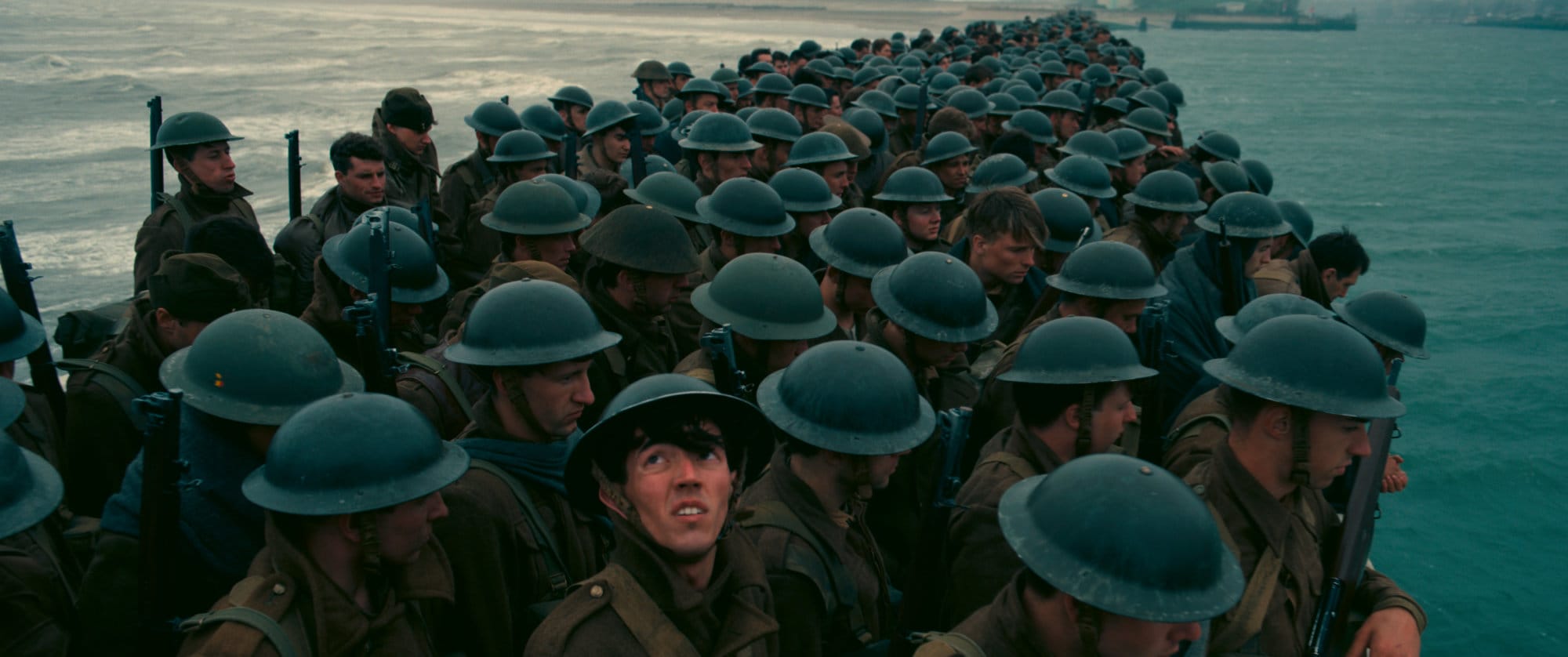
To capture what he might have needed, the film takes opportunities to show large groups of people, with reports that Nolan used upwards of six thousand extras to capture the scale of certain moments. There are times where it’s mindblowing, and knowing how much Nolan wants to capture in camera, the mind boggles at the sheer scope of the thing. Even with that volume he can only capture 2% of the men who needed rescue on those beaches, and that’s mindblowing enough.
… but Nolan also spends a lot of time on Mark Rylance’s personal boat. That story takes up a full third of the film. Another third of the film takes place in a cockpit where Tom Hardy is alone with the tedium of keeping enemy aircraft at bay. Rather than show a smattering of the soldiers on the beach or Churchill in a war room, the final, most memorable third of the film focuses on Fionn Whitehead’s efforts to get off this damn beach and out to sea. It also follows the ever-growing group of people who amass around him, banding together as their actions become increasingly desperate.
At the time, I didn’t really have a comeback for the critic’s complaints. Even if I did, there’s no way I was arguing with a dude who felt so strongly about something so personal. I’d seen the movie once and had liked it quite a bit even if Nolan’s other films were more up my alley. I myself hadn’t quite gotten what I’d been hoping for. I didn’t know about the events on that beach at Dunkirk or what it meant to people. The movie makes it clear that this was an event worth knowing about, but maybe Nolan missed the mark a bit. The way the critic talked about Operation Dynamo didn’t comport with the movie I’d seen. He wanted the miracle. He wanted something astonishing. He wanted something that conveyed one of the singular defining tactical victories of the war, the one that meant Britain didn’t fall to the mercy of some naval invasaion by Germany’s overwhelming superiority.
Even now, I’m not sure that Nolan truly captures that majesty.
Watching it again, though, for the first time in eight years, I’d since turned the film over in my mind, forgotten a lot of it in the interrim, and re-evaluated (or re-appreciated) Nolan as an intensely emotional filmmaker. What had come across as a stiff, impersonal movie cleverly interweaving across various time zones became something… rather profound. The structure turns this into a dizzying survey of life during wartime, a film that focuses exclusively on the people involved on and around this dire situation on the beaches of Dunkirk. It has very little interest in the larger mythology or a distanced, objective view of the event as most would describe it.
Of course that film critic hated it. Because Nolan was making a larger argument and had very little interest in repeating what everyone already knew. He was not present to validate the conventional wisdom.
Nolan playing this larger game is what makes Dunkirk so incredible, because Nolan bakes all of his themes into the very first shot.
The sound of gunfire, off in the distance
The opening of Dunkirk was my favorite part.
There were plenty of other parts of the movie I liked, but there’s always something captivating and dangerous about violence and war in locales that shouldn’t have them. It’s one of the things that makes World War II movies so surreal. Seeing all of the hollowed out infrastructure, the ruined towns, the buildings missing faces, the piles of rubble no one has cleaned up because it’s an active war zone… The final setpiece of Saving Private Ryan is a tremendous example of this. Everyone always talks about the invasion of Normandy (as they should), but the squads’ attempt to hold the town and prevent the German advance makes for an utterly stunning final battle.
When you hear “Christopher Nolan making a war movie” what you want is action in the streets and the lived in danger of being soldiers with their backs up against the wall. A trial by fire of harrowing death around every corner.
Nolan chooses to begin his war epic here, in the empty town of Dunkirk. This, with the soldiers in full kit patrolling down the streets is totally in line with what most would imagine this movie to be. Almost immediately though, Tommy (the main character of the land portion) loses his squadmates, but not before they peruse the eerie deserted streets. Signs of life are still present as though the populace just up and vanished. Tommy manages to get through friendly gun batteries, the only defenses keeping the enemy at bay. Once he does, though, he’s on the beach. We never return to the town. Hell, we never even see those machine gun encampments again.
There’s nothing stopping Nolan from showing this rear guard in action. He easily could have focused not on Tommy, but rather on the tension of sentries posted to stall the German advance as it slowly encroaches on the British position. It’s certainly dramatic enough.
The biggest reason Nolan chooses not to do this is because Nolan has very little interest in showcasing actual war. Between Saving Private Ryan and The Thin Red Line, it’s difficult to showcase better World War II battles. Nolan doesn’t even try to top them. In fact, the first shot is not showing the actual carnage of some attack, but rather the almost silent aftermath of it. As the papers flutte down, the squad of young men unfurl from their duck and cover positions. We never hear the explosion that made them cower. Nolan centers his narrative entirely on those experiencing the war rather than the war itself that is happening. The sounds of gunfire off in the distance? They kill Tommy’s squad with PG-13 level violence.
Grave sites out on the highway, a place where nobody knows
Most of the deaths and terror in Dunkirk don’t come from bullets at all. Even in the sequence with the most shooting (The Air) the bullets are merely a number ticking down, where the sound of the firing precedes a silent streak of smoke to tell the audience bullets have hit a plane.
The biggest threat in the film is also the biggest obstacle: the water.
Nolan weaponizes the sea itself, where an image that usually represents life, birth, baptism, and rebirth becomes the primary threat to everyone’s survival. It’s not just that people have to cross the ocean, they have to do so while worrying about drowning.
It’s this threat that keeps my partner from ever wanting to visit this movie again. Impossible to argue. The most memorable drowning bit is the one where the torpedo takes the ship that Tommy finally gets onto, forcing those on board to swim for a door when it opens… but there’s also the sequence in the trawler. When Tommy and the group that’s amassed around him wait in the trawler for the tide to take them out to sea. Unlike the opening, bullets aren’t terrifying because they might wound these men. No, they’re terrifying because they’re going to let the water in. When Collins’s plane goes down, the biggest danger is the water rushing into the plane, not the threat of a German attack.
Even during the climax, as Tommy and Alex manage to escape onto Rylance’s boat, the threat comes not from them drowning, but rather from the oil on the sea’s surface igniting, threatening those lucky enough to have not died on a sinking vessel.
This might seem minor, but, again, this all happens through the prism of “this is Nolan’s war movie.” And the most spectacular thing about “Nolan’s war movie” is the stunning aerial photography. It’s not marching troops or even the deep conversations on the beach. The most emotional death in the movie is George’s (Barry Keoghan), who dies as an accidental casualty when Cillian Murphy’s unnamed soldier tries to commandeer Mr. Dawson’s (Mark Rylance) civilian boat.
Don’t get exhausted
Again, it’s easy to look at all of this and ascribe Nolan’s seeming impersonality to it. Nolan’s films can feel technical, sterile, but is there any moment where the audience doesn’t care for the characters in Dunkirk or what they’re going through? The story of Dunkirk is so inherently dramatic and the stakes are so clear that it really doesn’t matter who these people are. We feel for all of them as we should for anyone in life-and-death war scenarios. And what arc would they even have? What is the lesson to possibly take from all of this other than it is, in fact, a miracle. What should Tommy or the Dawsons or Ferrier take away from this that they didn’t know at the outset?
It’s easy for critics and audiences to obsess about character arcs and stakes, an inherent dramatic tension with plot or what have you. They’re the first things that’s easy to understand. And yet, Nolan is a gifted enough storyteller to know that these are only so useful when building something that does not require them. What would be the value of a traditional hero’s journey here? There are plenty of opportunities for characters to explain their thinking, to talk about some backstory of who they were outside of the war. It’s usually a hallmark of all the great war films.
This holds back from that. Hell, it holds back from most dialogue. Instead, it’s a film built around mood, tones, an arthouse poem masquerading as blockbuster motion picture. Would the film be better with dialogue? With the big story of Tommy and all his plucky adventures trying to get off the beach? Is it better if Tom Hardy talks to Collins before they get into a dogfight about the girl he has back home?
No. Chris Nolan, a director known for his fantastical dreamscapes and interstellar majesties all in the IMAX aspect ratio decides to make a movie built entirely around real people undergoing real drama. His approach to war is starkly naturalistic.
And why wouldn’t it be?
Getting used to it now
Circling back to the original complaint. What was it again? That Dunkirk doesn’t capture the full breadth and scope of this 10-day long evacuation, one so miraculous that it rallied basically an entire nation to be Europe’s lone light in the darkness of the long years between the France’s collapse and America’s entrance to war? Does this capture the full scope of the evacuation? Perhaps not. The most remarkable part of the legend centers around the fleet of ships that came to the rescue. Hundreds of civilian merchant ships ranging from fishing boats to yachts to lifeboats. Together they helped ferry the men when the British navy proved itself unable to provide the resources necessary to mount an evacuation of that scale that quickly. Nolan captures this as best he can: a majestic shot of dozens of these boats arriving for the first time: salvation by normal people in boats that look fresh from the piers of your local municipal marina.
And yet, what’s remarkable about Dunkirk and the events Nolan presents is how seemingly unremarkable all of it can be. There’s no grand heroics. The biggest moments of heroism a man deciding not to head back to refuel and another person who opens a stuck door on a sinking destroyer. Most of the scenes on the land are about pure self-preservation, trying to get off the beach before anyone else. Being there is dangerous, with every second bringing everyone that much closer to what seems like certain oblivion. Hard to be heroic in that situation.
The Evacuation of Dunkirk is about the 368,000 troops who the Brtish navy managed to get off the beach and back to the safety of Britain. But that is just a statistic, something to marvel at in an abstract way.
Dunkirk is about a small sliver of those hundreds of thousands of people, where no more than a dozen feature in any prominent way. The intimacy is what brings home the dread and terror of what makes the miracle itself so important. Each person on that beach mattered, but so did those who defended from the air and those civilians who heard their country calling and braved the waves and probably U-Boats.
Because, really, the thing that’s amazing about the Miracle of Dunkirk is not that the big few giant ships carried all of those people to safety, it’s that a bunch of smaller, individual pieces added up to something truly remarkable. All of these disparate elements feel disjointed, separated across space and time. But Nolan uses the power of cinema and his own propensity for nonlinear storytelling to paint in vivid detail a small corner that invites us to imagine the vastness of the whole canvas. Think this film is powerful and overwhelming? Multiply it by thirty thousand and you’ll see why that film critic was so completely pissed off that it didn’t capture something impossible to do.
Chris Nolan did is made a war movie and stripped away as much war as he possibly could. Having done that, all that’s left are the people themselves. Battles are legendary, but even more legendary are the people at the center of them. Generals get the credit, but they are nothing without the boots on the ground and the infrastructure supporting them. Nolan focuses on them: the unremarkable, the self-centered, and the scared.
When I think of Dunkirk, I don’t think about the statistic and the dates, I think about these characters and what they went through on that beach. I think of the few casualties but also the unfathomable level of survival. I think about the people, the lives preserved, and how what seemed impossible became a moment of historical wonder.
Is there a higher compliment?