
Kerouacking - Midnight Run
Bounty hunter Robert De Niro. Shady accountant Charles Grodin. A cross-country road trip. Hilarity ensues.
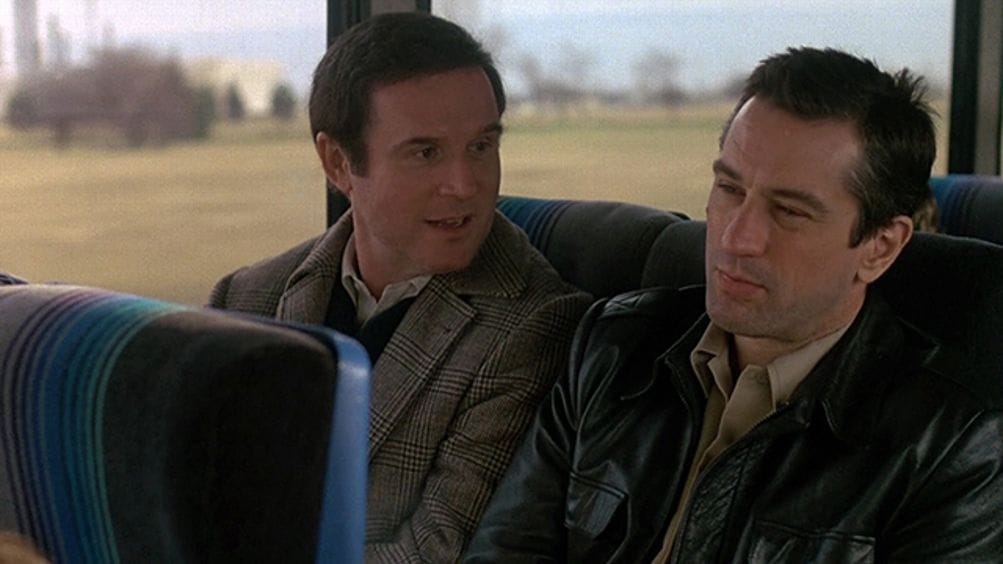
Midnight Run is a movie that falls in a weird cinematic sweet spot. If you ask a hundred people to list a hundred movies they love, it would probably appear a couple of times, but not with the frequency of, say, Jurassic Park. Or The Godfather. Or even Lethal Weapon. It’s void is that one that isn’t a terribly deep cut movie, but it’s off the main road just enough that it’s a little gem of a thing. Essentially: those who saw this movie on initial release or fit into the generation of its average magnetic pool know about it and sing its praises, but outside of that it’s been slightly lost to time. That will only continue as time goes on.
Nevertheless, there’s way more to this 80s movie where bounty hunter Robert De Niro has to transport shady accountant Charles Grodin across the country to bail bondsman Joey Pantoliano while avoiding FBI agent Yaphet Kotto and also the goons working for mob boss Dennis Farina. At the core of this movie is something that is quintessentially American, that fits within the canon of great American cinema without ever really reaching the classic status of all-time classics.
And its secret is 1988.
Kerouacking
Much of American exceptionalism has its roots in the post-World War II era. The world lost a decade and a half to the one-two punch of a singular global financial crisis followed by a devastating global war across the developed world. Helping to pull the world out of this hole was America, which hadn’t suffered the financial and infrastructural devastation that so many other afflicted nations had. America’s ability to help put the world together came via the Marshall Plan, the United Nations, and other global initiatives.
Of course, there were domestic initiatives as well.
A lot of the domestic developments came from The New Deal, an initiative from FDR’s administration that shored up financial pillars that had collapsed and put Americans back to work with a massive influx of cash into the American economy. This jump-start provided a lot of good-paying jobs and helped provide social safety nets for the lower and middle classes. This philosophy of a government that worked for the public good had a long tail, stretching from FDR’s election in 1932 all the way to Ronald Reagan’s election in 1980.
In the 1950s, President Dwight D. Eisenhower unveiled one of his signature initiatives and put it into motion. In 1956 the government began building the Interstate Highway System. This project lasted for several decades but has since become ubiquitous. Traveling abroad, one of the features other countries most envy about American infrastructure is our interlocking, interconnected system of roads and highways. Today anyone with a car can get from anywhere in the country to just about anywhere else within a matter of days at most. It’s an incredible achievement.
Then again, something like the highway system is incredibly necessary for the United States. The U.S.A. is a massive, sprawling country, with the area of the continental 48 states roughly the same as the size of Europe in totality. Transportation and communication have been difficult going back to the earliest days of the republic, where Thomas Jefferson commissioned the Lewis & Clark expedition to find a way across the continent’s great expanse. That venture took two and a half years to complete, and it’s not like they could just text Jefferson when they got back in range of a cell phone tower to give the update. See also the Pony Express, or why Juneteenth is the celebration of the abolition of slavery rather than the ratifying of the 13th Amendment.
With such a vast expanse, communication and transportation are a major problem America is continually trying to solve. The transcontinental railroad helped, though that could only serve major arteries. Telegrams also helped, but that required hubs to which senders could send their messages. With the invention of the automobile, however, mobility became much more possible and feasible to anyone with a car. By the 40s and 50s, cars had become more necessity than luxury, and so it stands that the Interstate Highway Project was a major player in cultivating American self-identity in the mid-to-late 20th Century.
Enter Jack Kerouac.
In 1957, Jack Kerouac released On the Road, a novel that helped to define the Beat Generation via the main characters’ travels around the country. A lot of that travel comes by automotive vehicle (be it car or bus). In the wake of this American exceptionalism, this intranational travel became a defining characteristic of the boundless freedoms within America. Societally speaking, freedom of movement is a relatively recent concept. Interstate highways allowed navigation through America’s vast expanse with little restriction (no security checkpoints at state borders etc.), helping to define a contour of what makes this country so great. Thus one of the hallmarks of Americana is that sense of traveling from place to place. It’s a core freedom.
This aspect (which I’ve taken to shorthand as “Kerouacking”) is all over culture once you start seeing it. Easy Rider is the defining film for the Boomer generation (though with motorcycles rather than cars), while Thelma & Louise defines the open road as an escape from the oppressive misogyny of a patriarchy that entrenches women as second class citizens. There’s comedies like The Muppet Movie, Little Miss Sunshine, and Planes, Trains & Automobiles. Obsessed as he is with Americana, David Lynch made The Straight Story, a mainstream, G-rated feature about an old man who Kerouacs to visit his sick brother, only he travels by slow-moving tractor.
And (scandal noted on this one) but part of the power of something like Neil Gaiman’s American Gods comes from its road trip across the United States. He ties America’s mythology explicitly to the sort of book for which Kerouac was most famous.
Double Act
Of course, all of the Kerouacking in Midnight Run is just the tapestry upon which Jack Walsh haults Mardukas from New York to Los Angeles. Every discussion of this film comes back toits central double act bonding as they travel west.
It’s easy to forget just how good De Niro is. So many of his definitive roles come from his natural hardened edge. It’s present from Meet the Parents to just about any of his collaborations with Martin Scorsese, which ranged from violent psychopath to controlled psychopath. Even silly roles like Stardust still have a particular bite when he’s playing the terror of the pirate captain. Through that prism, seeing De Niro in other contexts (especially on the “good” side of the law) is always jarring. But here’s Midnight Run. Unlike the Scorseses, he’s not a psychopath, nor is he the disciplined perfection of Heat. He builds Jack Walsh from his innate flavors, but even with those the character feels fresh and unique. De Niro has always known his lane, but playing a kaleidoscope within that lane shows his skills as an actor. Very few have been as good as him.
To counter is Charles Grodin, an actor who likewise always felt like he had a difficult or sinister tone to him. Here, though, the movie builds on that as well. The second he’s on screen, Mardukas feels like some arch-manipulator, the sort of dude who would have embezzled millions of dollars from the mob and not felt bad about it. But Grodin also has the sort of charisma that can sell the “this freaking dog” energy of Beethoven and its sequels. At no point is it really possible to dislike Mardukas, even when conning Walsh (as he does so many times).
And their pairing is fabulous, where neither seems to appreciate what they’ve found until the last few minutes. They never make it easy for the other, but their arc of building trust sparkles.
The Duke walks into a bar…
By the late Regan era, America had turned on the philosophies that had made it the most powerful nation on Earth. Reagan’s philosophies stemmed from a deep distrust of the American government and an emphasis on military power. There was also a tinge of white supremacy to Reagan’s persona, where the betrayal of the Civil Rights Acts flipped the South away from the Democrats and towards the party of Lincoln. Given that the Democrats were the party of a big powerful central government, Reagan instead was a pro-business president, ushering in the era we’re still living in today. Governmental power has waned, tipping the scales towards powerful corporations and budding monopolies.
Midnight Run sits in the weird liminal space where its central operating premise requires the governmental infrastructure that would have made Reagan scoff and the Reaganesque view that distrusts institutions themselves. The FBI is only so competent, with Jack Walsh constantly fooling them. They get the bad guys in the end, but not before losing badges and finding themselves always a step behind.
Walsh, it turns out, is a former cop, brought down by a corrupt police department who planted evidence to make him look guilty. His wife divorced him and married another cop (who is also corrupt), leaving Walsh to take up as a bounty hunter, serving a modicum of justice without officially upholding the law. This vision of governmental institution as corrupt is still very primordial in 1988, where the modern Republican party has grown to focus on being pro law enforcement. Those are institutions that help to keep the peace in what many see as an increasingly lawless and godless society. Why else has Law & Order run for decades?
But look at the scene in which Mardukas ropes Walsh into scamming a bar out of the money they’ll need to continue their trek across the country. In it, the Duke uses his brains and wits to impersonate FBI agent Mosely, developing a cock and bull story about counterfeit dollar bills. It’s a terrific con, but it also preys upon the inherent trust Americans had of their government at the time.
It creates a fascinating tension. This film lives on the infrastructure of a big government that made the country a better place. It also exploits those who trust in governmental systems by showing its inherent limits. The FBI can take down a big crime fish like Serrano, but it has no capacity to handle itself when dealing with regular, normal people like Walsh or Mardukas.
Being a comedy, this read is not the primary aim, but it’s certainly present. Midnight Run is a byproduct of its environment as the country rapidly disarms from a strong central authority. Competent though they may be, its citizenry is starting to be on its own.
Even within the lightest of films, there is still something rich to discover. When the director is someone smart and engaging like Martin Brest, these readings happen. He’s engaged in the world, dialed into the zeitgeist. Even the hint of it elevates Midnight Run from just another buddy road trip movie and into being something greater and worth of a place in the great American canon.
The Top 250 tries not to drown…
Midnight Run wasn’t on my top list last time, nor was it on the list of my other compatriots who made one. It’s difficult to imagine it not making it now, though probably very low. Movies like this are so delightful and so fun, gems to discover when you’re out of things to watch but want a classic that’s feel-good, exciting, and a great time at the movies.
But next week we’re digging into something different: Christopher Nolan’s (to date) only war epic, which blends his transtemporal storytelling with stalwart heroic individuals facing impossible odds. Being his first major, intentional Oscar play, Dunkirk is the Nolan that gets lost in the shuffle. But should it?
Thanks for reading Narrative Looking Glass! Feel free to share my pretentious ramblings about America with everyone you know!