July 2025 Check-in
Gosh is the year half started already?
It’s July? My goodness.
June came and went. It’s funny. Looking back at the post from last month there was a list of more than a dozen movies to watch for Pride and it looks like we watched… three of them. And then two more came up as part of the Criterion Challenge. Guess I’m just a really good ally? More on those in a minute.
With Blank Check in the rearview, I’ve been turning to the biggest project I’ve been neglecting: the Criterion Challenge. Current goal is to finish with it completely by this time next month. It looks like as of this writing I have 13 left, with all but 2 under two hours. Even then, the longest one left (Yi Yi), is supposed to be absolutely magnificent and it’s one of the ones I’ve most been looking forward to. Hell, all the ones that are left are ones I’m super excited for, even if the odd outlier (Detour) I’m mostly excited about because it’s 68 minutes.
I’m still trying (and failing) to peel away from movies though. Now that there’s less 2025 left than there has been, it means that all of these plans for the year are going to start consolidating. The rewatch for the Top 250 has been taking some time and while I’m nibbling at the reviews to stay ahead of things, the Eternal Sunshine one is proving to be extremely difficult. It should have been obvious, but the hardest thing about discussing films like this is trying not to retread fully worn ground. Given that there’s a lot of big, totemic stuff to discuss, it’s a concerted effort to get over that and just be honest about what I’m thinking.
Anyways, I’m looking forward to film going on the back burner, which is probably why I’m going for this last big burst of glory as I get to the end of this massive educate-myself project. I’m already planning on what to get to when that block of time frees up and it’s gonna be to finally finish Deadwood, The Shield, and who knows what else.
Also heck yeah Zohran Mamdami. Anyways, what else is going on?
Pride Recap
The Pride watch this year wasn’t as robust as I’d hoped. It always starts with a burst of energy, but it can fizzle quickly as life gets in the way. Regardless, besides the standard rewatch of The Birdcage here are the three films I saw that… left their mark.
Dicks: The Musical
Larry Charles directed this adaptation of Aaron Jackson & Josh Sharp’s hit UCB show (Jackson & Charles also wrote and starred in the film). It premiered at TIFF and got a ton of buzz. One look at the trailer and you’ll probably be able to guess how you’d feel about it.
It’s an extremely funny movie, but it comes with an energy that requires anyone watching to be on its wavelength. For me, I wasn’t. That level of loud chaos and mayhem only works so much. More than that, though, it really did feel like a big screen version of a UCB show. For those who haven’t gotten a chance to experience UCB (the Upright Citizens Brigade), it’s a great place for young talent to learn and hone their craft. Their shows can have a manic, no-boundaries energy that can go in crazy directions, and have very little care for “taste” when the laugh (and entertainment) is what matters. That’s how the movie works.
This movie worked for a lot of people, but it’s the sort of camp cult classic that puts it in line with The Rocky Horror Picture Show and the filmography of John Waters (both of which were among the major influences for Dicks). For me, these aren’t movies that I connect with. More than that, though, it reminded me a lot of the shows I saw when I was living in Los Angeles in my early 20s, the ones where I went and spent the cost of a movie ticket to see my friends’ hour-long shows to support them. I happily did it to support people I know, but for this work for which I had less experience with, it was a big struggle. Glad it was streaming and I didn’t have to spend more on it.
Nowhere
This 1997 film from writer/director/editor/producer Gregg Araki follows a bunch of queer youths through a strange day in Los Angeles. It wasn’t on the original Pride-watch list, but happened to come up as a part of the Criterion Challenge. Like Dicks it felt frenetic to start, its aesthetic very much in an indie camp sensibility. It kind of mellowed out, but by the end of it it was still an absolutely insane, unhinged experience, involving a cult leader masquerading as a televangelist played by John Ritter, a random alien abduction subplot, and a dude who uses a can of tomato soup to murder someone at a house party. None of those things intersected in terms of plot.
There is a sense of ache and longing about it. The characters were all excellent at playing in these weird malaisey spaces. And yet, for all that my regular argument that the only thing more interesting than an intimate interpersonal drama is an intimate interpersonal drama with rad genre elements… this gave me that and I rejected it.
I’m still not entirely sure why. Maybe because the subject matter is so dark. There’s a truly, truly horrific rape scene in the middle, and Araki does not flinch from the events that lead to it nor the fallout after it happens… But even before then I wasn’t super feeling it. I think it’s because that malaise is so difficult to convey. The “central” relationship is one of a couple who have opened their relationship, but their pairing has started to disintegrate because of it. It feels potent, like it’s really dialed into it all, but it’s difficult to separate the forest from the trees. Perhaps one day I’ll return to it. If that happens, it will be because for some reason I’ve decided to make that a priority.
Will & Harper
Will Ferrell’s documentary chronicling his cross-country road trip with former SNL head writer Harper Steele. It’s their first time seeing each other since Harper’s transition, and the bulk of the film is the two visiting various areas throughout the country to help her acclimate to living her authentic self in a country dominated by rampant transphobia. Lots of driving, parking, pulling out camping chairs, and talking about life.
It’s a beautiful piece and at times a hard watch. They visit areas that make Harper wary and eat dinner in a restaurant that makes them feel as unwelcome as possible. Ferrell himself talks about his own feelings about possibly making Harper feel unwelcome, and Harper goes into intense detail of the life she was trying to build. Towards the end of the film, they visit a small, dilapidated house she purchased in Arizona and discuss what she imagined her existence would be like. It’s heartbreaking, tragic, and speaks to the cages trans-folk can find themselves in when in a society that wants them to stay invisible.
If the goal of telling stories like this is building empathy, I can’t think of a better and more powerful example. Harper’s is just one story, but there are so many universal truths within it. Seeing her in this mode is wonderful and even though she came out in her late 50s, it’s important to reinforce one of the great lasting messages from I Saw the TV Glow: “there is still time.”
Every minute of living one’s own authentic truth is a minute worth striving for and living for. No one should have to feel like Harper did before transition. That we have created an environment and society and culture that makes such realities an every day occurrence is a great shame. Fixing it should be something we all strive for.
NYT Top 100 Movies
This was big on the internet last week. The New York Times polled over 500 critics and Hollywood types, then created a list of the Top 100 Films of the 21st Century (so far). It was a topic on two podcasts I listened to today (Unspooled and also the bonus segment on Scriptnotes). There’s already controversy with the list, but it has a lot of great, populist choices on there that everyone should watch. Nothing on it I wouldn’t recommend. Of the 100 on the list I’ve seen 77, with another three I was already planning to watch before the end of the year1.
One of the big viral pushes of the list was the New York Times creating a way to create and share your own choices of 10 movies you’d submit. I couldn’t help but participate, though it was a different sort of process than how I typically build my lists. I tried to be a bit more objective, representing great films that are also major achievements that represent the best of the medium. They wouldn’t be my ten favorites of the decade (or Everything Everywhere All At Once would have wound up on it), but here’s what I wound up with:
- Mulholland Drive (2001)
- In the Mood for Love (2001)
- Spirited Away (2002)
- Eternal Sunshine of the Spotless Mind (2004)
- Zodiac (2007)
- Interstellar (2014)
- Tangerine (2015)
- Moonlight (2016)
- Parasite (2019)
- Spider-man: Across the Spider-verse (2023)
Can’t believe I left off Mad Max: Fury Road. Unreal. Regardless, I’d be surprised if any of these don’t wind up in my own personal Top 100 when I make the 250 in a few months.
Because I can’t get enough of it, what did you put in your Top 10 Lists?
The Pitt
I’m definitely behind on HBO’s medical show from a few months ago, but given my constant kvetching about the state of television, The Pitt is a terrific antidote. The show’s format is such that the season takes place roughly in real time, with each hour-long episode covering roughly one hour in the day of this Pittsburgh hospital’s ER unit.
Other have said this, but what’s compelling about it is seeing the way stories flit in and out of the narrative. Characters will show up and they might be in for one episode (if it’s like an ankle sprain or something that requires immediate surgery) or multiple episodes (if there’s some ongoing treatment). It plays into television’s greatest strength as a location in which to hang out with characters you love.
The cast is great, and while there are a lot of central characters, it quickly becomes easy to pick out the various players, their roles in the hospital’s infrastructure, and the personalities that define how they administer care. None of what I’m saying is revolutionary, but god damn it’s incredible to see a tried-and-true television format made through the capacity of prestige television. SO good.
Watchmen
I’m gearing up to re-watch Damon Lindelof’s Watchmen television series. Not having seen it since it aired, I’m stoked beyond reason. That said, knowing what I know about it, I wanted to go back and re-read the source text by writer Alan Moore & artist David Gibbons.
… I mean what can I say. Watchmen is brilliant, absolutely deserving of its reputation. It’s also a tome that just about everyone who’s spent any time reading comics has covered at length. Just about everyone has completely picked it over, talking about everything from its deconstruction of superheroes to Gibbons’s work utilizing the 9-panel grid to Moore’s extreme attention to detail to the subtext and connections that come within individual pages and panels, where unrelated narration or voiceover will enhance and shade whatever dialogue is happening within the scene.
What strikes me most in re-reading is just how much its influences has completely taken over culture today. Moore’s use of the format is so cinematic. His match cuts and dissolves in Chapter 2 are mindblowing, when he moves into and out of the flashbacks about The Comedian. The symmetrical Chapter 5 is truly an unbelievable issue of comics, and every time I read it my mind boggles at the amount of work it must have taken for Moore to design the structure of the thing, to say nothing of how much work Gibbons must have put into laying out and drawing all of these pages so they match up basically perfectly. The flashback chapters that focus almost exclusively on each character is one that clearly inspired Lindelof in the creation of LOST and who knows what else.
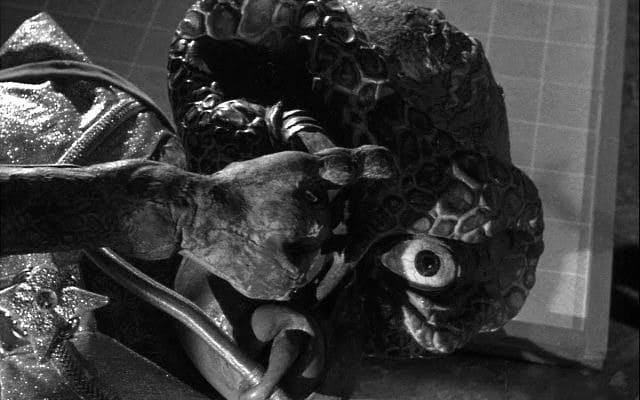
It’s funny, though. Watchmen’s editor Len Wein famously loved the comic during production, but gave a note to Alan Moore that the ending of the series (where (spoilers for a 40 year-old comic book) Ozymandias teleports a giant mutant space squid into the heart of Manhattan, thereby calming the international boil that threatens nuclear war and pushing humanity towards a more peaceful and possibly utopic society) rips off its core conceit from “The Architects of Fear”, an early episode of The Outer Limits. According to Wein, Moore more or less ignored the note and the editor resigned in protest late in production.
Now, without seeing that episode of The Outer Limits but having done diligent research (Wikipedia), it does seem like Moore straight up lifted the premise of “scientists devise alien invasion to prevent global thermonuclear war” and did his own spin on it, funneling it through the super villain’s master plan. It’s a shocking development, and the actual “attack” on New York is really incredible to witness every time. But it always feels like there’s something odd about it, like it’s a big idea Moore had that sticks out from the rest of the series. It also doesn’t help that the idea of “everyone disarms” is quixotic. Even someone as zealous and brilliant as Veidt can only plan for so much before human nature takes over. It’s also not like the final moment (where the New Frontiersman assistant pulls Rorschach’s journal off the stack) feels like the sort of magic bullet that might topple the whole unjust system. That’s just not how humanity (or the world) works.
None of this takes away from what’s basically a perfect book, though. Watchmen is and always will be one of the best examples of how good the medium can be when it’s operating at that level. It’s also a great lesson in like… for all that it’s a book with big themes, technical mastery, and formal experimentation, Moore crafts a gripping, terrific story. The characters all sparkle and play off each other. The simple murder mystery spirals into a larger conspiracy that ends up encompassing (and solving) the threat of global thermonuclear war. It’s funny and intense and just so so good.
God it’s just a great book. I don’t revisit it often, but I’m always glad when I do.
Though… I think I’m done reading the back matter after each chapter. It’s not that it’s bad, but it slows down the read and I’d much rather just get to the pretty pretty picture parts.
Upcoming this month…
The current goal is to finish the Criterion Challenge. Will write here when that’s finished. I’m also trying to get ahead on this 25-film rewatch so that I’m not scrambling with the reviews and such. But I also don’t want to get so far ahead that I’m behind on reviews… Learning balance.
Isles of the Emberdark showed up in my inbox today. Super exciting. Need to finish Gardends of the Moon first. So the plan is to finish that, do the podcast with Chris, and then slam out Emberdark. We’ll do an episode on that. Then we’ll get back to Malazan with Deadhouse Gates. But no way is all that getting done this month. Or maybe it is. Who knows.
Also planning for reviews of Superman and Fantastic Four for sure. Possibly even Jurassic World and others if they have stuff worth talking about.
And… yeah. I’ll just say I’ll do something about the Emmy noms when they come out. We’re free flowing here and we gotta feed the content generation machine.
Anyways. See paid subscribers back here on Friday for Before Sunrise. Excited to get this series rolling out!
Funny enough, one of those happens to be the aforementioned film Yi Yi. ↩