James Cameron & The Art of the Sequel - Terminator 2: Judgment Day
In which James Cameron shows the difference between plot and story
Tell me whether I’m describing Alien or Aliens:
The Weyland-Yutani corporation tasks a crew of space travelers (one of whom is Ellen Ripley) to investigate a strange signal from planet LV-426.
Upon arrival at the planet, the crew awakes from hypersleep and shares a meal around a table. During this, we get a brief sketch of the major players on the ship, who they are, and what they do.
Said crew lands on LV-426.
Investigating the planet’s strange anomaly (which is a beacon of some sort), the senior team heads into a massive structure, in which they will engage an alien threat.
The alien force attacks the engaging crew.
Part of the horror here is a chestburster emerging from an infected individual.
This initial push (which gives us our first look at the alien) costs the lives of about half the crew.
The alien threat proceeds to siege whoever remains.
The crew learns that the air vents are one of the methods by which that threat is traveling around unseen. Their remedy is to track via motion detector, which communicates via dots on a screen and loud (signature) beep.
Ripley realizes the best way to handle the alien threat is to blow up their location. She and the crew make plans to hold out long enough to escape from this necessary (and eventually unstoppable) explosion.
Amidst this, the weird character who doesn’t fit in reveals himself as a traitor. Sympathetic to the company’s desires to obtain a sample of the alien species, he makes his play to betray the crew.
To cover this up, the spy attempts to murder Ripley. This involves locking Ripley in an enclosed space, away from those who can save her. It’s a dire situation (that she probably wouldn’t survive) that involves her suffocating in truly harrowing fashion. Luckily, surviving crew members arrive in time and foil the spy’s plans. This might be the scariest scene in the entire movie.
With that handled, the alien threat rears its ugly head in a last attempt to eliminate the crew. It slaughters half of the remaining characters.
Time running out, Ripley manages to get to safety from the explosion, but not before realizing that the surviving (innocent and helpless) being for which she has a duty of care won’t make it to safety without her intervention.
To add to the menace, there’s a moment where said being comes face to face with an alien.
While she engages her rescue mission, the tension rises as an iconic female computer voice counts down, regularly warning how much time is left “to reach minimum safe distance”.
Ripley manages to save her duty of care. She does briefly encounter the alien, basically coming face to face at one point. Without defeating it, she manages to get away. Escaping should be enough.
There’s a massive thermonuclear explosion. No way could anything (let alone the alien threat) survive that.
Safely aboard the escape ship, Ripley relaxes. Though it’s weird that the film hasn’t… ended.
But uh oh, the alien threat did manage to survive by stowing away on her ship. Now she has to neutralize it once and for all.
So. Ripley puts on a rad as hell sci-fi suit that will protect her in this battle. She confronts the alien, vanquishing it by sucking it out the airlock.
Finally safe for real this time, she returns to hypersleep. We end on a static shot of her serenely sleeping. All is right in the world.
Also there’s an android as part of the crew.
It’s both movies. Surprise.
In writing, one of the biggest challenges is trying to break a story’s structure. This sounds like developing “what happens”. Most assume this is plot: incidents and sequences that can thrill the audience while propelling the story forward. Plot, though, is a matter of imagination and has its own challenges. The actual backbreaking work cultivates emotional arcs and develops characters along their journeys. Plot is what happens, but emotional core is why audiences return to narratives over and over and over again. Anything else can only take you so far.
The deep dark secret of James Cameron is that whenever he makes a sequel, he lifts the plot of the original installment, breaks it down into component pieces, and uses that as the skeleton around which he builds his own story. If Alien & Aliens seem structurally similar, it’s because that’s intentional. Layer the two films on top of each other so they start and end at the same time and it’s obvious that Cameron lifted the original’s plot wholesale, switched the genre from “horror” to “action”, and assumed no one would notice.
Which… did you?
What worked before can absolutely work again. Part of the joy of sequels is returning to something familiar and comfortable. The challenge comes from serving that master while also presenting something that feels new. This means characters (for whom we’ve already seen the big defining adventure of their life) need new arcs to justify their returns. Therefore, audiences care more about the emotional truth of a character’s journey than the tedious plot details of getting there. Plot is the wheels, but character is (or should be) the driver.
Before Terminator 2: Judgment Day, Cameron lifted from other sources. Nicking Dan O’Bannon’s Alien screenplay and (to a lesser extent) Spielberg’s Close Encounters of the Third Kind (for The Abyss) is playing in the safe space of others’ work. It’s paying tribute. Ripping himself off to make the sequel to his breakout hit is something else entirely. It should feel hacky and lazy.
But it’s not. Terminator 2: Judgment Day is one of the great sequels of all time. It’s also just a redo of The Terminator. And no one seems to complain about it. Hell, people love both movies and don’t dismiss one in the name of the other.
So how the hell did Cameron pull this off?
Flippantly talking about structure
So now that we’ve played the Cameron sequel game with Aliens, let’s play do the same for T2. Only this time, here’s how Cameron deviates and what that does to feed into his larger themes.
We open in the future. It’s a bombed out wasteland, a world devastated by thermonuclear war. Soldiers move amongst the wreckage and use rad laser rifles to fight giant hunter-killer robots. He’s establishing this war between the humans and the machines. It’s awesome.
He also establishes that what we’re about to watch is the war’s final battle. It will take place in the past. The rules? The machines and the humans get to send back one individual each. The entire future is at stake.
In The Terminator, Cameron has the budget to show brief glimpses of the future. In T2 he shows full on terminator endoskeletons and a massive siege. There’s also the necessary retcon that the machines got sent two individuals back: one to target Sarah (in The Terminator) and another to attack John (which will be this movie). Again, though the humans get another swing at protection.
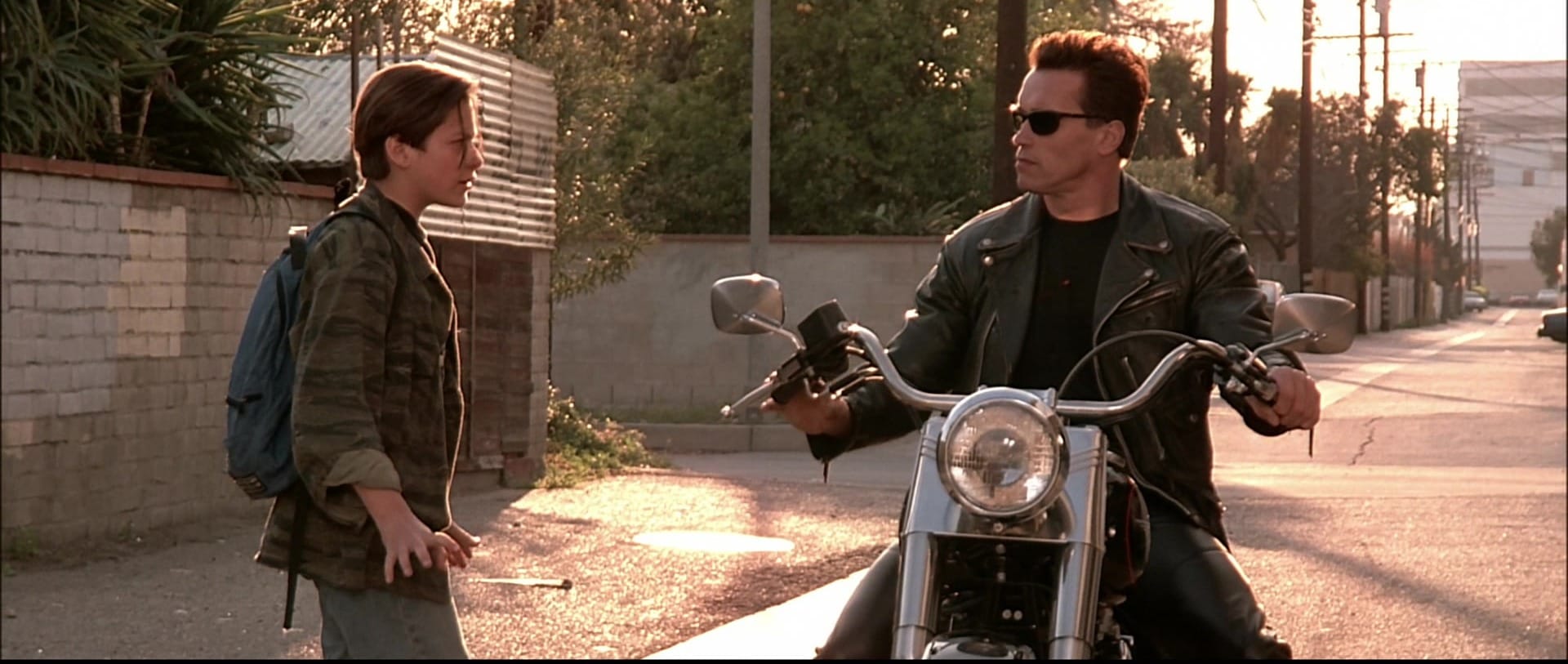
Two individuals arrive via time bubble. The terminator assassin commits murder in cold blood, keeping talking to a minimum. The protector’s sequence is a bit more involved, helping to build out that character a bit more because he’s on the good guy team and we’ll be following him primarily for the rest of the movie’s runtime.
Arnold arrives first; he tangles with street toughs.
Non-Arnold arrives second; he encounters the police.
One of the great tricks of T2 is an entire first act where we can’t be sure which character from the future is who. They spoiled this in the trailers before the movie came out, and it’s really difficult to escape the notion that Arnold isn’t here to protect and be the hero this time. His major movie stardom won’t let him be the emotional second fiddle anymore.
We then meet the one who will save humanity (we’ll call them “Connor” for the sake of clarity moving forward). Connor’s life is… passable but fundamentally broken. While this goes on, the two from the future begin the process of tracking them down.
Also in this sequence the terminator parks on a suburban street and knocks on the door of someone (an innocent) he will shortly kill.
The Terminator is a relentless freight train, where Cameron uses economy to establish all the things we need to know about Sarah. She’s a waitress and it sucks. The boy she’s supposed to go out with stands her up. She goes out on a date by herself on a Friday night. She’s lonely.
Because T2 is a sequel, Cameron has to take a bit more time here, establishing not only John’s estranged relationship with Sarah (and his foster parents) but also how Sarah has changed in the decade since that first film. More on this later.
When it comes to the Terminators, Cameron keeps Arnold at bay hide the big reveal that he’s the protector. Centering the T-1000 in the scene with John’s foster parents helps to build out the mystery of who this new person is (Robert Patrick is still an unknown quantity in 1991 as opposed to Arnold’s ubiquity), and also sets up his later infiltration of the Voight household.
Connor goes out for some recreation, hanging out at the local social oasis that befits both age and zeitgeist.
The protector and the terminator close in. The protector manages to track down Connor first and follows them, but can’t get close yet.
Meanwhile, the terminator doesn’t wait. As soon as it locates Connor it makes a beeline for Connor and manages to get a gun trained on them.
The protector shows up and shotgun blasts the terminator as a means of slowing him down. A brief fight ensues. Then a car chase. Connor and the protector manage to escape the terminator.
In this car chase the protector manages to create an explosion that subdues the terminator.
A major crash into a wall eventually stops the terminator from pursuing.
There’s also a moment during the initial fight where Arnold flies through a sheet glass window, gets back up, and re-enters the fight by going back through the now-broken window.
For Sarah, this is the sequence at Tech Noir, for John it’s an arcade. As this goes down, Cameron keeps the shell game going about who he can trust until the big reveal (though we have our suspicions). The moment that seals it for Reese (“Come with me if you want to live!”) is iconic. For the Terminator it’s the hero moment of “Get down!” Considering he’s not spoken since his introduction, this is an incredible catharsis.
Cameron, obviously, saves the “come with me if you want to live” moment for when he can directly repeat it to earn Sarah’s trust during the escape from Pescadero.
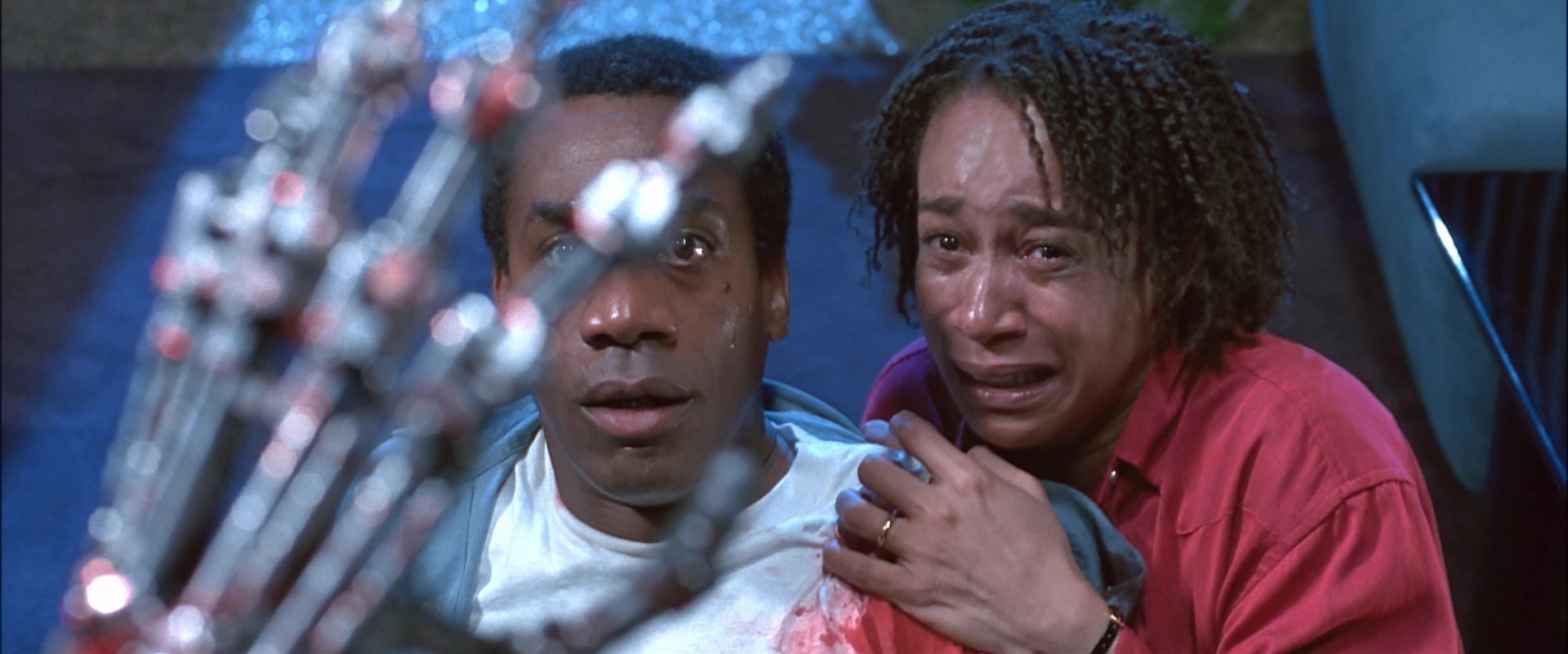
- With a moment to breathe, the protector explains to Connor backstory about the future. Around this time, Connor learns that the terminator has killed the people with whom they were living.
In T2 Cameron has less to do here. He doesn’t have to explain the rules of the future so much because The Terminator did a lot of that heavy lifting already. But it needs to be here so it can confirm to John that his mother isn’t a basket case.
This is also when he starts to layer in the emotional core of the movie. As Kyle explains things to Sarah it starts to build the trust between them that will eventually blossom into a full-on love story. Here, this is when John starts to realize his new best friend Terminator has to listen to him. Like an ideal father, the Terminator has a duty of care that is all-consuming. It starts the father-son relationship that defines one leg of the family dynamic triangle that Cameron is building.
- Realizing that Sarah is locked down in a location with lots of guards and guns, the terminator infiltrates that location, killing anyone who gets between him and his target. The protector manages to get to Sarah, and they barely manage to escape the terminator’s clutches via car.
Arnold shooting up the police station in The Terminator is a fabulous sequence, but, the exfiltration from Pescadero is truly incredible. Part of the trick of the sequel is not just that Arnold is the protector now, but also that Cameron has split the protector role in half. Sarah is a Connor (which is why “come with me if you want to live” works so well) but also qualifies as protector, adding complexity to the story’s emotional core.
- Without any leads, the terminator basically vanishes from the narrative until Sarah creates the future.
This is the biggest problem in The Terminator. After the police station siege, there’s no reason to think why Sarah and Kyle can’t get away (and “we ran out of gas” isn’t going to cut it). The movie also literally stops the thrill ride so it can kick the love story into high gear.
Meanwhile, this is where the movie pauses to shift the emotional burden to Sarah. Like when the horror movie suddenly careens into a love story, this swerves away from a T-1000 chase movie and moves into something more interesting: what it would take to change the future.
Regardless, it’s still easy to feel a bit of the tension out of the balloon as the narrative shifts to its thematic subplot.
Sarah Connor thinks about what she wants the future to be and how she can get to it. As part of this sequence, the protector has a nightmare where they imagine the future. It’s bleak and terrible.
Someone states John’s message to Sarah from the future: “We have no fate but what we make for ourselves”.
Sarah takes the future into her own hands. In doing so (because she succeeds), she becomes a master of her own fate.
More on this in a bit, but briefly:
In The Terminator, Sarah realizes that Kyle is in love with her. The two have sex and conceive John, thereby closing the time loop that will make the future happen.
In T2, this is the entire sequence that starts with Sarah attempting to assassinate Miles Dyson up til the point where they manage to destroy Cyberdyne). It’s big and sexy and noisy, but it serves exactly the same narrative function as Sarah sleeping with Kyle.
And finally, the third act.
The future now set, the terminator re-appears with a fiery vengenace. The protector starts to weaken slightly, sustaining injuries that physically show the wear and tear of this whole experience. It’s the first hint that maybe they’re not gonna walk away from this.
We get a big final chase scene, during which our heroes try to escape via hijacked truck.
The terminator relentlessly chases them down, which ends in a massive crash, knocking out both forms of transportation.
The Connor/protector vehicle crashes by flipping.
The terminator hijacks a big semi truck and resumes the chase. The heroes flee, but they’re not match for the speed. This relentless chase feels like it will never end.
There is a moment where the terminator’s semi truck drives over a curb and knocks over standing object, signifying how unstoppable it is.
The protector manages to destroy the terminator’s truck in spectacular fashion. No way did this not kill the terminator.
Oh shit big reveal: this has just slowed the terminator down, revealing its truest form to our heroes. This is the first time they truly see their enemy for what it is. How the hell are they supposed to kill it now?
The Connor/protector team flees into a large industrial complex. The terminator pursues. A game of cat & mouse happens.
For at least part of this cat & mouse game Sarah’s leg has sustained an injury that forces her to limp.
The protector tries to go toe-to-toe with the terminator. Despite the passion, the terminator is far, far too powerful and absolutely wrecks the protector. The protector dies in the fight1.
The protector falls and it’s not clear how the hell Connor is going to get out of this. What can they possibly do?
Luckily, they manage to weaken the terminator just enough that one last brilliant move of action kills it once and for all.
Sarah presses a button that lowers machinery that kills the Arnold Schwarzenegger character. The last thing we see of the Arnold character is his right hand reaching out.
The final image is a stretch of road that seems like it will go on forever.
There’s a lot to that last sequence, and Cameron adds plenty of contours when he revisits it for T2. Part of this has to be a question of taste (like the semi-truck hopping a curb and toppling the standing object (in The Terminator it’s a tree, in T2 it’s a stop sign), but Sarah pressing the button to lower machinery that kills the Arnold character? Come on.
Where it feels different is Cameron making a lot of switches to small details. Some of this is budget: in The Terminator, the terminator conducts the first part of the final chase is on a bike whereas in T2, it flies a helicopter. Others are practical: the semi explodes in The Terminator so it can melt off the terminator’s skin, but in T2 the T-1000 freezes via liquid nitrogen. Despite this, the rough roadmap is functionally extremely similar. Good luck watching either of these ever again without thinking about the other.
My emotions
Between film’s obsession with the director as the central creative voice of a given product and Cameron’s own position as a visionary filmmaker within that paradigm, it’s easy to assume that he’s an amazing director who writes himself basic scripts upon which he can layer thrills, excitement, action, and tone.
The thing is, though, Cameron is a hell of a writer.
I’ve always lived in a world where the Terminator voluntarily sacrifices himself2. It’s one of those plot details that snuck through the firewall of my elementary-school peers who’d gotten to see the movie. It’s always been a moving scene, but there’s nothing like watching this movie with a friend for the first time. She had no spoilers, and when Arnold said “No. There is another chip and it must be destroyed also”, my friend let slip a gasp of quiet devastation.
Her gasp locked me in. It wasn’t that the film had engrossed me any more than normal, but it really brought home just how powerful this farewell really is. For the first time maybe ever, this final farewell made me tear up.
A lot of this is down to Arnold Schwarzenegger’s iconic performance as the Terminator. In The Terminator he was a stone-faced, stone-cold, silent killer. He never displayed anything, not even malice. Without a mask, Schwarzenegger gave the sort of performance that Nick Castle gave John Carpenter when he played Michael Myers in Halloween3. His Terminator is always thinking, always processing, but it’s the thought process of a computer. There’s no emotion to it at all. Ever.
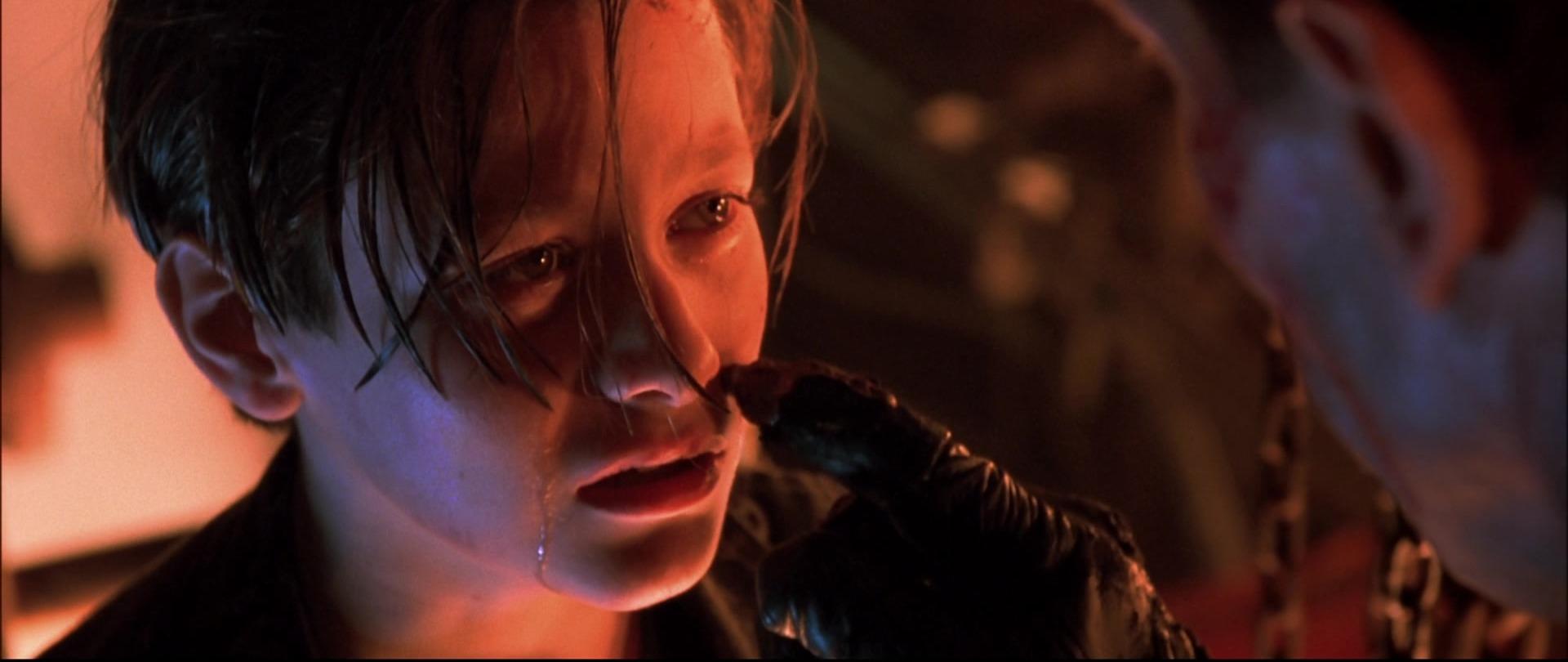
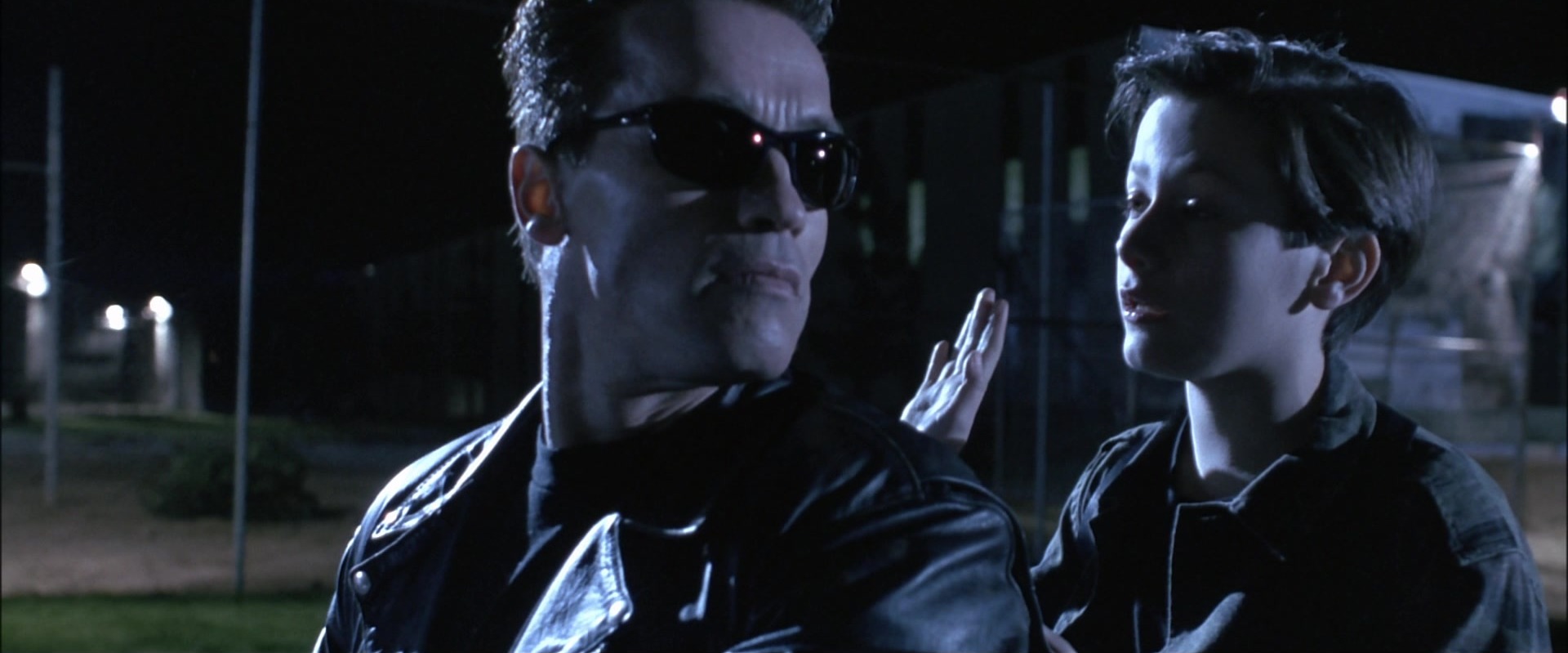
In T2, what can feel stiff is actually a performance of tremendous emotional pathos. As John starts to realize what’s happening, the Terminator apologizes to him. “I’m sorry, John. I’m so sorry.” Taken in a vacuum, it feels like a terrible line delivery. Wooden. But Schwarzenegger knows that the Terminator is incapable of delivering even the most devastating moment of its life with anything resembling emotion. It drops its voice and tries for empathy. But as John cries and screams and begs, the Terminator does the one thing he does very little of in two full films:
He uses his words.
“I know now why you cry. But it is something I can never do.”
That’s just good writing. It’s simple, it’s direct. It fulfills the arc of the character and sucker punches the audience with an emotional wallop. James Cameron is not an emotionally subtle writer, but god damn if it isn’t effective. Viewers are more likely to complain4 about the incendiary thumbs up than the above line. That’s because the most crucial line of the whole movie resounds with emotional resonance while Arnold gives it none. If the choice is emotional clarity via a bold statement of purpose vs. a muddled moment or (worse) the Star Wars prequels, the former should win out every time.
So, yes, T2 might be Cameron lifting his own structure in the name of a sequel. But is there anything in The Terminator that compares? Sarah’s final monologue into the tape recorder is certainly a lovely close, but it doesn’t have the same impact as the Terminator wiping away John’s tears.
Plot is not the point
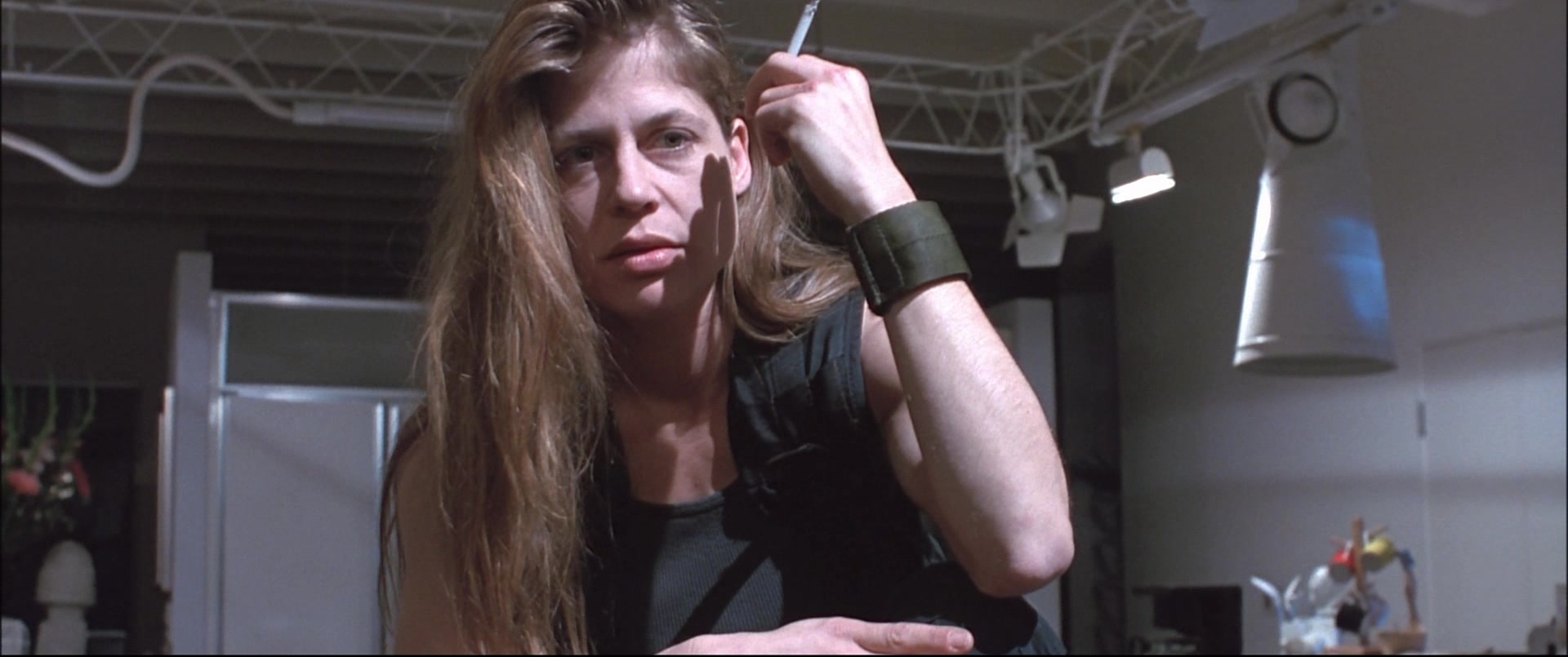
In both of Cameron’s Terminator films, in the second half of the second act, there is the point where Sarah Connor decides to take the future into her own hands and make it into what she wants. To do this, she harnesses the tropes of the story she’s experiencing. In the love story she has sex; in the action movie she blows shit up.
The original Terminator can feel fatalist. Sarah’s arc in the movie is about accepting her role in a predestined future to come. She still has choice. She doesn’t have to trust Kyle, nor does she have to sleep with him. But doing so will break her from the tedious doldrums of her nothing life. The last thing she really says in the movie is “know that in the few hours we had together, we lived a lifetime’s worth.” Yes, she’s creating a future that will be awful, but that future is going to come anyway. The least she can do is raise their child in the shadow of dark and ominous storm clouds and maybe it will be okay. She’s not trading her brief time with Kyle for anything. She has accepted that this story was worth it.
T2 is about embracing the hope of what tomorrow might be. Sarah’s arc in the movie is about trying to find her place in a world barrelling towards a future she desperately wants to avoid. When we finally witness her taking it into her own hands, it’s the most terrifying sequence in the film.
It starts with a dream where she witnesses the nuclear holocaust. The final image tells you what’s happened to her. It burns and blasts away her skin, leaving her as a skeleton clinging hopelessly to the chain link fence.
A skeleton, though? In a film series with another extremely iconic skeleton?
Changing the future was once an act of love. As she attempts to assassinate Miles Dyson, it’s an act of ruthless violence and murder. Sarah acts like the machine that’s haunted her every waking moment. She is silent, relentless, and uncompromising. She becomes a Terminator.
Only… that’s not Sarah is it? She’s a fighter and a mother and a teacher. When saving the future might involve murdering Dyson’s innocent child, she breaks down. A computer can make that calculation instantly. The child must die. As a human, Sarah can’t. She feels too intensely. Her emotions are too strong.
Within the family she has formed, though, there is strength in working together. They team up. They obliterate Cyberdyne. They stop Judgment Day.
And so Sarah Connor frees herself from the future.
The lesson
It blows my mind that more writers don’t fully take advantage of this system. In our modern world of sequels and prequels, re-appropriating an existing structure or plot helps remove the uncertainty of “where do we go next” or “what will audiences like?” Writers could build off existing templates, playing the hits for comfort while focusing more intently on the heavy lifting of finding the new emotional truth of central characters. They’ve been through all this before? Great. So how is it different this time?
Cameron repeats this trick with The Way of Water, where the large movements of that movie mimic and repeat Avatar and what it did. He changes the themes, though, shifting the story from one about a lone man finding his place in a new world into one about a father trying desperately to hold his family together. It’ll be interesting to see if Cameron repeats this trick for the third installment Fire & Ash. We’ve never seen him do a third before.
This doesn’t mean it’s an automatic ticket for success. Kasdan and Abrams ripping off Star Wars for The Force Awakens didn’t go over well with viewers who wanted something new and fresh. There are enough small tweaks in there that the movie is still enjoyable, and fandom embraced it as a warm blanket. Complaints still happened.
Rian Johnson used this exact trick for The Last Jedi, where that movie repeats The Empire Strikes Back basically beat for beat. There, though, a screaming minority rejected it. Why? Because Johnson made a movie about questioning orthodoxy and expanding the possibilities of what Star Wars (both diegetically and not) could be. Fans took that as an attack, rather than a bold statement about how great Star Wars could be if it was just allowed to grow. Weird how they locked in on the emotional thematics of Johnson’s film rather his rehash of a plot.
This is why it doesn’t matter that Cameron steals from others when making sequels. He’s the best sequelizer in the history of cinema because of how he makes his movies feel fresh and new and exciting. This wasn’t #1 at the box office in 1991 because it had a cool-ass liquid metal villain, a helicopter chase, and tons of glorious action. Those elements certainly helped. But the surest way to make a successful project and an enduring story is to take the audience on an emotional journey. The beats playing familiar is a feature, not a bug. Stories are about emotions, not plot. Deep down every audience member knows that.
If every sequel learned this lesson, we’d almost certainly be looking at a better, brighter future.
Hilarious because the T-1000 absolutely kills Arnold in this fight. Arnold just (luckily) manages to reroute power to an alternate source. ↩
First time I heard it I vividly remember hearing he dies by nobly melting himself but falling into some lava. It’s not… inaccurate, but my imagined ending is always what I think of first. ↩
Carpenter famously gave Castle no direction when the actor asked for some. “What’s my motivation as I walk across the room?” “Your motivation is that you’re walking across the room.” Shit like that. ↩
Wrongly. ↩