Feb 2026 Check-in
Happy Valentine's Day from our inherently satirical existence
Hello!
Hope your year is going well so far. I know for me the last month has been a lot of catching leftover 2025 films (including several in theaters) and getting back into television. It’s strange. Being so movie-centric for the past three years has given me a love and appreciation for the medium, but there’s nothing like slipping back into the comfort of checking in with a regular cast of characters. Like the entire medium is the Cheers bar or something.
There are a couple things that are in media res at the moment, stuff that is neither worth weekly coverage nor discussing as of yet. The most high profile of these is Starfleet Academy, the new Star Trek series, but I’ve only seen the first two episodes so far. There’s also been catch up for the Oscar nominations (I still have about 5-6 movies to watch), a ton of theater trips, great 2026 kickoffs with 28 Years Later: The Bone Temple (stupid good) and Send Help (wicked fun), and holdovers like Hamnet (liked a lot but didn’t love) and No Other Choice (sublime). I’ll talk about this more in an upcoming post, but last year can’t quite seem to escape the sense that what’s good was great but most movies didn’t quite hit the way I wanted them to.
Still good, but based on this year (which has two fabulous entries already) we’re in for a hell of a ride.
Here’s what else I’ve been up to…
Criterion Challenge Check-In
Would like to do a regular monthly check-in on this year’s Criterion Challenge to keep myself accountable and expand a bit on what I’ve watched. The goal is to do one film every weekend day, meaning I should be about ten movies in. Currently I’m at… six. Not ideal, but… I’ll catch up.
Flow (#4: 2020s or an upcoming release)
This was the first Criterion of the year and I shared it with my partner (who is also participating with her own list; very exciting). This Oscar winner for Best Animated Picture follows a cat’s adventure through a flooded, quasi-post-apocalyptic world. It’s almost entirely silent save for the sound design and animal sounds and a lot of the joy is seeing the world as it exists through the eyes of these creatures who are just doing their best.
Mostly, it’s difficult to figure out what to say about it. Even the big moments like the secretarybird’s ascent into the heavens or the meaning of the whale feel like they defy concrete explanation. Because the whole thing is basically an art piece (albeit a super kid friendly one), it’s the sort of movie to enjoy thinking about, meditating on. Explaining it or turning it into some grand allegory feels like it robs it of its power as a movie designed to make you feel.
There’s ways to talk about it. Like I could talk about how the lemur is greedy and materialist and would have to seriously consider whether to die with its things or live without them… or I could expound upon the dogs wanting to be part of a pack and that tribalism grants a permission structure to excuse toxic behavior… Mostly, though, it’s just a nice pallet cleanser for those who want to zen out amidst gorgeous, independent animation. It’s okay to have movies that require emotional thinking rather than brain thinking. Honestly, it’s probably preferable.
Totally deserved the win.
Half a Loaf of Kung Fu (#22: Watch a film rated 2.0-2.9 stars)
Challenge prompts like this I try to get through early. Letterboxd ratings generally reflect quality and any movie esoteric enough to be in the Collection is going to have an audience base that reflects a solid average of taste. That’s a seriously low rating though. Last time I got this prompt I watched the final Bruce Lee film Game of Death and it was… not good!
Half a Loaf of Kung Fu has significance in its early use of Jackie Chan. He stars in it, did fight choreo, and also co-wrote the screenplay. But… it’s mostly here to preserve the primordial version of a totemic performer rather than the quality of the man’s art in its most refined form. The movie itself is a parody of other kung fu films and feels like the byproduct of creatives who wish their favorite genre could be more fun.
Unfortunately, their creative nascency robs the film of its ability to be a good movie. It’s so concerned with trying to be silly that it forgets to be… interesting or engaging. It lacks the dynamic power of something like Dragon Inn or Lady Snowblood. Chan himself is impressive, but compared to the baroque insanity of something like Police Story it’s hardly the same. The best part about him is that shaggy 70s hairdo.
Still, I’m glad I watched it. Even gladder it’s in the rearview.
La Llorona (#10: Random Number Generator (Spine #1156))
This is the big prompt I try to get out of the way immediately. The random number generator means watching just about anything, and when I drew this number I immediately panicked because… La Llorona? The horror movie? Great.
Turns out, La Llorona is not the mainstream one that most people think about. That film is The Curse of La Llorona (out the same year) and had all the glossy hallmarks of a Hollywood horror blockbuster. This is a smaller horror film from Guatemala, and builds itself on dread and tension rather than jump scares and production value. It follows an aging former dictator who orchestrated a genocide of the Mayan people during his regime. Though a jury found him guilty of that crime, the government overturns the conviction and remands him to his residence. His family remains with him.
Almost the entire movie takes place in his manor as the angry populace outside protests the injustice. Things get stranger and more intense. People start seeing things. The native woman who’s helping with domestic upkeep is a bit too silent. Weird things start to happen. Finally, it explodes in a creepy climax as all the man’s sins finally come calling for retribution.
It’s intense and (thankfully) not as “here to scare you as much as possible” as the Hollywood version probably is. What it is instead is a reflection on generational trauma and life after genocide. It’s about what justice (and injustice) looks like in the wake of true horror and how valuable accountability is to a populace that needs it as part of their healing process. It’s about what recourse exists when those traditional methods fail.
Best of all, there’s an undercurrent of casual racism that buttresses everything to support this reality. There’s no doubt that the dictator perpetuated this ethnic cleansing, but his daughter casually framing the indignant native population with dehumanizing language brings the point home. She remarks at one point “natives have many children so fast”. It’s not a huge leap from there to calling them “an infestation” or to compare them to some rapidly reproducing rodent.
It’s not that she supports her father (though she does stand by him) or believes what he did was right, but that one moment speaks so much to how he raised her and the worldview/perspective he infected her with. While hardly my favorite film of even this month, I’m so glad the RNG worked out this year and put me on this. Never would have watched it otherwise.
The Most Dangerous Game (#37: Must see Cirterion released films as featured on Danny Peary’s “Guide for the Film Fanatic”)
It’s nice to watch a movie that’s less than 90 minutes. The Most Dangerous Game is a simple enough story: man washes up on an island and unwittingly lands in the care of a hunter who pursues the greatest sport of all: man.
There are certain stories that carry with them an inherent tension and stakes. Stories about people hunting people… are great. They’re intense and provide immediate stakes for all involved. That stays true here, and the highlight of The Most Dangerous Game is the first half when we get to learn about the psychotic Count Zaroff and what compels him to hunt people. But it does fall apart a bit once the hunt starts. This being a movie from the 30’s, there’s not really an opportunity for intense action or exciting, escalating set pieces. Honestly, the coolest thing about this is that they recycled these sets and backdrops to play a similar jungle locale in King Kong. Other than that… it’s a lot of theatrical action in a way that’s difficult to hold up nearly a century later.
Ratcatcher (#15: Director approved)
Lynne Ramsey’s directorial debut is a double dip with Blank Check. They’re covering her films at the moment, and adding it to the Challenge was a no-brainer.
Ratcatcher is not exactly an easy watch of a movie. It follows a young boy in the wake of a friend’s drowning and shows the aftermath of him living with the guilt of maybe having caused it. He befriends a teenage girl whom other boys in his small town bully (in part by sexually assaulting her) and navigates a home life in part defined by his family’s poverty (which… is not unique to him; it’s a generally poor town).
Where it excels is in its moments of beauty and joy. The almost Malick-esque field of wheat or the mouse that floats to the moon via balloon. Or even the intimacy between the main character and the girl, which Ramsey carefully sculpts to be innocent and pre-sexual. They look out for each other, care for each other, and seeing that is absolutely beautiful. That bathtub scene. Ugh.
A Woman Under the Influence (#24: 1001 Movies You Must See Before You Die)
In watching these Criterion films, I build out a rough viewing order before I start watching. It helps to backload all the ones I want to watch most as a treat for the home stretch. This means the first few months are rough, but those last ten fo;,s… Boy do those usually go down smooth.
A Woman Under the Influence was one I had planned for my final block. Luckily a local theater offered up a chance to see it on the big screen. Plans changed.
Starring Gena Rowlands and Peter Falk as a married couple, John Cassavetes’ most famous work focuses entirely on the home life they’ve built. His movies usually land on actors’ favorites lists, and given what he manages to pull out of the ones he worked with it’s easy to see why. Peter Falk is insanely good (and so different from what I’ve seen him do before), but Rowlands’s performance is absolutely incredible, vacillating between madness and quirkiness and free-spiritedness in ways that are deeply offputting.
With a title like this, we expect to see a crazy Gena Rowlands descending into madness. But Falk’s character is just as bad in different ways. Worse, honestly. The patriarchal nature of society excuses his more pronounced outbursts in ways that force a questioning of one’s priors. By the end it’s clear that theirs is a family built on abuse and a permission structure that lets him off the hook while he sends her off to the loony bin for a bit of psychological rehab. She’s imperfect, yes, but does the punishment fit her “crimes?” And he gets no pushback.
Fantastic movie. Wish I saved it for later but wouldn’t trade that screening for anything.
Slow Horses Seasons 1 & 2
It was the only nominated drama at last year’s Emmy’s that I hadn’t seen. Not for lack of wanting to. A British spy show? Right up my alley. Five seasons? A lot to catch up on.
This month I buckled down and watched the first two seasons. And… Slow Horses? Extremely my alley.
There’s a quality of television that thrives within the realm of “misfit toys”. It’s often that the characters of a given show don’t conform to the exact ideal of what they should be. At their best, characters are unique, odd, broken. Slow Horses leans fully into this. Following the Slough House unit of MI5, it stars Gary Oldman as Jackson Lamb, a cantankerous, lecherous individual at the head of the eponymous team. Also at the lead is Jack Lowden as River Cartwright, an agent who made a colossal fuck up during a training exercise and found himself exiled to this group of washed up fuck-ups and losers who can’t cut it within the high stakes of the larger agency. There’s no promise he (or anyone he works with) will ever manage to escape.
Regardless, the group has incredible talent, even if there are characters like Min Harper (Dustin Demri-Burns) who is so incompetent he’ll forget to gas up a car during a long distance chase… even though he and his partner made an extended stop at a gas station to check on some information. He has an excuse, though. He was thinking about having sex with co-worker he’s driving with.
This isn’t a comedy about these people. Rather, it’s one that treats them as the quality Lamb knows them to be, where he’s constantly demanding the best of them within their skillset and always getting results.
It’s terrific. The first season follows their attempts to foil a white supremacist plot to kidnap a British-Pakistani student and murder him in the name of British nationalism. Along the way there’s plenty of intrigue and scandal within the government and agency itself. Lamb’s icy superior Diana Tavener (Kristen Scott-Thomas) is constantly trying to tap into Lamb’s undeniable utility while being fully ready to throw him under the bus in the name of her own ambition and dedication to British national security.
The second season was slightly stronger. It starts with a strange murder and follows the various characters in their investigation into a Russian sleeper cell within the U.K. Where the first story featured episodes where members of the team sat around in a coffee shoppe waiting for their next move, this constantly gave each plot to explore alongside an emotional angle amidst the larger conspiracy.
Not sure how the rest of the seasons will shake out, though. Or the future of the show for that matter. There was an announcement in the middle of last year that creator Will Smith stepped down as showrunner at the end of the most recent season. Other hands will lead the show for the next two seasons. It’s possible this will go okay, but these sorts of transitions typically have turbulence as the incoming visionaries try to dial into that ineffable je nais se quois while also telling the stories they want to tell.
I live in hope, though. And I’m excited to watch the next three seasons.
The Gorge
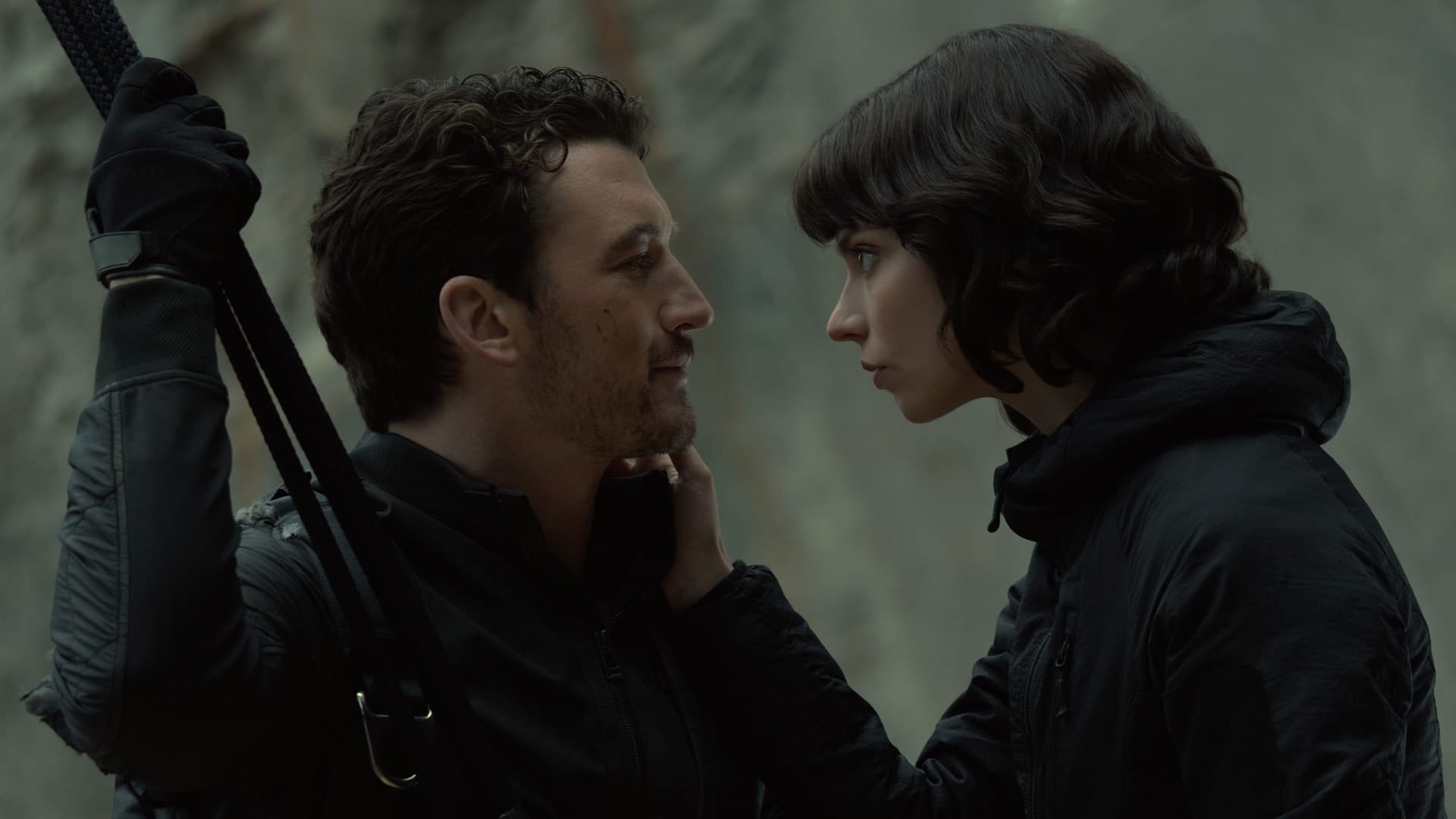
Needed something to put on one night this month and started this late. This streaming movie on Apple TV stars Miles Teller and Anya Taylor-Joy as lone sentries on opposite sides of a very strange and dangerous gorge full of unspeakable horrors. It’s also got a composers Trent Reznor & Atticus Ross (always a good thing), director Scott Derrickson (Dr. Strange, The Black Phone), and co-star Sigourney Weaver. Hell, the script came from the 2020 Black List (an annual curated selection of the best unproduced spec scripts in Hollywood)… which is a thing in its favor. At least it’d be interesting.
Unfortunately, The Gorge is a airy, vapid example of why movies that come out via streaming services are such a questionable proposition. The talent is certainly present, but none of it made it on screen. It looks like dog shit, falling into the same generic, smeary sludge that defines blockbuster films with high volumes of CGI. The effects themselves were lackluster, generic, and bland. And all of that is whatever.
What irked me, though, was seeing this the month after Avatar Fire & Ash. I don’t feel the need to defend that movie, but when one of the complaints about it stems from its CGI effects and how the high frame rate makes it “a three hour video game cut scene”, I challenge all of those people to watch The Gorge.
Video games live in a world of vicariousness. At their most narrative, video games put those who experience them in the shoes of their characters and build emotion out of “you” doing something. Or having some arc. Players drive the action itself, and it’s through those actions that players can immerse themselves in what’s in front of them. While The Gorge acts like a film for its first half, events at the halfway mark turns the film into a survival game where these vague cyphers become stand ins for the audience to experience what happens in the titular chasm. For whatever reason, the second half lives in a world that wants to be immersive, to show off these cool action set pieces, and feel like the audiences are living this experience. Whatever perfunctory character work they’d spent thus far building collapsed in the face of relentless, tedious action.
It’s the barest framework of a story. In a world where video games are growing to be the dominant narrative medium for an entire generation of young people (and that’s not going to go away), that style of storytelling is going to define more and more of the stories we experience over the coming decades. It’s not that we should “get used to it” and demand less. I have no problem with fetch quests and video game structures defining stories and how they happen. Hell, what is Raiders of the Lost Ark if not a serialized sequence of escalating set pieces?
But this is just a structure. It’s not a story. And The Gorge mistakes that structure for actual character development. It assumes that just things happening to characters we’ve spent half a movie with is inherently engaging. That these perilous situations are enough to invest in because digital artists created creepy monster designs in a magic computer box.
For some people, it might be. But there’s no way this is the best possible version of this story. Not with effects this lackluster. Not with an emotional story that adds up to “of course this heteronormative pair of hot movie stars will fall in love” without doing anything special to justify that assumption. Not with this generic of a mythology.
At least Avatar had scenes grappling with grieving parents and their struggles raising mixed race children, the blurred loyalties of a colonizer who looks the willingly colonized, and an adopted orphan finally earning acceptance from his chosen mother. This might not have worked for people, but it’s far, far better than something this cookie cutter.
And, hey, if this is preferable to Avatar, I’ve got really good news: these sorts of factory line, streaming-quality B-movies come out practically daily. And from high profile superhero directors like Zack Snyder and Scott Derrickson. Don’t need to wait three years (much less decades) for the next one. Spin up literally any service and within a few quick scrolls there’ll be one just like this that no one has ever seen.
Just don’t ever demand more from cinema if this is what counts as an apex. Studios see something like The Gorge and are more than happy to churn trash like it out as fast as they can in the name of feeding the endless hunger of an infinite catalog.
Blockbuster film can be so much more than this. And while studios have always churned out at least some mediocre product in a given year, theatrical exhibition created a bar of quality that these films had to clear in order to reasonably make money. In a world of streaming, movies like The Gorge are a perk of the system rather than some promise of entertainment. One more line item of Apple TV’s lineup without ever assuming (or needing) its audience to watch it.
Or even enjoy it.
Eddington
Ari Aster’s latest film came out in the middle of last year. Responses felt… mixed. While I know of some who liked the movie for its biting satire of the world as it exists, I saw a number of responses that felt… muted. Like they were somehow too good for the film. Or though Aster was too on the nose.
Eddington is absolutely that, but it made me think about the nature of satire and the world as it exists.
What makes the movie hit so close to home is how Aster wraps its inherent absurdity in the reality of life in 2020 as a reflection of how little we’ve moved evolved less than a decade later. While it’s easy to look at Joaquin Phoenix’s Sheriff Joe Cross as a caricature of right wing behavior, it’s not far beyond what people were seeing documented on social media day in day out. There really was movement against masking in public, deep skepticism about the nature of COVID, and a hostile backlash against what conservatives viewed as overreach. In some ways, it’s a skewering, though much of that skewering lives separate from the actual actions of Sheriff Joe to affect the plot.
On the flip side of that is the left, with Mayor Ted Garcia (Pedro Pascal) taking proactive measures to keep the community safe during a once-in-a-century health crisis. More hilariously are the youth, staging Black Lives Matter protests in the middle of the street to protest the police’s public execution of George Floyd. Though I’m someone on the left (and sympathetic to the cause), watching their actions in a vacuum highlight the utter ridiculousness of the manner they chose to try to make change. It’s a lot of yelling, a lot of noise. Righteous, sure. But screaming about how evil cops are (however right that might be) and excoriating any dissenters doesn’t do anything to win the battle of more equal justice under the law. Aster is absolutely vicious to the Left’s very real concerns, and it’s hard not to see him as… completely correct in determining so.
While satire is very common in general, it’s rare to see a truly sublime satirical work. Is it easy to judge it in real time? Attempting to portray 2020 in all its tumult is explicitly political art, and Aster is clearly making a satire here. It makes me wonder, though, about critics who know what satire is and understand its function within culture. If they’re complaining that it’s… too sledgehammery… what is the alternative? To make it more subtle? It creates a problem about what is important. Should Aster dumb down what he’s saying so that the larger audience can miss his point? Or is making something like this necessary so that anyone who watches it can come away reflecting about the society they live in?
Looking back at the great satirists dating back to ancient times, it’s hard to look at Aristophanes and understand all of the many contemporary points he was making in The Birds or The Frogs. Some of it translates, but I’m sure a lot of it doesn’t. The universal remains, but the esoteric specifics erode over time. People hold up Candide as a pinnacle of the form, but even in Voltaire’s more modern sensibilities (relative to Ancient Greece) there have to be people who look at his work and think it’s too specific, too pointed, too direct. Should Jonathan Swift’s A Modest Proposal stated something less extreme than offering up Irish babies for the British to consume?
Likewise, is the take on The Adventures of Huckleberry Finn that Mark Twain writes the N-word too much? You could say the same for Blazing Saddles. Should Michael Scott be less extreme on The Office or The Book of Mormon less relentless in the utter absurdity of the cultures we create around belief?
Satire is always pushing the inherent absurdity of a situation to its logical (and extreme) conclusion. The point Aster is making in Eddington is that our world in its current paradigm is, itself, satire. Outside of the antifa attack at the end or the madness of the town electing a functionally brain-dead right-wing Mayor, he doesn’t overstate the world as it exists. America of the now is an inherently insane, unbelievable place if we take a step back and look at it. No heightening necessary, really.
If the complaint is that the movie doesn’t go far enough… I don’t know. Did those people watch the movie? Do they wish the leftist children who took a minute of silence to honor George Floyd were more tedious and annoying than their actions already are? The entire point is that we’re living in a satire. It’s a hell of an observation, and long past overdue in a mainstream film with major movie stars.
Maybe in appreciating that we can start to recognize just how broken our world currently is. It’s the only way I can think for us to start pulling out of this particular death spiral.
Boy do we need to.
Upcoming topics this month…
Still planning on weekly The Pitt reviews. Those are thrilling and every week I fall in love with the show more and more. I also finished The Legend of Zelda Tears of the Kingdom the other night and there’s plenty to discuss there. Survivor kicks off its 50th season at the end of the month and it’s worth reflecting on the state of the show. There’s also Wuthering Heights, Scream 7, Nirvana The Band The Show The Movie, How To Make A Killing… I should be wrapping up the first season of ER within the next week as well. Would love to break down that season and talk about what works and what doesn’t (though most of it totally works).
Other than that… let’s see what happens.
Have a great month!