
Fame's Shallow Ocean - Sunset Boulevard
Billy Wilder's 75-year-old celebration of old and new Hollywood buts up against the value of fame and celebrity. And it's probably even more relevant now than it was when it first came out
Movies are just a little bit over a hundred years old. I mean, imagine being there a hundred years into painting or theater. We don't know where this incredible journey is going from here, but to know that you think that I'm a meaningful part of it means the world to me.
In accepting his Oscar for Oppenheimer, Christopher Nolan said the above, reflecting on the nascency of film as an art form. It’s easy to forget. Movies are everywhere. There’s two to three new releases at the multiplex every weekend (and that’s every weekend, sometimes there’s more). There’s new drops on streaming, straight-to-DVD/VHS were ubiquitous through the pre-streaming home video era… new made-for-TV movies… And that’s just America. Dig into foreign film and it’s a veritable ocean1.
It’s a lot for a medium that’s been around for not even a century and a half.
That birth of mainstream cinema culture coincides with the rise of Los Angeles, the first consolidated home for the industry. It was a city located in an extremely temperate climate, ideal for year-round filming. First came the silent films, with everything from Buster Keaton to D.W. Griffith. Soon after came the talkies and then color pictures and that’s still more or less the era we live in today.
Now, though, there’s a camera in everyone’s pocket. The time it takes for anyone to be on a screen in someone’s face is a question of seconds and a few finger swipes. The resultant fame is practically instantaneous.
In 1950, Billy Wilder made a movie called Sunset Boulevard. The film was a wistful look at an industry that had been in L.A. for mere decades at that point. And yet, the points Wilder makes about the “aging” actress at the center of the narrative is still one Hollywood and film still grapple with today. Los Angeles, “this town”, he argues, has always been like this. Fame will always be like this.
It’s scary how right he is.
Old Hollywood Fame
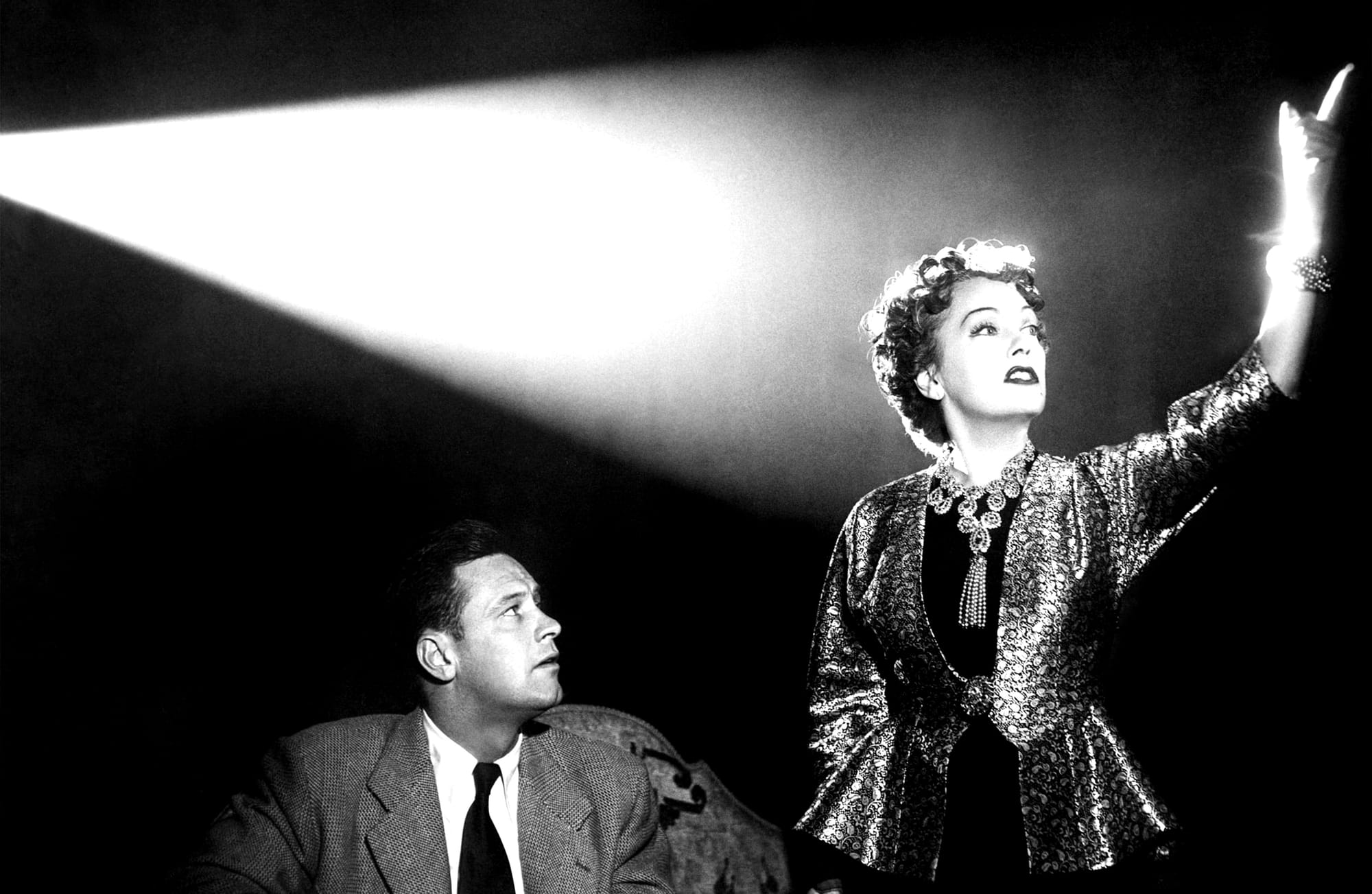
It’s a mark of Gloria Swanson’s performance as Norma Desmond that any discussion of the film almost necessarily revolves around her. The story is unquestionably Joe Gillis’s, and yet even though he’s in basically every scene and has voiceover throughout, it’s Norma Desmond who captures the spotlight even when she’s not directly in it. It’s she who gets the last, stunning moment in the film. The one that everyone quotes even though the quote is almost always wrong.
A major talent during the silent era, Desmond’s star faded more than a decade previous even though she’s only 51. Still, she longs to return to the spotlight. While she waits, her Hollywood is the one where she lives “alone” in her lavish empty mansion. Where she can hire bands to play for the New Years Eves she spends alone and who pines for hours and hours about a screenplay she’s working on based on Salome (in which she will star, of course). She will have bridge nights with other silent film stars like Anna Q. Nilsson, H.B. Warner, and Buster Keaton (all playing themselves). Even as the phones have stopped ringing, when the calls eventually do slowly come in she refuses to talk to anyone who isn’t Cecil B. DeMille. She both overvalues herself yet prizes her worth. All while she waits for some glorious revival that she knows will come but almost certainly never might.
She’s a modern day Mrs. Havisham, though instead of a wedding dress it’s winged eyeliner and carrying herself with the star power of an A-list movie star.
What’s funny is how quick everyone is to defer to the star power Desmond demands. Most obviously this comes from Max, the film director who first discovered her. He fell in love with her, married her, and then gave up everything to wait on her hand and foot. Just being in her presence is enough for him. He is entirely clear about who she is, and yet he treats her as one of the greats of her age. The final moment of her coming down the stairs is his moment as much as hers, the end result of a life’s work to make her the star he knows she is. Granted, it’s only possible because her insanity has finally earned her that one more moment in the limelight. But all press is good press.
More than him, though, that star power never changes. When she finally gets her meeting with Cecil B. DeMille (playing himself) he is quick to not alienate her even though he knows he’ll probably get no blowback were he to behave otherwise. All this while various crew of the film he’s working on flock to see Norma Desmond when the gaffer shines the light on her. The bright lights of a Hollywood soundstage give her the adoring fans she always speaks about having.
It’s this nicety that makes Hollywood feel like the fake place of its reputation. Flattery gets you everywhere. Making people feel important can take you far. It’s about finding the line between pleasant to work with and the status that comes with being a horrific asshole under the “tortured genius” umbrella. This culture of protecting artists is hardly unique to the film industry, but Hollywood has made it more mainstream. Before the motion picture, seeing major cultural force in person was much more difficult. Relatively few people saw Lincoln actually speak compared to the people who voted for him. But someone like Norma Desmond? She could be on your local movie screen several times a year. You’d probably go a few times.
This fame entirely corrupts Norma Desmond. She’s not without talent. She was in enough movies to earn her the big empty mansion, but she also fails to appreciate all the additional talents who get her there. She loves Cecil B. DeMille and recognizes him as a wagon to whom she can hitch whatever return she might make, but she also recognizes the value of having Joe Gillis in her employ. She can spend a decade toiling over her screenplay to Salome, but even a lackluster screenwriter like Joe Gillis can do wonders to patch up her fever dreams into some coherent narrative worthy of her grand return.
Especially when she can make his time worthwhile.
What we can’t have
In the end, both Joe Gillis and Norma Desmond use each other for their own ends. She’s smart enough to know that she can’t get back to where she wants without him, but to keep him around she needs to keep him in a place of financial need. Joe Gillis’s career is in a rough patch (those happen in Hollywood), but that’s meant the money has dried up. For Norma Desmond, money is no object, and she can afford to give him room and board for as long as he needs. What she needs is companionship, adulation…
This means that their relationship is far from professional, though it only crosses the line in ways the Hays’ Code wouldn’t find objectionable. In her mind she might be aging but she’s still as sexy and desirable as ever (and to her credit, she is beautiful). She attempts suicide when he rejects her advances and calls Betty like a jealous lover when she learns about their creative affair. She is in love with him because of what it would mean for him to be in love with her. And why wouldn’t he be? She’s Norma Desmond.
For Joe Gillis, so much of the malaise he feels through most of the film is a directionless lack of drive. There’s no sense that he loves Norma Desmond or any of the work that he’s doing even before he winds up at her mansion. He can’t handle the vanity or the self-obsession. Yes, he races off to her when he learns of her suicide attempt, but much of that is the guilt over how much he’s felt like he’s using her and how little he seemed to appreciate it.
But then there’s Betty, the young up-and-coming writer he meets early on and whom he later collaborates with on an original screenplay. The film treats this like a torrid affair, one that’s clandestine, middle-of-the-night and playing out on old, empty movie studio backlots. Pure romance. In theory, there’s no reason he and Betty fall in love, but he falls in love with her for the same reason Norma falls in love with him. When they meet again after he’s fallen in with Norma, she’s always quick to talk about the possibilities of the future. Before they kindle their relationship with the screenplay, Joe has stopped pretending he’s a writer, content as he is to live out his days in the weird intimacy he shares with Norma Desmond.
Once it’s gone, it’s difficult to return to that youthful exuberance that time erodes in all of us. Joe Gillis is a cynic. Norma Desmond is delusional. Betty Schaefer, though, she’s an idealist.
All of this comes to a head by way of the writing. It’s not a thing Wilder explicitly underlines, but part of the reason Norma Desmond falls for Joe Gillis is because of the intimacy that comes from him putting care and time into what she hopes will be a resurgence of her life’s work. Meanwhile, Joe and Betty fall in love because of the intimacy that comes from writing together, from sharing the emotional openness of pulling from the soul.
What all of these people are missing is human connection, the feeling that comes from well and truly seeing the other person. It’s why Betty & Joe’s kiss feels so sweepingly romantic (if also doomed) or why Norma Desmond’s final descent down the flight of stairs is as powerful as it is. Max puts his director hat on for the world to see Norma Desmond as she truly is. Only when we see her she’s completely gone, having fully given into madness and her final break with reality.
Everywhere is Hollywood
Hollywood’s ubiquity with fame, star power, and celebrity is what happens when high powered artistry meets with mass culture. Charles Dickens performed A Christmas Carol on stage, but a small fraction of the interested population ended up seeing him do it. With film, though, audiences could see big beautiful faces on large luscious screens every week. That connection brought love and adoration from fans. Thus bred fame. And no one is immune from its alluring temptation.
It’s a vicious cycle.
Now, everyone has a phone in their pocket with the ability to gain anyone’s attention at a second’s notice. Anyone who you might see first on a YouTube page is going to have outsized import if/when a real life encounter happens.
What Sunset Boulevard captures is the emptiness that comes from chasing these old ghosts of attention for the wrong reasons. Because like… why does Norma Desmond have a dead monkey in her bedroom? What was the monkey doing in life that was bringing such joy to her? The answer, of course, is the attention she so deeply craves. Monkeys might be autonomous, but it’s still a pet, something for her to play with and to whom they can both dote care and affection.
When he shows up, it’s clear that Joe Gillis is a replacement for the monkey. As a writer, he’s just one step up from the dead and slowly rotting primate she buries in a child’s coffin. But Joe’s autonomy can better capture Norma’s attention given that he’s a person, not an animal. She can relate to him (however obliquely). His autonomy and strong-headedness only makes him more inclined to wander. And as he wanders, she seeks more and more of him. To capture his attention as he has captured hers.
Today, this quest for meaning in the attention of others has completely overtaken our culture. From dudes who stream on twitch to Disney influencers who live stream from the line at the Grand Californian, careful to crop out the top of their head because their hair isn’t done2. All of it is the vain quest for a beast that will never satiate. There will never be enough followers, enough likes, enough views. There’s always room for growth and always a large portion of the population that just can’t be bothered to tune in.
So… what is it for?
Norma clearly wants to be in movies again. She’d love to have her career. But she only talks about her adoring fans. She talks about screentime. She doesn’t talk about the work itself, the joy of acting, the community around her. Compare that to the world DeMille maintains around him, where he’s close to the crew and speaks with compassion about Norma Desmond even though flattering her gets him nothing.
What wakes Joe Gillis up is not just that Betty is a beautiful woman. He loves that she brings the joy of writing back to him. It’s the idea that he might write something for himself rather than cobbling together the dreary ramblings of a fading star (or worse, writing nothing at all and not paying his bills). Work for hire killed him. Writing for himself makes a difference.
Self-actualization is the key. It’s not the fame or the glory. Betty’s recognition is something, but it’s the challenge of making himself into something.
And for Norma Desmond? What is her triumphant moment?
In my head, I always go back to when she’s putting on her little follies for Joe. When she’s not afraid to dress up like Charlie Chaplin with that ridiculous little mustache and those oversized pants. It’s a level of ridiculous she only achieves accidentally through the rest of the film. The performance is only for Joe because she loves him. However the love manifests, it’s far from the pound of makeup she puts on to see DeMille or the Olympic level preparation she does at the mere thought of being in the pictures once again.
A Love Letter to Old Hollywood
In all this, Billy Wilder’s love of Old Hollywood shines through. He spent an entire film sending up the silent era of the 1910s-1920s. Today, that’d be like celebrating what cinema spanned from Back to the Future to Gladiator. That nostalgia, though, has power. And Billy Wilder brings with him a sense of awe and reverence to capture this industry he (and we) loved so much.
Because in the end, Gloria Swanson is not Norma Desmond. Norma Desmond is a twisted and warped individual who’s so lost in the fog of fame and self-obsession she can’t escape the narcissism that comes with it. But putting a silent film star like Gloria Swanson in a movie like this and encasing her in amber as one of the most iconic roles of all time (and in a talkie no less) is a wonderful gift to an actor of yesteryear. Time easily could have forgotten her, but he etched her into he marble of cinema history.
“I’m ready for my close-up, Mr. DeMille” is as iconic a line as “play it again, Sam.” Neither are the exact quote from their respective films, but they fully capture the spirit and intent of their respective moments. It’s an emotion, a moment, a feeling. This is what cinema captures. Nothing matches its ability to make that connection with its audience, to stir deep in the soulswhen Norma Desmond speaks directly to camera about “all those wonderful people out there in the dark”, to have it subtly haunt the narrative as she blurs into nothing… that is its strength.
Because fame isn’t about recognition, it’s about connection, empathy, and linking souls across space and time. That’s the immortality of the cinema, and that’s why as a medium, we’ll find it difficult to replace.
The Top 250 survey aims to misbehave…
When I last made my Top 100, The Apartment was the only Billy Wilder that made it for me. Now, having visited or revisited several of his other major films, I can’t imagine they all don’t make it. Outside of The Apartment, that would include this, Double Indemnity, and Some Like It Hot.
There’s plenty of room for all of them, but I’d guess the order above is how they’ll shake out in the list.
But next week, we’re finishing the big Joss Whedon/Firefly conversation with a revisit of his big theatrical debut. In 2005 Serenity, a small $40m sci-fi movie based on a cancelled TV show, came out to little fanfare and lackluster box office. It’s since become a big name within its own circles… but how does it play outside of the Firefly fans for whom Whedon made it? Well… let’s find out.
Thanks for reading Narrative Looking Glass! This post is a subscriber exclusive but feel free to share it with whomever you think might like to read it!
Seriously do a quick dive into Indian film. Their industry is so massive. They break it up by language and there’s like 4-5 “major” ones. ↩
This is about no one specific except the one person a few years ago who was four people in line in front of me getting a cookie shot from the dessert cart in the hotel lobby. Good luck finding this person. ↩