Even Stories Should Bare Their Soul
In a world of adapting intellectual property to a new medium, how much should creators trust their source material?
This week, in my ongoing effort to catch up on Blank Check, I found myself watching the extant Teenage Mutant Ninja Turtles films I hadn’t seen. As a child of the 90s, TMNT was ubiquitous. I owned VHS tapes (though there are loads of episodes I’ve never seen), watched the original 1990 live action film multiple times (had a VHS of that too), and during a trip to Walt Disney World as a kid ran after the Turtles as they down the streets of MGM Studios in their van (unfortunately, no VHS of this, though my mom still brings it up. I was chasing them for a while, apparently).
In the ongoing quest to turn all IP into a self-sustaining money-printing film pipeline, it’s hardly a surprise that something like TMNT fits snugly into the formula popularized by Marvel Studios. The property itself is a parody of contemporaneous comic books from the early 80s, taking inspirations from DC’s Teen Titans and Marvel’s X-Men, but eventually gained enough notoriety that it became its own part of the genre tapestry that is teenage comic book superheroes. Like how Shrek was Jeffrey Katzenberg exorcising the many demons that came from being handcuffed by the limitations of Disney animation, only to become cutesy animation in its own right.
TMNT is currently on its fourth incarnation, with each new incarnation building out from the emergent technology available. For the two live action efforts, they went with what was popular athe time. In the early 90s they came as creations of Jim Henson’s Creature Shop. In 2014 and 2016 they came to life via mo-cap. With mo-cap and live action, it’s clear that the take is to do the Turtles but in real life. These technologies can give the audience what they want: seeing the Turtles brought to flesh and blood life (only… digital).
But… I have to ask: is this what the audience actually wants?
“Live Action” does not equal “Verisimilitude”
Given my obsession with Richard Donner’s Superman: The Movie, verisimilitude is one I come back to time and time again.
Verisimilitude is the idea that a creator is treating something as though it is real. To tie it back to Superman, it’s really all in the tagline: “You’ll believe a man can fly.” If Donner does his job you’ll believe that this flying, functionally-invincible alien from a long-extinct planet really is deathly allergic to a chunk of rock.
That, however, is not the same as live action.
The 2014 and 2016 Teenage Mutant Ninja Turtles movies (or as I call them, the Platinum Dunes TMNT films) focus on live action rather than verisimilitude. The filmmakers clearly ask the question “okay, so if the Turtles really came into the real world, what would it be like?” And, yes, this is an important question. They should ask it. But framing the adaptation that way doesn’t put the Turtles first. It puts the medium itself first. And… fine. The creative execs who throw nine-figure budgets at these movies have to justify the investment somehow.
But it’s very easy for creative execs to simply not understand the film that they’re making. They come with their own concerns and fears for lighting that much money on fire. Again, that’s fine. But homogenization as a constraint in the name of broad appeal can kneecap a project, making it harder to achieve in its own ideal form. They might seem small but these small changes can have massive implications that robfinal product of its inherent joy.
What is a soul?
It’s hard to embody the source material when the creative has a cynical viewpoint of whatever the source material is. It’s like Zack Snyder in Batman v Superman making Jimmy Olsen some random CIA operative who valiantly sacrifices his life for Lois Lane. It feels (like so much of Snyder’s work) like a cynical attempt to fix something embarassing. The real Jimmy Olsen, the plucky photographer who’s barely old enough to drink and who wears a bowtie and proudly proclaims himself “Superman’s BFF” is lame. No way will audiences take him seriously.
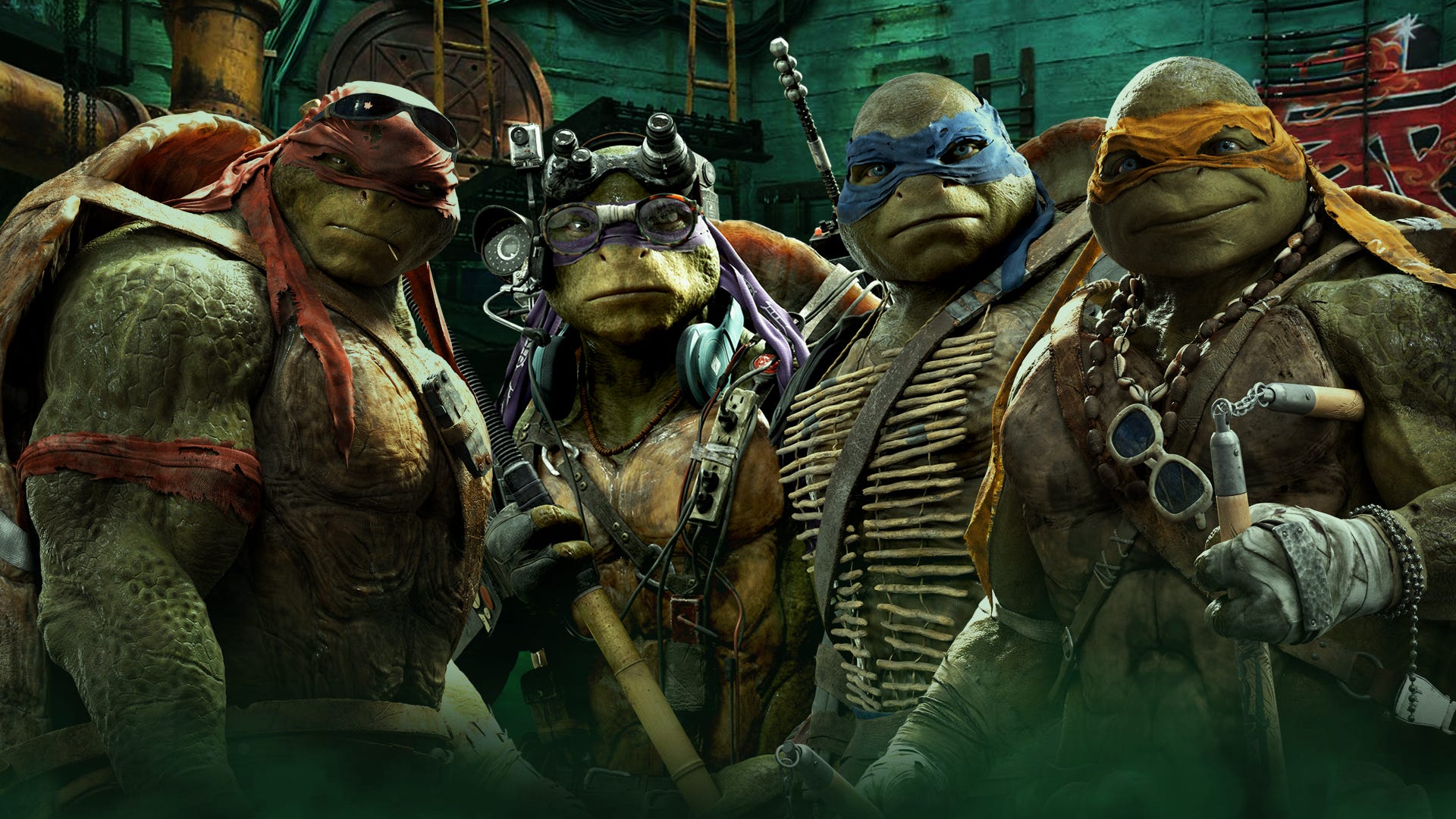
Part of the reason why the two Platinum Dunes movies feel weird is because of this… shame at making the Turtles the silly parodies they are. Out of the Shadows has plenty of nods to the classic Turtles themselves, like giving Bebop an electric purple mohawk or having Steven Amell use a hockey stick, but these signifiers are mimicking the original source material at a purely surface level. They aren’t embodying what makes the source material sing. I mean, look at the Turtles. There’s a sense that the Turtles need to wear pants and have extremely individualistic designs so they can look like real anthropomorphic giant turtles.
And it all just feels so… fake. Think about the eye masks they wear. Donatello wears purple (signifying royalty or high class) and Raphael wears red (because he’s a hot head) and Michaelangelo wears orange (because he’s always down to party) and Leonardo wears blue (because he’s their cool, calm, collected leader). That, though, is not good enough here. Donatello has to have the big science goggles on his head so everyone knows he’s the big nerd of the group. Raphael has to wear the bandana on his head so we know he’s the one to take seriously.
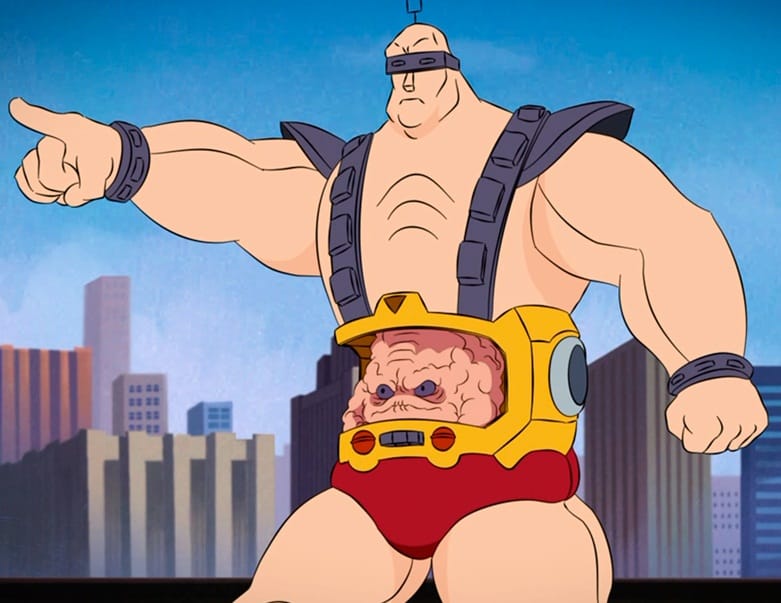
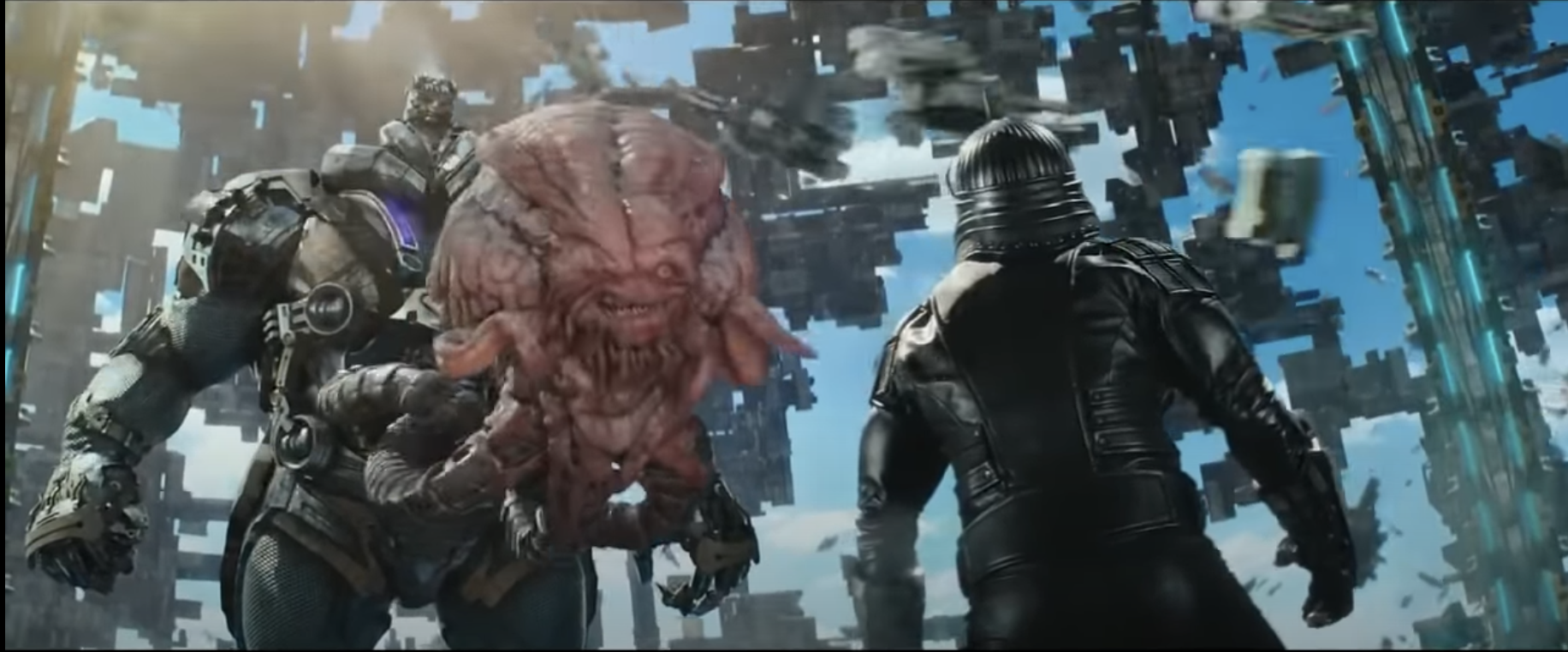
The most egregious example of this is Krang. In that first animated series, the Turtles’ big archenemy Krang was an alien who looks like a brain. All slime and tentacle and snarl. Because he was a squishy little thing, they put him in a big ol’ robot, one wearing silly glasses and weirdly fleshy and naked save for like a red speedo and a giant yellow box in his abdomen where Krang would sit and cackle maniacally as his tendrils gripped those little levers. It was ridiculous. It was inherently silly. In Out of the Shadows? Krang is in a super cool looking mech robot. It’s all metal and edges. You know that robot will kick your ass.
It completely misses the point. The animated robot is scary because it is a tool by which this whiny little bratty brain can kick your ass just by toggling some levers. No one is trusting that big almost-naked robot because it looks like an absolute menace. It’s not trusting the source material. They’re pulling from it, sure, but it takes itself so seriously that it comes off as misaligned with the very spirit of that original vision. It’s about Anthropomorphic Mutant Turtles who are Teenaged and also Ninjas. That will never not be silly. Yet, by adding all of these extra bobs and whistles, it leaves behind that key whimsy that comes from having main characters named after Renaissance artists for no discernible reason. It can give Bebop that purple mohawk, but the rest of his warthog body is so concerned with looking like a real warthog that it leaves no room for the stylized excess that might elevate him to being… rad.

We don’t have to accept that “good enough” is good enough.
The Turtles are hardly the only example of this. Prior to Iron Man, superhero movies regularly eschewed the more inherently weird aspects of Marvel Comics, choosing instead to give subtle winks and Easter Eggs. In 2007’s Fantastic Four: Rise of the Silver Surfer, they eschewed Galactus’s original design of “really big cosmic entity who dresses like a Jack Kirby drawing”, and instead attempted something more palatable: a giant swarm cloud of space locusts who are going to devour the Earth. But to throw a bone to the fans who “really know” they made sure that the swarm cloud’s shadow looked like Galactus’s head as it passed over the face of Saturn. At the time, I remember someone saying to me “yeah, it’s lame but they put it in there because real ones know the big boy’s in there.”
I’m sorry, but screw that entire line of reasoning. In attempting to appeal to a mass audience, the people making that movie hid from something that’s inherently rad and cool. Would it be hard to show Galactus in all his glory? Sure. But if you build your story right, your audience will go along with literally anything no matter how out there. Copping out isn’t helping anyone. The nerdy fans might care that Galactus doesn’t look like Galactus, but know who truly does not care one whit about Galactus at all? The civillian audience. By losing the specificity of Kirby’s aesthetic (an aesthetic that has functionally defined comics to this day), you’ve robbed the audience’s ability to connect with something proven to work for its own audience.
And audiences can smell generic and phony from a mile away.
Things have gotten better. We live in a world where the Guardians of the Galaxy movies are unironic and fully embrace the utter weirdness of that. Audiences loved it. In fact, Marvel Studios’ undersung gift to the world is its full-throated endorsement of the comics’ more gonzo elements.
Maybe this is all silly, railing against a movie that’s almost a decade old for a problem that’s improved. But finding that core and heart of a narrative’s soul is the thing that’s going to win an audience over. Trying to reinvent something that’s previously worked is just adding a lot more work for basically no upside. And… yeah, sometimes you have to make changes in adaptation. But a lot of these changes are aesthetic choices from people who can easily miss the point of that original source material.
If we have to live in a world of IP, where studios run IP farms and try to milk them for all they’re worth, the least we can do is demand the IP be the best possible form of what it could be. That means embracing it for what it is and celebrating the reason it was so coveted for adaptation in the first place.
Hell, if all they’re going to do is exploit a built-in audience so they get a big opening weekend, the least we can ask is that they exploit us by giving us what we want. It’s the least they can do.