Dreams Are Just Memories While We Sleep - Eternal Sunshine of the Spotless Mind
Relationships are so much more than a cost/benefit analysis
My senior year of high school, my best friend recommended to me three films to watch with my new Netflix account. One was last week’s film, Before Sunrise. Another was Almost Famous. The third was Eternal Sunshine of the Spotless Mind.
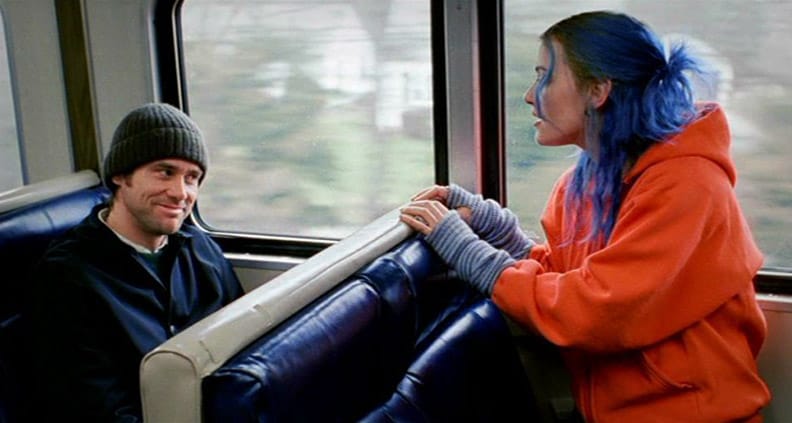
Funny enough, I don’t think I finished it. My sensibilities were very different than they are now. There was something… low rent about it. I hadn’t really watched a lot of low-budget films, nor had I watched anything so peculiar and weird. Most of my experiences were of big budget blockbusters or (if lower budget) films with high production value. There’s a claustrophobic intimacy to the story, and that’s coming after the strangeness of Joel (Jim Carrey) and Clementine (Kate Winslet) meeting on the train heading back from Montauk1.
To be honest, it was confusing and my head wasn’t right for it. So I didn’t finish it. Huge mistake.
A couple years later, I took a screenwriting class in college. The best writer in the class and my screenwriting professor both admitted that their favorite film was Eternal Sunshine. And so around that time I must have revisited it.
With the wisdom of years, it was a totally different experience. The low-budget feel was part of its charm. The strange lighting and tactile sets made the film deliberately unsettling as it travels through Joel’s memories. It had a tactility to its production design, a potency to its emotional core. Not to bandwagon off two people whose opinions I deeply respected, but sometimes a movie lives up to its reputation.
Look no further than a couple of weeks ago, when the New York Times released a list the Top 100 films of the century so far. They polled critics and industry insiders to make something comprehensive that wasn’t just their culture team yelling in an echo chamber or (worse) a lead film critic holding court about how the century has worked.
Eternal Sunshine of the Spotless Mind came in at #7.
The NYT invited readers to make their own lists, asking what they would pick as the 10 best films of the century so far. It wasn’t even a question that it would end up on mine2, but of the lists I saw floating around, Eternal Sunshine was a popular choice.
Sure enough, Eternal Sunshine was in my Top 10 for a decade, though in the Top 100 of 2022, it had dropped to #20. That’s not a reflection on the movie. Maybe four of my Top 10 carried over from before. The fickle mistress of the ranking engine did a right proper jumble of my preconceived notions. And now… well. In a few months we’ll know what realignments have come. But there’s one thing that will always be true: Eternal Sunshine of the Spotless Mind is a singular, incredible film. A shining example of the medium and what it can do.
A uniquely not-unique story
Bad breakups are not special. Plenty of relationships break apart for any number of reasons. These can be for as simple as a disagreement on where it’s going (like about kids in the future) or as complex and opaque as “we just grew apart”. A relationship can be a sticker that loses its adhesion over time.
What screenwriter Charlie Kaufman brings to the fore is a highly fantastical idea (you can erase a relationship from your memory) paired with extremely lo-fi technology (the Lacuna machine is a tangle of wires and cables) and couples them into the universality of a bad breakup that you don’t think you can survive. It turns into a journey that takes us through Joel’s mind, running through memories as he tries to cling onto the parts of this relationship that he loved.
We don’t really get Clementine’s perspective or the sequence of events that result in her deciding to undergo the Lacuna procedure. The movie stays focused primarily on Joel and keeps Clementine at a distance. It’s easy to objectify her. And yes, one of the criticisms against the movie is Clem’s status as a manic pixie dream girl (the hair doesn’t help). When we see Clem in Joel’s memories, however, they’re of how Joel remembers her. Of course, on the night of the film, Joel remembers their relationship in reverse, with the wipe starting with the most recent events that led to their bad breakup and moving into his earliest, brightest memories of how happy and in love they were at first. As such, she’s terse, mean, and bitchy in the beginning and warms as time goes on. By the time he gets to their first meetings, all of the bad times have washed away. He ends the night stuck between the infinity of what could have been and the fear of losing her as the tide washes into the house.
If anything, Joel and Clementine opting to erase themselves from each others’ memories is the easiest solution to the pain of living with what they’ve lost. I remember the first time I met someone who handled a breakup with a callous apathy. There was a day where he was sad, where he talked about how devastated he was to lose this brief but wonderful companion. The next day, during a check-in he said “oh I’m over it.” Total stone. Just absolutely put her in a box and then let the box go out with the tide. Not super believable, to be honest. Either the pain was there and he’d had some pretty serious emotional anesthesia, or he just turned off that part of his brain like that one scene in Star Trek First Contact when Data turns off the emotion chip. Click.
It’s horrifying, to be perfectly honest. So anathema to the way life works when it’s the sum total of our experiences. I knew better than to ask again, but he wasn’t the only person who was like this. There are others who walk through life and deal with breakups by deciding it’s better to just lop off the emotional limb than continue to opine what they’ve lost.
Even if these characters lop off these appendages, Kaufman knows they’re missing some part of their soul. Joel’s decision at the beginning of the movie to skip work and go to Montauk only comes because of the small echo of Clementine still rattling around in his head. In Montauk his life changed. He doesn’t remember it, but the promise of the place becomes the driving force for him at the beginning of the film. It’s a perfect Inception.
Ethics in memory erasure
But the story I keep coming back to is the one at Lacuna, and specifically the one surrounding Mary. Kirsten Dunst slays this film. She’s always good, but she’s perfect as Lacuna’s receptionist, the young ingenue who eventually releases all her employer’s case files to undo the damage the company has done.
Because Lacuna itself is morass of moral depravity.
Lead technician Stan (Mark Ruffalo) is in a secret relationship with Mary. She comes over for Joel’s erasure and the two spend the first part of the evening drinking, getting high, dancing around in their underwear, and having sex. Honestly, the biggest problem with it (besides the clandestine workplace romance) is that it reveals their immaturity. They feel like teenagers, alone in the house while the parents are gone for the weekend.
Patrick (Elijah Wood) is dating Clementine. He developed feelings for her while watching her sleep as he and Stan erased her memories of Joel. He uses all of the she provided to Lacuna to create the perfect relationship with her. It’s a disgusting situation, deeply emotionally manipulative and also doing untold damage to Clementine herself. She’s in the midst of a nervous breakdown, where everything in her body is screaming that something is wrong. It has to be doing some sort of psychological damage. Like the negative space in Clementine’s brain is creating a perfect picture that’s perpetually out of focus. It freaks her the fuck out. Why wouldn’t it?
But the big twist is the relationship between Mary and Howard (Tom Wilkinson). It’s Mary’s idea to bring Howard over once Joel goes “off the map”. When Stan informs her Howard is coming over, she demands to stay (and then goes off to primp and preen). Once alone with him, Mary makes her move. Howard gets uncomfortable, but from there it unravels. It turns out that the two of them had an affair. He ended it. In its wake, Mary couldn’t handle working for him while being so in love with him. So she erased their relationship from her memory. And kept working at Lacuna.
Howard allowing this is both cruel and extremely unethical. But it all comes down to his own unhappiness. He loves the attention. He loves her and loves her loving him. Even within the confines of Lacuna, there are all these small moments, like her lingering touch on his shoulder or looking back at him as she leaves the room. It’s so awful to watch him casually lay a hand on her shoulder while she’s at the front desk. Dunst reacts to it perfectly, a jolt of electricity as she receives the touch she spends all days craving. Her desire for him is impossibly real, where a crush can turn anyone into a bumbling, fumbling idiot. Regardless of whether or not she’s forgotten what happened between them, her feelings will not change. She will always be in love with him. She needs the intimacy with him. Every casual graze of fabric or brush of skin can feel like sex.
It’s utterly heartbreaking to watch, and Dunst’s charisma is off the charts. The scene where Mary professes her love to Howard is utterly devastating. The two care about each other so much, where Mary’s only sin is loving a man she can’t help but feel for. Howard’s sin is far worse. He is the older man, wiser, married, the inventor of the technology. He knows better. Yet he puts himself in this situation with her and allows it to happen. Their chemistry is practically intoxicating, a delirious mix of seeing him struggle with the conflicting inside him while she throws caution to the wind and seizes what she so desperately needs.
Weep not for Howard, though. The clinical way he speaks to her on the tape where she describes their relationship is brutal. A perfect affair where he gets to keep his marriage, wife, and children. Meanwhile, she has to see him day in and day out, never knowing the brief happiness she had, her love a prison despite Howard quietly requiting it. And she can’t understand why all of this is the way it is.
Ache
The sum total of the film playing in this space is a lingering emotional ache. This, while it resonates with intense beauty. Kaufman certainly can’t help the underlying melancholy of his writing. It’s prevalent in his other films, but of the others I’ve seen don’t feel nearly so hopeful as this. Perhaps it’s because as Joel falls further and further back in time to earlier and earlier memories, the possibilities with Clementine feel tremendous. His whole relationship is in front of him as the house in Montauk crumbles, the tide rushes in, and the ghost of her whispers play in his ear.
What makes this movie so remarkable is that sense of beauty mixed with Kaufman and Gondry’s mastery of cinema. It’s in the lighting, the cross-cutting, the strangeness. It’s claustrophobic and impressionistic. Surreal when Joel is a child under the table in the kitchen. The two filmmakers understand that they can use the economy of the medium to convey these relationships and Joel’s mental state. Every actor at the center of this understands the movie they’re making and brings this aching, longing to it all.
Romantic relationships are messy and require so much. They require an intimacy reserved for a precious few. At the end of the movie, when Joel and Clementine hear their tapes describing each other, it’s raw, painful. Brutal. They’re reflecting at the end of their relationship, at their most heightened anguish. They can only think of the bad aspects that made everything fall apart. Concurrently, the two are in the blissful beginnings of a new blank slate, struggling with whether their current euphorias are worth the possibility of an inevitability.
That they try for it at all is utterly profound.
Being with someone can end in pain and suffering. In its wake there can be an endless abyss that we might think we’ll never escape from. Most relationships end this way. Many go on for far longer than they should, all in the name of trying to get back to that promising beginning. They leave wreckage, and there are times where it feels like we’ll never escape. Like we would be better off without them in the first place.
But relationships are also impossibly beautiful. There’s a reason people love to fall in love. The reason breakups hurt so bad is because they’re the opposite of that unique euphoria. It’s beyond drugs. Even when it doesn’t last long, falling in love with someone who falls in love with you is a transcendental experience. We can’t stop. Why would we?
This movie sits in the eternity between the moment of connection and the moment of severance. The Lacuna machine’s cables actualize how complicated things can get when people unleash these endless wells of emotion within them. It makes people do stupid things, act recklessly, be rationally irrational. It’s Mary opening the door for Howard, the opportunity to be with him alone, outside of the professional work environment. It’s Joel fleeing to a memory of his mom walking in on him jerking off, bravely letting Clem see him at his worst so he can keep what he loved about her alive until morning. It’s Stan describing Mary as “happy”, the nicest thing he can give her to prove he cares. It’s Clementine rocketing up from the ice when she’s there with Patrick, the everything in her screaming that this perfect moment is perfectly wrong. It’s Howard giving that small smile as he can’t deny anymore that Mary is still in love with him.
And in the end there is that hallway, where Clementine starts coming up with every reason why Joel shouldn’t want to be with her. She just heard all of the most horrible, awful caricatures of her. Her concern is that she’s a mess and a lot to handle, exactly the same thing she said to him when he asked her out in the bookstore. History repeats.
After an entire film of seeing Joel learning (and then forgetting) to not regret his time spent with Clementine, he gets the opportunity to fall in love with her again, only this time with all the knowledge of how horrible things might turn out. With all of this awful knowledge and tremendous pain, without even the memories he had that made him remember how in love with her he was…
He says “okay” anyway. And she says “okay” back. They know there will be pain, possibly tremendous, unbearable pain. But what they feel in that moment is euphoric, the possibility that it might be different this time. Who wouldn’t risk everything for just that little bit more euphoria with the person you love? Isn’t that worth it?
Chances are…
Prior to 2022, I made a relatively static Top 10 in 2014. Eternal Sunshine was in there. In 2022 it just barely made the Top 20. This time… There’s a lot of good movies out there, but every time I revisit this one I find something new to pick up. It’s emotionally heavy, but every time it comes on I find it enrapturing. Jim Carrey is magnificent and it sucks that Hollywood still didn’t treat him like a serious actor after this. Gondry’s odd verite style is dreamy and wonderful. And Kaufman uses the language of cinema to tell a story that could only work in this medium. This could work as a book, but it wouldn’t be as effective without the pressure cooker of no pause button. It might work as a play, but you’d lose some of the propulsive urgency.
So yeah. This movie is totally making the list. I shouldn’t wager, but there’s a very good chance it’ll make the Top 20 again. Maybe even go higher. Not the Top 10 probably, but… you never know…
Next week…
The Wachowskis teamed up with Tom Twyker to make an insane, three hours of cross-cutting adaptation of David Mitchell’s Cloud Atlas. And yes. We’ll talk about the yellowface.
Thanks for reading! This post is private but if you feel like someone might appreciate it, please do share regardless.
Funny how both Before Sunrise and Eternal Sunshine start with the central couple meeting on a train. Love a train. ↩
In release order, my selections were In the Mood For Love, Mulholland Drive, Spirited Away, Eternal Sunshine of the Spotless Mind, Zodiac, Interstellar, Tangerine, Moonlight, Parasite, Spider-Man: Across the Spider-verse. ↩