
Does This Count As Lazy? - Avatar: The Way of Water
13 years after 13 years later, James Cameron puts out another masterpiece.
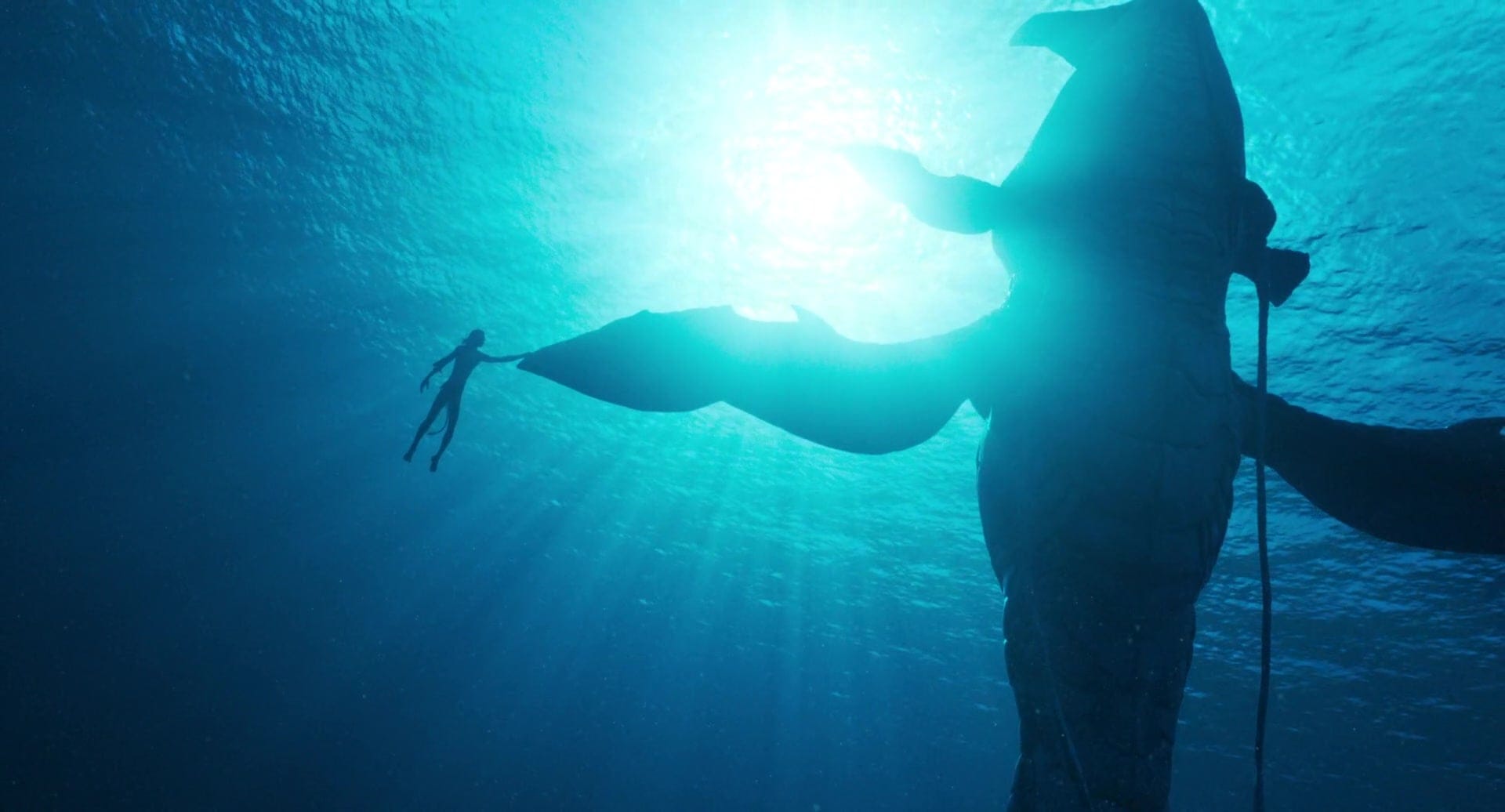
As James Cameron pulled the trigger on Avatar sequels, his ambition took over. Discontent to make another “biggest movie of all time” or some standalone sequel/follow-up, Cameron chose to invest this capital in multiple Avatar sequels that “no one was asking for”1.
To him, this meant a saga.
Sequel planning might seem normal in our world of subsequent installments and shared universes, but these gambles are ones studios remain reluctant to make. Sometimes film sequels will shoot back-to-back. Back to the Future and Pirates of the Caribbean sought to complete a trilogy, even though their first films didn’t demand one. It’s risky, but with a sure enough original hit, studios can justify the rewards. And three is a nice round number.
Building out a saga to start, though? Kevin Costner’s recent western Horizon: An American Saga is a series of four, three-hour movies (each) that Costner wanted to produce all at once. He managed to make the first two, with plans for the second to roll into theaters just a few weeks after the first (to draft on the guaranteed hype2). Of course, when Chapter 1 immediately flopped, New Line Cinema pulled Chapter 2 off the schedule. More than a year later it’s still waiting for a release date (and that sucker is like…done and in the can and has been).
Even Marvel doesn’t work like this. Marvel Studios has plans for upcoming films and keeps the trains moving on time, but they (proudly) have never gone into production with a finalized script, let alone completed scripts for future films. The result is a film series that only has a vague idea of where each installment will land. As for the future beyond that? They can only guess.
Cameron’s post-Avatar position is unique. He made the highest grossing film of all time, followed that up with the highest grossing film again, and received a request from the studio to make multiple Avatar films. With such a mandate, Cameron decided this afforded him the opportunity to plot a full trilogy from scratch to make up a proper Avatar saga, equating it to The Lord of the Rings. There, Peter Jackon’s full picture gave him the ability to show everyone the entire narrative to help the creatives (especially the actors) understand where they were going. Eventually, “Avatar 2” proved so big that Cameron split it down the middle, evolving the trilogy into a four-film series. With success no guarantee, he gave himself the ability to stop after Avatar 3 should the first two sequels prove Avatar really was the weird anomaly everyone claimed.
While Avatar: The Way of Water didn’t make the box office receipts of its predecessor, it still topped Titanic to become the #3 highest grossing film of all time3. Currently, and if this holds up, on a per-film basis Avatar is the most successful genre film series of all time. And from one lead creator at that.
Enter someone I know.
We saw Avatar: The Way of Water (separately). While she’s like other Cameron films (and counts one as one of her top five movies of all time), she’s been lukewarm on Avatar. After she got out of The Way of Water, I checked in for her thoughts. The complaint?
“Bringing back the bad guy from the first movie was… not something I was interested in watching […] same bad guy felt incredibly lazy to me.”
Oh boy.
I disagreed with her, obviously, but I’ll go farther than that. Bringing back Quaritch as the ubervillain isn’t just Cameron giving everyone “more of the same”. It’s one of the best ideas in a movie full of brilliant ones, the frosting on this particular cake that most brings out its thematic harmony.
Family falls in line
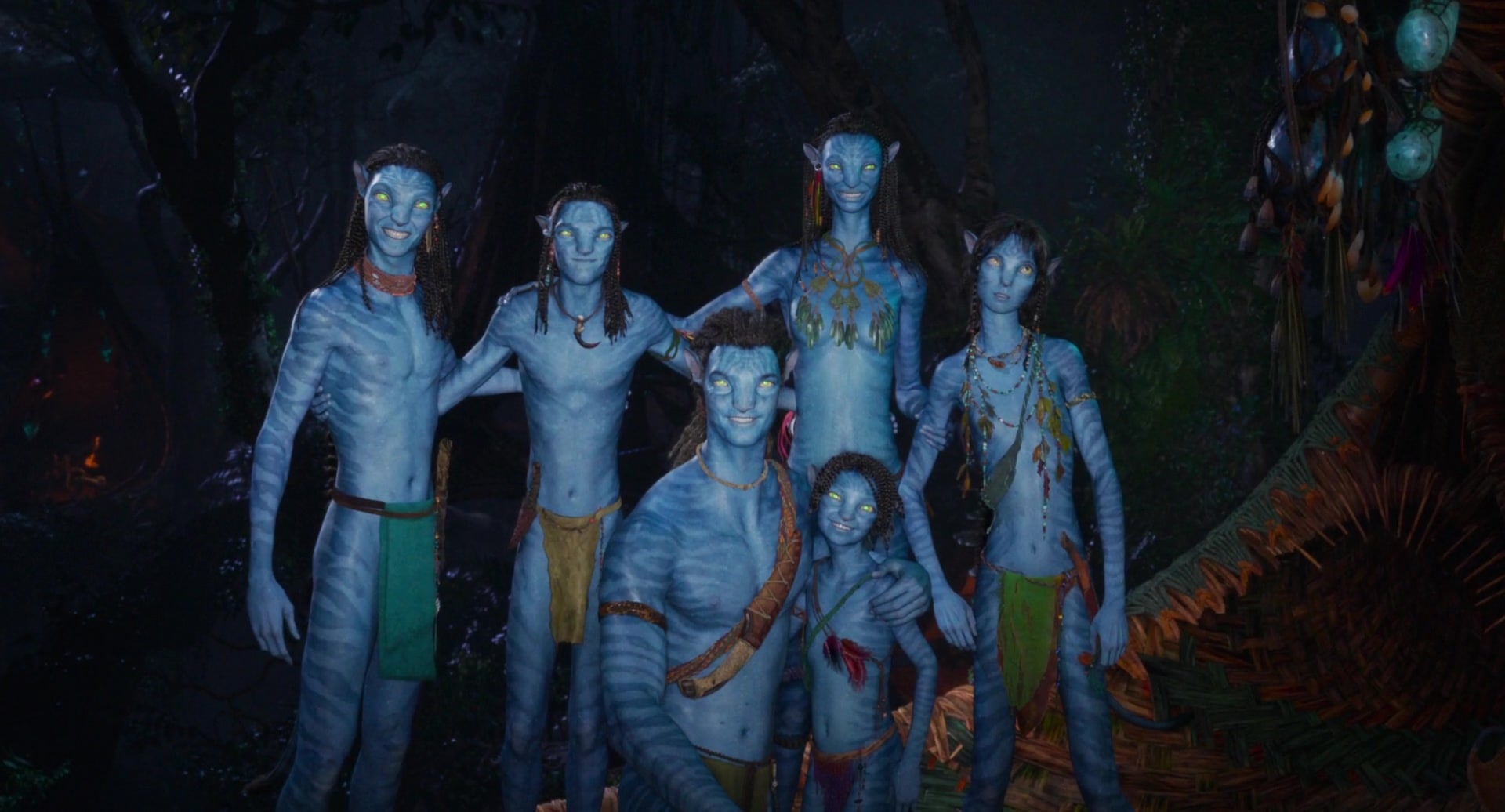
From the earliest public discussions of Avatar’s sequels, James Cameron has been open about the series’ focus on the offspring of Jake and Neytiri and their resulting family unit. This should be concerning. Precocious children are often a source of audience cringe. Luckily, the Sully children (which includes Spider) are all believably reckless but also reasonably obedient, believable in every way. More importantly, though, Cameron’s propensity for corniness and bleeding heart emotion helps power the struggles of family beyond Jake’s. As allies, the leaders of the Metkayina clan have children too. As villain, Scorseby and his team of Tulkun hunters specifically target a mother when the harvest the species’ brain fluid.
Where it gets personal is in Cameron opening up in press. Because those around him so often doubted his vision, for his career up through Avatar he viewed his film sets as a battlefield, where he was a military general going to war with literally everyone who got in his way. Those who followed him were under his command and they required discipline. He also admitted he ported this behavior to his family life at home, running his household like he was the leader of some squad. Around the time of Avatar’s release, his wife and children sat him down and delivered him an ultimatum. They’d had enough of this. Basically: “change or we’re leaving.”
By all accounts he did. That translated back to his film sets, and while working on Avatar movies has proved its own daunting task, there is a sense he’s mellowed out. Expectations stay high but he doesn’t descend into tyranny. Apparently this improved both morale and the quality of the output. Weird.
In The Way of Water Jake’s struggles stem from running his own family like a military force (Neytiri calls this out directly) and fleeing rather than taking the fight to Quaritch once he makes his presence known. To him, their safety is paramount. But telling his family to “form up” has an alienating effect on the love between them all. Jake is scared, scared of losing his children, scared of what Quaritch might do and what this threat might cost him. It makes him an asshole. But he also remains passive to the point of inaction, and this leaves him (and the various Na’vi tribes) open to an assault from the humans who care about nothing but their own bottomless avarice.
That inaction, though, is not enough to save the life of his eldest son. All of that hand-wringing, and Neteyam still winds up on that rock with a hole through his chest.
James Cameron’s Galaxy Brain
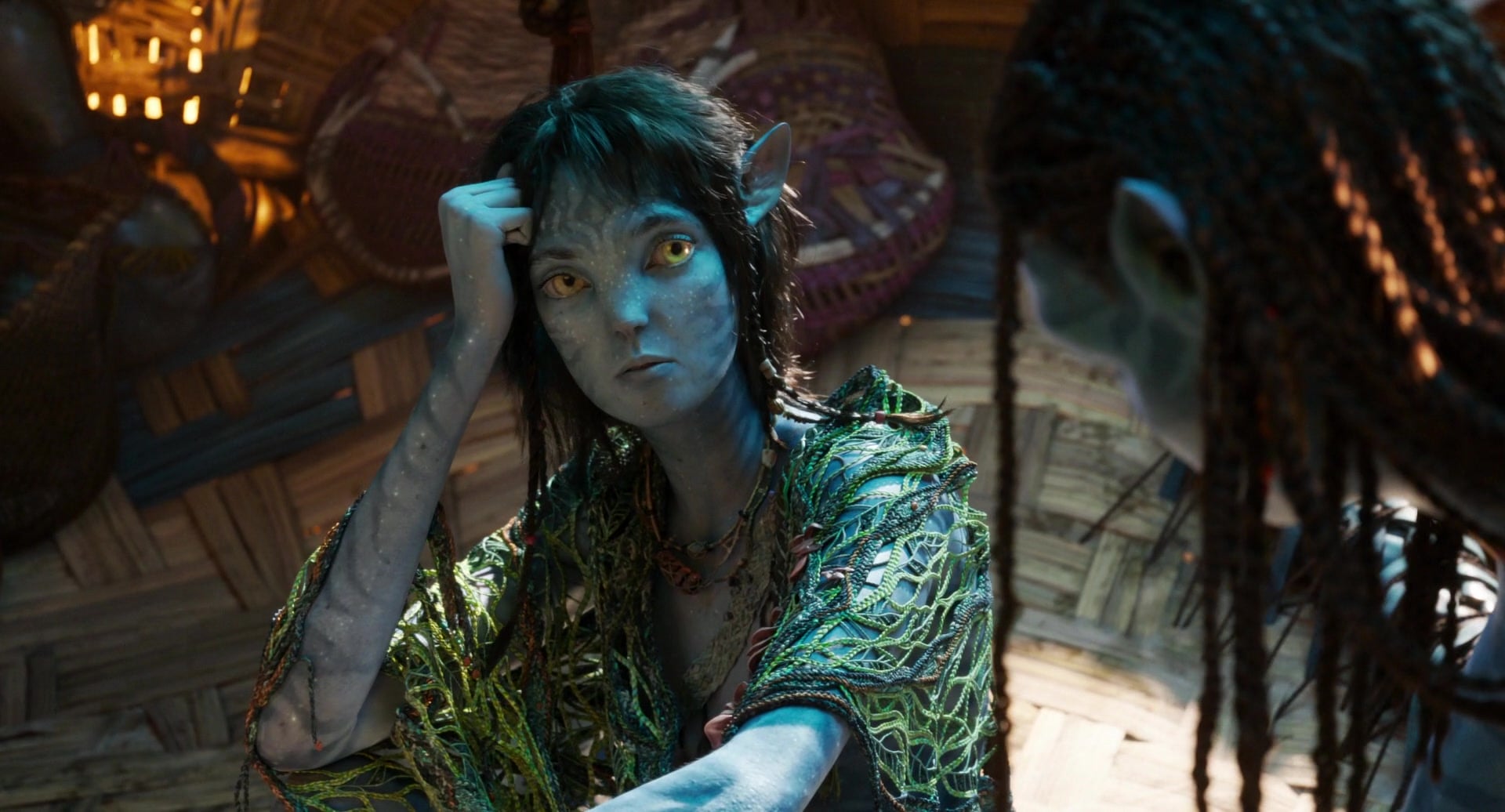
While Neteyam, Lo’ak, and Tuk are all direct genetic offspring of Jake & Neytiri, the Sullys also have two additional adopted members. No amount of blue paint can hide this about Spider (more on him in a bit), but it’s easy to forget that Kiri is also an adopted child, born of Grace’s Avatar from an as yet unrevealed father.
Kiri is a character Cameron tees up but without yet paying off. There are moments where she conducts elements of Eywa (the anemones attacking the submarines or the glowing yellow fish she sends into the ship to rescue Tuk and Neytiri, or even when her breathing causes ripple rings in the grass), but a lot of the movie is of her learning about her powers and starting the process of tapping into them. Whatever is going on with Kiri is a long term plan that will take the rest of the saga to play out.
Really, though, let’s take a minute to appreciate that James Cameron cast Sigourney fucking Weaver to play her. Weaver herself was approaching 70 when she started playing Kiri, and she’ll be in her 80s by the time the final film comes out. For all the discussion of Cameron as a dude who is always pushing technology forward, casting a septuagenarian to play a hormonal teenager is the ultimate in age-blind casting. And it absolutely rocks. In a world where actresses struggle to find major/juicy roles as they grow older, Cameron uses Avatar to make an argument that the technology can enable actors or actresses to play whatever they want as long as the realism of the performance is authentic. Think Sigourney’s heyday is behind her? Well you’ve never seen her as a child actor. And god dammit if it isn’t a thrill to watch.
This, though feeds into that larger Kiri story. If Cameron is building these Avatar sequels as a grand epic, casting Weaver to play the most mythologically promising character is an assurance to audiences that there is a plan. The payoff is absolutely going to come and it’s going to be a doozy when it does.
But… let’s get to the other family in this.
Bringing back Quaritch
There can be good father-stories nowadays, but there have been so many throughout the history of our patriarchal society (and especially in the wake of Star Wars) that trying to find new and interesting ways to portray them has proved more and more difficult.
With Quaritch, though, there’s a whole messy situation.
Like with giving Grace’s Avatar a baby and bringing back Quaritch in Avatar form, giving Quaritch a previously-unknown child is one that Cameron asks the audience to get on board with. It’s then up to him to justify that buy-in with a good story.
And so… Cameron creates a film about family that explicitly puts not Quaritch, but rather Spider through the emotional ringer. He’s not the film’s thematic center (that’s still Jake), but he is the key to these particular thematic locks. And it’s why bringing Quaritch back isn’t a lazy choice.
Just to burn the metatext of this really quickly, it’s unreasonable to think that James Cameron spent 13 years making this movie and never once thought about creating an alternate villain. This is the dude who designed the Alien Queen and the T-1000. And he had way less time to think about those films than he did this one. A dude this straight up smart and talented and ambitious (and conceited), working with a writers’ room, taking co-screenwriting credit on all of these films4, and equating this saga as one big narrative like Lord of the Rings… and he chooses the path of least resistance by making Quaritch as a bad guy? What? So they could call it for the day as a job well done and/or take an early lunch? I mean, Quaritch’s presence does provide a narrative shortcut, but considering how ruthlessly economical Cameron has been painting characters over the course of his entire career (including with Quaritch himself)? No way was he incapable of bringing in a more compelling villain if he thought of one.
No. Quaritch has far, far more going on in this movie than he did previously. Most obviously, this isn’t the Quaritch of the first film. This is a brain scan of Quaritch as he was the morning before the big battle in the original film. And now he’s in an Avatar body. There’s a tension in that, where he identifies as human but his genetics now make him a different species.
Seems easy enough, only this development doesn’t occur in a vacuum. Quaritch isn’t here just because Jake’s past coming back to haunt him. That’s a reductive reading that puts everything on their culminating fistfight. The most expansive and correct view centers Quaritch as the critical component of Spider’s journey.
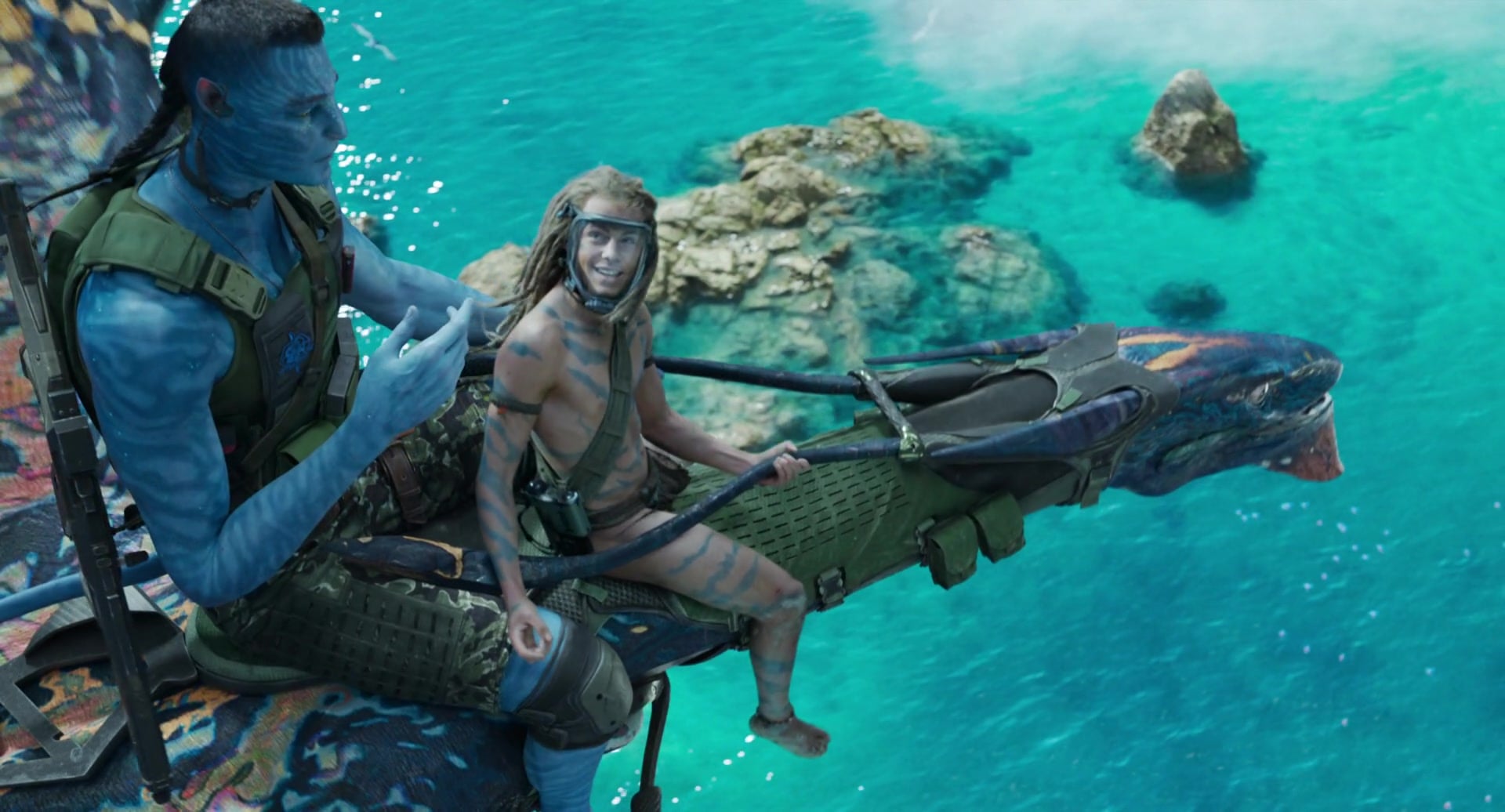
Spider
Spider is an orphan. The humans had to leave him behind when the Na’vi expelled them from Pandora. If he belongs anywhere, he’s part of the Sully clan as the children have quasi-adopted him as one of their own. But Jake explains very early that Neytiri will never accept him because he’s an alien. This leaves him at a remove from being an intimate member of the family. Meanwhile, he knows the identity of his true father, but given that he knows the man’s rep, the two never met, and Quaritch’s body is still rotting in that mech suit, it’s easy to accept this as an unfortunate feature of his existence. But it doesn’t need to be his legacy. And by the time we meet him he’s beyond that and doing what he can to be a Na’vi.
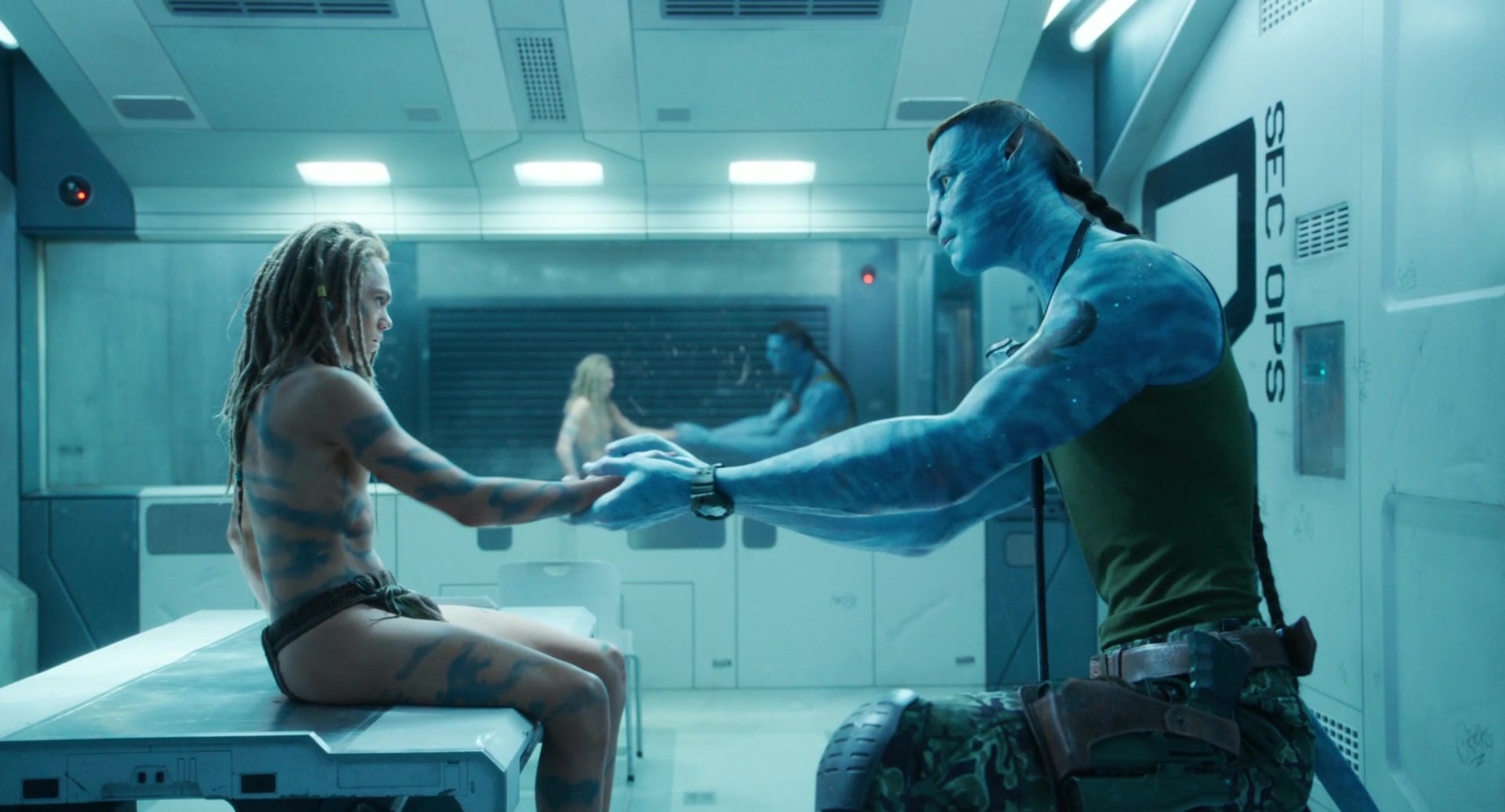
But when Quaritch shows up, something happens. Were this original Quaritch or some standard clone, his father’s assholery would allow Spider to reject him outright. when they first meet, Quaritch is tall and blue and Na’vi. He’s crushing his long-dead human skull and threatening Lo’ak in the Na’vi language. After Spider’s capture, Quaritch is the one who shows him kindness. He doesn’t immediately pretend like things are fine, but it allows for a rapport between the two. That father-son connection is hard to deny, especially considering that Quaritch now looks like what Spider has always his wanted to be and Spider being human allows Quaritch to pretend like he’s not a Na’vi.
More importantly, Quaritch listens to Spider, relying on him to teach about getting into the Na’vi mindset. And so Quaritch bonds with an Ikran (making him a man in the eyes of the Omatikaya clan) and takes advice on how to accurately speak the language. For Spider, he believes that Quaritch wants to legitimately learn about Pandora and they grow closer as they ride on his Ikran. Maybe his father in Na’vi form is different or maybe everyone was wrong about his father in the first place. Maybe it’s possible he will love and respect Pandora like Spider does. They fill a void for one another, bonding because they can’t help emotional genetics.
Nothing, though, can hide Quaritch’s true nature when the hunt really begins. The man terrorizes Na’vi, burns villages, and orders the execution of an Ilu. He participates in the slaughter of a Tulkun and (as if that’s not enough) uses the carcass as a message to lure out Jake (horrifying because this entire operation wastes this meaningless death). All of the affection Spider feels for him shakes under the weight of seeing his father for who he truly is.
Despite this, Spider saves Quaritch’s life. He could have let him drown underwater, but that bond between the two of them matters and Spider can’t turn his back yet. Quaritch can say that they’re nothing to each other (“not even the same species”), but the way he caves to Neytiri’s threats say otherwise. The moan of “Spider!” as Spider leaves him and dives into the sea is more than just a yell. It’s one of weakness, empathy, compassion… and love.
It leaves Spider in a difficult place. He’s best friends with Lo’ak and the story is heavily hinting that he and Kiri will end up together, but who knows what will come of his relationship with Neytiri. She held a knife to his throat and slashed his chest. And it’s not just that shokcing moment, Neytiri’s dismantling of the meager human force on the boat is the most monstrous and alien she’s ever looked. Her limbs stick out at odd angles and her feral screams of anguish make her feel monstrous. When she speaks to Quaritch in English, it’s in a broken form (“I cut”), furthering the demonization of her in his eyes. It’s possible, even probable, that he will never trust her again. We’ll have to see.
All of this is a carefully orchestrated emotional arc exploring Cameron’s themes of family and belonging, where he hides them in plain sight. They’re not the thematic sledgehammer of Star Lord playing a game of catch with Ego or an empty buzzword masquerading as platitude in Fast & Furious. Spider’s struggle is the very heart of the Avatar saga. It might look simple, but all of this is extremely complex. It’s hardly lazy.
Cameron’s legacy
History has yet to put the final word on Cameron’s legacy. It’s possible cinematic stuck-ups will continue, meaning the Avatar films will not be the definitive word on him, nor is it likely that such a sci-fi film will reach the same cinematic validity of a period epic that appealed to Oscar voters. Nothing will stop Aliens, Titanic, or his Terminator films from being landmark films in cinema history. Nothing can take away from Avatar’s box office or even the fact that Way of Water made an absolutely insane box office run that topped even Titanic. Even still, he might never top Avatar.
On its own, The Way of Water is an incredible film, a landmark in visual effects and motion capture technology. It’s the audacious second step in a journey that has already taken up the majority of Cameron’s career. For his entire filmography, it’s easy to treat Cameron’s love and implementation of new technologies as the focus filmmaking. It’s very likely the technological advancements will remain the most remembered aspect of his legacy. The Oscars will be what the medium as a whole remembers him for.
Not that this is wrong. The third act of this movie is a breathtaking 50-minute action sequence. It incorporates real and digital elements while moving into and out of water like it’s no big deal. He does this while juggling up to ten narrative threads (the entire Sully clan plus Payakan plus Quaritch and also the attacking Metkayina tribe) as they all weave through a final battle involving skimwings, ilu, multiple Ikran, two different kinds of submarines, half a dozen boats, a giant whaling cruiser, and Payakan. The pacing is relentless, but the crosscutting keeps the battle crystal clear. There’s no confusion about the geography of the space or the crosscutting of who is where and when. It’s one of the most insane, breathtaking action sequences in blockbuster history, a staggering achievement in filmmaking and cinematic storytelling.
And yet! In the end, all of the big explosions, dozens of skimwings, Payakan’s valiant joining the fight, crazy crab submarines, a behanding, and a massive boat falling to the bottom of the cove are not what matters. The end of the movie is Jake & Quaritch in a fight (just like the first movie) while Neytiri tries to rescue Tuk from the bowels of the sinking vessel. It’s Lo’ak going to rescue his father and guiding him safely through the underwater wreck. Cameron makes sure to take the time to make Neteyam’s death the narrative wallop it needs to be. It builds itself entirely from the emotional stakes of what has happened to these characters and then takes the time in the denouement to reckon with the incalculable loss of the death of a child. One of the most devastating moments in the movie is when Jake quietly shivs Lo’ak by saying “you’ve done enough”. Cameron gets the reputation for being loud and bombastic, but his movies always end in small and intimate ways, centering on the characters and resolving their emotional journeys. At most, the technology available to him bolsters that focus.
It’s his storytelling that should be the legacy. The Way of Water follows the same sequel swiping he did for both Aliens and T2. It’s about Jake (and his clan) joining a new culture and finding acceptance. They learn its ways and bond with the local fauna. Jake riding the Ilu parallels Quaritch’s claiming an Ikran. The slaughter of the Tulkun mother in the name of some magic priceless resources directly echoes the destruction of Home Tree and even gets the same musical theme. There’s direct lifts like Quaritch giving a speech to the marines and Sigourney Weaver’s character bonding directly with an Eywa source. And both films end with a spectacular battle of Pandoran nature versus humanity’s technology that gives way to Jake going toe-to-toe with Quaritch for one last stand.
And the end with Neteyam’s funeral and Jake & Neytiri visiting him within the heart of Eywa is staggeringly emotional. For all that people complain about Neteyam’s lack of character development, that doesn’t mean his death can’t be affecting.
Once the dust clears and people finally get over themselves that these bright, exuberant, films have a unique appeal to a mass audience, naysayers might see them for the stunning narrative achievements that they are rather than just appreciating the wonderful technology before them. People can argue that the Avatar movies are cynical cash grabs or maybe even lazy, but these movies are way too much work for that reputation. The anti-capitalist, anti-military, pro-environmentalist messaging are all too earnest. The emotional potency of the death of a child isn’t cynical. It’s real.
If directing were just about shot composition or dialogue or new technologies James Cameron would be a solid filmmaker. But who else could have made this movie, let alone this sublimely? Film directing is an incredibly difficult, singular art and the storytelling prowess it requires is far more than the general (or even movie-loving) public realize. He’s created tremendous realities, but he builds them on emotion just as much as mythology. This world and this medium are forever lucky that someone as talented as Cameron has dedicated his life to this.
And I can’t believe we get to reap the rewards of three more Avatar sequels.
Quoting every film bro. ↩
Do you have any idea how popular Yellowstone is? ↩
Worth remembering that it also came out in 2022, which had had some great box office successes (Top Gun: Maverick, Everything Everywhere All At Once), but the lingering pandemic probably dulled Way of Water’s returns somewhat. ↩
Where the only other times he has co-screenwriting credit on films he directs is on the Terminator movies. ↩