Catharsis Without Synthesis - Cloud Atlas
The Wachowskis bring multiple timelines together without the use of time travel
One of film’s most unique qualities comes from its use of time. At its basest function, all storytelling is a product of controlling the diegetic temporal flow of a story. It can be a sprawling epic tale that takes place over generations or an episode of How I Met Your Mother that takes place within the thirty seconds it takes Ted Mosby to walk out of his apartment and to the street corner. But there’s one advantage that film (and theater) have. Generally speaking, from the second you sit down, you’re going to get a beginning, a middle, and an end. When you stand up, the entire story will be in your brain. This is possible with books, but just about every author is going to assume that the majority of their audience will not read their book in one sitting. The same goes for television.
With this in mind, consider how films teach audiences to retain information. In a novel, readers aren’t going to remember every word, every breathy beat. It’s mostly the larger movements. But in film (and theater) creators can weaponize the “locked in” nature of absorbing the story. It’s why Chekov’s Gun is such a potent concept. If something pays off in a film, an audience only learned about it in the immediate past. They might not notice the plant, but they’ll notice the catharsis.
The two most prevalent examples of this are Back to the Future and Die Hard. In the former, something as innocuous as an audition to be the band for the school dance pays off later when Marty plays “Johnny B. Goode” on stage after his parents kiss. In the latter, well… the bare feet, the maiden name, the watch… take your pick.
Many, many films do this, planting subtle hints in the beginning that pay off in big ways that make the audiences feel smart. It’s engaging and enticing.
Most of the time, this comes through synthesis. It can be characters all reuniting for a climax or yanking that moment from the past and cementing it as the cornerstone of the present.
In 2012, the Wachowskis returned to cinemas with (to date) their penultimate cinematic collaboration: Cloud Atlas. 13 years after they rewrote the rules of Hollywood action movies with The Matrix, their tale is one of slow decline. The Matrix Reloaded received a muted response and audiences really didn’t like The Matrix Revolutions. Speed Racer basically came and went… and then after Cloud Atlas they have Jupiter Ascending, which is a misfire and the end of their Matrix goodwill.
Cloud Atlas, though, is an ambitious, wild swing of a movie. The Wachowskis always gone big, but this film is something else. Teaming up with Tom Tykwer (Run Lola Run), they made an R-rated, three-hour movie that cost more than $100m, adapted from an epic, nigh-unadaptable book, and on top of that it was essentially impossible to market. The original trailer was almost six minutes long, a sprawling demonstration of the film’s tone and scope that meant it didn’t wind up in theaters for the general audience.
It’s an extremely challenging work, one which eschews a traditional planting/payoff format in favor of something that resonates across its whole structure. The connections are myriad, and the Wachowskis & Tykwer do everything in their power to justify a book that meant a lot to the three of them. With the level of talent between them, Cloud Atlas is a remarkable cinematic achievement, one that despite its major release isis so thoroughly off the mainstream that it’s easy to forget it even exists.
Having only seen this movie once since 2012, I’d forgotten all the various intricacies of its opera’s various movements. But the moments that stuck with me were surprising, powerful. Every glimpse back at the singular watching experience sparked a sense of wonder and catharsis even if I couldn’t fully explain it.
Rewatching it again, the question is… “but how did they do it?”
Tarantino’s discordance
He wasn’t the first to recognize this, but one of the hallmarks of Quentin Tarantino’s films is to put two elements together that feel incongruous. Most obviously, this would be a moment built off some emotion while the non-diegetic music would be discordantly. Off-beat, out of place, out of time… however it would work. Given his status as one of the premier mainstream post-modernist directors, this clash of styles makes sense.
This is different than the atonality of the classical composers of the early 20th Century. While those artists were trying to create harmony through disharmony, forcing a clash in listeners’ minds, what Tarantino does is open two doors and force the human brain to put these two oddly-shaped puzzle pieces into an interlocking sculpture. It doesn’t always work. Sometimes, it’s not obvious why they go together. But our rational brains will twist themselves into knots to make the world make sense. Put two random items on a table and a casual observer will try to make them make sense. A pen next to a piece of paper? Sure. But a banana next to a walkman? The mind boggles. Already your brain has started to try to piece these two things together.
That entire rationale is how Cloud Atlas functions. There are times where the directors will let stories linger for a scene or two, but there are numerous breathless moments where the stories all intercut across time and space. Take the scene in which stowaway slave Autua works to single-handedly set the rigging on the main sail. At the same time Somni-451 crosses a narrow bridge with Hae-Joo Chang. This narrow walkway suspended over space becomes the lone link between these two events, the threat and danger of gunfire equally dangerous in both places. Despite the three centuries separating them, history itself echoes in ways these characters are oblivious to. To make this harder on themselves, the directors only show this is through the film’s editing. It’s not like there’s anyone out there underlining what it is that they’re doing.
Colorface
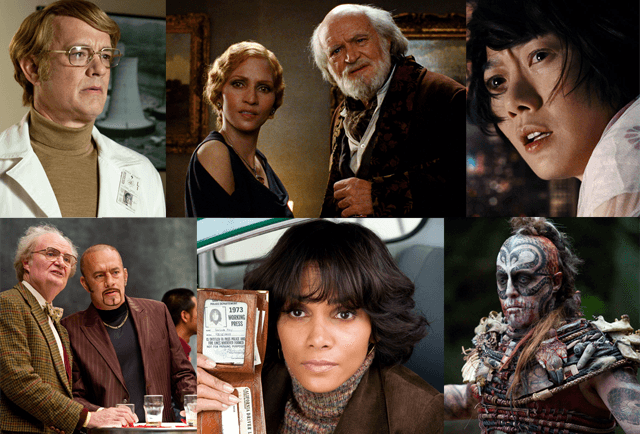
Of course, a movie like this is not without controversy. A major complaint is the use of makeup to change the races of the various actors who participate at the center of this story. At the time, this was very controversial, the most glaring of which is Jim Sturgess in yellowface as Hae-Joo Chang in the 2144 segment.
This is hardly the only example of actors playing characters of different races. Halle Berry plays a white Jewish woman in 1936 and a Korean man in 2144. Doona Bae plays a white woman in 1849 and a hispanic woman in 1977. Hugo Weaving plays a woman in 2012 and a Korean man in 2144. There are others.
Notably, there aren’t any examples of blackface specifically. Considering America’s long-running daliances with that horrid practice1 this is hardly surprising. But there is a challenge with putting white actors into yellowface. Given the UK’s history of tokenism when it comes to the Far East and colonialism more generally, this becomes especially complicated with Jim Sturgess and Jim Broadbent. It sucks to single out Sturgess when he’s hardly the only example of it. He just happens to be the most prominent.
It’s easy to point out that changing an actor’s race is generally a bad thing. The internet hive mind is quick to glom onto any sort of morally righteous outrage, and it doesn’t take much to get anyone there, especially when blackface (for example) is a clear cut issue.
I agree broadly with this consensus, though it’s worth delving into why this is a problem. For starters, actors (especially white actors) playing characters of other races can lead to vicious (sometimes unintentional, but let’s be honest in that being an exception) stereotypes. These stereotypes perpetuate white supremacy, an easy way for creatives to enforce the social hierarchy by dehumanizing the racially gerrymandered lower classes. Intentional or not, it makes for a situation where they can “keep people in their place” as it were. That has recently extended to the queer community, where stereotypes coming from straights playing gays (etc) made their way into the cultural vernacular. Demanding representation allows the previously under-represented the agency to tell their own stories. Eddie Redmayne can play the eponymous character in The Danish Girl, but that robs a trans-actor from playing a part that might help capture nuance that is simply beyond Redmayne’s lived experience.
Here, though, the colorwashing doesn’t bother me because it’s here to enhance the story without doing any of the grotesque punching down that it’s so easy to fall into. For starters, the way the Wachowskis and Tykwer choose to have the cast play different characters across the film’s timeline helps build into the film’s resonance. Should they… all just be absent from the Korea-set 2144 section? Or perhaps the entirely Korean cast that works in the 2144 section should play racebend towards all of the characters throughout the rest of the film. No doubt making this choice means they’re going to wade into these troubled tides. They make a conscious choice to have these characters not punch down. Sturgess isn’t doing some overly exaggerated accent. Nor is Halle Berry playing into the anti-semitism that can come so easily with Gentiles playing Jews.
This is also hearsay, but on Blank Check, Griffin cites an interview with Halle Berry where she remarks the limited bank of parts for her default to the 20th Century or later. American-set tales with black people specifically will always have to contend with the spectre of slavery or Jim Crow. Cloud Atlas doing race-bending is an opportunity for her (and others) to play roles that history otherwise wouldn’t afford to them. More than that, casting Berry as a slave for her 1849 role is a way to prove they’re not hiding from America’s unsavory past with slavery and race relations. There’s no hint that anyone’s hands are clean or unaware.
Helping all of this is the aforementioned way that most of the film’s colorfacing is conscious of stereotyping and punching downwards. It works extremely hard not to. There’s not always success. Doona Bae’s 1977 hispanic woman is a bit of a shrieking, one-dimensional character for her very brief cameo, but it happens fast enough that it adds flavor to an otherwise exhilarating chase scene.
And…. with all of that in mind there are two other important notes.
As a white person, seeing nonwhite actors in whiteface does make me uncomfortable because it presents an uncanny valley effect. But… perhaps that’s good for me (or anyone who feels it) to experience. There are so many white performers in the world that there’s no shortage of them when a story calls for one. The lack of stigma around white performers helps to make sure that they’re never having to turn to non-white performers to fill in the gap2.
Yet seeing it here brings with it a level of discomfort because… I’ve never had to be black and live in a world where I have to watch white people do blackface. I’ve never been asian in a world where white people do yellowface. As it stands, such caricatures makes me deeply uncomfortable and negatively taint the final product no matter how good it is. Seeing whiteface here, I can at least empathize with the pain of others. Artists throughout history have buttressed white supremacy with their actions. Flipping the script is hardly a bad thing.
Most importantly, though, choosing to do racebending adds to the overall impact of the film itself. It connects the disparate stories in ways that wouldn’t be possible if this was a sprawling, epic cast of dozens of actors. In 1936 Halle Berry’s marriage to Jim Broadbent’s character flits forward into their weird, brief interaction in 2012, providing a layer that goes beyond what would exist otherwise. Ben Wishaw plays the doomed Robert Frobisher in 1936. We see him in the prologue as he puts a gun in his mouth and dies by suicide. And yet there is redemption in 1973, when Wishaw plays the record store clerk who tells Luisa about Frobisher’s magnum opus and how genius it was.
Spread across time and space
The harmony of this film is the joy in its aggressive cross-cutting. No actor has we’re-following-you importance across every timeline. Tom Hanks obviously has major impact every time he shows up, but it’s not like the movie is arguing that he’s some grand reincarnated soul over and over and over again. These brief glimpses of these actors forces our minds work overtime to try to make these connections work. There must be some logical sense, some sense of order.
This, however, is not the point. Casting actors who play major characters across multiple time zones is just a tool for the Wachowskis and Tykwer to make larger points about the universe and the way that time moves. When Zachary and Meronym make it to the top of the mountain and discover the room with all the dead soldiers, it feels like a bit of texture. But then, later, they show the actual battle that resulted in that same event. The future precedes the past, but this is also the moment where Somni-451 makes her broadcast that inspires her worship in the far-future timeline.
In the grand scheme of things, these are small connections and mostly there for us and our understanding of this large, somewhat interwoven tapestry.
So why is Cloud Atlas so deeply satisfying? It’s not like there’s some great moment where all the characters meet together throughout space and time. It’s not like Zachary has any concept of Cavendish’s incarcceration in 2012, much less any connection to Dr. Henry Goose in 1849. Halle Berry’s characters are searching for some grand meaning, repeating some quest over and over again until she finally gets it right. This isn’t a film about reincarnation or renewal. Hell, it’s not like there’s even some redemption for the great evil. When Hugh Grant shows up he’s always a putz of some sort. Hugo Weaving is always some dark, elemental force, one wielded by entrenched sociological power to suppress whatever the protagonist is trying to accomplish.
These characters represent ideas and movements, archetypes that point at some larger statement about how the world feels, not how it works. The entire film works on narrative logic in the basest of ways: the stories all work. Instead, it leverages that small “easy” aspect to get at grander truths about the world, empathy, compassion, and overcoming adversity. It uses art to pass stories across time and space, where the main character in every time zone builds off some lasting vestige of what came before. Sure, Frobisher creates music and Cavendish provides a screenplay, but Ewing’s journal is hardly some profound work (despite Frobisher’s obsession with it) and Somni-451’s revolution speech is just her speaking her truth in the moment.
There’s a critique, there. It’s possible that this movie feeling profound is only because the movie makes grand gestures at its own profundity. David Mitchell himself merely wrote a book that doesn’t do the intense cross-cutting of the film, opting instead to split each individual narrative in half rather than ask his audience to keep track of the shifting tectonics of six stories. It sounds so haughty and self-important. But isn’t something profound regardless of how well anyone can intellectualize how the artist got there?
Profound is profound. It’s not like this is some 2001 experience where film nerds have so thoroughly figured out Cloud Atlas that they’ve functionally solved it. This is one that defies intellectual determination. It’s corny, but if the underlying strength of any narrative is its raw emotional core, then what matters the intellectual merits of criticisms against it? Many things can make me think, but few things make me feel like this does. That’s a tremendous virtue, and the level of craft is so undeniable that how I feel is entirely intentional even if I can’t totally vocalize it.
Counter-cultural outsiders
Apologies for the Tykwer erasure here, but this film really is famous for being a Wachowski operation. Withough them, this movie does not exist.
Obviously, they will always be most famous for The Matrix and its sequels. Their other films are various combinations of forgotten, dismissed, self-important, and punchline. But Cloud Atlas is a remarkable standout from visionaries who somehow got a blank check to produce something this insane.
Since the Wachowskis have fully come out as transgender, there’s been a re-evaluation of The Matrix. It doesn’t make the film lesser, but it makes certain aspects of that movie all the richer. Neo’s own awakening is one that turns him from Keanu Reeves into a similarly androgynous child-looking being, what with the pale skin and smooth face and shaved head. Twitch specifically was a characters the Wachowski’s conceived as gender fluid, with the Matrix and real world being poles between which their gender bounced.
Apologies for making grand generalizations about this, but the diversity of viewpoint that comes from Hollywood hiring extremely gifted, talented trans creators helps to facilitate more diverse stories. Speed Racer speaks to concerns about capitalism, and The Matrix sequels concern themselves with finding new ways to combat pre-written destinies. I’ve read several trans-writers who have no illusions about the social inequity present in the world. This can often manifest as a rebuke of capitalism itself.
With that in mind, it’s no surprise that Cloud Atlas concerns itself with entrenched authoritarian systems, ones that undermine society with varying degrees of overtness. As transgender folk can fall through the cracks of society, it’s not surprising that trans perspectives can discuss the various ways a society desiring equability must rebuild in an image that is more compassionate, more caring, more inclusive.
This movie discusses slavery, a gay romance, and a society that harnesses clones as a cheap and exploitable labor force. It argues for a world that is far more just and improving, but also one that is worth saving despite its systemic flaws. It’s a deeply, deeply optimistic film. In the end, when Jim Sturgess utters the Mitchell’s most iconic line (“what is an ocean but a multitude of drops?”), it speaks to a deep well of possibility. As slivers of infinity, the possibilities that come from us bouncing off each other are, indeed, infinite.
It’s difficult to see this as potent without the diverse perspective the Wachowskis bring. Their ability to do all of this while also making a film of tremendous spectacle is why something like The Matrix blew the doors off of the film industry in a year already saturated with incredible films. Speed Racer, Jupiter Ascending, and this are all much more esoteric, but they make a concerted effort to build films that have broad appeal. They have diverse casts in everything they make and for all that it’s easy for them to get fascinated by their own esoteric ideas, they really do want the largest possible audience for their work.
As a three-hour, R-rated epic sci-fi (and other genres) film, this can only be so popular. But we are so lucky to have something this entertaining that’s also this profound. The Matrix will almost certainly always be their best work, but this is a film that shows what happens when they adapt the work of another, insanely talented artist. It’s hard to imagine this film being so excellent without them. Hell, it probalby wouldn’t work at all. But god dammit what a loud-yet-quiet masterpiece this is. I could watch it over and over again, losing myself to its various motions, its ebbs, its flows, its tidal waves, its low tides.
It’s the most ambitious work by filmmakers known for their ambition. It, like all their other films, pays off. And it does so without ever bringing all the disparate threads directly together in some grand narrative synthesis. It is, instead, almost entirely an emotional catharsis that’s hard to describe or explain. But it’s undeniably there, and to experience that is a remarkable, singular experience.
Onto the Top 250?
I don’t believe Cloud Atlas was even in the pool I considered three years ago. It certainly didn’t make the list when the engine spit it out. I assume it slipped through the cracks.
As it stands, this is a movie that’s easy to lose track of. For all its pomp and circumstance, history has relegated it to the odd curio status that comes from being a non-Matrix Wachowski project. This is, of course, unfair. Thirteen years later this movie hit as hard now as it did then. Watching this movie with two other friends who’d also only seen it once was an incredible experience, where it left us flabbergasted in different ways but no less profoundly. All three of us couldn’t even articulate why it was working. We just knew that it id.
This time, it’s going into the pool of options. Given the size and scope of the 250, I can’t imagine this not being present. I’ve no idea where it will land. This movie has a way of waning in impression as time goes on. But considering I’m still churning it over in my head since I re-watched it weeks ago and that every time I think about it I want to watch it… yeah. This will do just fine.
And I’m so glad I rewatched.
More Tom Hanks next week…
Going to come back next week with one of the great post-Lincoln Spielberg films, Bridge of Spies. Huge dad movie energy. Huge dad energy at the center of it all.
Excited to stand up for it.
For more information on blackface, I recommend Spike Lee’s Bamboozled. A rough, rough watch that will show you just how deep, ingrained, and bleak it is. ↩
To take it one cynical step further: it’s hard enough to break through as an actor of color in this industry. In what world does “competing for white parts” sound like a thing that’s even on the table. ↩