Canon Conundrum - A Prelude
The first in a series discussing canon, continuity, and the art of the retcon
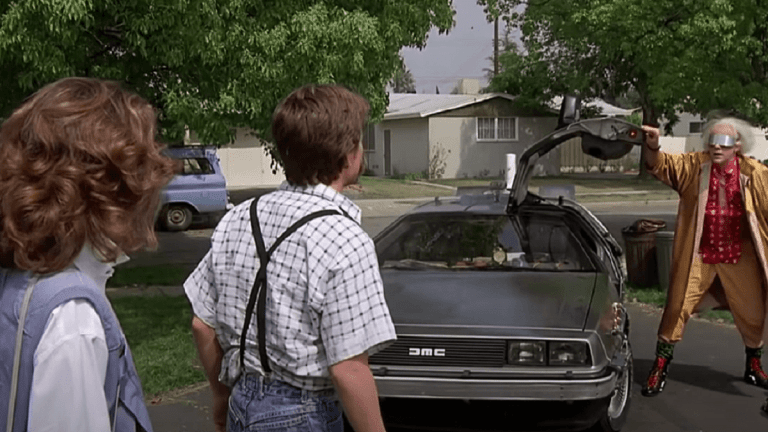
Back to the Future came out in 1985. Directed by Robert Zemeckis and written by Zemeckis and Bob Gale, the movie was a one-off time travel adventure about what it would be like if you went back in time and met your parents when they were in high school. At the movie’s end (spoilers), Doc Brown picks up Marty McFly and his girlfriend Jennifer and tells them they have to go to to the future to do something about their kids. The Delorean lifts into the air, now able to fly into the sky. It races towards the camera, and then (in theaters), they smashed to the credits and the big music you know.
If you’re reading this, I’m assuming you’ve seen it.
It was only on VHS that they added “To Be Continued…”, which is something audiences everywhere understand and know. Zemeckis might have gotten tied up making Who Framed Roger Rabbit?, but he and Gale wrote Parts II and III in that span, shot both films back to back, and released them seven months apart between November 1989 and May 1990. Since then, the Back to the Future trilogy is one of the great cultural institutions of cinema history, spawning fan events that still happen, a short-lived animated TV series in the early 90s, a terrific theme park ride at Universal Studios (RIP), and a recent Broadway adaptation.
It is something of a minor miracle that Zemeckis & Gale have kept such a tight hold on everything Back to the Future. Apparently, any new Back to the Future has to go through them based on whatever rights they hold because of the initial deal they signed. In the wild west of what is possible in narrative mass media, Hollywood is quick to assume past precedent but quite near-sighted when imagining what the future might hold. This was the industry, after all, that gave George Lucas the merchandising rights to Star Wars less than a decade earlier.
Imagine Hollywood making these mistakes now.
Who’s driving this car?
Over the past year, I’ve been developing a theory lately about the ebb and flow of the film industry. I’ve been thinking a lot about the great films of yore and the different circumstances that birthed them. To put it briefly, film is a constant push and pull between the art of making something creative that costs millions of dollars and the commerce of deploying art to a mass audience and making it connect with people. As suits have consolidated control over the levers of narrative storytelling, the stories these entities are telling through film regularly have to serve the larger goal of some idealized IP that cannot functionally change, lest audiences don’t inherently recognize it as a thing they want to see.
Now that we’re in a world created in Marvel Studios’s image, where every company is stripmining any piece of IP for any possible scrap of possibility, it strikes me just how stagnant these various wells have become. I don’t want this Substack to be an anti-Marvel corner of the digital world, but it’s true that they’re the poster child of where the industry is right now. I’m thinking about Thor: Love & Thunder or Wakanda Forever, and the knots Waititi and Coogler had to twist themselves into so they could serve the master that is the MCU’s vast tapestry.
Of course, studios have always run the show and pulled strings and even withheld final cut if that’s not something the directors have in their contract. Of course there have been notes, but it’s weird how it feels like directors these days are the equivalent of sock puppets in the service of some larger goal. The directors Marvel hires might feel ownership of these properties when they come in, but have you noticed that if Marvel brings a director back for another swing, that followup is consistently inferior to the original?
Canon should go boom.
Which… brings me to this series something of an ellipses. As this miniseries continues, we should explore canon as a concept. What stories count? Can things not exist? Is continuity absolute? And what is Hypertime? My answer stems from these stories not being dependent on some unseen arbiter. Once it exists in the world, art becomes ours to digest as we will. You don’t need a restaurant owner to come out during the meal, sit with you, and explain how you’re meant to be tasting your food as you chew. It’s not theirs anymore.
If we’re going to get back to original ideas in mass media, we should start with the idea that ideas and stories (not canon or continuity) should be king, not continuity. If canon or continuity is going to get in the way of telling a better story, a perfectly harmonized, Swiss watch canon is not worth it.
Not everything can be Back to the Future. That specific, walled-off garden paradigm will never happen again, and nowadays no IP is safe from a reboot or a retcon. Despite this, I can think of one film series that’s been extremely loose with its continuity over the past three decades, not letting the shackles of canon get in the way of telling the stories it wants to tell. Of course, this particular institution is overseen by a unique sort of mad man, but it’s a fascinating case study. It’s maybe the best example of how loose an overarching narrative can be, and how big the gaps can be without an audience really registering them.
It’s a model we should revere, and with the eight Mission: Impossible film on the horizon, it’s a great time to look at how that series has evolved into the gold standard of how to push these sorts of narratives into the future. What Chris McQuarrie and Tom Cruise know is that continuity is nowhere near as important as weaving a riproaring emotional story that their audience will love.
To discuss canon, we should really start there.