Because I Saw You - Avatar: Fire & Ash
It's more Avatar: The Way of Water 2...
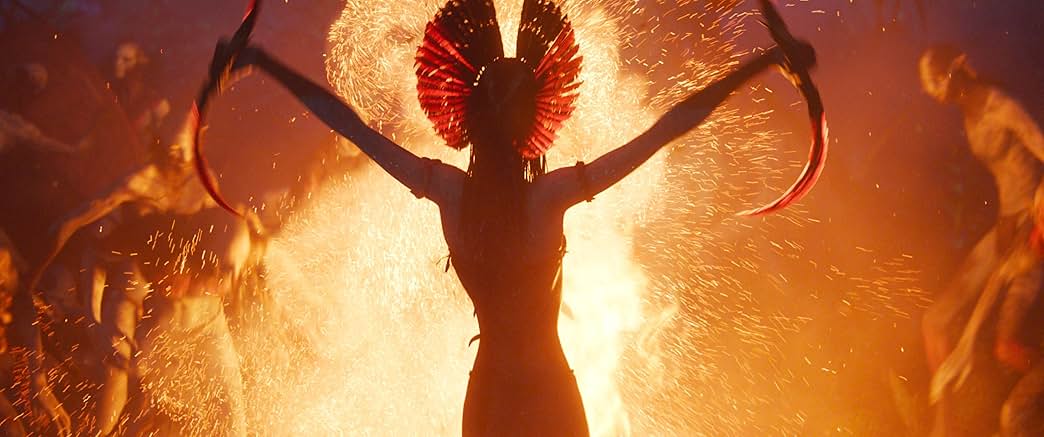
The number of sequels to “pinnacle of no cultural relevance” Avatar has long been a punchline. A bunch of movies that no one wants that all continue the story of a movie everyone hated and even more didn’t care about?
Originally, James Cameron announced three films to continue/complete the story of Jake Sully, Neytiri, and all the biome of Pandora. Soon that expanded to four sequels, and sometime after that he confirmed they had to split Avatar 2 into two films. The Way of Water told the first half of that and was a fully self-contained installment. It had several unresolved plotlines, but was a whole meal. Fire & Ash continues those storylines and ends up closing out this particular arc of the story.
If this ends up being the end of our time on Pandora, or our time with Cameron at the helm, this is still going to go down as the most successful original film series of all time. Everyone will remember these movies for the visual effects and the leaps forward in motion capture.
But what makes the Avatar trilogy (as it currently stands) so remarkable is its position as a monument to what happens when you give a visionary artist a ton of money and free rein to make something original and exciting. In a world of sequels, prequels, remakes, and reboots, Avatar might seem like it’s part of that zeitgeist, but that ignores the way studios weaponize modern film series to get audiences into the theater so they can maximally monetize the medium. To dismiss the Avatar sequels as part of this industry-wide cynical cash grabs ignores that Fire & Ash’s release in 2025 comes a full decade and a half after the first movie and three years after the previous installment.
As the most recent episode of Blank Check points out, the length of time between Avatar and The Way of Water encompasses every single Marvel movie from Iron Man 2 to Wakanda Forever. Expand that to Fire & Ash and it’s every Marvel movie to date that isn’t the original Iron Man1.
Avatar films aren’t coming off a studio assembly line. They’re works of incredible care and craft, massive passion projects from a single authorial voice in collaboration with hundreds of talented artists and technicians. That voice is the greatest blockbuster filmmaker of all time, and his staggering success is not because he’s great at stunning visuals, innovative technology, or high frame rate. It’s because he makes deep, rich emotional dramas that tackle massive, universal themes that appeal to a worldwide audience.
Avatar, The Way of Water, and Fire & Ash might have the most incredible scope of any film series ever, but they’re also the most personal blockbusters ever made, or certainly the most at this scale. If this is to be the end, it calls for a celebration of the gift James Cameron has given us.
So let’s do just that.
The alternate title for this piece was “Way of Water: For Good”.
To get the big complaint out of the way: splitting Avatar 2 into two films was probably a mistake. Much of the complaints about this online is that it feels like Cameron is repeating himself, reiterating narrative beats and plot points from The Way of Water in ways that feel stale. Never mind that Cameron himself has cribbed from both his and others’ source texts before, there are times where this movie doesn’t echo Way of Water so much as it reiterates Avatar wholesale.
If anything, it’s worth taking a minute to reconstruct what Avatar 2 must have looked like. Based on Cameron’s admission that he moved the opening of “Avatar 2” into Fire & Ash, these two movies play the same, only shifting the Mangkwan introduction/attack to later helps give the story room to breathe and not rush an entirely new facet into a film already saturated with them.
These repeated elements are what seem to be bothering people. The capture in the forest, the brief tulkun hunt, Quaritch talking to Spider in the holding cell, a big aquatic battle with skimwings and tulkun etc… all of these overlap both films.
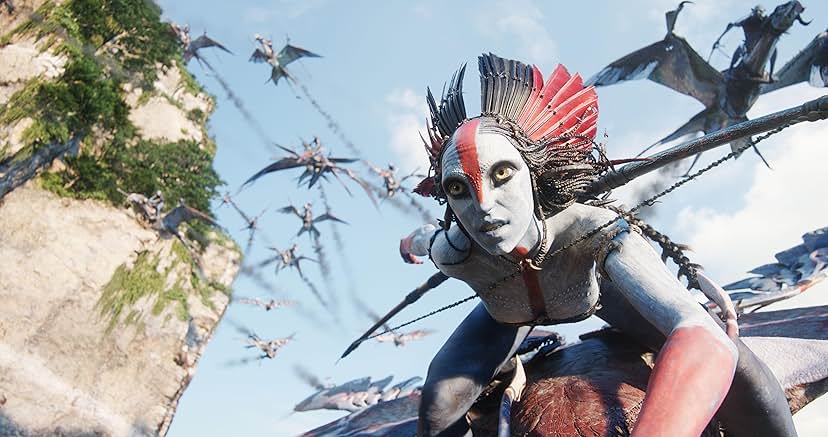
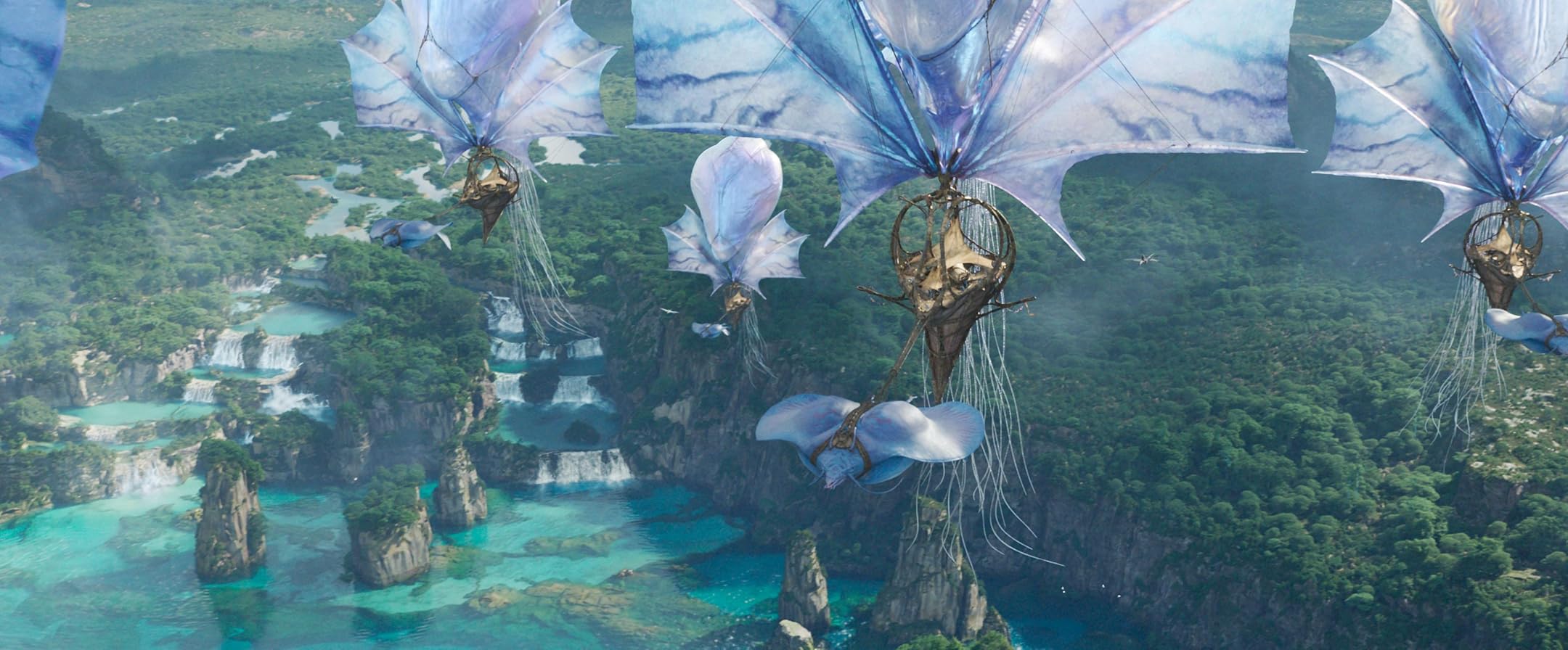
But some of what Cameron repeats here also comes from the original Avatar. Tackling this head on, the most obvious comparison is the return of Toruk so that Jake can be Toruk Makto once more. It’s the kickoff to the final act of the film, in which Jake calls all the clans together to stand against the humans (he does the same in Avatar). The Na’vi forces all cling to floating rocks while they wait for human dropships to get in position (though this time, there’s the Skimwings on the water helping). and then fly as one and start to kick some human ass. As the tide turns, there’s a lot of carnage and beloved characters die quick, merciless deaths. How will the Na’vi save themselves?
The answer is exactly the same as Avatar. In that movie, Jake communed with Eywa at one of her sources, begging for her to help. In Fire & Ash, it’s Kiri (with help from Spider and Tuk) reaching out to Eywa directy. Before, Eywa sent every land creature to stop the mechs alongside every ikran in the area to attack the human forces. Here, it’s an endless force of those squid things that hunted Lo’ak earlier in the movie alongside… every ikran in the area. Eywa fights back and totally wrecks the humans’ incursionary force. She picks a side.
And.. yeah. That’s pretty stale. Both times I’ve seen the movie, it feels like Cameron is out of ideas for how to do a big climax, repeating the same sort of motions because it worked before. Previously, he’s been far more elegant about this, but considering he’s stretching things a bit thin within an existing framework, it’s only natural that he slip somewhat. Adding a bunch of tulkun and the Mangkwan and setting it over water isn’t enough to escape that gravitational narrative pull.
This ends up being the problem with splitting Avatar 2 into The Way of Water and Fire & Ash. The Way of Water felt unique in the newness of what the future had brought, The “learning about the new culture and ecology” felt new because the water felt new. The murder of the tulkun mother deliberately echoed the collapse of Hometree but was so upsetting I doubt anyone really cared. The end was a big massive climax that felt new, but it was still the Na’vi going to war against the humans in a jaw-dropping battle at brain-melting scale. Compared to Fire & Ash, it’s far more innovative in that respect.
Fire & Ash on the other hand gets Jake locked in a glass prison cell (complete with escape by flight) and a repeat of Avatar’s big third act. Weirdly, it makes Fire & Ash feel like Wicked: For Good to The Way of Water’s Wicked: Part One.
Critique-able? Absolutely. But what James Cameron knows (and has proven) is stories don’t live and die by their plots. It’s all about characters, themes, and emotional resonance.
Knowing when to judge
Earlier this year, when film critic Chris Klimek was on the Pop Culture Happy Hour episode to discuss Mission: Impossible - The Final Reckoning, he qualified his muted reaction by saying:
“When I watch a new one of these, I am always aware that I'm beginning a long relationship with a movie and that my impression of it will evolve.”
I’ve been thinking about that a lot. My expectations for Final Reckoning were sky high, and I was very much the one of the group who liked it the most, but so much of my brain process in post-screening debrief over fast food chicken was a clouded mess of trying to stick all of these distinct parts together it was hard to articulate something cohesive.
As the dust settled over the next few days and I saw it again, my read crystalized into something specific. The past six months have been turning over that movie’s themes in my head, reflecting on how in conversation it is with the current zeitgeist and how all the things that seem questionable about the movie are rather incredibly intentional and staggering to think about. My appreciation for it has grown quite a lot.
This is not how these things normally operate.
It’s very easy to walk out of blockbusters or studio films nowadays and have an immediate take. There’s no Marvel movie that requires multiple viewings to pull out greater understandings. Even the most thematically rich MCU films like Black Panther don’t massively improve on rewatch. These “only one viewing necessary” movies have value, and there’s nothing wrong with immediately graspable films…
But Christopher McQuarrie and James Cameron are two incredibly smart writers who work tirelessly to ensure that the product they’re making fully conforms to their sky-high standards. When it comes to their work, almost all of it is the sort where that first impression simply establishes the baseline and figuring out what the hell the thing is. The joy is in the relationship I’ll be having with it for the rest of my life.
Walking out of the first screening of Fire & Ash less than 72 hours ago, my partner asked if I liked it while I was still starting to turn over the many aspects of of the movie in my head. Trying to make sense of all the disparate threads Cameron throws out, it was hard to put together the new Mangkwan tribe (the Ash people) with Quaritch going native or how Lo’ak’s bleak-as-fuck suicide attempt plays in the same movie as Jake nearly murdering Spider for the greater good. Ronal has her baby and dies; Neytiri admits that she hates the human aspect of her children. Kiri infects Spider with a mycellium parasite that rewrites his entire biology at a cellular level, and also Lo’ak and the other Metkayina children interrupt the council of tulkun to plead with them to join the fight against the humans.
I made a flippant comment about it being a mess. I did like it, but all of these pieces didn’t fit together. There’s just so much movie. It’s easy to say “oh this should just be a television show”, but placing all of these pieces in one container is happening for a reason.
So why?
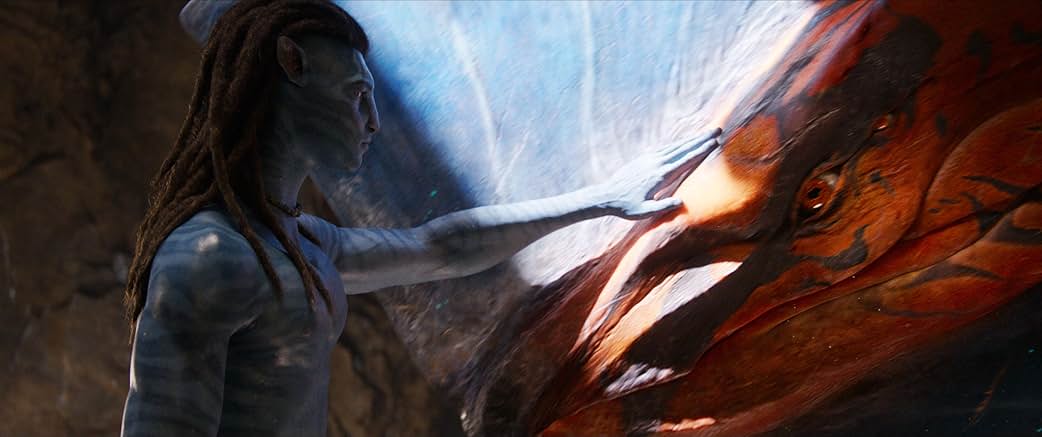
Challenging orthodoxy/celebrating heterodoxy
Because of this bifurcated narrative, it’s tempting to consider The Way of Water and Fire & Ash as one bifurcated narrative that Cameron split down the middle. Not so different from the recent Wicked duology. Like that movie, Cameron shot both films at the same time and ran the post production process in parallel. He always intended for these two to pair together.
The difference, though, is that where Wicked split its narrative down the middle and left the weaker half out to dry, Cameron worked his two halves into distinct, discrete installments. They share locations and characters and even some plot beats, but they both concern themselves with different themes and ultimately build into different stories. They are in dialogue with each other, but remain independent.
Fire & Ash itself questions existing systems and interrogates what it takes to evolve them into something newer, better, stronger. It’s about challenging orthodoxy and embracing heterodoxy.
Cameron saturates the film in this idea. Most obviously, Jake says it to Quaritch three times. First, when they speak after they’ve escaped from the Mangkwan hunters he tells Quaritch to open his eyes and see Pandora in an avatar body as a gift. When they speak in the prison cell, Jake pleads with him to look with his fresh eyes and see the new man he could be, rather than repeating the actions of the dead man he’s imitating. Finally, when they speak after saving Spider, he encourages Quaritch to let go of the past and embrace the beauty of Pandora.
If Jake doesn’t have an arc in this movie, it’s because The Way of Water was so much about building him up to the idea that a good defense means nothing in the face of relentless offense. He doesn’t need to learn the lesson here: that growth and heterodoxical thinking is far more valuable than the rigidity of orthodoxy.
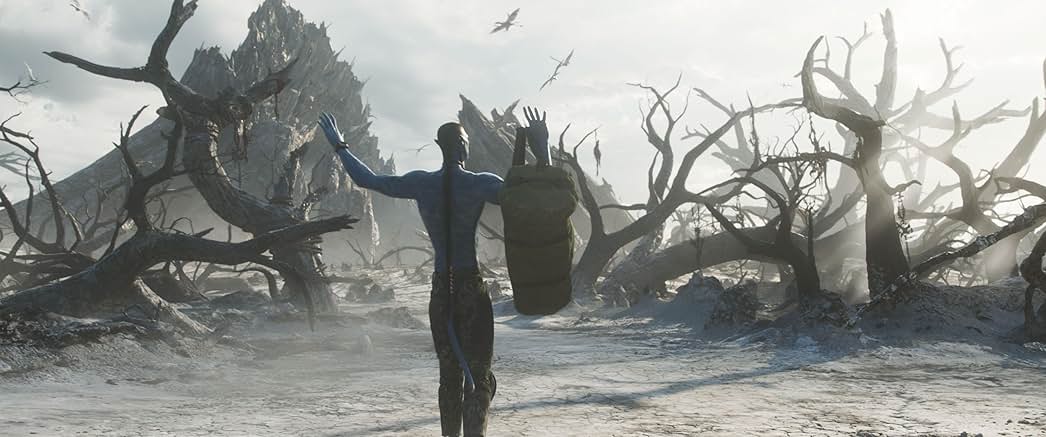
Quaritch and the Mangkwan
To Quaritch’s credit, he’s the most interesting person in the movie. It’s hardly surprising that he tries to be Spider’s father, but what’s more surprising (and shocking, really) is when he finds himself seduced by Varang’s seductions. She tells him she could make him her slave, but they end up treating each other as equals, building a mutual respect as well as a sexual (and seemingly emotional) relationship. On the eve of the final battle, Quaritch marches into the final meeting painted like a member of the Mangkwan tribe. It’s a shocking moment, one that reveals just how far down this path he is. Last we saw him he was emerging from Varang’s tent with what seemed like a light dusting of paint and he joined some of her people in drinking. Now, he’s gone full native.
In The Way of Water, Quaritch begins the second hour of that movie telling his marines that they’re going to fully assimilate into the Pandoran ecosystem:
We go Na'vi. Full tilt all the way. That means we eat Na'vi, we ride Na'vi, think Na'vi…
Just this little bit is enough to endear Spider to him such that Spider will save his life. But in Varang (and the Mangkwan) Quaritch has found a kindred spirit through whom he can fully embrace the lifestyle of his new body.
The man is dangerous not just because of his dogged pursuit of Jake, but because he has proven himself adaptable to the situation. This isn’t the last we’ve seen of the Mangkwan, and though Quaritch seems to meet his end by falling off that rock and into either the fire or the water far below… there’s no way this is the end of him.
And why the Mangkwan?
Well… it’s in Varang’s monologue. The ash people are different because they have rejected Eywa’s teachings. They prayed to the goddess and she gave them nothing. Lest they die, they changed their ways and it warped their brains. But what it does give them is a level of success and conviction that makes them utterly terrifying. In the absence of a belief system, Varang forges a new one. It makes them villainous.
If this is a movie about overturning conventional wisdom, that makes the Mangkwan the perfect antagonistic foil.
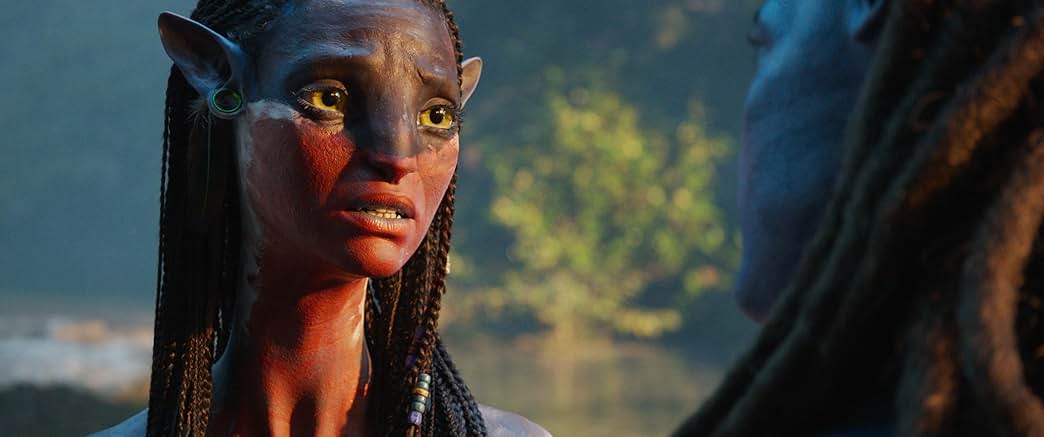
Neytiri and Spider
Staying set in your ways is an opportunity for decay, rot, and death. This is mild when Neytiri butts heads with Ronal over Metkayina v Omatikaya medicinal practices. More damningly, her inability to let go of her (justified) prejudices against the humans has poisoned her relationship with her children. It leaves her standing to the side while everyone scrambles to get Spider his replacement mask. She’s willing to let him die and open to murdering him in the name of saving the planet.
It’s this last bit that’s the most horrific to contemplate. Spider has committed no crime. If anything, to kill him is to deny the blessing Kiri (as a daughter of Eywa) bestowed upon him.
This idea, though, radicalizes Jake to almost make one of the most devastating decisions in the movie. The scene where he threatens to murder Spider is shocking and comes basically out of nowhere. We’re not privy to Jake’s thought process in getting here, but it leads to a moment that directly invokes Abraham’s sacrifice of Isaac. It’s the hardest thing Jake has to do, but he decides (as does Neytiri) that there has to be another way. Not only can Neytiri not live with the blood on her hands, the two of them together can’t bear to lose another son.
Also, not for nothing, but there’s a meta commentary here that we should be telling better stories than the one about a god who tests faith, especially when it calls for the murder of one’s own child.
Spider, though, is one of the two main heroes in Fire & Ash because of how open he, himself, is to the very idea of change. All he wants is to be Pandoran. Kiri’s mycellium gift gives him exactly that, and he relishes the opportunity to breathe the air and grow a kuru.
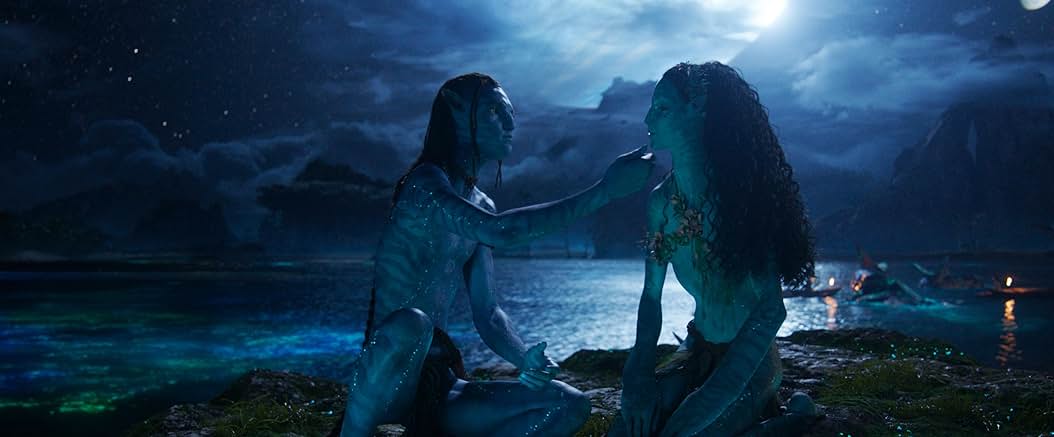
Lo’ak and Payakan
At the heart of all of this, though, is Lo’ak. What makes Lo’ak the perfect central character for this is how openly he questions the authority of everyone around him. He tries to be a good son and he might screw up here and there, but it’s his actions that lead the tulkun to change their ways and take the fight to the whalers threatening to slaughter their entire species.
To get there, he has to be willing to give up everything he has. Payakan does the same. He threatens to outcast himself from society. So ardent are his convictions that Reya, Aonung, and Rotxo all threaten to follow him into exile.
This challenge from the youth is not surprising, but it’s the sort of thing that comes from Cameron and his hippy progressivism. The tulkun way has been in place for millennia, a broad consensus that pacifism is the only acceptable manner of living if the alternative is carnage and bloodshed. It’s not a horrible idea in theory, but it fails to account for the human incursion, and the capitalist greed that will force the entire species into extinction if it means making lots and lots of money. Without a way to defend themselves, they will all die.
Keeping such a policy in place is foolish, and the folly is one the tulkun don’t see until it stares them right in the face when Payakan’s scarred brother testifies. Obliteration at this scale can feel so abstract, but it shames the entire species into action.
The rules that exist are there for a reason. But blindly following tradition when circumstances change is exactly the sort of stubborness that will lead to unnecessary death and suffering. Understanding why things are the way they are is much more mature and allows for nuance in complex solutions. It’s a much better, healthier way to live.
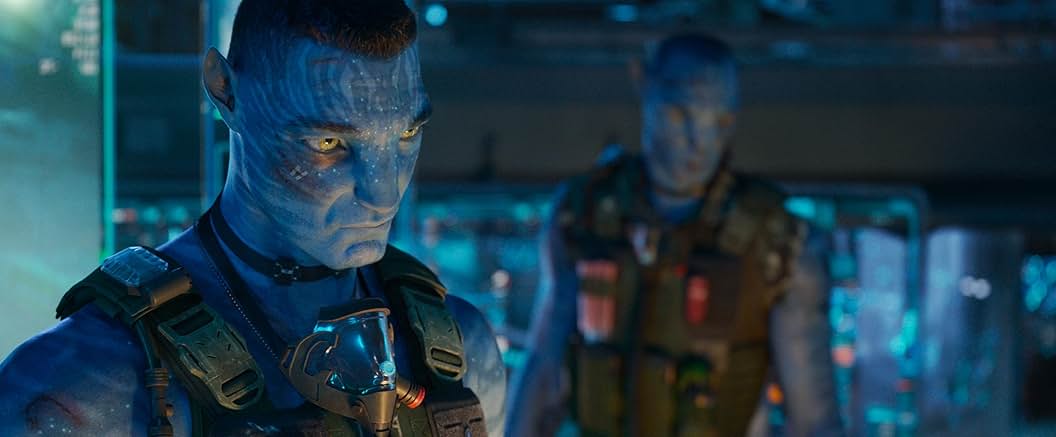
Evolve or die
In the end, growth and evolution saves Pandora. The tulkun fight. Eywa sends reinforcements. Neytiri delivers and protects Ronal’s baby. Kiri calls Varang a bitch because James Cameron knows how much Sigourney Weaver can yell the word “bitch!” and mean it.
And Spider earns access to the spirit world. The final scene, where Kiri leads him into the spirit world is incredibly emotional. It’s a reward not for his heroism and bravery, but for his respect and assimilation into the Na’vi culture. He is a child of Pandora, and now that is almost as true as it could possibly be.
Meanwhile, the humans have taken to building their city like the garish factories of earth. After hours spent in the lush Pandora flora, Bridgehead city is a sprawling, garish headache of metal pipes, smoke stacks, and the hazy glow of orange light. This technology has not evolved. It’s still the same horrible industrialization I looked at in my childhood.
For Cameron, humanity itself is a cancer that spreads without growing. No wonder they’re the bad guys.
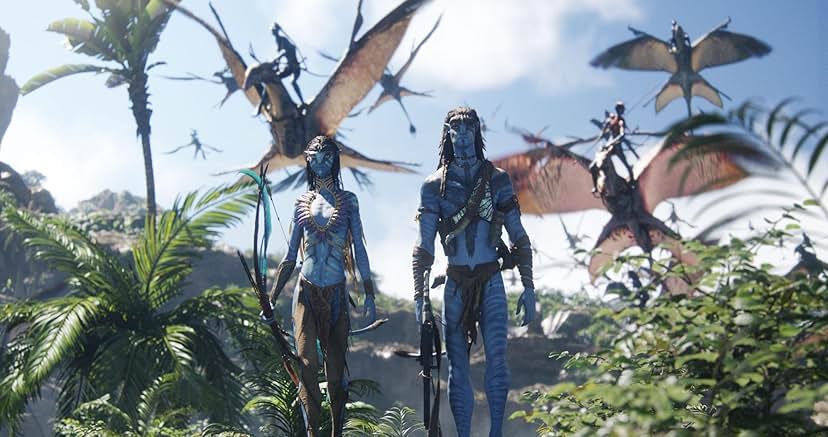
Looking to the future
Whether we get more Avatar sequels is still up in the air.
For Way of Water, being the 3rd highest grossing film of all time should have been enough to greenlight Avatar 4 & 5. And yet in the lead up to this film’s release, there’s been a caginess about what the future of the series looks like. This is an undeniable ending, with even the closing credits feeling like a celebration of the characters rather than the celebration of Pandora they were in previous installments.
Cameron himself has been extremely noncommittal about doing the final two Avatar movies, even though he’s called Avatar 5 “a mother fucker” in terms of how awesome it is. There’s a part of him that clearly wants to do it, but he’s getting old. He’s in his 70s now. His narrative career has been almost exclusively Pandora for decades, and there’s no guarantee he’ll even be able to finish these films if he starts working on them.
And then, of course, there’s the death of his longtime producing partner Jon Landau 18 months ago. Rumors abound that having to finish Fire & Ash without the person he’s considered most integral to his work has been emotionally taxing. If he’s to make Avatar 4 & 5, it’ll be without the man who’d been at his right hand since Titanic.
Walking into Fire & Ash I had resigned myself to this being the end. Nothing on these movies is going to happen until Cameron confirms what these last sequels will look like. I expected an ending. And I got one.
But… I’m sorry. If this is the end of Avatar, it’ll probably bum me out forever.
Even with this (and The Way of Water) spinning out similar plot beats, there’s so much rich narrative texture to explore. This is just an ending. It’s not the ending Cameron and his team envisioned going back tot he beginning. I want to see what else happens to Kiri and Spider and Lo’ak and Tuk. I want to know what Miles Quartich’s proper ending is. I want this world to go on because there’s nothing like this series in all of cinema.
I’m sure no more Avatar movies will make a vocal minority of the population happy, but there’s a reason these movies hit like they do. There’s a reason they’re so popular. And the thing about it is Cameron does not define his success by the standard metric of our current world. His movies are not puzzles to solve nor are they beatable tests of intelligence.
Instead, they are glorious, beautiful works of art with broad cultural appeal and an anti-capitalist, anti-colonial, anti-war, pro-environmentalist spine running down the center. They’re original stories inspired by decades of similar genre films as well as the incorporation of colonial history and indigenous populations.
Most importantly, though? They’re so, so easy to love.
That, of course, requires a slight evolution of mindset, but on the other side of it is joy, harmony, and an appreciation for some of the finest blockbusters ever made.
Now please… just two more. I’ll wait as long as it takes.
It’s 31 or 37 films respectively, plus a dozen-odd television series (with some of those getting a second season)… ↩