
Be the Triangle You Want to See In the World - Seven Samurai
The circles alone are not enough.
More than halfway through this rewatch of 25 great films, it’s remarkable how many had burned themselves into my brain. That iconicness might be why I picked them, but only two films in this curation date back to watches from my early childhood. One of those, Casablanca, is coming up in a few weeks, though I know I’ve seen that one a few times.
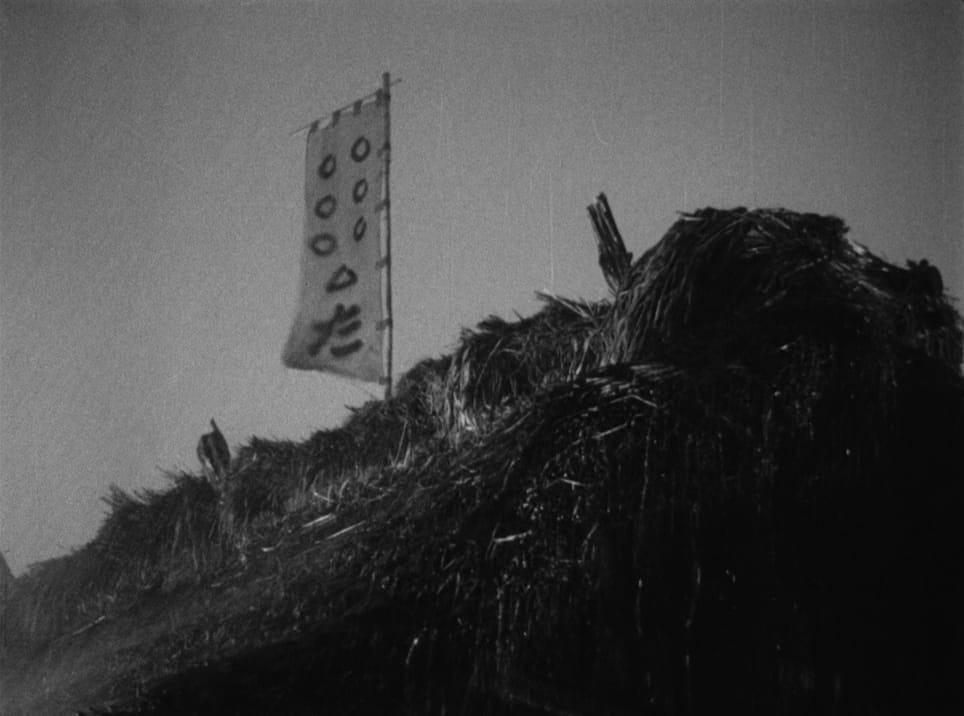
But Seven Samurai is one that I saw when I was quite young, so young that only a few moments stayed potent. I could always say I’ve seen it, but it’s always felt disingenuous to talk about it as “Kurosawa’s greatest” when my adult brain was going purely on how it made me feel decades ago. But those memories stayed: the creation of the iconic flag, Kikuchiyo mounting it on the rooftop, the bandits’ muskets (and the huge deal that was), and the final showdown with the bandit chief…
At a three and a half hour run time, though, it’s a harder sell than it should be. That’s especially true in a world where people complain about any movie that’s longer than 100 minutes. A shame, because the breadth of the piece adds up to a massive samurai epic. And because writer/director Akira Kurosawa pushed for a film that’s more than 200 minutes, Seven Samurai is a seminal classic, a straight up incredible film, with a rock solid story from which lithe thematic tendrils creep out. It explores notions of honor and class struggle and love and sacrifice...
And yeah it’s a bloody masterpiece.
Griffin the Chef
There is a 1968 Doctor Who story called “The Enemy of the World”. Over the course of its six episodes, writer David Whittaker sketches out this near future, in which a ruthless megalomaniac named Salamander has developed a plot to destroy the world and rebuild it in his image. The story’s ensemble features him, his inner circle, and the forces opposing him. It covers the unwitting participants in Salamander’s scheme and the people who are actively trying to carry out the plot.
But episode three features Griffin, Salamander’s chef. The primary reason Whittaker needs Griffin in the plot is to create tension without spoiling the story’s great twist1, but the amazing thing about Griffin is the way Whittaker sketches him out. He’s not nefarious like Salamander or some insurgent like those working with The Doctor. He’s just a dry, witty, put-upon guy who’s trying to get through the day without Salamander killing him for some imagined slight. Then again, with his luck the firing squad would probably miss him completely.
Despite how hard he pops, Whittaker relegates this runner exclusively to episode three. Yet Griffin’s presence gives the defense that this contest of wills between Salamander and The Doctor is more than just some black and white affair. Between these two extremes of fighting forces lie a whole plethora of people who are just trying to survive.
This isn’t an unusual trick in narrative storytelling, but it’s rarer than it should be. Writers can so easily tie themselves up with the “good vs evil” of, say, Star Wars that they miss that there’s an entire galaxy of people who aren’t involved in the machinations of either the Empire or Rebellion. It’s why Rian Johnson’s stop to Canto Bight in The Last Jedi matters so much. The war profiteers and the money people thrive on the black-vs-white dichotomy inherent in the Star Wars’s central conflict.
In Seven Samurai, it’s everything that isn’t the eponymous warriors. This film uses its three hours to explore these farmers, their land, and their various perspectives. Some want to fight. Some want to acquiesce. But all of these viewpoints help round out the town, breathing life into the imagination of this one setting.
It would have been much easier for Kurosawa to focus entirely on Kambei (Takashi Shimura) as the leader of this band. He’s the one who makes the battle plans and inspires the town and this could be the story of an aging, proud hero reclaiming his glory days. Kikuchiyo (Toshiro Mifune) would also be an interesting center, telling the story of a man who has no place in the world and ultimately proves himself the braves of all when he makes the noble sacrifice at the end. The survivors valorize him as one of their own even if he’s not a samurai. Or, Kurosawa could have told the romantic love story about Katsushirō and the brief tryst he has with Shino, the local farmer’s daughter. This one focuses on a bright-eyed optimist, the events and horrors of the film corrupting his views and robbing him of his innocence.
All of those work in the 90 minute version. But at three and a half hours, Kurosawa makes an ensemble piece, giving all of these characters those same arcs without having to prioritize one over the other. As Kambei, Shichirōji, and Katsushirō stand at the grave of their fallen comrades, the old leader reflects on how they saved the day but the cost was too great for them. Katsushirō gets one last moment with Shino, but given the opportunity to meet him outside the context of the assault on the town, she returns to the comfort of planting crops in the field.
This return to normalcy might be bittersweet, but it also feels real to the world that Kurosawa created and the story he told. The life of a samurai might be glorious and exciting, but it comes at tremendous cost. For the four who die, the cost is their life. For the three who live, existence and solitude become prisons of their own kind.
Cycles of violence
Most of this read comes from Kikuchiyo’s backstory. Unlike the other six, his character is not a samurai but rather the son of a farmer. While they’re doing this because they receive rice as payment, he does this because the village reminds him of his own.
This texture and layer extends to the love story, where the only reason Katsushirō and Shino even meet is because of this extraordinary circumstance. It might seem like they’re going to be something else, but outside of the heightened experience of “we might die”, there’s nothing else to support that. The farmers themselves become a militia capable of repelling the invaders, but as soon as it’s over, it’s not like any of them head out to become samurai or make a better or different life for themselves. And that’s not because their life is bad, but rather because there is a contentment within the simplicity of this existence.
Taken as a whole, the world is far, far more than cool ronin who do cool things. They are enough to save the village, but beyond that…? Their life is one of hunger, strife, violence, and death.
But it’s also important that while this film’s ending is deeply Pyrrhic, it’s not a bummer of a movie. There is an innate pleasure to everything that happens and Kurosawa never lectures his audience that what they want to see his wrong. It’s tense and exciting and got lots of cool samurai action. While the town suffers undeniable losses, there is an overwhelming sense of undeniable victory. The world works as it should: the state’s military class keeps peace and order alive in a world overrun by predators who live on the outskirts of society. These parasites occur naturally, upsetting that natural order, but this is why this order of peacekeepers exist.
And yet, there is the implication that this village is extremely lucky while others are not. Kikuchiyo’s rage at the samurai stems from memories of his own history. FOr him, this system didn’t work out. The world didn’t operate like it should have.
But saving the village and maintaining this order still demands a tremendous sacrifice. It costs a majority of the samurai’s lives. The farmers might get to live, but they still sacrifice their own food stores to feed those they hire. Worse, others lose their homes and even their lives. The one baby who survives will be an orphan. The cycle continues.
Focusing on one central point
Kurosawa weaves all these pieces together to create a grand synthesis. On a purely plot level, Seven Samurai works to tell a story that almost everyone can get behind. It’s a story of underdogs and exceptional leadership filled with action and adventure and romance. But all of these undercurrents synthesize into something deeper and more thematically rich. The biggest difference between a great story and a freaking masterpiece is that depth and breadth of vision. It’s considering all of the implications of the work and subtly addressing them to incorporate them into the central argument.
As I get older, these are the pieces I find myself most drawn to. And oops oh yeah here I am, compelled by masterpieces. But it’s more than that. It’s appreciating just how much thought and care goes into the craft of the writing. Mastery of subject means being able to boil it down to its simplest sentence while also imbuing that phrase with the deep complexity of its implications.
It’s why Kikuchiyo is the best character in Seven Samurai, and why it makes sense for one of the Japan’s greatest cinematic actors to play him. Kurosawa could have cast Mifune as Kambei or anyone else, but he chose Kikuchiyo to make sure every audience member would draw themselves into him and his outsider viewpoint on everything that’s happening. Even the flag they paint to represent the seven reflects this idea. The first six get to be circles, but Kikuchiyo must be a traingle. But it can’t be an accident that they also use circles to represent the number of bandits they need to kill. The only practical difference between the bandits and the samurai is a matter of perspective.
Without Kikuchiyo, though, this film is far less. This group is nothing. Even at the end of the movie, one of the holes in the world is triangle-shaped. He was brave and valiant when no one else was. He takes a bullet and still doesn’t stop. And despite his several screw ups and comedic moments, he ends up being the one who saves the day.
This orphaned son of a farmer.
How wonderful it is a movie like this exists. It’s one that starts so humbly and ends up being excellent and then afterwards becomes something deeply mythic. This movie has been around for 70 years and it’s just as good today as it was on the day it came out. It will always be as good as that because the story itself remains so timeless. Its themes still resonate and so long as society has a structure and inside of that lies injustice both within and without, it’s going to continue to be the defining work of Kurosawa’s career and a high-ranking entry in Japan’s cinematic canon.
And if it’s less than three and a half hours… welll. It’s probably A Bug’s Life. And no shade on A Bug’s Life, but it’s no Seven Samurai.
Nothing really is.
And also probably to pad out the six-episode runtime. ↩